
On this page
Start here
Quick answer
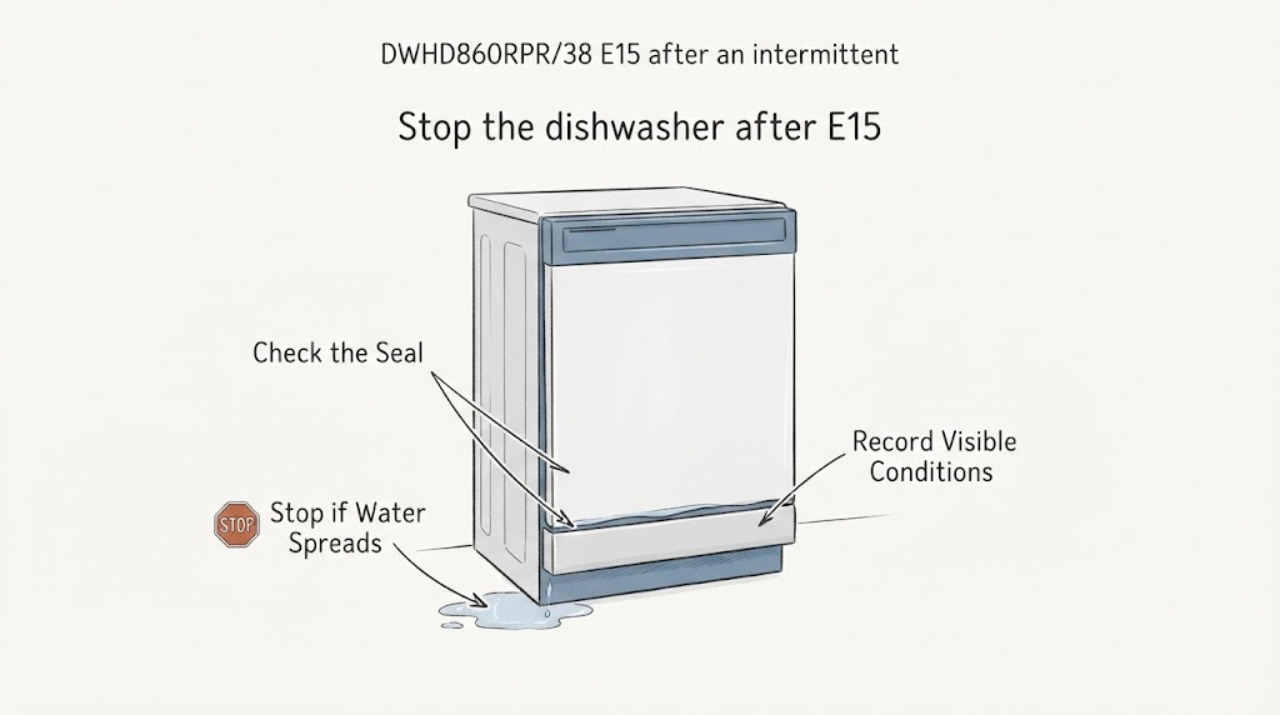
Thermador's E15 means the safety switch detected water in the dishwasher base and the leakage-protection system activated; it does not identify a sump gasket. Because the leak appears only about every 7–8 cycles or once a week, stop treating a dry floor between events as proof that the machine is safe. Record the cycle stage and first visible wet point, inspect only the door edge and accessible connections from outside, and stop using the dishwasher with the water supply off until Thermador service checks the source. Do not tilt the unit, remove the base, apply sealant, or keep running cycles to make the leak recur.
Before you begin
Safety first
- Do not tilt or pull out the built-in dishwasher, open the base, remove panels, apply sealant, repeatedly run it, or choose a sump gasket or other part from E15 alone.
Work through in order
Diagnostic checks
Use only checks that match the exact appliance or system and its official guide.
-
Check 1
Stop the dishwasher after E15, turn off the water inflow, and make a simple timeline for the last several cycles: programme, load shape, detergent type or unusual suds, when water was first noticed, and whether E15 appeared during washing, draining, or after completion.
Expected result: The event clusters around a particular programme, load, detergent/suds condition, or cycle stage, or no consistent trigger is found.
Next step: Keep the dishwasher unused with the water supply off and give the timeline to Thermador service; do not run extra cycles to force a pattern.
Stop if: Stop immediately for flooding, water near electrical equipment, smoke, burning odor, sparking, or a hot/damaged power component.
Why this matters
Why: A repeatable stage or usage condition can guide the service inspection, but intermittent timing does not prove a gasket, pump, hose, or other component.
-
Check 2
With the appliance off, inspect only from outside for the first visible wet point: the door perimeter, lower corners, accessible supply or drain connections, floor, and cabinetry. Note whether the inside door seal is visibly pulled out of position or a dish projects beyond the rack; do not pull the dishwasher out.
Expected result: Water is first visible at the door edge, at an accessible connection, on the floor/cabinet, or nowhere outside despite E15.
Next step: Photograph the wet point without wiping away evidence and leave diagnosis to qualified service. Do not identify the sump gasket from the location alone.
Stop if: Do not tilt, move, dismantle, or open the lower base to search for a hidden leak.
Why this matters
Why: A door-edge observation can fit detergent/suds, a seal disturbed by loading, a blocked vent, or leveling/installation conditions; no visible point does not rule out water contained in the base.
-
Check 3
Record the loading and detergent details from the leaking cycle without restarting the dishwasher: whether dishes or utensils extended past the rack, whether the detergent was dishwasher detergent rather than hand dish soap, whether suds were present, and whether the visible condensation-vent area was obstructed.
Expected result: An oversized or projecting item, unusual suds/incorrect detergent, or a blocked visible vent is associated with the event, or none of these is present.
Next step: Preserve the observation for the service visit. Keep the water supply off and do not add oil, chemicals, sealant, or another detergent to test a theory.
Stop if: Do not run a cycle to reproduce the leak, force the door closed, or adjust installation feet yourself on a built-in unit.
Why this matters
Why: Thermador lists these as possible door-leak contributors, but a usage correlation does not prove the leak source and does not explain away E15 if water reached the base.
-
Check 4
Prepare the service handoff for the exact DWHD860RPR/38: include the E15 photo, the every-7–8-cycles/weekly timeline, programme stage, load and detergent notes, first wet point, standing-water status, and any prior repair or cleaning history.
Expected result: E15 returns, water remains in the base or on the floor, the source is not visible, or the event stops after the water is turned off.
Next step: Leave the dishwasher off with the water supply closed and schedule Thermador service. Ask the technician to verify the leak source and the safety system before any part recommendation.
Stop if: Do not continue normal use, repeatedly reset E15, open the base, or apply a sealant repair.
Why this matters
Why: The pattern is a leakage-protection event requiring source diagnosis; it is not enough evidence to select a sump gasket or another part.
Use your observations
Decision map
Find the observation that best matches what you see, then follow the next safe action.
-
PATH 01Next step
What you see
E15 returns after several apparently dry cycles, with no clear external wet point.
Do this next
Keep the water supply off and arrange Thermador service. Do not run more cycles to reproduce the interval and do not name a sump gasket without a source diagnosis.
Why this path and its safety boundary
Why it matters: Water is still reaching the base intermittently or being contained before it becomes visible; a dry floor does not clear the leakage-protection signal.
-
PATH 02Next step
What you see
Water is first visible at the door perimeter and the leaking cycle had projecting dishes, unusual suds, a non-dishwasher detergent, or an obstructed condensation vent.
Do this next
Preserve the evidence, keep the unit off with water closed, and have service verify the door seal, vent, leveling, and any hidden source before deciding on parts.
Why this path and its safety boundary
Why it matters: Thermador documents these as possible door-leak contributors, so the usage/door branch is more plausible than an immediate gasket conclusion; E15 still means water reached the base.
-
PATH 03Next step
What you see
Water is visible at an accessible connection or on the floor/cabinet rather than first at the door.
Do this next
Do not pull out or disconnect the built-in dishwasher. Keep the water closed and provide photographs and the timing record to Thermador service.
Why this path and its safety boundary
Why it matters: The supply, drain, or installation branch needs professional confirmation; the location does not establish a sump leak or a particular failed seal.
-
PATH 04Next step
What you see
There is flooding, water near electrical equipment, smoke, sparking, burning odor, exposed wiring, or repeated breaker operation.
Do this next
Stay clear, close the water supply, isolate power only if safely accessible without touching a hazard, and contact qualified appliance/electrical service; use emergency help for active fire.
Why this path and its safety boundary
Why it matters: This is an immediate stop-use safety condition, not a gasket or leak-location exercise.
Helpful context
Understand the symptom
What the intermittent pattern changes
An E15 that appears only every several cycles still means the base safety switch saw water. A dry floor on the other days cannot distinguish a small timed leak from water that has dried or been contained by the base. The useful record is the cycle stage, load and detergent conditions, and where the first water is seen—not a guess that the sump gasket is the cause.
Why the suspected gasket is not a diagnosis
Thermador's public guidance lists several possible door-leak contributors, including incorrect detergent or suds, a door seal disturbed by the load, a blocked condensation vent, and installation or leveling conditions. Those are different branches from water detected in the base. The accessible evidence does not justify selecting a sump gasket before the leak source is located by a qualified technician.
When checks do not resolve it
Need a professional?
Call Thermador service for any E15 event on this exact model, especially when it recurs every 7–8 cycles, the source is not visible, or water reaches the floor. Turn off the water inflow and leave the dishwasher off while waiting. Stop immediately for flooding, water near electrical parts, smoke, sparking, burning odor, exposed wiring, or repeated breaker operation.
Safety scope: Do not tilt or pull out the built-in dishwasher, open the base, remove panels, apply sealant, repeatedly run it, or choose a sump gasket or other part from E15 alone.
Have this ready
- Provide model DWHD860RPR/38, E15 photo, cycle-stage timeline, first wet point, load/detergent/suds notes, standing-water status, and repair history.
Common questions
FAQ
Does E15 prove the sump gasket is leaking?
No. Thermador defines E15 as water detected in the dishwasher base and leakage protection activated. The code does not identify the source. Door loading, suds or incorrect detergent, a blocked vent, leveling, connections, and other conditions still need to be separated by inspection and service.
If the leak happens only once a week, can I keep using the dishwasher?
No. Intermittency does not cancel E15. Turn off the water inflow, leave the dishwasher off, preserve the cycle timeline and wet-point evidence, and arrange Thermador service rather than running additional cycles to reproduce it.
Can I apply sealant or tilt the dishwasher to find the leak?
No. Do not apply sealant, tilt, pull out, or open the built-in dishwasher. Those actions can hide the source or create installation and electrical risks; provide the exact model and E15 timeline to qualified service.
Read the exact guide
Official sources
- Appliance Information - fully-integrated dishwasher | DWHD860RPR/38Thermador · Opened the exact Thermador product-service page. It identifies DWHD860RPR/38 as a fully-integrated 24-inch dishwasher and provides its manuals and owner-support resources.
- Appliance Features | Dishwashers Support | ThermadorThermador · Opened Thermador's official dishwasher support page. Its water-leak section lists incorrect detergent or suds, a door seal disturbed by dishes, a blocked condensation vent, and improper leveling/installation as possible door-leak contributors.
- Error Codes | Dishwashers Support | ThermadorThermador · Opened Thermador's official dishwasher error-code page. E15 is defined as the safety switch detecting water in the dishwasher base and the leakage-protection system activating; Thermador says to turn off water inflow and contact support.
Community feedback
Share a repair observation
Share a plain-text repair observation. Accepted observations are published automatically; this page may take a moment to update.