
On this page
Start here
Quick answer
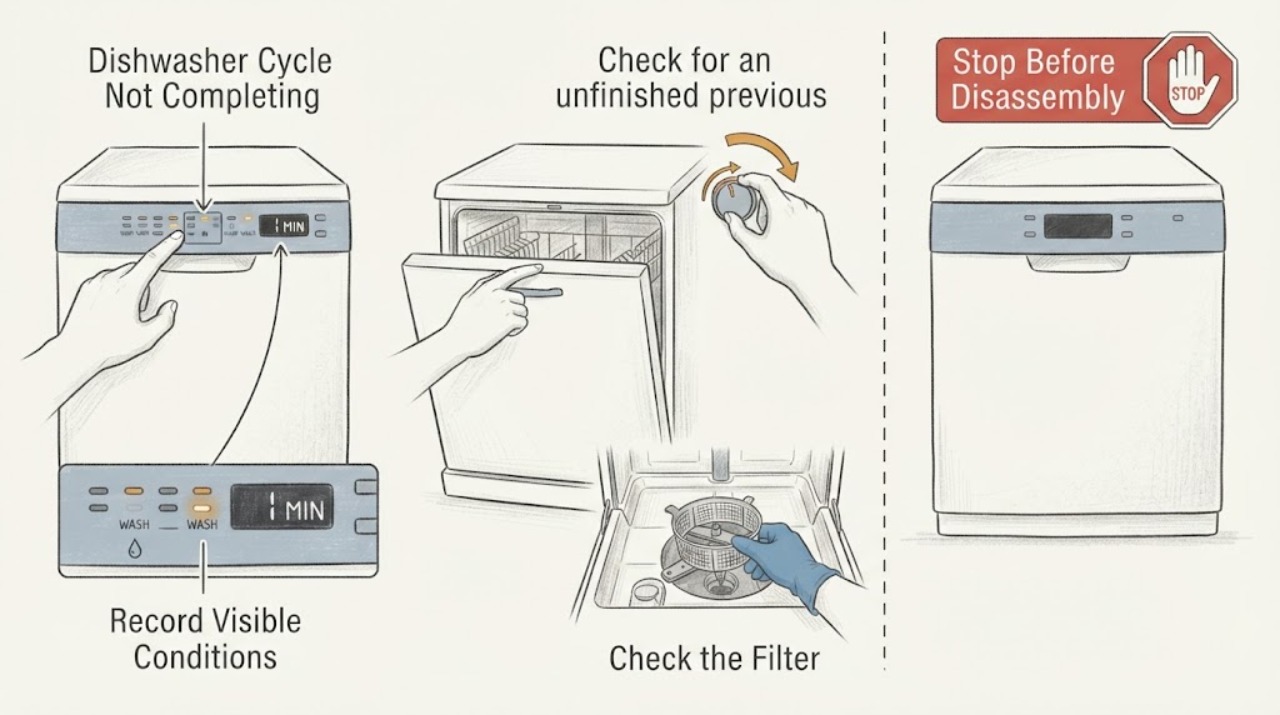
When a Thermador dishwasher does not complete its cycle, first note whether it is waiting, not filling, leaving water inside, or showing a code. Thermador says an unfinished previous cycle can affect the next cycle and should be reset according to the owner's manual. If water remains, check the drain line, garbage-disposal connection or air gap, filter, and accessible pump area; select the documented CANCEL/DRAIN program after clearing a blockage. If the machine runs for a long time, incoming water may be too cool, dishes may be heavily soiled, or rinse aid may be empty. Do not force a reset sequence from another model. Stop and arrange service for a recurring incomplete cycle, leak, electrical smell, inability to fill or drain after the checks, or an unresolved code.
Work through in order
Diagnostic checks
Use only checks that match the exact appliance or system and its official guide.
-
Check 1
Record the point where the cycle stops: selected program, display time or code, whether water is entering, whether water remains in the tub, and whether the controls respond.
Expected result: The dishwasher is waiting, not filling, running for a long time, stopping with water, or showing a code.
Next step: Follow the matching check below and preserve the exact display text for the manual or service visit.
Why this matters
Why: Each pattern points to a different branch; a changing time can be normal sensor behavior, while residual water makes drainage more likely.
-
Check 2
Check for an unfinished previous cycle or active delay start, then use the reset or cancel step printed in the exact owner's manual.
Expected result: The previous cycle was interrupted, delay start is active, or the program state appears normal.
Next step: Complete one documented reset or cancel operation; do not repeat an unverified button sequence.
Why this matters
Why: Thermador identifies an unfinished previous cycle and delay start as reasons the next wash may not begin or complete as expected.
-
Check 3
If water remains, inspect the visible drain line, garbage-disposal connection, air gap, filter, and accessible pump area after following the manual's safe access and power-isolation instructions.
Expected result: A line, air gap, filter, or pump area is blocked, or all visible drain points are clear.
Next step: Clear only accessible debris, rinse and reinstall the filter correctly, then select the model-documented CANCEL/DRAIN or short test program.
Why this matters
Why: A blockage or dirty filter can keep the dishwasher from reaching its end state; a clear visible path makes a hidden pump or control fault more likely.
-
Check 4
Check the water-inlet path without opening the appliance: verify the under-sink valve is open, the supply line is not kinked, and delay start is not holding the program.
Expected result: The valve is closed, the line is kinked or clogged, household water is off, or the inlet path is clear.
Next step: Correct only an obvious valve or hose condition described by the manual; arrange service if the machine still will not fill.
Why this matters
Why: Thermador lists a blocked water supply and delay start as causes of a dishwasher that does not fill, which can look like a stopped cycle.
-
Check 5
If the dishwasher runs unusually long but is filling and draining, note whether incoming water is hot, dishes are heavily soiled, and rinse aid is present.
Expected result: Water is cool, dishes are heavily soiled, rinse aid is empty, or none of these apply.
Next step: Use the documented hot-water and rinse-aid guidance for the model, then allow one complete cycle before judging the timing.
Why this matters
Why: Thermador says the dishwasher may extend the cycle to heat cool water, process heavy soil, or compensate for missing rinse aid; this is different from a failed drain.
-
Check 6
Apply the stop boundary after one documented test: check for a leak, burning smell, smoke, repeated breaker trip, hot standing water, or a code that returns.
Expected result: A safety warning or recurring failure is present, or the cycle completes normally.
Next step: Stop using the dishwasher for a warning or recurring failure and arrange Thermador service with the model, program, code, and observations.
Why this matters
Why: A recurring failure after the external checks requires component diagnosis; a single successful cycle does not prove a latent fault is fixed.
Use your observations
Decision map
Find the observation that best matches what you see, then follow the next safe action.
-
PATH 01Next step
What you see
The cycle will not begin or resume, and the previous cycle was interrupted or delay start is active.
Do this next
Use the exact owner's manual reset or delay-start cancellation step once, then run a short documented test; service it if the state returns.
Why this path and its safety boundary
Why it matters: The program state is more likely than a drain failure.
-
PATH 02Next step
What you see
The dishwasher stops with water in the tub and the drain line, air gap, filter, or pump area is blocked.
Do this next
Isolate power as instructed, clear accessible debris, reinstall the filter, and run CANCEL/DRAIN; arrange service if water remains.
Why this path and its safety boundary
Why it matters: The observed pattern makes a drain restriction more likely than a generic control fault.
-
PATH 03Next step
What you see
The dishwasher fills and drains but the cycle runs long while incoming water is cool, soil is heavy, or rinse aid is empty.
Do this next
Correct the documented condition and allow one complete cycle; service it if the program still never completes.
Why this path and its safety boundary
Why it matters: The longer time may be a documented heating, sensing, or rinse-aid compensation behavior rather than a stuck control.
-
PATH 04Next step
What you see
A leak, hot water, electrical warning, repeated code, or failure to fill or drain remains after the safe checks.
Do this next
Stop use and arrange qualified Thermador service; do not open panels or replace a part on a guess.
Why this path and its safety boundary
Why it matters: The symptom is beyond routine user troubleshooting and may involve an internal valve, pump, heater, sensor, or control.
Helpful context
Understand the symptom
A cycle that appears stuck can be waiting for water, still heating, sensing heavy soil, paused by delay start, or unable to drain. The display time may change during a normal sensor-controlled wash. Start by recording the stage, remaining time, code, water level, and whether the controls respond; that separates a program-state problem from an inlet or drain problem.
Use only the exact Thermador owner's manual for reset, cancel, access, and installation details. Keep the checks at the filter, hose, air gap, valve, and control boundary; do not open live wiring or substitute a pump or valve based only on an incomplete cycle.
When checks do not resolve it
Need a professional?
A technician may need to test the inlet valve, drain pump and hose, filter path, heater or heat pump, sensors, door latch, and control system. Provide the E-Nr/model, selected program, code, water level, and results of the reset, drain, and inlet checks.
Common questions
FAQ
Why does my Thermador dishwasher stop before the cycle ends?
Record whether it is waiting, not filling, running long, or leaving water. An interrupted previous cycle, delay start, blocked inlet or drain, dirty filter, or a normal heating or soil-sensing extension can each look like a stop; the exact observation selects the next step.
How do I reset a Thermador dishwasher cycle?
Use the reset or cancel procedure in the exact owner's manual. Thermador does not make one button sequence universal across models, so do not copy a timing from another dishwasher.
What if water is left inside after the cycle stops?
Check the visible drain line, garbage-disposal connection or air gap, filter, and accessible pump area according to the manual, then use the documented CANCEL/DRAIN program. Persistent water needs service.
Why is my Thermador dishwasher taking much longer than expected?
Thermador says cool incoming water, heavily soiled dishes, and empty rinse-aid dispensers can extend a cycle. If it still never completes after those conditions are addressed, arrange service.
Read the exact guide
Official sources
- Owner Support ResourcesThermador · Use to locate the exact dishwasher manual and authorized service after symptom checks.
- Dishwashers - TroubleshootingThermador · Use for Thermador dishwashers at symptom level; reset and access steps remain model-specific.
Community feedback
Share a repair observation
Share a plain-text repair observation. Accepted observations are published automatically; this page may take a moment to update.