
On this page
Start here
Quick answer
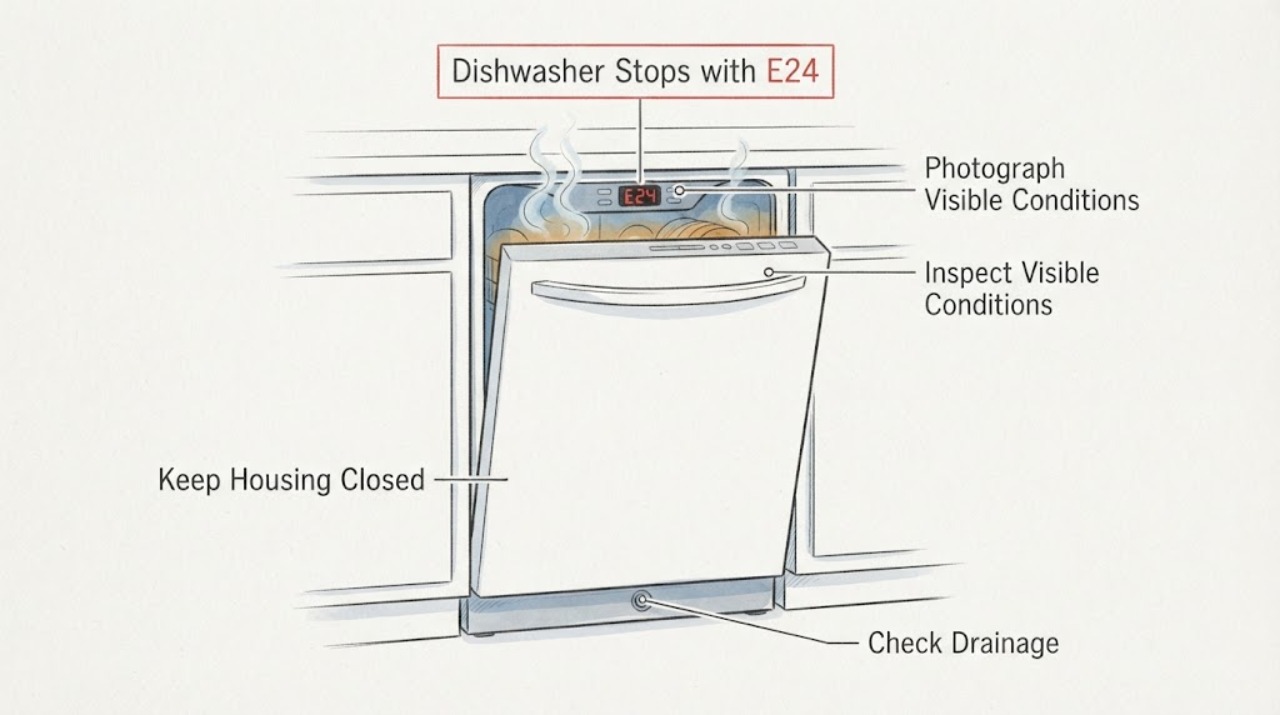
On a Thermador DWHD650WFM, E24 and E25 are both listed by Thermador as drain-path error codes. The official page gives the same possible paths for each code—blocked drain-pump area or loose cover, a kinked drain hose, or a blocked air gap or drain hose—so an E24→E25 or E25→E24 sequence does not by itself prove two failed parts or a control-board failure. Because this dishwasher stops only minutes into a hot cycle, first record which code appeared first and whether water remains, then make only safe external checks for a visible hose kink, air-gap problem, or water at the base. Do not remove the pump cover, disconnect a hose, tilt the dishwasher, enter service mode, or repeat hot-wash tests; arrange Thermador service if the sequence returns or the unit cannot complete a cycle.
Before you begin
Safety first
- Do not remove the drain-pump cover, disconnect the drain or water hose, tilt the dishwasher, open the base, enter service mode, bypass protection, or perform a live electrical test. Stop for leaks, water near electrical parts, smoke, sparking, burning odor, exposed wiring, or repeated breaker trips.
Work through in order
Diagnostic checks
Use only checks that match the exact appliance or system and its official guide.
-
Check 1
Before pressing buttons or restarting the dishwasher, photograph the display and write the exact sequence: E24, E25, E-24, E-25, another code, or a flashing pattern. Record the selected hot cycle, how many minutes had elapsed, whether the appliance had been filling or washing, and whether water remained when it stopped.
Expected result: The sequence is E24 then E25, E25 then E24, only one code appears, the display is uncertain, or the code appears before or after visible water is present.
Next step: Keep the exact model revision, code order, cycle stage, and water status for the matching manual or service request. Do not repeat a hot cycle just to reproduce the sequence.
Stop if: Do not enter service diagnostics, clear stored faults, or press a hidden button combination.
Why this matters
Why: Thermador gives E24 and E25 the same drain-path meaning, so their order is evidence about timing but not proof of two separate failed components. An uncertain display cannot safely be mapped to a different code family.
-
Check 2
If the dishwasher is stopped, cool enough to approach safely, and there is no active leak or electrical warning, look through the open door for obvious standing water. From outside the unit, look at the floor and toe-kick edge for water without removing panels or touching wiring.
Expected result: Water is visibly pooled inside, the tub is empty, water is at the floor or toe-kick, or the water status cannot be seen safely.
Next step: If water is at the floor or base, stop using the dishwasher and turn off the water inflow only if it is safely accessible. Otherwise leave the unit alone and arrange qualified service; do not tilt it or remove the base.
Stop if: Do not reach under the appliance, touch wet electrical parts, or continue a cycle with uncontrolled water.
Why this matters
Why: Standing water makes a drain-path condition more relevant to the E24/E25 report. Water at the base or floor also raises a leak-protection concern; an empty tub does not prove that the drain path is good because the dishwasher may have stopped before or after a drain attempt.
-
Check 3
With the dishwasher off and power isolated from a safe, dry location, inspect only the externally visible drain route: the hose where it can be seen under the sink or at the connection area, and the sink air-gap opening if present. Look for a sharp kink, crushing, or an obvious sink/air-gap blockage; do not disconnect the hose or remove the pump cover.
Expected result: A visible drain hose is kinked or crushed, the air gap or sink connection is visibly obstructed, the visible route looks normal, or the route is hidden or unsafe to reach.
Next step: Correct only a plainly visible, safe external obstruction. If the route looks normal, the obstruction is hidden, or E24/E25 returns, stop and provide the observations to Thermador service.
Stop if: Do not disconnect a water or drain hose, remove the pump cover, pull the dishwasher out, or work beneath the base.
Why this matters
Why: Thermador lists a kinked drain-pump hose and a clogged air gap or drain hose among the E24/E25 possibilities. A clear visible section does not rule out a hidden restriction, a pump-cover condition, or an internal fault, and it does not justify a pump replacement.
-
Check 4
After power is isolated and the appliance is cool, make only a no-tool visual check inside the tub for loose debris sitting on the visible filter area or blocking a spray arm. Do not remove the filter, pump cover, or any bottom assembly for this E24/E25 investigation, and do not touch sharp debris.
Expected result: Loose debris is plainly visible, the visible area is clear, there is broken glass or another sharp object, or the interior cannot be inspected safely.
Next step: Photograph the visible condition without reaching into it and arrange service if debris is sharp, the code returns, or the dishwasher stops again. Do not perform a powered test after a loose-object discovery.
Stop if: Do not use tools, reach into the sump, remove the drain-pump cover, or tilt the dishwasher.
Why this matters
Why: Visible debris can be useful service evidence, but Thermador's E24/E25 page does not authorize treating it as a confirmed pump failure. Sharp debris or an inaccessible area makes further user inspection unsafe.
-
Check 5
Compare the code record with the full model revision and do not apply an E24/E25 procedure from a different Thermador or BSH platform. If a normal, dry, safely accessible external check has been completed, leave the dishwasher off rather than repeating a hot wash; the official page directs support when the issue persists.
Expected result: The exact revision is known and the code returns, the revision is missing, the code is unlisted or different, or the dishwasher completes no cycle.
Next step: Arrange qualified Thermador service with the model suffix, exact code order, cycle timing, water status, and visible drain observations. Do not repeat hot-wash tests or order a part from the code alone.
Stop if: Do not reset repeatedly, invoke service mode, bypass protection, or operate with panels removed.
Why this matters
Why: Thermador's support lookup separates revisions of DWHD650WFM, and its error page says unlisted or persistent errors may require technician assistance. A repeated combination after an external check is not evidence for a particular pump or control-board part.
Use your observations
Decision map
Find the observation that best matches what you see, then follow the next safe action.
-
PATH 01Next step
What you see
E24 and E25 both appear during the same hot-wash event, in either order, and standing water remains in the tub.
Do this next
Leave the dishwasher off, document the water level and code order, inspect only visible external hose/air-gap conditions after safe power isolation, and arrange service if no safe obstruction is found or the codes return.
Why this path and its safety boundary
Why it matters: The combined pattern points first to the shared drain-path decision documented by Thermador, not to two independently identified parts. Cycle timing explains when the fault was noticed but does not prove a heater or control fault.
-
PATH 02Next step
What you see
A visible external drain hose kink, crushed section, or air-gap/sink obstruction is present and there is no leak or electrical warning.
Do this next
Correct only the plainly visible condition without disconnecting plumbing, then stop rather than repeating a hot wash if either code returns. Have service verify the complete drain path.
Why this path and its safety boundary
Why it matters: The documented E24/E25 drain-path possibilities include an external routing or air-gap restriction, so that visible condition is a higher-priority user check than selecting a pump or control board.
-
PATH 03Next step
What you see
The visible hose and air-gap area look normal, the tub may be empty, and E24/E25 returns or the dishwasher still stops after a few minutes.
Do this next
Stop further hot-wash tests and arrange model-revision-specific service with the exact sequence, cycle timing, and water observation. Do not remove the pump cover, disconnect hoses, or enter diagnostics.
Why this path and its safety boundary
Why it matters: A clear visible route does not rule out the other drain-path possibilities listed by Thermador, but the public code page does not identify which internal condition is present or justify a component swap.
-
PATH 04Safety boundary
What you see
Water is visible at the floor or base, a breaker trips, there is smoke or sparking, a burning odor, exposed wiring, or the appliance is unsafe to approach.
Do this next
Stop using the dishwasher. Turn off the water inflow and isolate power only if it is safely accessible; otherwise keep clear and obtain qualified appliance or electrical help.
Why this path and its safety boundary
Why it matters: This has crossed the leak or electrical safety boundary and should not be treated as an ordinary E24/E25 drain check.
Safety stop: No restart, tilt, panel removal, plumbing disconnection, service-mode entry, or repeated breaker reset.
Helpful context
Understand the symptom
What E24 and E25 establish
Thermador's official dishwasher table lists E24 and E25 in separate headings but gives both the same possible causes and the same drain-focused checks. That makes the observed order useful as a timeline, not as proof that the first code is a pump fault and the second is a control fault. A stop a few minutes into a hot wash may simply be when the dishwasher reaches a drain or fault-check stage; the timing alone does not establish a heating failure.
Model and revision matter
Thermador's support lookup shows DWHD650WFM/01, /13, /14, and /15 as separate products and the product-support pages route owners to revision-specific manuals. Record the full rating-label suffix before a service visit. This article stays at the common E24/E25 drain-path guidance found on Thermador's official US error page and does not invent a revision-specific reset or component test.
When checks do not resolve it
Need a professional?
Call Thermador or qualified appliance service for a returning E24/E25 sequence, any mid-cycle stop that cannot be explained by a plainly visible external obstruction, or any internal drain, pump, control, or wiring diagnosis.
Safety scope: Do not remove the drain-pump cover, disconnect the drain or water hose, tilt the dishwasher, open the base, enter service mode, bypass protection, or perform a live electrical test. Stop for leaks, water near electrical parts, smoke, sparking, burning odor, exposed wiring, or repeated breaker trips.
Have this ready
- Provide the full rating-label model and revision, exact E24/E25 order, selected hot cycle, elapsed time to stop, water level inside and outside the unit, visible hose or air-gap observations, and whether the dishwasher had been moved or serviced recently.
Common questions
FAQ
Is E24 different from E25 on a Thermador DWHD650WFM?
Thermador's official dishwasher page lists both codes with the same possible drain-path causes and the same checks. Their order can be recorded as part of the timeline, but the public page does not support assigning one code to a separate pump or control-board failure.
Why does the dishwasher stop a few minutes into a hot cycle?
The timing may be when the program reaches a drain or fault-check stage, but timing alone does not prove a heating problem. Record whether water entered, whether water remains, and which code appeared first; then use the shared E24/E25 drain-path branch.
Can I remove the drain-pump cover for E24 or E25?
Thermador's page describes that procedure, but this article's safe boundary does not ask a user to remove the pump cover or work in the base. With power isolated, limit yourself to visible standing water, an externally visible hose kink, and an accessible air-gap condition; arrange service for anything beyond that.
Should I keep running hot cycles to see whether E24 or E25 returns?
No. Do not repeat hot-wash tests after a mid-cycle stop, especially if water is present or the code returns. Keep the code order, cycle timing, and water observations and give them to Thermador service.
Read the exact guide
Official sources
- Showing results for DWHD650WFMThermador · Official Thermador support lookup opened for the exact base model. It lists four product revisions, DWHD650WFM/01, /13, /14, and /15, so the rating-label suffix should be recorded before applying revision-specific instructions.
- Error Codes | Dishwashers Support | ThermadorThermador · Official Thermador US dishwasher error-code page opened for E24 and E25. It gives both codes the same drain-path possibilities and directions, including visible hose/air-gap checks and service if the issue persists.
- Appliance Information - Dishwasher | DWHD650WFM/15Thermador · Official Thermador product-service page opened for one exact revision of the DWHD650WFM family. It identifies the appliance as a dishwasher and provides revision-specific manuals and installation documents; it is used for identity and documentation scope, not to infer an E24/E25 part.
Community feedback
Share a repair observation
Share a plain-text repair observation. Accepted observations are published automatically; this page may take a moment to update.