
On this page
Start here
Quick answer
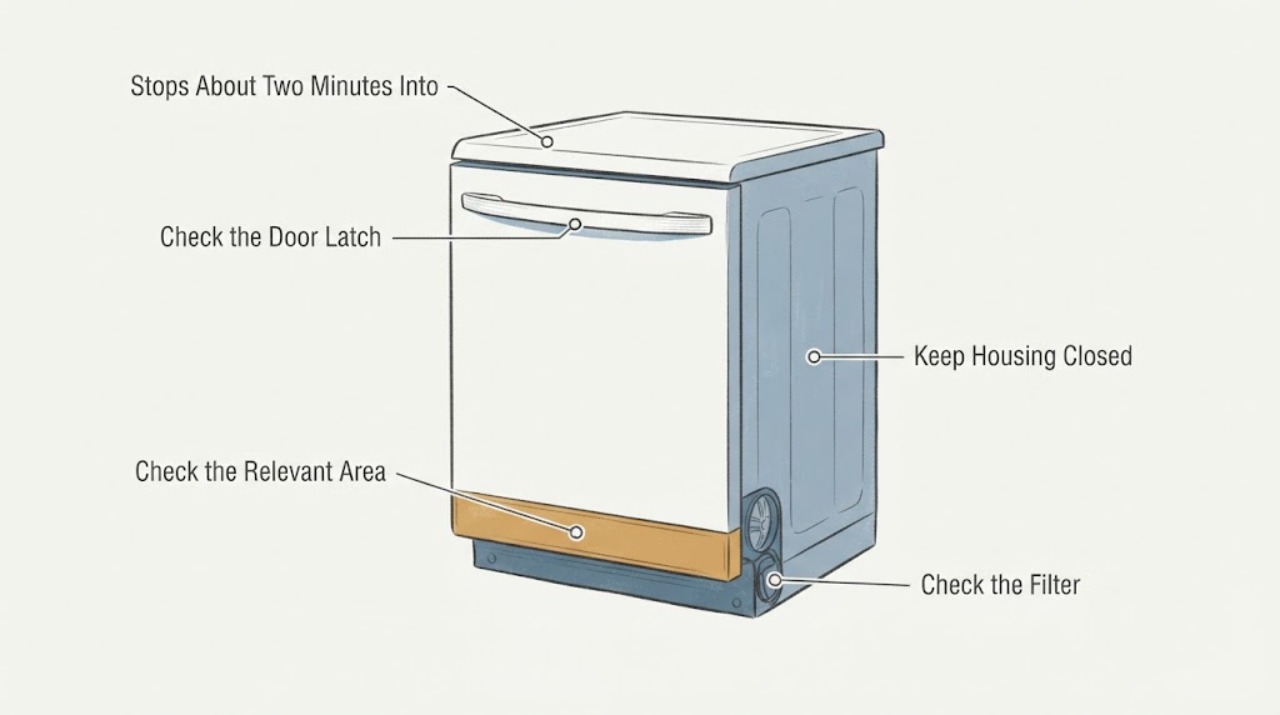
A Thermador DWHD650WFM that fills, starts the circulation motor, and stops about two minutes later should not be diagnosed from the timing alone. Because the door and loading have already been finicky, first document whether the door stays fully latched when the racks are correctly loaded and whether the stop leaves water in the tub. A door that loses its latch or is pushed by a rack or dish points to the door/interlock or loading path; standing water points toward drain or pump; no water entering points toward supply or cycle state. Thermador's support guidance says to use the exact owner's manual for reset, check water supply and drain paths, and treat cycle-time changes as potentially normal sensor behavior. Record the exact E-Nr. suffix, display, fill/drain sounds, door movement, and water level, then arrange service if the stop repeats. Do not hold the latch closed, bypass the interlock, remove panels, or keep restarting a door that will not stay secured.
Before you begin
Safety first
- Do not bypass the door interlock, hold the latch closed, force or bend the door, remove panels, disconnect plumbing, reach into the pump area, or perform live electrical checks. Stop use for a door that will not remain latched, standing water, leaks, burning odor, repeated breaker trips, or hot water that cannot be safely contained.
Work through in order
Diagnostic checks
Use only checks that match the exact appliance or system and its official guide.
-
Check 1
On the next safe observation, record the exact sequence without holding or pushing the door: selected cycle, display or code, approximate elapsed time, whether the door visibly moves or unlatches, whether filling stops, whether the circulation sound starts, and whether the controls remain responsive.
Expected result: The door shifts or loses its latch before the stop, the door remains secured while the motor stops, the display changes, or the sequence cannot be observed reliably.
Next step: Stop repeated attempts, preserve the display and timing, and continue only with the non-invasive water-level and loading observations below. Arrange service if the door does not remain secured.
Stop if: Do not hold the latch shut, press on the door during operation, bypass the interlock, or repeatedly restart to reproduce the stop.
Why this matters
Why: A door movement at the stop makes latch/interlock, loading, hinge, or alignment more likely; a stable door with a motor or water-state change keeps supply, drain, controls, and pump in the differential. An unrecorded timing alone cannot select a part.
-
Check 2
When the dishwasher is off and safe to open, remove only obviously loose items and check the rack and door path: no dish, pan handle, utensil, detergent item, or rack edge should press the inner door or prevent a normal latch. Confirm that the racks are fully in their tracks and not overloaded at the front.
Expected result: A dish or rack touches the door, the door closes unevenly, the latch click is absent or weak, or the empty racks and door path look normal.
Next step: Reposition only the loose loading item according to the matching manual. Do not run the appliance if the door will not latch securely; arrange qualified Thermador service for persistent resistance or latch behavior.
Stop if: Do not force the racks, bend the door or latch, adjust springs, or remove the door or enclosure panels.
Why this matters
Why: A loading obstruction can explain a finicky door and an intermittent cycle stop. If the path is clear but the latch still does not engage or the door springs back, hardware or interlock becomes more likely; a normal empty closure reduces but does not eliminate that possibility.
-
Check 3
After a stop and only when it is safe to open the door, note the water condition: empty or nearly empty tub, normal wash water with no pool, or standing water above the filter area. Do not reach into moving equipment or dismantle the pump.
Expected result: The tub is left with standing water, is dry after the stop, or the water state is unclear because the door cannot be opened safely.
Next step: For accessible debris, follow the exact manual's safe filter or CANCEL/DRAIN procedure once. If water remains, the door cannot be secured, or the stop repeats, stop use and arrange service.
Stop if: Do not run the pump with tools, probe the pump, remove sealed covers, or keep operating with standing water and an unresolved stop.
Why this matters
Why: Standing water makes a drain line, air gap, filter, or pump-area restriction more likely than a door-only fault. A dry tub shifts attention toward filling, controls, latch sensing, or cycle state; an unclear state requires service rather than guessing.
-
Check 4
Check the accessible water-supply side without pulling the built-in dishwasher: confirm the under-sink valve is open, the visible inlet hose is not kinked, and household water service is available. Also note whether delay start or an unfinished previous cycle is shown in the controls.
Expected result: The valve is closed, the line is kinked or visibly damaged, the previous cycle was interrupted, delay start is active, or the accessible supply appears normal.
Next step: Correct only an obvious valve or delay-state condition documented by the exact manual. If the line or connection needs disassembly, or the machine still stops after filling, arrange service.
Stop if: Do not disconnect hoses, move the appliance, alter plumbing, or open electrical compartments.
Why this matters
Why: Thermador lists a blocked supply, unfinished previous cycle, and active delay start as causes of a dishwasher that does not fill or begin as expected. A normal accessible supply does not rule out an inlet valve or control fault, but it prevents misclassifying the door history as the only cause.
-
Check 5
Read the rating plate and record the complete DWHD650WFM suffix, serial information, and market. Use Thermador's model support page to locate the matching manual, installation instructions, and any documented reset or door guidance before using a reset.
Expected result: The suffix matches a Thermador manual, the product page lists multiple revisions but no matching document is available, or the identity is incomplete.
Next step: Use only the matching manual's reset or CANCEL/DRAIN instruction once, then document whether the stop returns. If the suffix cannot be matched, give the identity and symptom record to Thermador service.
Stop if: Do not enter an undocumented diagnostic mode or copy a button sequence from a Bosch or neighboring Thermador model.
Why this matters
Why: The base model has multiple revision records, so a reset, latch behavior, display convention, or loading instruction from another revision may not apply. An exact manual is needed before treating one reset as a valid diagnostic step.
-
Check 6
If the door remains latched and the tub is not left with standing water, note whether the cycle resumes or stops when the circulation motor starts, whether a breaker or display resets, and whether the failure occurs on more than one documented cycle. Do not keep running cycles if a warning or damaged door is present.
Expected result: Only one cycle stops, every cycle stops at the same stage, the display/power resets, a code returns, or the dishwasher completes after a single exact-manual reset.
Next step: Arrange qualified Thermador service for a recurring stop and provide the exact revision, cycle, timing, door result, water level, and display behavior. Keep the appliance out of use if power, water, or heat appears abnormal.
Stop if: Do not replace a pump, latch, control, or sensor solely because the stop occurs at two minutes, and do not perform live electrical checks.
Why this matters
Why: A repeatable stop with a secure door and no obvious drain or supply condition suggests a control, sensor, circulation, or power diagnosis that cannot be selected from the symptom alone. A one-time recovery after a documented reset is not proof that the underlying issue is fixed.
Use your observations
Decision map
Find the observation that best matches what you see, then follow the next safe action.
-
PATH 01Next step
What you see
The empty or correctly loaded door does not reach or hold the latch, the door moves at the stop, or the cycle stops when the door is disturbed, with no confirmed drain blockage.
Do this next
Stop using the dishwasher and arrange qualified Thermador service for the latch, interlock, hinges, seal, rack clearance, and installation alignment. Do not hold or bypass the door state.
Why this path and its safety boundary
Why it matters: The prior door/loading history is materially relevant: a dish or rack obstruction, alignment issue, latch, hinge, or door-sensing interlock is more likely than a generic pump diagnosis.
-
PATH 02Next step
What you see
The door stays latched, the dishwasher fills, and the stop leaves standing water above the filter area.
Do this next
Follow the exact manual for one safe accessible filter/CANCEL-DRAIN check. If water remains or the stop returns, stop use and arrange service rather than opening the pump or replacing it on a guess.
Why this path and its safety boundary
Why it matters: A drain-path issue is more likely than the door history: Thermador lists drain lines, the garbage-disposal/air-gap path, the filter, and the pump area as separate drain checks.
-
PATH 03Next step
What you see
The door stays latched, the tub is not left with standing water, and the dishwasher stops after filling when circulation starts, with no obvious supply or loading obstruction.
Do this next
Stop repeated restarts, preserve the display/sound/timing record, and arrange Thermador service with the complete model suffix and cycle details.
Why this path and its safety boundary
Why it matters: The exact two-minute sequence remains unresolved but is less consistent with a simple door obstruction or drain blockage. A control, sensor, circulation system, or power event requires qualified diagnosis; timing alone does not identify the part.
-
PATH 04Next step
What you see
The appliance does not refill or does not reach the circulation stage, the previous cycle was interrupted, delay start is active, or the accessible supply valve/line is abnormal.
Do this next
Correct only the plainly documented cycle-state or accessible valve condition, then use one exact-manual reset if applicable. Arrange service if filling remains abnormal or the same stop returns.
Why this path and its safety boundary
Why it matters: Thermador's not-filling branch is more likely than a motor or latch conclusion: cycle state, water supply, valve, hose, or delay start can prevent normal progression.
-
PATH 05Next step
What you see
A reset makes one cycle complete, but the door remains finicky or the two-minute stop returns on a later cycle.
Do this next
Stop treating the reset as a repair; provide service with the full revision, recurrence timing, door/loading findings, water level, and any display or power event.
Why this path and its safety boundary
Why it matters: A temporary recovery does not prove a latch, pump, or control fault is repaired. The recurrence plus the door history warrants a documented system diagnosis.
Helpful context
Understand the symptom
Why the door history changes the first check
The exact user report describes a DWHD650WFM that had long been finicky with its door or with too many dishes, then began filling, starting the motor, and stopping within roughly thirty seconds of that motor sound. That report does not prove a failed latch or control, but it makes the door state worth recording at the moment of the stop. A rack or dish can keep the door from reaching the latch, and an intermittent latch or interlock can make a cycle stop even when the appliance has already filled. If the door remains firmly latched through the stop, do not keep blaming the door; use the water-level and drain branches instead.
The water level is the second discriminator
Thermador's official guidance treats filling and draining as separate paths. A blocked supply, closed valve, kinked line, unfinished previous cycle, or delay start can affect filling. A blocked drain line, air gap, filter, or pump area can leave water behind. Do not infer a pump or control-board failure from the two-minute mark alone: note whether the tub is empty, has a normal shallow amount of water, or is left with standing water, and preserve the exact display or sound sequence for service.
Exact revision matters
Thermador's support results list multiple DWHD650WFM revisions, including /01, /13, /14, and /15, while the task supplies the base model without a suffix. Use the rating plate to capture the complete E-Nr. or model suffix before copying a reset or loading instruction. Thermador says to use the owner's manual for reset and model-specific operating details; a neighboring revision or an unrelated Bosch-family procedure should not be treated as interchangeable.
When checks do not resolve it
Need a professional?
Book qualified Thermador service for a recurring stop after filling, a door/latch or loading-related interruption, unresolved standing water, a persistent no-fill condition, a returning code or power reset, or any mismatch between the appliance revision and the available manual.
Safety scope: Do not bypass the door interlock, hold the latch closed, force or bend the door, remove panels, disconnect plumbing, reach into the pump area, or perform live electrical checks. Stop use for a door that will not remain latched, standing water, leaks, burning odor, repeated breaker trips, or hot water that cannot be safely contained.
Have this ready
- Provide the complete DWHD650WFM E-Nr./suffix, serial and market, selected cycle, exact display/code, elapsed time to stop, whether the door remained latched, loading/rack findings, fill and circulation sounds, tub water level, filter/drain observations, and any temporary reset result.
Common questions
FAQ
Why does my Thermador DWHD650WFM stop about two minutes after starting?
The timing alone does not identify a part. First record whether the door stays latched and whether water remains in the tub after the dishwasher fills and the circulation motor starts. Those results separate door/loading, drain, supply, cycle-state, and service-only branches.
Could too many dishes or a finicky door stop the cycle?
A dish or rack can prevent the door from reaching the latch, and the exact user report links the history to loading and door behavior. Remove only loose loading obstructions with the appliance off; if an empty or correctly loaded door will not latch and stay secured, stop use and arrange service.
What does standing water after the stop suggest?
Standing water makes the drain path more important than the two-minute timing. Thermador lists the drain line, disposal or air gap, filter, and pump area as separate checks. Use only the matching manual's safe accessible steps, and seek service if water remains.
Is a power disconnect a permanent fix?
No. A temporary recovery after a reset or power disconnect does not establish that the door, pump, control, or sensor fault is repaired. Record the recurrence and arrange service if the stop returns, especially when the door has been unreliable.
Do I need the suffix after DWHD650WFM?
Yes. Thermador's support results list several DWHD650WFM revisions, so the complete rating-plate suffix helps match the correct manual and service information. Do not copy a reset or diagnostic sequence from a neighboring revision.
Read the exact guide
Official sources
- Troubleshooting | Dishwashers SupportThermador · Opened Thermador's official dishwasher troubleshooting page for the model-manual reset boundary and the separate fill, drain, filter, cycle-time, and loading branches; it is brand-level guidance and does not diagnose the assigned unit.
- Showing results for DWHD650WFMThermador · Opened Thermador's official support result for the assigned base model to confirm that several revision suffixes are listed and that model-specific manuals/support are available; it does not establish the cause of the stop.
- dishwasher stops about 2 minutes into the cycle.Reddit r/Appliances · Opened the exact Reddit post named by the topic. It identifies Thermador DWHD650WFM and the door/loading and two-minute symptom sequence, but comments do not establish a verified cause or repair.
- DWHD650WFM DishwasherThermador · Opened Thermador's official product page to confirm the base DWHD650WFM appliance identity and its manuals/documents area; the page does not define the two-minute stop cause.
Community feedback
Share a repair observation
Share a plain-text repair observation. Accepted observations are published automatically; this page may take a moment to update.