
On this page
Start here
Quick answer
Do not keep trying to light a Thermador gas oven until you know whether gas is reaching the appliance and whether the ignition system is responding. First check the exact model's control state, power, and gas supply without opening the appliance. A click with no flame, a glow without ignition, a delayed whoosh, or no ignition response leads to different next steps. If you smell gas, hear a delayed ignition or bang, see an abnormal flame, detect smoke or carbon-monoxide symptoms, or see electrical arcing, stop immediately: avoid flames and electrical switches, leave the area, and contact emergency or gas-utility support from a safe location. Do not dismantle the gas appliance or repeatedly attempt ignition.
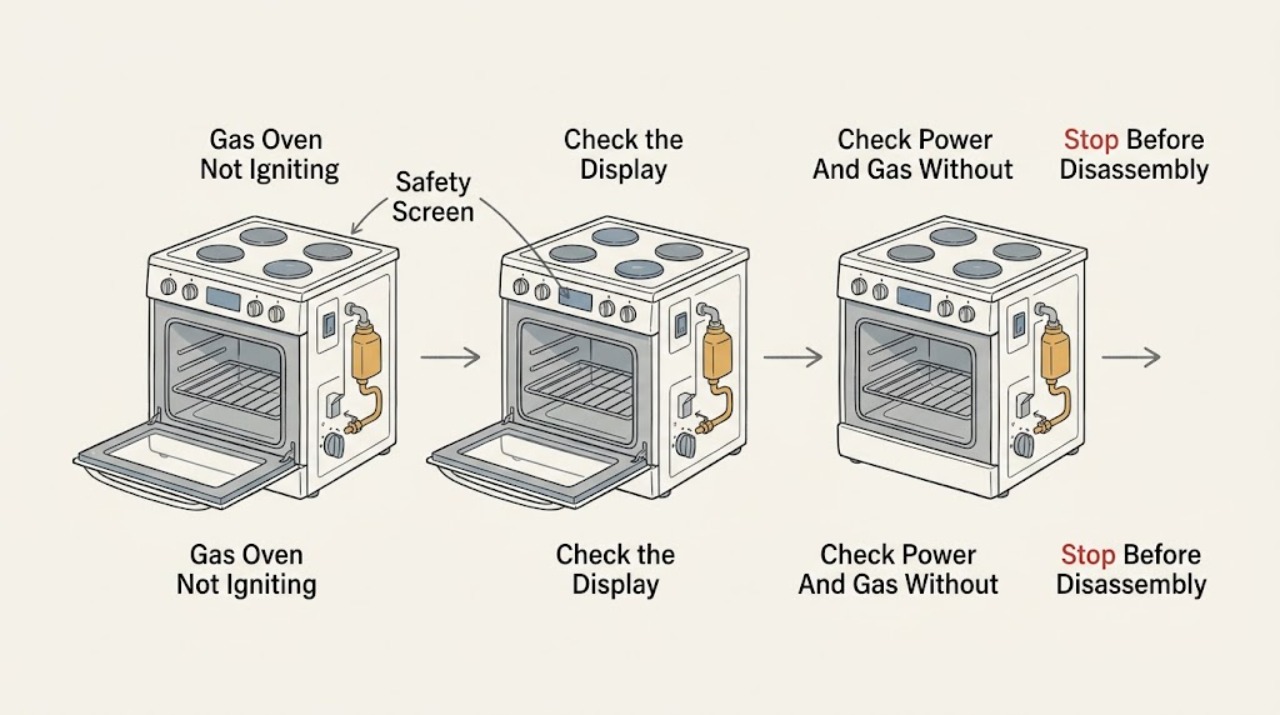
Work through in order
Diagnostic checks
Use only checks that match the exact appliance or system and its official guide.
-
Check 1
Before another ignition attempt, stop and assess from a safe position for gas odor, a delayed whoosh or bang, flame outside the burner area, smoke, a carbon-monoxide alarm or symptoms, sparks or arcing, a hot cord or outlet, or a tripped circuit.
Expected result: No hazard is present, or any gas, fire, combustion, or electrical warning is present.
Next step: If any warning is present, stop using the oven, avoid flames and electrical switches, leave by a safe route, and contact emergency or gas-utility support from a safe location. Otherwise continue without opening the appliance.
Stop if: Do not attempt another ignition when gas odor, delayed ignition, abnormal flame, smoke, arcing, or carbon-monoxide symptoms are present.
Why this matters
Why: A hazard changes the task from troubleshooting to emergency safety; absence of a warning allows only the low-risk identification checks below.
-
Check 2
With the appliance cool and hazard-free, record the full model, display message, selected cooking mode, temperature request, timer or delay state, lock indicator, and whether the control panel has power. Use the matching Thermador manual to confirm that the selected mode is a gas-oven mode supported by that model.
Expected result: The display is dark, a lock or delay is active, an error is shown, the control responds normally, or the mode is not confirmed from the manual.
Next step: Clear only a documented lock, delay, or cancellation state once. If the display remains faulty or the correct mode is uncertain, keep the oven unused and arrange model-specific support.
Stop if: Do not bypass a lock, force a control, or continue if the panel is wet, cracked, sparking, or repeatedly trips the circuit.
Why this matters
Why: A dark display or lock can prevent an ignition command; an error may require a documented service path; an unconfirmed mode should not be tested by guessing.
-
Check 3
Check only externally and without dismantling: confirm the oven has its normal power indication, the household supply has not been interrupted, and the appliance's accessible gas shutoff position matches the installation instructions. Do not move the appliance or manipulate internal piping.
Expected result: Power is absent, the supply appears normal, the gas shutoff is not in the documented operating position, or the supply condition cannot be confirmed safely.
Next step: Restore only a clearly interrupted household supply through normal safe controls, or have the installation checked by a qualified professional. Do not open the gas circuit or perform live electrical tests.
Stop if: Stop for gas odor, damaged pipe or connector, water near electrics, a hot outlet, smoke, arcing, or a repeated trip.
Why this matters
Why: No power can prevent electronic ignition; a closed or unconfirmed gas supply can prevent a flame; an unresolved supply issue is not evidence that an igniter or valve should be replaced.
-
Check 4
If there is no immediate hazard and the manual permits a normal start, make one controlled observation of the ignition response without extending the attempt: note whether there is no response, a click or spark, a glow, a gas smell without flame, a brief flame that goes out, or a delayed ignition.
Expected result: The oven gives no ignition response; it responds but does not light; it lights briefly and goes out; or it produces a delayed ignition, abnormal flame, or persistent gas odor.
Next step: For the first two low-risk patterns, stop after the single observation and use the model manual or service route. For a flame-out, delayed ignition, abnormal flame, or odor, isolate and escalate according to the safety branch.
Stop if: Do not relight, hold a control longer, or repeat the attempt after delayed ignition, a bang, abnormal flame, smoke, gas odor, or arcing.
Why this matters
Why: No response points toward power, controls, or ignition command. A response without flame points toward gas delivery, burner, igniter, or safety-control diagnosis. Delayed ignition, abnormal flame, or persistent odor is unsafe to repeat.
-
Check 5
After the oven and burner area are fully cool and the energy is safely isolated if required, inspect only visible, accessible surfaces for a wet control area, spilled food around the burner opening, a displaced visible cap or cover if the manual identifies one, or an obstruction at the door that prevents the correct operating state. Do not insert tools into ports and do not remove gas components.
Expected result: Moisture or residue is visible, a user-removable part is visibly mispositioned according to the manual, the door does not close normally, or the visible area is clean and correctly positioned.
Next step: Follow only the manual's cleaning and drying instructions, allow complete drying, and make one later normal check only if the manual permits. Otherwise record the finding for service.
Stop if: Do not scrape into gas ports, spray liquid into the appliance, dismantle burner or ignition parts, or continue when a part is damaged.
Why this matters
Why: Moisture, residue, a mispositioned user-removable piece, or a door-state problem can interfere with ignition; a clean, correctly positioned exterior with continued failure points toward service diagnosis.
-
Check 6
Only when the appliance is cool, dry, hazard-free, and the exact manual documents a power reset, perform that reset once using the normal isolator or breaker, then leave the oven idle and observe whether the error or ignition failure returns. Do not use a reset as an ignition test.
Expected result: The control returns to idle and remains normal, or the fault returns, the oven remains unable to ignite, the circuit trips, or a hazard appears.
Next step: Do not repeat the reset. Keep the gas oven out of service and provide the technician with the model, display state, ignition response, supply observations, and reset result.
Stop if: Stop immediately if smoke, odor, flame abnormality, arcing, water near electrics, hot wiring, or a trip occurs.
Why this matters
Why: A stable idle state may clear a temporary control state, but a recurring fault or continued no-ignition condition needs qualified diagnosis of the ignition, valve, sensor, or control system.
Use your observations
Decision map
Find the observation that best matches what you see, then follow the next safe action.
-
PATH 01Next step
What you see
The display and normal controls have no power
Do this next
Check only the normal household supply and documented isolator state. If supply is normal but the oven remains dead, stop and arrange qualified service.
Why this path and its safety boundary
Why it matters: The oven may not be able to command its electronic ignition system.
-
PATH 02Next step
What you see
The display responds but there is no click, glow, or other ignition response
Do this next
Record the mode, display, and model, then use the matching manual and service route. Do not open the oven or make live measurements.
Why this path and its safety boundary
Why it matters: The control-to-ignition path or a model-specific safety condition may be preventing ignition.
-
PATH 03Next step
What you see
There is a click or glow but no flame
Do this next
Stop after the controlled observation, do not repeat ignition, and arrange qualified gas-appliance service if the model manual does not provide a clearly safe external correction.
Why this path and its safety boundary
Why it matters: Gas delivery, burner condition, ignition position, or a safety control may require diagnosis.
-
PATH 04Next step
What you see
The flame appears briefly and goes out
Do this next
Do not keep relighting. Keep the oven unused and request qualified service with the exact timing and flame behavior.
Why this path and its safety boundary
Why it matters: The ignition may be occurring but flame sensing, gas control, airflow, or another safety condition may be involved.
-
PATH 05Next step
What you see
Gas odor persists, ignition is delayed, there is a bang, abnormal flame, smoke, a gas alarm, or carbon-monoxide symptoms
Do this next
Do not operate lights, appliances, phones, or other switches in the affected area. Leave immediately and contact emergency or gas-utility support from outside; do not return until professionals say it is safe.
Why this path and its safety boundary
Why it matters: Treat the situation as a gas or combustion emergency, not as a routine ignition fault.
Helpful context
Understand the symptom
Start with the ignition symptom
A gas oven can fail in more than one way. No display or no response suggests power or control state. A normal control response with no click or glow suggests an ignition or control path issue. A click or glow with no flame suggests that gas delivery, burner condition, ignition position, or a safety control needs model-specific diagnosis. A flame that lights and goes out can involve flame sensing or gas control. Record exactly what you hear, see, and smell rather than trying more cycles.
Do not confuse a delayed light with a normal start
A brief, controlled ignition response is not a reason to keep testing if the burner does not light promptly. A delayed whoosh, bang, flame outside the burner area, or gas odor that persists after an attempt is a stop condition. Keep the door closed during an unsafe symptom, avoid searching for a leak, and let qualified service determine whether the valve, igniter, burner, or combustion system is involved.
Use the exact Thermador documentation
Thermador publishes model support pages with manuals and owner-support resources. Controls, locks, error messages, ignition components, and reset behavior are not identical across every range or oven. Use the full model and revision information from the rating label to select the correct manual. A generic sequence from another model can leave an ignition command active or hide a safety fault.
Safety boundary
Stop conditions
- Stop immediately for persistent gas odor, delayed ignition, a bang, abnormal or unstable flame, smoke, carbon-monoxide alarm or symptoms, electrical sparks or arcing, a hot cord or outlet, water near electrical parts, or repeated circuit trips.
- Do not relight repeatedly, search for a leak, open the gas circuit, remove covers, bypass a safety device, or make live electrical measurements.
- If a single documented external correction or reset does not restore safe ignition, leave the oven unused until qualified service diagnoses it.
Only after diagnosis
Potential parts
- oven igniter or ignition electrode
Only consider this part class after a qualified diagnosis confirms that the control calls for ignition but the model's ignition component does not produce the required response.
Confirm the complete model and the technician's diagnosis before sourcing any part. - oven gas valve
Only consider a gas valve after a qualified technician identifies a fuel-control fault; a no-flame symptom alone does not identify the valve.
Gas components require model-specific fitment and qualified installation. - flame-sensing or temperature-control component
Only consider this class if the flame lights and then drops out or a model-specific diagnostic identifies sensing or temperature-control failure.
Use the exact model's parts information and professional diagnosis; do not substitute across models.
When checks do not resolve it
Need a professional?
Arrange qualified Thermador appliance service when the oven has power but still gives no ignition, clicks or glows without a flame, lights and goes out, displays an unresolved error, or needs inspection of the igniter, burner, valve, sensor, control, or wiring. For gas odor, delayed ignition, abnormal flame, smoke, carbon-monoxide symptoms, or an active fire, leave first and contact local emergency or gas-utility support from a safe location.
Have this ready
- Complete Thermador model and serial information
- Fuel arrangement and the exact cooking mode selected
- Display message, lock or timer state, and whether the panel has power
- Whether there was no response, a click, a glow, a brief flame, a delayed ignition, or an abnormal flame
- Any odor, smoke, carbon-monoxide alarm, circuit trip, or result of one documented reset
Common questions
FAQ
Why does my Thermador gas oven click but not ignite?
A click shows that an ignition response is occurring, but it does not prove that gas delivery, burner condition, ignition position, or safety sensing is correct. Stop after one controlled observation and use the exact model manual or qualified service route rather than repeating ignition.
Can I keep trying if the oven lights and then goes out?
No. Do not keep relighting. Record the timing and flame behavior, keep the oven unused, and arrange qualified gas-appliance service. A flame that drops out can require diagnosis of sensing or fuel-control behavior.
What should I do if I smell gas while the oven will not ignite?
Do not operate lights, appliances, phones, or other switches in the affected area. Leave immediately and contact emergency or gas-utility support from outside. Do not return or test the oven until professionals say it is safe.
Is a reset enough to fix a Thermador gas oven that will not ignite?
Only perform a power reset if the exact model manual documents it and the appliance is cool, dry, and hazard-free. Perform it once; if ignition still fails or the fault returns, leave the oven unused and arrange service.
Read the exact guide
Official sources
- Oven Troubleshooting for Ranges | Support | ThermadorThermador · Thermador ovens and ovens integrated into ranges; verify exact model and fuel arrangement
- Service Assistance - PRG304GH/16 | THERMADOR USThermador · Official example of Thermador gas-appliance support; use the user's exact model page for applicability
- NFPA Educational Messages: 2026 Edition Desk Reference for the Fire Service and Fire and Life Safety EducatorsNational Fire Protection Association · General home fuel-gas emergency safety; not a Thermador repair manual
Community feedback
Share a repair observation
Share a plain-text repair observation. Accepted observations are published automatically; this page may take a moment to update.