
On this page
Start here
Quick answer
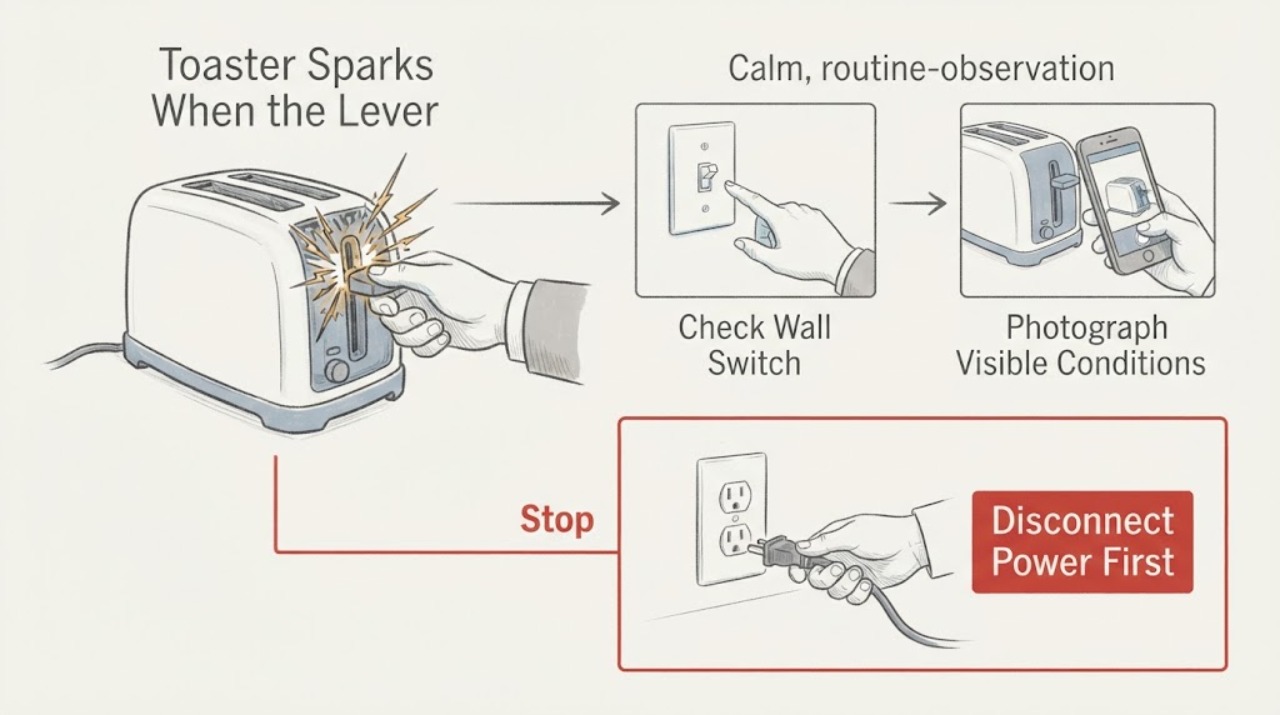
A visible spark when a toaster lever is pressed is an electrical stop condition, not a reason to keep trying the lever. Switch the toaster off and unplug it only if the plug, cord and outlet are cool, dry and safe to touch; otherwise turn off the circuit from a safe location and get qualified help. Do not press the lever again, insert a knife or utensil, shake the toaster while powered, open the case, or replace a switch from the symptom alone. After it is disconnected and cool, you may photograph the outside, model label, cord, plug and outlet without touching damaged parts. A toaster with recurring sparks, a hot or discolored plug, smoke, a tripped breaker or visible damage should remain out of service for qualified appliance or electrical assessment.
Work through in order
Diagnostic checks
Use only checks that match the exact appliance or system and its official guide.
-
Check 1
Stop pressing the lever. If the toaster, plug and outlet are cool, dry and undamaged, switch it off and remove the plug by gripping the plug body; if there is smoke, heat, active arcing, water or a damaged connection, do not touch it and use a safe breaker or qualified emergency help instead.
Expected result: The spark occurred inside or near the toaster, the plug/outlet is hot or discolored, smoke or odor is present, or unplugging would require touching a hazardous connection.
Next step: Keep the toaster out of service and contact qualified appliance/electrical service; leave the area and use emergency assistance for active smoke or fire. Do not reset a breaker repeatedly to test it.
Stop if: Stop immediately for smoke, flame, continuing arcing, a hot outlet, exposed conductor, wetness or a burning odor.
Why this matters
Why: Sparking can indicate an electrical fire or shock hazard. The CPSC directs users to unplug and stop using appliances with sparks, smoke, hot plugs or damaged cords, while unsafe connections should not be handled as a routine unplugging task.
-
Check 2
After power is safely isolated and the toaster is cool, photograph the model/serial label and accessible exterior without inserting anything into the slots or removing the case. Note whether the spark was at the lever, plug, cord, outlet or inside the slot, and whether the breaker tripped.
Expected result: The spark location is visible, only the lever area is marked, the plug/outlet shows heat or discoloration, or the location cannot be determined without opening the toaster.
Next step: Give the photos and sequence to qualified service. If the source cannot be seen externally, do not open the case or power the toaster for another observation.
Why this matters
Why: Location and recurrence are useful service observations, but an external mark does not prove which internal component failed. A plug or outlet mark may shift the service boundary to an electrician as well as an appliance technician.
-
Check 3
Inspect only the unplugged cord, plug blades, outlet face and surrounding counter from a distance. Look for melting, soot, cracks, looseness, moisture or a cord that was pinched or pulled; do not bend blades, test the outlet with the toaster, or move a damaged receptacle cover.
Expected result: The cord/plug or outlet is damaged, loose, hot or discolored, or all accessible external parts look normal.
Next step: Leave the appliance unplugged. Use a qualified electrician for outlet/plug damage and qualified appliance service for an internal toaster fault; do not substitute a cord or plug yourself.
Stop if: Stop if any outlet, plug or cord component is hot, wet, melted, loose or carbonized.
Why this matters
Why: CPSC identifies damaged insulation, loose plugs, arcing, smoke and overheating as warnings that require qualified repair or electrical assessment. A normal-looking exterior does not clear the toaster because the spark may be internal.
-
Check 4
Do not put a knife, fork, metal tool or improvised object into the toaster. If the exact model manual later documents a removable crumb tray, clean that tray only while the unplugged toaster is fully cool and without opening the body; do not shake or turn a damaged toaster over.
Expected result: A jammed item, accumulated crumbs or foreign material is visible externally, or resolving it would require reaching through a slot or entering the case.
Next step: Leave any jam or internal debris for qualified service. Do not power the toaster after cleaning to see whether the spark is gone.
Stop if: Stop for any debris that cannot be removed using the exact manual's tool-free, unplugged procedure or for any scorching/melting.
Why this matters
Why: Breville's official toaster manual warns that extracting a jam with an object can contact live elements and cause electrocution, and says crumb-tray cleaning must be done with the toaster unplugged and cool. Those instructions do not authorize work on this unknown toaster after a spark.
-
Check 5
Arrange qualified appliance or electrical service before any further use. Provide the exact model, spark location, whether the lever latched, plug/outlet condition, breaker behavior, smoke or odor, and photographs; ask the technician to assess the appliance and receptacle rather than ordering a switch from the symptom.
Expected result: The spark recurs, the lever will not latch, the toaster is damaged, the breaker trips, or no safe external explanation is available.
Next step: Keep the toaster unplugged until it has been cleared or replaced by qualified service. Do not open the case, bypass the lever interlock, make live tests or use an extension cord to relocate the problem.
Why this matters
Why: The sources support stop-use and qualified repair boundaries but do not identify a switch, latch, heating element or control-board failure for an unknown toaster.
Use your observations
Decision map
Find the observation that best matches what you see, then follow the next safe action.
-
PATH 01Next step
What you see
The spark is accompanied by smoke, burning odor, heat, active arcing, a hot/discolored plug or outlet, or a tripped breaker.
Do this next
Do not touch or re-energize the toaster. Disconnect power only if safe from a dry location; otherwise use a safe breaker or emergency assistance, then arrange qualified appliance/electrical inspection.
Why this path and its safety boundary
Why it matters: This is an electrical fire or shock stop condition, not a lever-adjustment problem.
-
PATH 02Next step
What you see
The toaster is unplugged and cool, and only an external crumb tray is dirty with no scorch, melting, odor, damaged cord or outlet.
Do this next
Use the exact model manual's unplugged cleaning procedure only, then keep the toaster out of service until qualified guidance says it is safe; do not conduct a powered re-test.
Why this path and its safety boundary
Why it matters: A maintenance issue may be present, but it does not explain or clear a reported spark by itself.
-
PATH 03Next step
What you see
The plug, cord or outlet shows heat, looseness, cracks, soot, melting or other damage.
Do this next
Stop using that outlet and toaster, avoid touching damaged parts, and arrange qualified electrical inspection and appliance service.
Why this path and its safety boundary
Why it matters: The power connection itself may be unsafe and can damage any replacement toaster as well as the current one.
-
PATH 04Next step
What you see
The exterior looks normal but the toaster sparks again when the lever is pressed, or the lever will not latch.
Do this next
Keep it unplugged and provide the model and event details to qualified service. Do not bypass the lever, open the case or replace an internal part from the symptom alone.
Why this path and its safety boundary
Why it matters: An internal electrical or mechanical fault remains unresolved; the absence of an external mark does not make another test safe.
-
PATH 05Next step
What you see
Removing the jam or inspecting the source would require a knife, metal tool, case removal, live measurement or repeated power-up.
Do this next
Stop and use qualified appliance service; preserve the toaster unplugged and cool for assessment.
Why this path and its safety boundary
Why it matters: The check would expose live heating or electrical components and exceeds a safe user-level inspection.
Helpful context
Understand the symptom
A spark changes the troubleshooting order
The assigned toaster has no brand or model, and a spark at the lever could be inside the switch path, near a cord or plug, or caused by another electrical fault. A single observation cannot identify a failed switch, latch, heating element or control. The safe first decision is to remove power without touching a hot, wet or visibly damaged connection, then keep the toaster out of service.
Use only a non-contact inspection
Once disconnected and cool, record the model label and photograph the lever area, cord, plug, outlet face and any visible scorch, melting or debris from a distance. Do not open the shell or probe the slots. Breville's official toaster safety instructions prohibit using a knife or other object to extract a jam and require unplugging before cleaning or moving; the exact unknown toaster may have different user-cleaning instructions.
Crumbs are a maintenance issue, not an invitation to re-test
Manufacturer manuals commonly provide a removable crumb-tray cleaning routine, but a toaster that has already produced a spark should not be powered again merely to see whether cleaning helped. If a model-specific manual later authorizes cleaning, perform it only after the toaster is unplugged and fully cool, and stop if cleaning would require entering the case or touching electrical parts.
When checks do not resolve it
Need a professional?
Arrange qualified appliance or electrical service immediately for any spark, smoke, heat, odor, damaged cord/plug/outlet, breaker trip, lever failure or internal obstruction. Use emergency help for active fire or continuing arcing.
Common questions
FAQ
Is a small spark when pressing a toaster lever normal?
Do not assume it is normal. With no brand or model, a visible spark is an unresolved electrical warning. Stop using the toaster, disconnect it only if safe, and obtain qualified assessment rather than repeating the lever test.
Can I press the lever once more to locate the spark?
No. A powered repeat test can worsen an arcing or overheating fault. Photograph the unplugged toaster and describe where the spark was seen to qualified service.
Can I remove the bread or debris with a knife?
No. The official toaster manual warns that a knife or other object can contact live elements and cause electrocution. Keep the toaster unplugged and use only the exact manual's safe, tool-free cleaning procedure; otherwise call service.
What if the plug or outlet is hot or discolored?
Stop using both the toaster and that connection. CPSC treats hot plugs, arcing, smoke, damaged insulation and discoloration as hazards requiring qualified repair or electrical assessment.
Could crumbs cause the spark?
Crumbs can be a fire hazard when they accumulate, but they do not prove the cause of a visible spark. Do not power the toaster to test a crumb theory; use the exact manual's unplugged cleaning instructions only after the appliance is cool, and escalate any spark or damage.
Read the exact guide
Official sources
- CPSC Guide to Home Wiring HazardsU.S. Consumer Product Safety Commission · Government electrical-safety guidance used for the stop-use response to sparks, smoke, hot plugs, damaged cords and repeated breaker trips. It does not diagnose this unknown toaster's internal fault.
- Instruction Book - BKT682Breville · Manufacturer-specific toaster safety example, not a model match for the unknown toaster. Used only for the boundaries that maintenance other than cleaning belongs to authorized service, the toaster must be unplugged and cool before cleaning/moving, and objects must not be inserted to free a jam.
- CPSC, Whirlpool Announce Recall of KitchenAid® ToastersU.S. Consumer Product Safety Commission · A recall example showing that toaster electrical defects can require immediate unplugging and stop-use. It is not evidence that the unknown toaster is a recalled KitchenAid model or that its spark has the same cause.
Community feedback
Share a repair observation
Share a plain-text repair observation. Accepted observations are published automatically; this page may take a moment to update.