
On this page
Start here
Quick answer
If a Viking DFUD042 dishwasher puts water on the floor during heated dry, stop the cycle, switch off power at a safe point, and close the dishwasher's water shutoff. Do not run another heated cycle to locate the source, pull the built-in unit forward, remove the toe-kick, tilt it, or apply sealant. Once the area is safe and the dishwasher is cool, record whether the water first appeared at an upper door corner, lower front edge, side of the cabinet, or after the machine had been standing, and whether it was clean water or foamy wash water. Viking's DFUD042 documentation describes a drying vent path and installation water connections, but those observations cannot identify a door seal, vent, hose, pump, or heater remotely. Keep the dishwasher out of use and arrange qualified service for recurring floor water, any leak near electrical parts, or any uncertain source.
Work through in order
Diagnostic checks
Use only checks that match the exact appliance or system and its official guide.
-
Check 1
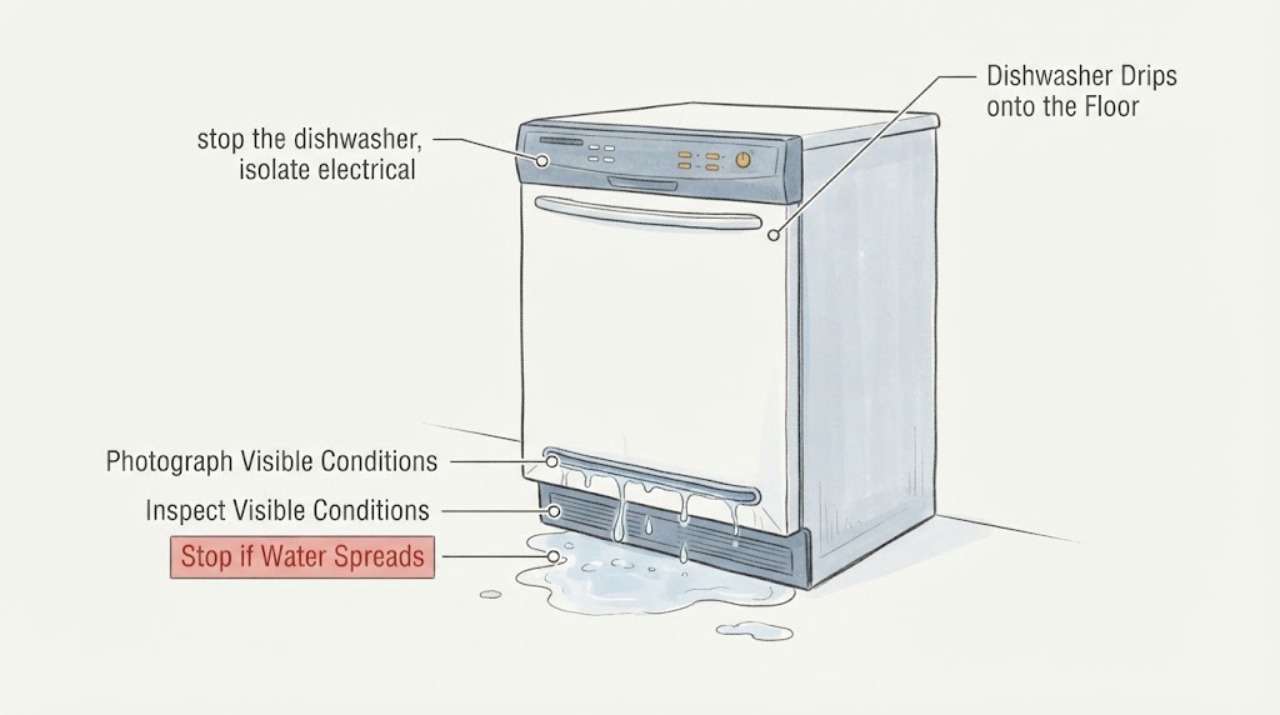
If water is on the floor, stop the dishwasher, isolate electrical power at the breaker or another safe disconnect, and close the dishwasher water shutoff if it is safely accessible. Keep hands and feet away from pooled water near the appliance and do not restart it to reproduce the drip.
Expected result: Water is still spreading, is near an outlet or wiring, the breaker has tripped, or the area is dry and there is no immediate electrical concern.
Next step: For active water or any electrical concern, keep power and water isolated and arrange qualified appliance or electrical service. Only continue with the cool external record after the area is safe.
Why this matters
Why: Active water near electrical equipment is a stop-use condition. A dry floor after cleanup does not show that the leak is repaired or safe to test again.
-
Check 2
Without moving the dishwasher, write down when the first moisture appeared: during washing, during the heated-dry portion, immediately when the door was opened, or after the cycle had ended. Photograph the floor pattern and the visible front door edges only after the unit is off and cool.
Expected result: The first water is consistently associated with heated dry, with opening the door, with an earlier wash stage, or with no clear stage.
Next step: Give the timing and photos to the servicer. Do not run another cycle merely to improve the timing record.
Why this matters
Why: A dry-stage-only event keeps the door/vent/condensation path in scope; water that starts during filling or washing keeps inlet, drain, foam, and sealing paths in scope. An unknown stage means the source remains unresolved and should not be assigned to a component.
-
Check 3
After the dishwasher is cool and power is isolated, inspect only the visible door perimeter, lower front edge, adjacent cabinetry, and any accessible floor staining. Look for a gasket that is visibly folded or out of its channel, a door or custom panel that does not meet squarely, dried detergent residue, or a drip trail from one side. Do not remove the toe-kick or reach below the machine.
Expected result: A visible door-edge gap, displaced seal, misaligned front, or localized trail is present, or the visible perimeter looks intact.
Next step: Leave the dishwasher unused and report the exact location to qualified service. Do not apply caulk, tape, or a temporary seal, and do not adjust the door or leveling feet yourself.
Why this matters
Why: A localized door-edge pattern makes a closure or sealing problem more plausible, but it does not prove that the gasket is the only leak path. An intact visible perimeter cannot rule out an inlet, drain, or base-pan leak.
-
Check 4
When the unit is cool and the door can be opened without standing water, look inside for unusual foam, a detergent film, or water remaining beyond the normal filter area. Do not add vinegar, detergent, drain cleaner, or another chemical, and do not touch a suspected leak path while power is connected.
Expected result: Foam or a strong detergent film is visible, the water is clear without foam, or the tub contains an abnormal amount of standing water.
Next step: Keep the appliance off, record the detergent used and the water appearance, and arrange service if there was floor water. Do not attempt a chemical flush or a drain-pump inspection.
Why this matters
Why: Foam makes a detergent or oversudsing contribution possible; standing water keeps incomplete drainage or a leak into the base in scope. Neither observation identifies a pump or heater, and clear water does not rule out an installation leak.
-
Check 5
Collect the full rating-label model and serial information, the house handover or installation paperwork if available, and whether the dishwasher has a custom front. Note any prior flooring, cabinet, plumbing, or dishwasher work. Do not pull the unit out to find the label or inspect the rear connections.
Expected result: The unit is confirmed as DFUD042 with an accessible label and known installation history, or the suffix/history and connection details are unknown.
Next step: Send the model/serial, stage, water location, photos, detergent information, and installation history to an authorized or qualified dishwasher servicer. Leave the appliance out of use until assessed.
Why this matters
Why: The Viking documentation covers DFUD042/142 family variants, while an inherited installation may have different front, leveling, or connection conditions. Missing history is a reason to give the servicer more context, not to assume the current leak path.
Use your observations
Decision map
Find the observation that best matches what you see, then follow the next safe action.
-
PATH 01Next step
What you see
Water reaches the floor or cabinetry, especially near electrical parts, and the source cannot be isolated without moving the dishwasher.
Do this next
Keep power and the dishwasher water supply isolated, do not run another cycle, and arrange qualified appliance service. Use electrical service if the water reached wiring or a breaker tripped.
Why this path and its safety boundary
Why it matters: This is an active leak and electrical-safety boundary, not a safe location test. The source could be a door, inlet, drain, or base-pan path.
-
PATH 02Next step
What you see
The first visible moisture occurs only during heated dry or when the door is opened, and the trail is at an upper door corner or adjacent cabinet rather than from beneath the unit.
Do this next
Keep the unit out of use if water reached the floor, document the corner and door alignment, and have a qualified technician check the door seal, vent path, and installation without the homeowner dismantling the unit.
Why this path and its safety boundary
Why it matters: The timing is consistent with the DFUD042 drying/venting phase or door-area condensation, but a door-seal or vent defect remains possible and cannot be confirmed from a photograph alone.
-
PATH 03Next step
What you see
The drip trail starts at a lower front corner or side, appears during filling or washing, or the tub has unusual foam or standing water.
Do this next
Do not add chemicals or inspect below the appliance. Keep the water supply and power off and give the servicer the stage, fluid appearance, and exact trail location.
Why this path and its safety boundary
Why it matters: This pattern makes a door seal, foam-related overflow, inlet connection, drain path, or base-pan response more plausible than a dry-stage-only condensation explanation. It still does not identify a pump, heater, or hose.
-
PATH 04Next step
What you see
The visible door perimeter looks normal, but floor water recurs or appears after the dishwasher has been idle.
Do this next
Leave the dishwasher unused and request professional inspection of the installation and water paths. Do not pull, tilt, level, or seal the unit as a home test.
Why this path and its safety boundary
Why it matters: A cool exterior check cannot rule out an inlet, drain, base-pan, or connection leak. The inherited-house context also leaves installation and leveling history uncertain.
-
PATH 05Next step
What you see
No floor water recurs after cleanup, but the original event was not directly observed or its stage and location are unknown.
Do this next
Do not schedule a deliberate heated test. Preserve photos and the event details and have the technician decide whether a controlled inspection is safe.
Why this path and its safety boundary
Why it matters: The absence of a later drip is not a repair result; it only leaves the leak source unresolved. A later cycle could recreate the hazard.
Helpful context
Understand the symptom
The DFUD042 is a built-in Viking dishwasher with a documented drying and venting path. A drip that appears during heated dry may be related to steam/condensation at the door area, but water on the floor can also reflect a sealing, installation, inlet, drain, or base-pan problem. The time of first moisture and its location are more useful than a guess that the heater or pump is bad.
Because this dishwasher is inherited with a new house, do not assume the installation, custom front, leveling, or water connections were left in serviceable condition. Make only cool, external observations. Do not explore underneath while powered or hot, remove panels, or repeat a cycle with water already reaching the floor.
When checks do not resolve it
Need a professional?
Keep the Viking DFUD042 out of use and arrange qualified appliance service for any water on the floor, recurring drip, unknown leak source, foam or abnormal standing water, door or seal misalignment, or inherited installation with uncertain connections. Isolate power and close the water shutoff first when safe. Escalate electrical service for water near wiring or a breaker trip. Do not run a heated test, remove the toe-kick, pull the dishwasher forward, tilt it, apply caulk or tape, open internal panels, or guess a pump, heater, valve, hose, or gasket replacement.
Common questions
FAQ
Is a DFUD042 heated-dry drip automatically a bad heater?
No. Viking documents a drying and venting path, but a floor drip can also involve door sealing, foam, inlet or drain connections, installation, or a base-pan leak. Timing and location are needed before a technician identifies any component.
Can I run another cycle with a towel underneath to find the leak?
No. Once water has reached the floor, keep power and water isolated when safe and do not create a second heated or wash test. Give the servicer the stage, photos, and visible trail instead.
Should I pull out the inherited dishwasher or reseal the door?
No. Do not pull, tilt, level, remove the toe-kick, or apply a temporary seal. Viking's installation material treats water connections, leveling, and leak checks as installation work; arrange qualified service for the built-in unit.
What information should I give the technician?
Give the full model and serial, the cycle stage when water first appeared, whether it was clear or foamy, the first visible location, photos, any standing water or door-edge gap, detergent information, and the house installation history. This is more useful than naming a replacement pump or heater yourself.
Read the exact guide
Official sources
- F20244C rework.qxdViking Range, LLC · The opened Viking installation document names DFUD042/DFUD142 and covers sealed inlet connections, base-pan/float response, checking for leaks, drain-line condition, and leveling; it is used to set a professional boundary, not to instruct a homeowner to move the appliance.
- Support CenterViking Range, LLC · Viking's support center provides product-support requests and an authorized-servicer route; it is used only for escalation and model/serial handoff.
- F20243E EN.qxp:F20243.qxdViking Range, LLC · The opened Viking use-and-care document names DFUD042/DFUD142, describes cycle and drying behavior, door-switch safety, detergent/foam concerns, and user-level operating context.
- KITCHEN CLEANUPViking Range, LLC · The opened Viking product document identifies the DFUD042/142 model options and describes Convect-Air fan drying, automatic water heating, and the dishwasher's undercounter form factor.
Community feedback
Share a repair observation
Share a plain-text repair observation. Accepted observations are published automatically; this page may take a moment to update.