
On this page
Start here
Quick answer
A Viking dishwasher that is not working may be stopped by the door, a delay setting, missing water supply, power protection, or a fault indication. Viking’s official use-and-care material starts diagnosis with the door and delay option, then water and power checks, filters, and the displayed fault pattern.
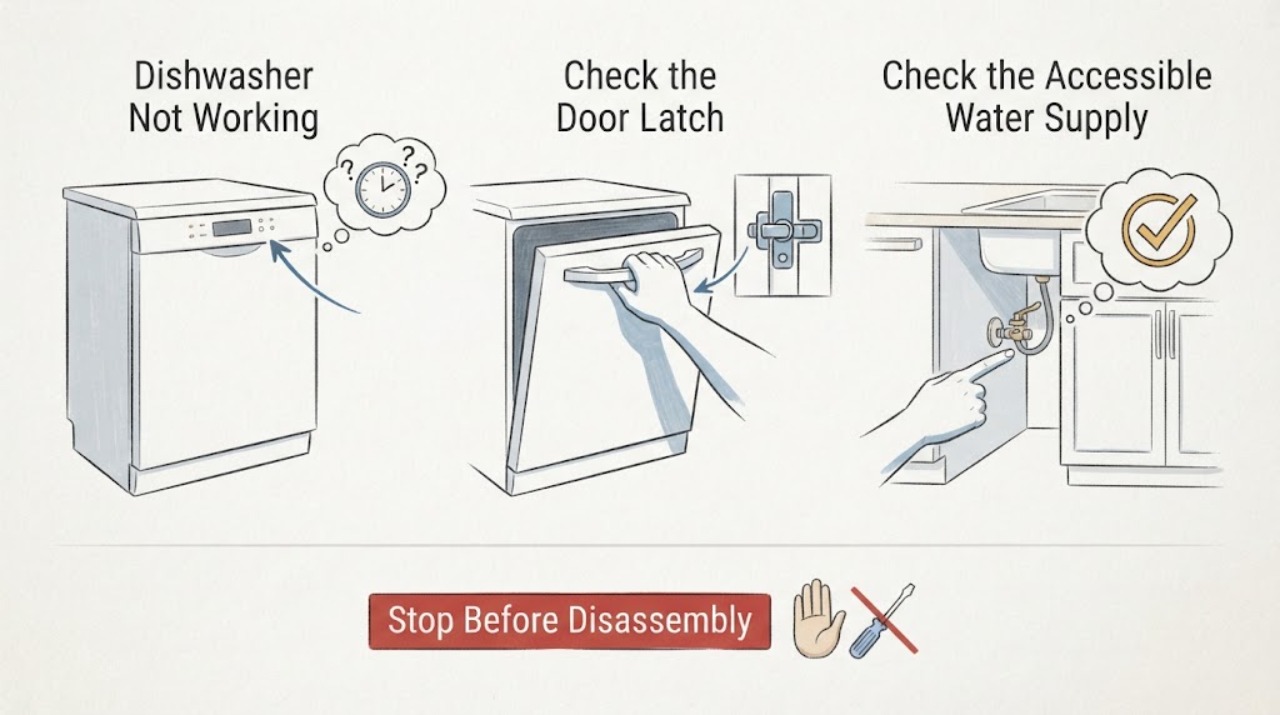
Work through in order
Diagnostic checks
Use only checks that match the exact appliance or system and its official guide.
-
Check 1
Close the door firmly until the latch engages, confirm Delay Start is off, select a cycle, press Start, and observe the indicator.
Expected result: The dishwasher starts after the latch or delay is corrected, or it remains silent with a flashing or unchanged indicator.
Next step: Run one normal cycle and record any remaining indicator pattern.
Why this matters
Why: Viking identifies the door and delay option as first causes of a dishwasher that does not start; a successful start makes those conditions more likely.
-
Check 2
Check the accessible water supply valve, inlet connection, and power cord or breaker without opening the dishwasher.
Expected result: Water is off or the inlet path is visibly restricted, the outlet has no power, or the breaker trips again.
Next step: Correct only an accessible valve or kink if safe; do not repeatedly reset a breaker or use an extension cord.
Why this matters
Why: A missing water or power supply can prevent the cycle from beginning or advancing; a repeat breaker trip needs electrical service.
-
Check 3
Inspect the user-accessible filter and drain or air-gap path according to the exact Viking manual, and ensure the spray arms are not obstructed.
Expected result: The filter or drain path is blocked, standing water remains, or the path is clear.
Next step: Clean and refit the filter as instructed, then try one rinse or normal cycle.
Why this matters
Why: A blocked drain or filter can leave the machine in a protective or incomplete state; clearing it does not prove the control or pump is healthy.
-
Check 4
Record flashing cycle buttons or fault symbols before switching the machine off.
Expected result: A fault pattern repeats, indicates water inlet, valve leakage, excess water, or blocked drain, or there is no fault pattern.
Next step: Use the model manual and arrange service for a repeated or unclear indication.
Why this matters
Why: The pattern narrows the model-specific path; absence of a code does not rule out an internal fault.
Use your observations
Decision map
Find the observation that best matches what you see, then follow the next safe action.
-
PATH 01Next step
What you see
The dishwasher starts after the door, delay, water, or accessible filter condition is corrected.
Do this next
Monitor the next cycle and keep the model manual with the appliance.
Why this path and its safety boundary
Why it matters: A correctable start or installation condition is more likely than an internal control failure.
-
PATH 02Next step
What you see
The dishwasher remains silent or stops with the same fault pattern after the safe checks.
Do this next
Stop repeated attempts and arrange qualified Viking service with the fault pattern.
Why this path and its safety boundary
Why it matters: A door sensor, inlet valve, pump, motor, control, or wiring issue is more likely.
-
PATH 03Next step
What you see
Water leaks, the breaker trips, smoke or sparking appears, or wiring is damaged.
Do this next
Turn off the water for a leak and isolate power only if safely accessible; arrange qualified service.
Why this path and its safety boundary
Why it matters: The issue is beyond safe user troubleshooting.
Helpful context
Understand the symptom
What to check first
A Viking dishwasher that is not working may be stopped by the door, a delay setting, missing water supply, power protection, or a fault indication. Viking’s official use-and-care material starts diagnosis with the door and delay option, then water and power checks, filters, and the displayed fault pattern. Record the exact model and symptom pattern before ordering a part. A user check should change the next decision; it should not be used to infer an unverified component.
When checks do not resolve it
Need a professional?
Arrange qualified Viking service when the dishwasher remains inoperative after door, delay, water, power, and accessible filter checks, when a fault pattern repeats, or when pump, motor, wiring, or control diagnosis is needed.
Common questions
FAQ
Can I keep resetting the breaker to make the dishwasher run?
No. A repeat trip indicates an electrical condition that needs qualified evaluation.
What should I record before service?
Record the model, door and delay status, water and power observations, whether the pump runs, and any flashing buttons or fault symbols.
Read the exact guide
Official sources
- Viking Use & Care ManualViking · Viking Use & Care Manual is official manufacturer material; model-specific details remain limited to the named product or manual.
- Viking Support and DocumentationViking · Viking Support and Documentation is official manufacturer material; model-specific details remain limited to the named product or manual.
Community feedback
Share a repair observation
Share a plain-text repair observation. Accepted observations are published automatically; this page may take a moment to update.