
On this page
Start here
Quick answer
If a Beko dishwasher is not working, first check that the display or indicator lights respond, the plug and household power are available, and the selected program is not waiting on a delay or an interrupted cycle. Close the door firmly until the latch engages; Beko dishwashers will not start when the door is detected as open. Then check that the water tap is on and the accessible inlet and drain hoses are not kinked. If water remains inside, a clogged filter or drain path can prevent the next fill. If the display remains unresponsive, the latch is damaged, the appliance leaks, a fault returns after the model-specific restart procedure, or electrical access is needed, stop and arrange authorized service.
Before you begin
Safety first
- This article covers external power, door, visible hose, accessible filter, and documented program observations. Qualified service must handle energized wiring, interlock replacement, pressurized connections, internal pump or valve access, controls, and fixed panels.
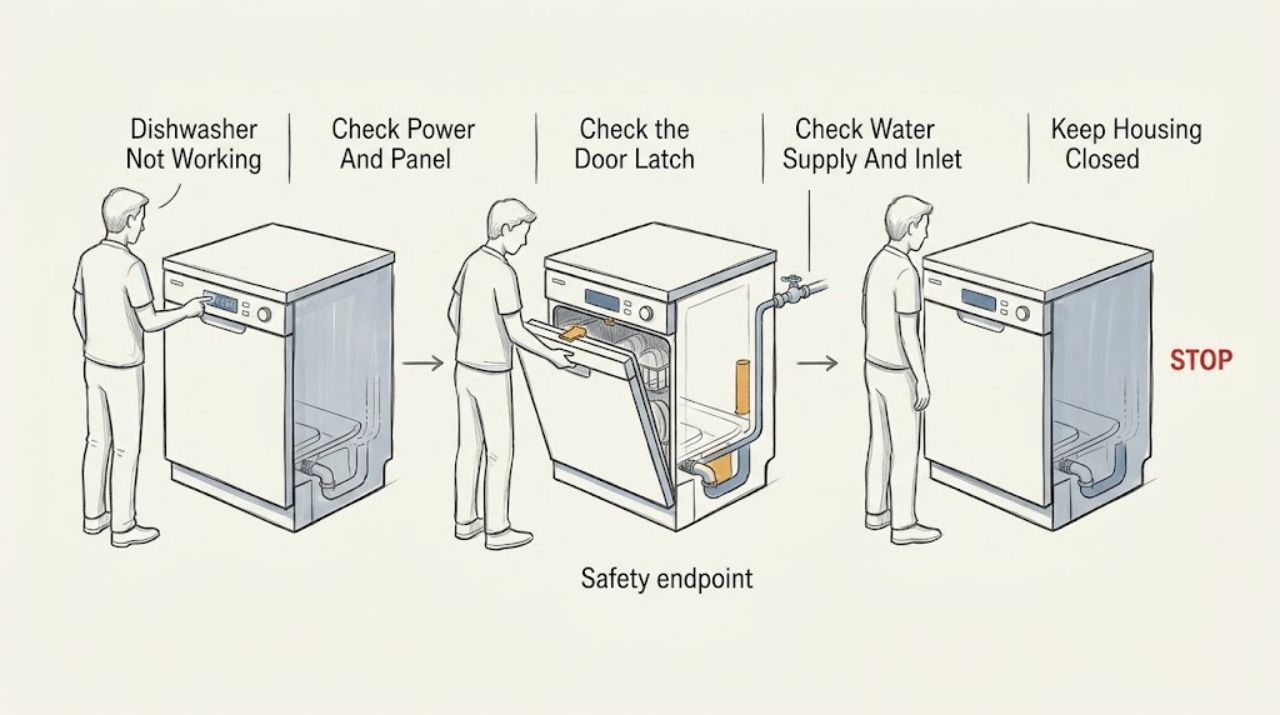
Work through in order
Diagnostic checks
Use only checks that match the exact appliance or system and its official guide.
-
Check 1
Check whether the dishwasher display or indicator lights respond. Confirm the plug is seated in its normal outlet and check whether another household appliance or light has power, without opening the dishwasher's electrical enclosure.
Expected result: The panel is dark, household power is also absent, the panel lights but commands do not respond, or the panel behaves normally.
Next step: Restore only an obviously loose plug or household power condition. Follow the exact model manual for a restart or cancel sequence; arrange authorized service for a failed outlet, cord, fuse, display, or persistent unresponsive controls.
Stop if: Do not bypass a fuse or protective device, use a damaged cord, remove an electrical cover, or continue if there is smoke, burning odor, or arcing.
Why this matters
Why: A dark panel with wider power loss points to the supply. If other appliances work but the dishwasher stays dark, its outlet, fuse, cord, or internal power path may need qualified diagnosis. A lit but unresponsive panel shifts concern toward controls, a delay, an interrupted cycle, or a technical fault.
-
Check 2
Close the dishwasher door slowly and firmly, checking that no rack, dish, or detergent dispenser is in the way and that the latch engages as described in the model instructions.
Expected result: The door closes and locks normally, it springs back open, no locking sound occurs, or the latch, door, or frame is cracked or damaged.
Next step: Remove only an obvious loading obstruction and retry the documented start sequence. Arrange service for a loose or damaged latch, cracked door or frame, or a door that will not stay closed.
Stop if: Do not force the door, bend the latch, defeat the door interlock, or run the dishwasher with a cracked door or leaking seal.
Why this matters
Why: Beko says the dishwasher will not start when it detects an open door. A poor closure or damaged latch can therefore look like a dead control panel or a program fault even when the appliance has power.
-
Check 3
Confirm that water is available at a nearby tap and that the dishwasher's accessible water-supply tap is open. Inspect only the visible inlet hose for a sharp bend, crushing, leakage, or damage; do not disconnect it.
Expected result: The tap is closed or water is unavailable, the inlet hose is kinked or leaking, the hose looks clear, or the dishwasher still does not fill.
Next step: Restore only an obviously closed tap or gently relieve an accessible bend without moving the appliance. Arrange service for a leak, damaged hose, blocked inlet filter, persistent no-fill condition, or any connection that needs removal.
Stop if: Do not disconnect a pressurized hose, force the supply tap, reach behind a built-in unit, or continue with water on the floor.
Why this matters
Why: No water or a restricted inlet path can prevent the dishwasher from starting its fill stage. A leak or damaged hose is a repair boundary. If supply conditions look normal, a filter, inlet valve, door signal, or control fault becomes more likely.
-
Check 4
If water is standing in the tub or the previous cycle did not finish, switch the appliance off using its normal control and inspect the visible drain area and filter according to the model manual. Look at the accessible drain hose and sink connection for a bend or blockage.
Expected result: The filter contains food debris, the drain hose is bent, the sink connection is blocked, the tub is empty and the path looks clear, or the dishwasher will not drain.
Next step: Clean only the removable filter using the model instructions and clear an obvious external hose or sink-path obstruction. Arrange service for a blocked internal path, pump issue, leakage, broken filter parts, or a drain problem that returns.
Stop if: Do not reach into standing water with the appliance energized, remove the pump protection or fixed panels, use chemical drain cleaner, or keep restarting a machine that is overflowing.
Why this matters
Why: Beko explains that a dishwasher that cannot drain may not take in water for the next stage. A clogged filter or restricted drain path therefore fits a start-then-stop or no-fill symptom; a clear path with persistent standing water suggests a pump, sensor, or control fault.
-
Check 5
Review the selected program, delay indicator, Start/Pause status, and any displayed fault indication against the exact Beko manual. If the cycle was interrupted by opening the door or a power outage, use only the model's documented resume or cancel procedure.
Expected result: A delay is active, the cycle is paused or waiting for a door close, a fault indicator returns, or the program state appears normal but the dishwasher still will not run.
Next step: Cancel or resume only as the model manual directs. Record the exact display or light pattern and arrange authorized service if the indication returns or the appliance remains inactive.
Stop if: Do not guess at an error-code meaning, repeatedly cycle the power to conceal a fault, or open the door during a running hot cycle unless the manual's safety procedure permits it.
Why this matters
Why: A delayed or interrupted program can make a working dishwasher appear inactive. A recurring fault indication or normal program state with no operation points toward a technical problem rather than a loading adjustment.
Use your observations
Decision map
Find the observation that best matches what you see, then follow the next safe action.
-
PATH 01Safety boundary
What you see
The dishwasher is dark while other household power works, or the panel remains unresponsive after the model-specific restart procedure.
Do this next
Stop at the external observations and arrange authorized appliance or electrical service with the model information and panel behavior.
Why this path and its safety boundary
Why it matters: An appliance power path, fuse, display, control, or internal electrical fault is more likely than a water or loading issue.
Safety stop: Do not bypass protection, open the electrical enclosure, or use the appliance with smoke, arcing, or a burning odor.
-
PATH 02Safety boundary
What you see
The display works, but the program will not begin and the door does not close or latch reliably.
Do this next
Remove only an obvious rack or dish obstruction; arrange service for a damaged door, seal, latch, or frame.
Why this path and its safety boundary
Why it matters: The door interlock or a physical obstruction is more likely than a failed wash motor.
Safety stop: Do not defeat the interlock or force a damaged door closed.
-
PATH 03Safety boundary
What you see
The door latches, but the dishwasher stops before filling, leaves water in the tub, or shows a bent hose, clogged filter, closed tap, or blocked sink connection.
Do this next
Correct only an obvious external tap, hose, filter, or sink-path condition allowed by the model instructions. Arrange service for internal blockage, pump, inlet, leak, or recurring no-fill behavior.
Why this path and its safety boundary
Why it matters: A water-supply or drain restriction is more likely than a general control failure; Beko notes that inability to drain can prevent water entry.
Safety stop: Do not disconnect pressurized plumbing, reach into energized standing water, or use chemical drain products.
-
PATH 04Safety boundary
What you see
Power, door, tap, visible hoses, and filter checks are normal, but a delay or pause remains active, a fault indication returns, or the dishwasher still will not operate.
Do this next
Use the exact model manual to cancel or resume once, record the indicator pattern, and arrange authorized service if the problem persists.
Why this path and its safety boundary
Why it matters: A program-state, sensor, control, latch signal, pump, or other technical fault is more likely than a simple user adjustment.
Safety stop: Do not repeatedly restart to hide a fault or dismantle the appliance to test internal components.
Helpful context
Understand the symptom
Not working can mean several different symptoms
A dishwasher that is completely dark needs a power check. A dishwasher with lights that will not begin a cycle often needs a door, water-supply, delay, or interrupted-cycle check. A dishwasher that starts and then stops can leave a drain or inlet problem behind. Separating these symptoms prevents replacing a part before the basic start conditions have been checked.
The door and water path are start conditions
Beko states that the appliance will not start when it detects an open door, and its water-entry guidance explains that a dishwasher may not take in water if it cannot drain or if the supply and drain hoses are bent or clogged. A firm latch, an open water supply, clear accessible hoses, and a clean filter are therefore useful observations before deeper diagnosis.
Use the exact model guide before electrical or internal work
Beko models use different controls, programs, indicators, and access arrangements. The official troubleshooting manual advises using the product identification information when contacting after-sales service. Use the manual for any restart sequence, filter access, or error indication; do not remove electrical covers, force the latch, or work on pressurized water connections as a first check.
Safety boundary
Stop conditions
- Stop using the dishwasher for smoke, burning odor, arcing, a damaged cord, exposed wiring, uncontrolled water, or water reaching electrical parts.
- Do not defeat the door interlock, force a latch or water tap, disconnect pressurized hoses, or remove electrical covers as a first check.
- Do not reach into standing water while the dishwasher is energized, use chemical drain cleaner, or remove fixed pump protection or internal panels without model-specific service instructions.
- Do not keep restarting an appliance that leaks, overflows, or repeatedly shows a fault indication; arrange authorized service.
Only after diagnosis
Potential parts
- Model-matched dishwasher door latch or interlock
Consider this category only when inspection confirms that the door cannot latch or a technician confirms that the interlock signal is not being detected.
Confirm the exact Beko model, latch style, connector, and manufacturer's fit information before ordering; do not bypass the interlock. - Model-matched dishwasher inlet valve or inlet hose
Consider this category only when the tap is open, the visible hose is sound, and service testing confirms an inlet restriction or failed valve.
Confirm the exact model, hose connection, valve assembly, and manufacturer's fit information before ordering; pressurized water work should be handled by qualified service. - Model-matched dishwasher drain pump or filter assembly
Consider this category only when the filter and accessible drain path are clear but the dishwasher still cannot drain and service testing identifies a pump or damaged filter assembly fault.
Confirm the exact model, pump or filter design, and manufacturer's fit information before ordering; do not remove fixed pump protection as a first check.
When checks do not resolve it
Need a professional?
Safety scope: This article covers external power, door, visible hose, accessible filter, and documented program observations. Qualified service must handle energized wiring, interlock replacement, pressurized connections, internal pump or valve access, controls, and fixed panels.
Common questions
FAQ
Why is my Beko dishwasher not working but the display is on?
Check whether a delay or paused cycle is active, close the door firmly until the latch engages, and verify that the water tap is open. If the panel responds but a fault returns or the cycle still will not begin, use the model manual and arrange authorized service.
Can an open dishwasher door stop a Beko cycle from starting?
Yes. Beko says the dishwasher will not start when it detects that the door is open. Check for a rack or dish obstruction and confirm that the latch closes normally; do not bypass a damaged interlock.
Why does my Beko dishwasher not take in water?
Check the water supply tap, visible inlet hose, drain hose, and filter. Beko explains that a dishwasher that cannot drain may not take in water for the next stage. Arrange service for leaks, blocked internal paths, or a persistent no-fill condition.
What should I do if my Beko dishwasher stops after a power interruption?
A Beko dishwasher may require the model-specific Start or resume procedure after power returns or after the door has interrupted a cycle. Follow the exact manual, and arrange service if the fault indication returns or the appliance stays inactive.
When should I call service for a Beko dishwasher that is not working?
Call when the panel is unresponsive, the door or latch is damaged, water leaks or will not enter or drain, a fault returns after the model procedure, or internal electrical, pump, valve, sensor, or control access is needed. Stop using the appliance for smoke, burning odor, arcing, or uncontrolled water.
Read the exact guide
Official sources
- TROUBLESHOOTINGBeko · Official Beko dishwasher manual hosted on the Beko documents domain; exact model manual controls the applicable procedure and indicators.
- Help Center ResultBeko · Official Beko dishwasher help center; controls and available options vary by model.
- How to fix a dishwasher that won’t startBeko · Official Beko support article for dishwashers; exact model instructions control program and service procedures.
- How to fix a dishwasher that won’t take in waterBeko · Official Beko support article for dishwashers; model instructions control access to filters, hoses, and controls.
Community feedback
Share a repair observation
Share a plain-text repair observation. Accepted observations are published automatically; this page may take a moment to update.