
On this page
Start here
Quick answer
A Bosch dishwasher that is not working may have no power, power but no start, a cycle that stops, or a cycle that runs without filling or draining. First identify which of those symptoms is present. Check the accessible plug, outlet, breaker or fuse, door closure, control lock or delay setting, and water supply without removing panels. Bosch says an unlatched door, active child lock, disconnected power, tripped protection, or an obstructed load can prevent starting; its support guidance also links standing water with a filter, pump, or drain-path problem. If the dishwasher has water in its base, a leak, smoke, burning smell, damaged wiring, repeated trips, or an error that returns, turn off the water and power when safe and arrange qualified service. Do not reach into a moving pump, bypass the door or leak interlock, disconnect plumbing on a full machine, or assume a control board, pump, inlet valve, or latch needs replacement from the symptom alone.
Before you begin
Safety first
- This article covers external power, controls, door/load, accessible water route, removable filter, and visible drain-route checks only. A qualified technician must handle electrical covers, internal pumps, valves, heaters, controls, leak protection, energized testing, and built-in dismantling.
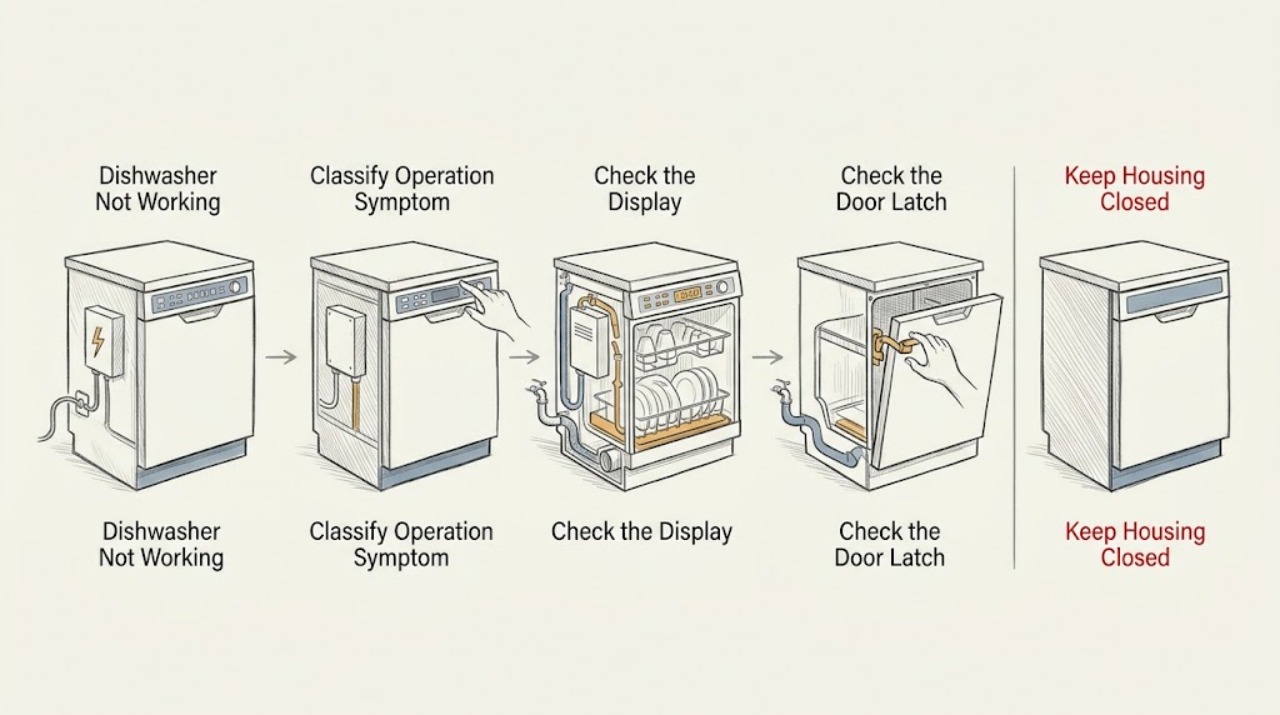
Work through in order
Diagnostic checks
Use only checks that match the exact appliance or system and its official guide.
-
Check 1
Record the complete model number and classify the symptom as a dark display/no lights, lights but no start, starts then stops, no water entering, standing water after a cycle, or an error/light pattern. Note any leak, odor, noise, or recent power or water interruption.
Expected result: The dishwasher is completely dark, controls light but no cycle starts, the cycle stops mid-way, water is absent, water remains, or a warning appears.
Next step: Follow the branch that matches the observed pattern and keep the model number for Bosch's owner manual and any service request.
Stop if: Stop for smoke, burning odor, damaged insulation, water near electrical parts, a leak that cannot be contained, or repeated circuit trips.
Why this matters
Why: Different symptoms point to different external checks: power and controls for a dark machine, door/lock/programme for no start, power/water/door/loading for a mid-cycle stop, inlet for no fill, and drain/filter/pump path for standing water.
-
Check 2
For a dark dishwasher, inspect the accessible power cord and plug, confirm the normal outlet connection, and check the household breaker or fuse from the user panel. For a lit dishwasher, check that the control lock or child lock, delay start, and selected programme are not preventing a start, using the exact manual for the button sequence.
Expected result: The cord/plug is damaged, the outlet or breaker has no supply, the control panel is locked or delayed, or power and controls look normal but the dishwasher remains unresponsive.
Next step: Correct only an obvious loose plug or documented control setting. If the outlet, cord, breaker, display, or control remains abnormal, leave the dishwasher out of service and arrange qualified help.
Stop if: Do not fit a higher-rated fuse, bypass a breaker or interlock, remove an electrical cover, or probe live wiring.
Why this matters
Why: An external supply or documented control mode can explain a dark or apparently inactive dishwasher. Normal power and controls shift suspicion toward the latch, control, or another internal fault without identifying a replaceable part.
-
Check 3
Close the dishwasher door without force and confirm that racks, dishes, a hose holder, or cabinetry are not preventing the latch from engaging. Inspect the accessible latch area for obvious damage and check the exact manual for the normal start sequence.
Expected result: The door does not latch, a dish or rack blocks closure, the latch is visibly damaged, the controls beep but no cycle starts, or the door latches and the dishwasher still does not start.
Next step: Remove only an item obstructing closure and try the model's normal start sequence once. If the latch is damaged, will not engage, or the cycle still will not start, arrange service rather than forcing or replacing the latch without diagnosis.
Stop if: Do not force the door, bend the latch, defeat the door switch, or pull a built-in dishwasher out to reach the latch.
Why this matters
Why: Bosch states that an improperly closed door can prevent starting and that loading or door-latch problems can stop a cycle. A securely latched door with normal controls makes a water, programme, control, or internal fault more likely.
-
Check 4
If the dishwasher starts but does not fill or stops during a cycle, inspect only the accessible water-supply valve and inlet hose for an obviously closed valve, kink, or damage. Note whether the door stayed latched and whether the pump or inlet sound changed; do not loosen a water connection.
Expected result: The valve is closed, the hose is kinked or damaged, the door opened or load pressed against it, there is no obvious external issue, or water is visible in the base.
Next step: Correct only an obvious accessible valve or hose route issue and test once if there is no leak or electrical hazard. If water is in the base, a hose is damaged, or the cycle still will not fill/continue, turn off the water and arrange qualified service.
Stop if: Do not disconnect the inlet hose, bypass a float or leak sensor, continue with a leak, or reach into a wet base near electrical parts.
Why this matters
Why: A closed or restricted supply, door interruption, or load obstruction can stop filling or a cycle. Water in the base may activate leak protection and is not a reason to keep restarting the machine; no visible external cause moves diagnosis toward the inlet valve, float, control, or another internal fault.
-
Check 5
If standing water remains, switch off and isolate power, then inspect and clean the removable filter exactly as the owner manual shows. Inspect the visible drain hose and accessible air-gap or sink connection for a kink or obvious blockage; do not open a pump cover unless the exact model manual makes that a safe user step.
Expected result: The filter contains food or foreign material, water remains after cleaning, the visible drain route is kinked or blocked, the connected sink drains slowly, or the accessible path is clear.
Next step: Remove only loose accessible debris, refit the filter securely, correct an obvious hose route issue, and make one controlled rinse test if safe. If water remains, the pump area is inaccessible, or a leak appears, keep the dishwasher isolated and call service.
Stop if: Do not reach into a moving pump, disconnect a water-filled hose, remove a pump cover without model instructions, or handle standing water near electrical parts.
Why this matters
Why: Bosch links standing water with failure to pump out and commonly with debris in the filter or pump. A kinked connected path can also restrict drainage. Persistent water with a clear safe path points beyond a user-level blockage.
-
Check 6
If an error code or flashing light returns, photograph or transcribe the complete pattern and compare it with the exact model's Bosch support page or owner manual. Record whether the code appears with no fill, standing water, a leak, no heat, or a door problem rather than repeatedly resetting the machine.
Expected result: The code matches a documented user check, is not listed for the model, returns after the documented check, or is accompanied by water in the base or an electrical hazard.
Next step: Perform only the exact manual-directed external check once. If the code returns or the symptom needs internal access, turn off water/power as appropriate and arrange qualified Bosch or appliance service with the code and model number.
Stop if: Do not bypass leak protection, open electrical covers, test energized components, or continue a cycle through a leak, smoke, burning odor, or repeated circuit trip.
Why this matters
Why: A documented code may point to a subsystem such as drainage, water flow, door sensing, heating, or control, but the code and model together determine the next step. A returning or unsupported code requires service; water in the base can indicate activated leak protection.
Use your observations
Decision map
Find the observation that best matches what you see, then follow the next safe action.
-
PATH 01Safety boundary
What you see
The display and lights are off, and the accessible cord, outlet, breaker/fuse, and plug connection do not restore power.
Do this next
Leave the dishwasher disconnected and arrange qualified electrical or appliance service with the model number and power observations.
Why this path and its safety boundary
Why it matters: A supply, wiring, control, or internal electrical fault is more likely than a door or drain blockage.
Safety stop: Do not bypass protection, use a damaged cord, remove an electrical cover, or probe live wiring.
-
PATH 02Safety boundary
What you see
The display works, but the cycle does not begin; the door may not latch, child lock/delay may be active, or a dish/rack may obstruct closure.
Do this next
Clear only the obstruction, follow the exact model's normal start or lock-release sequence once, and arrange service if the latch or start behavior remains abnormal.
Why this path and its safety boundary
Why it matters: A documented operating mode, door closure, or latch issue is more likely than a drain or inlet fault.
Safety stop: Do not force or bypass the latch, remove a built-in door panel, or repeatedly cycle the controls.
-
PATH 03Safety boundary
What you see
The dishwasher starts but stops, does not fill, or stops after the door was opened, power/water was interrupted, or a warning appears.
Do this next
Check only the accessible door/load and water-supply route. If water is in the base, the hose is damaged, or the cycle still stops, turn off water and arrange qualified service.
Why this path and its safety boundary
Why it matters: Door sensing, loading, water supply, inlet, float, leak protection, or control conditions are plausible; the symptom alone does not identify the valve or board.
Safety stop: Do not bypass the door or float switch, disconnect plumbing under pressure, or continue with a leak.
-
PATH 04Safety boundary
What you see
The cycle completes or stops with water in the base, a sewage-like odor, a drain-related code, or a visible kink/blockage in the accessible drain path.
Do this next
Isolate power, clean and refit the filter as the exact manual permits, correct only an obvious accessible hose route issue, and test once. Escalate if water remains, the pump is inaccessible, or a leak is present.
Why this path and its safety boundary
Why it matters: A filter, pump, drain hose, air-gap, or connected waste restriction is more likely than a simple start-control problem.
Safety stop: Do not reach into a moving pump, disconnect a full hose, remove the pump cover without model instructions, or handle water near electrical parts.
-
PATH 05Safety boundary
What you see
The dishwasher remains nonfunctional after external checks, an error returns, the door or controls are damaged, or there is smoke, burning odor, water near electrical parts, or repeated tripping.
Do this next
Keep the appliance out of service, turn off the water and isolate power when safe, and arrange qualified Bosch or appliance service with the model and symptom record.
Why this path and its safety boundary
Why it matters: An internal electrical, control, latch, pump, heater, inlet, or leak-protection fault is more likely and cannot be safely identified from the symptom alone.
Safety stop: Do not run another cycle, open covers, bypass protection, or test energized parts.
Helpful context
Understand the symptom
Separate no power from no start
A dark display and no response is a power or control question. A lit display that will not begin a cycle is more often related to the door latch, child lock, delay setting, selected programme, or a supply interruption. A cycle that starts and then stops adds door, water, vent, loading, and leak-protection checks. A completed cycle with standing water is primarily a drain symptom. Record the model number and any display or light behavior before applying model-specific instructions.
Keep checks external and dry
Switch the dishwasher off before inspecting the door, filter, or visible hose route; disconnect power before removing a filter or handling standing water, following the exact owner manual for a built-in unit. Do not reach into an operating pump, remove electrical covers, bypass the latch or leak sensor, force the appliance out, or disconnect a water hose unless the model manual and a safe empty condition permit it. Stop immediately for smoke, burning odor, a damaged cord, water near electrical parts, or repeated circuit trips.
A Bosch error or light pattern needs the exact model context
Bosch publishes a broad error-code reference, but listed remedies and control layouts depend on the dishwasher generation. For example, its reference associates some codes with filter, pump-cover, hose, or air-gap conditions and sends persistent faults to support. Treat an error as a clue to the relevant subsystem, not proof that one part should be ordered. Keep the complete code, model number, water condition, and whether the door latched for the technician.
Safety boundary
Stop conditions
- Stop using the dishwasher for smoke, burning or electrical odor, damaged insulation, repeated circuit trips, a leak reaching electrical parts, or water in the base with leak protection indicated.
- Do not reach into a moving pump, bypass the door, float, or leak interlock, remove electrical covers, test energized components, or force a built-in appliance out.
- Do not disconnect a water-filled hose, open a pump cover without exact model instructions, or continue a cycle when the appliance is leaking.
- Do not select a replacement pump, inlet valve, latch, heater, or control board solely from the no-working symptom; preserve the model number and error pattern for diagnosis.
When checks do not resolve it
Need a professional?
Safety scope: This article covers external power, controls, door/load, accessible water route, removable filter, and visible drain-route checks only. A qualified technician must handle electrical covers, internal pumps, valves, heaters, controls, leak protection, energized testing, and built-in dismantling.
Common questions
FAQ
Why is my Bosch dishwasher completely dead?
Check the accessible power cord, outlet, plug connection, and household breaker or fuse. If the display and lights remain off with no obvious external supply issue, leave it disconnected and arrange qualified service rather than opening the appliance.
Why does my Bosch dishwasher have power but will not start?
Check that the door latches, no rack or dish obstructs closure, child lock or delay is not active, and the exact model's normal start sequence is followed. If it still will not start or the latch is damaged, arrange service.
What should I check if my Bosch dishwasher stops mid-cycle?
Check that the door stayed latched, loading is not pressing against it, power and water supply are present, and the visible vent is not obstructed. A leak, water in the base, or repeated stopping is a service condition.
Why is there standing water in my Bosch dishwasher?
Bosch links standing water with failure to pump out and commonly with debris in the filter or pump. With power isolated, clean the removable filter and inspect only the accessible drain route as the exact manual permits. If water remains or a leak appears, arrange service.
Should I replace a Bosch dishwasher pump or control board because it is not working?
Not from the symptom alone. First separate power, door, water-entry, and drainage conditions. A pump, control, inlet valve, latch, or heater should be considered only after model-specific testing confirms the fault.
When should I stop using a Bosch dishwasher that is not working?
Stop for smoke, burning odor, damaged wiring, repeated circuit trips, a leak, water near electrical parts, or leak protection in the base. Isolate power and water when safe and arrange qualified service; do not bypass the safety devices.
Read the exact guide
Official sources
- Dishwasher Error Codes | Support | BoschBosch Home Appliances · Official Bosch US error-code reference; codes and supported remedies depend on the dishwasher model and control generation.
- Bosch Dishwasher Troubleshooting & Repair Guide | Bosch – Fix Common Dishwasher ProblemsBosch Home Appliances · Official Bosch US owner-support guidance; exact model manuals control button sequences, component access, and regional programme details.
Community feedback
Share a repair observation
Share a plain-text repair observation. Accepted observations are published automatically; this page may take a moment to update.