
On this page
Start here
Quick answer
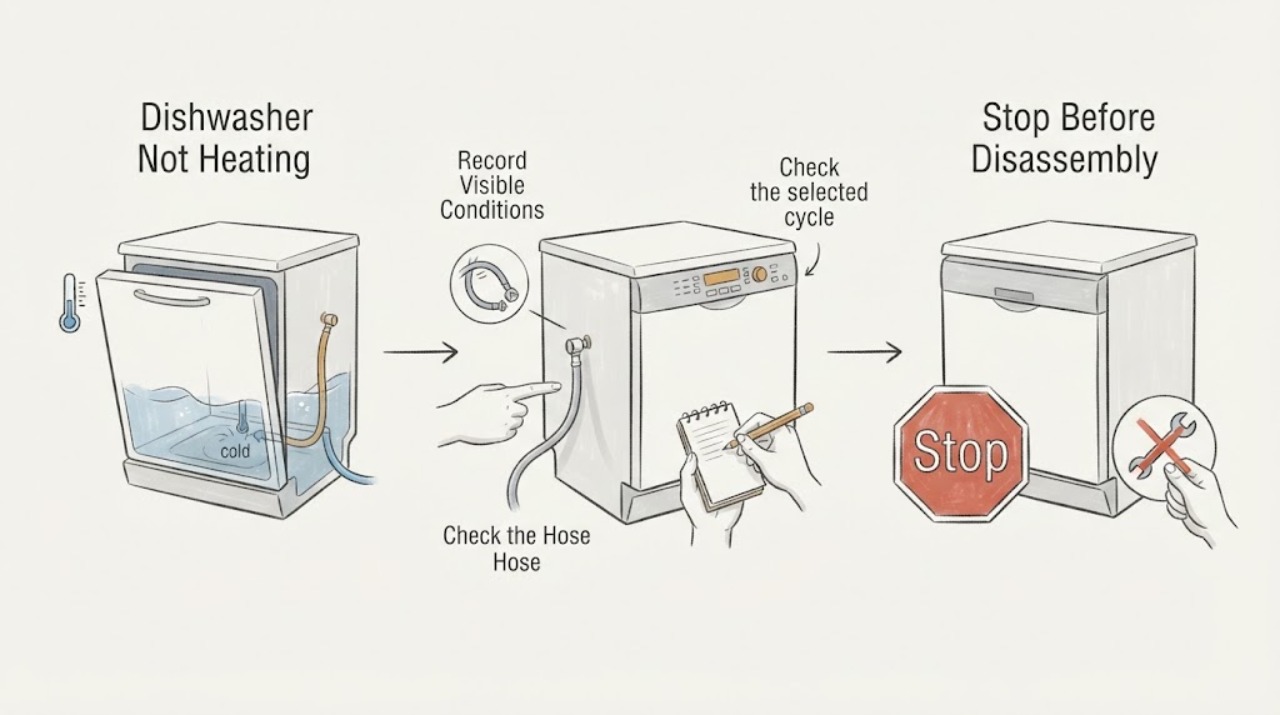
If a Viking dishwasher is not heating, first distinguish cold incoming water or a long cycle from dishes that remain cold and wet after completion. Confirm the dishwasher is connected to the intended hot-water supply, note the selected cycle, rinse aid, and any flashing fault pattern, and use the exact model manual. Do not access the heater or live wiring; recurring temperature or control faults require Viking service.
Work through in order
Diagnostic checks
Use only checks that match the exact appliance or system and its official guide.
-
Check 1
Record the selected cycle, cycle duration, final-dish temperature, drying result, and any flashing LEDs or fault code.
Expected result: The cycle is merely long, dishes finish hot but wet, dishes remain cold, or a temperature/heater fault appears.
Next step: Run no repeated diagnostic cycles. Compare the indication with the exact Viking manual and call service for a recurring temperature or heater fault.
Why this matters
Why: A long cycle can be a response to water temperature or load sensing, while cold dishes after completion or a temperature fault points to a heating-path diagnosis. A wet result alone does not prove no heat.
-
Check 2
Confirm the dishwasher has its intended water supply and that the household hot-water supply is available, without disconnecting hoses or exposing wiring.
Expected result: The supply is cold/off/restricted, the connection is newly installed, or hot water is available.
Next step: Correct only an accessible valve setting or report an installation issue to a qualified installer. Do not open the dishwasher to alter the heater circuit.
Why this matters
Why: Incorrect or insufficient incoming water temperature can change heating demand and cycle time. A proper supply with cold final dishes makes an internal heater, sensor, or control issue more likely.
-
Check 3
Check the selected cycle and rinse-aid indication against the model manual. Do not use a cycle outside the manual to force heat.
Expected result: A low-heat or special cycle is selected, rinse aid is empty, or a normal heated cycle still finishes cold.
Next step: Use the normal documented cycle once. If final dishes remain cold or a fault returns, arrange service.
Why this matters
Why: Viking manuals describe cycle-specific behavior and care; a setting or rinse-aid condition can affect drying and duration, but does not identify a failed heater.
-
Check 4
Inspect the filter and spray-arm area only as the user manual permits, keeping the dishwasher powered off before cleaning.
Expected result: The filter is blocked, spray arms cannot move, or the circulation path is clear.
Next step: Clean only the user-accessible filter/arms and reinstall them correctly. Do not remove the heater or control panel.
Why this matters
Why: Restricted washing can leave food and water on dishes and may be mistaken for no heat. A clear path with cold final water shifts attention to temperature sensing or heating.
-
Check 5
Read the exact model and serial information from the rating plate and retrieve Viking documentation.
Expected result: A matching manual identifies the LED fault pattern; the model is unknown; or a temperature/heater fault persists after safe checks.
Next step: Give Viking support the model, cycle, final temperature, code/flash pattern, and water-supply observation.
Why this matters
Why: Model identity determines cycle data and fault interpretation. Persistent heating failure needs authorized diagnosis rather than a guessed heater or sensor.
Use your observations
Decision map
Find the observation that best matches what you see, then follow the next safe action.
-
PATH 01Next step
What you see
The cycle is long but dishes finish hot or the selected cycle has extended heating behavior.
Do this next
Verify the cycle and hot-water supply from the manual, then monitor one normal load.
Why this path and its safety boundary
Why it matters: The result may reflect incoming-water temperature, soil sensing, or cycle design rather than a failed heater.
-
PATH 02Next step
What you see
The dishwasher completes but dishes and tub remain cold, while water supply and cycle are normal.
Do this next
Stop repeated cycles and arrange Viking service with the final temperature and cycle data.
Why this path and its safety boundary
Why it matters: A heating element, sensor, control, or wiring issue becomes more likely; no user-level observation identifies the part.
-
PATH 03Next step
What you see
A temperature-sensor, heater, or internal fault pattern appears and returns after the documented reset.
Do this next
Record the flash pattern/code, isolate power if safe, and contact Viking authorized service.
Why this path and its safety boundary
Why it matters: The fault is within the professional repair boundary.
-
PATH 04Next step
What you see
There is smoke, burning odor, sparking, water near electrical parts, or damaged wiring.
Do this next
Stop using the dishwasher, disconnect only if safe, and obtain qualified appliance or electrical help.
Why this path and its safety boundary
Why it matters: This is an immediate safety stop.
Helpful context
Understand the symptom
A long cycle does not automatically mean the heater failed: incoming water temperature, rinse aid, soil sensing, and cycle selection can change the run. The more useful observation is whether the cycle completes, whether dishes are still cold/wet, and whether the panel flashes a defined fault pattern.
Use the model number to select the correct Viking manual because fault patterns and reset controls vary. Keep the door closed during hot operation and do not remove panels or test heater resistance as a homeowner.
When checks do not resolve it
Need a professional?
Arrange Viking service when dishes remain cold after a normal heated cycle with proper water supply, a temperature/heater fault returns, or the model manual does not match. Provide model, cycle, duration, final temperature, drying result, and any LED pattern. Do not replace a heater, sensor, or control board based only on the symptom.
Common questions
FAQ
Does a long Viking dishwasher cycle prove the heater is broken?
No. Viking describes cycle extension based on incoming water and load conditions. Check final dish temperature and any fault pattern before concluding the heater failed.
What should I record when a Viking dishwasher does not heat?
Record the model, cycle, duration, final-dish temperature, drying result, water-supply condition, rinse-aid indication, and any flashing LEDs or code.
Can I test or replace the Viking dishwasher heater myself?
Do not access live wiring or the heater assembly. Persistent cold dishes or a heater fault should be handled by authorized service.
Read the exact guide
Official sources
- Viking Use & Care ManualViking Range, LLC · Viking dishwasher use, care, installation, wash-temperature, troubleshooting, and fault-code guidance; exact model must be confirmed.
- Support CenterViking Range, LLC · Viking authorized service and product-support routing.
- 24" Dishwasher w/Installed Professional Stainless Steel PanelViking Range, LLC · Official Viking dishwasher product documentation and model-specific manuals.
Community feedback
Share a repair observation
Share a plain-text repair observation. Accepted observations are published automatically; this page may take a moment to update.