
On this page
Start here
Quick answer
If a Viking dishwasher will not start, close the door firmly and confirm the selected program is not waiting on DELAY START. Then verify the water supply is on and the cord, outlet, fuse, or breaker are sound. Viking's manual treats these as separate start interlocks, so record what the display does after each check. If the controls remain dark, the door latch will not engage, or a fuse/breaker trips again, stop and arrange service rather than bypassing the latch or opening the electrical enclosure.
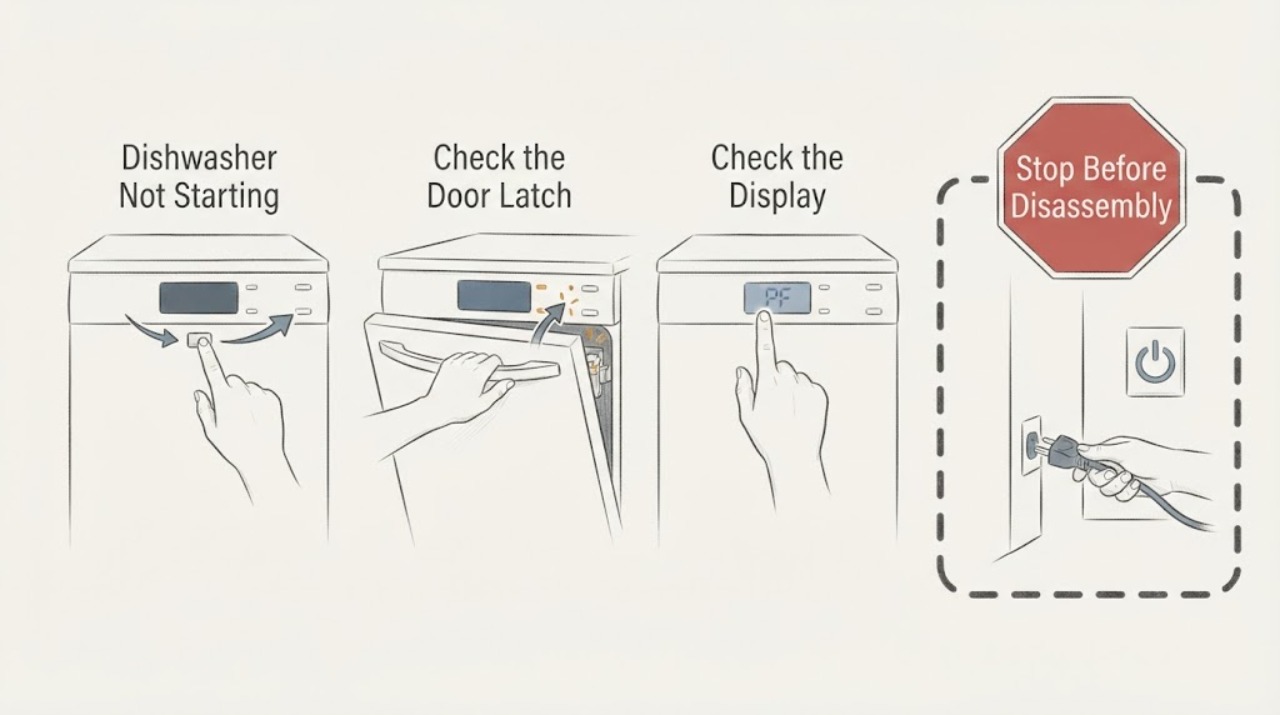
Work through in order
Diagnostic checks
Use only checks that match the exact appliance or system and its official guide.
-
Check 1
Press the door closed until the latch engages and inspect the gasket and racks for anything holding the door ajar. Select a normal program and press START once.
Expected result: The cycle begins, the panel remains lit but START is ignored, or the door will not latch.
Next step: Remove only an accessible obstruction; do not tape, bypass, or disassemble the latch.
Why this matters
Why: A successful latch points away from a door interlock obstruction. A door that will not latch can keep the control from energizing the cycle.
-
Check 2
Read the display for DELAY START, control-lock indication, flashing keys, or a fault code. Cancel the delay or unlock controls only by the exact Viking manual procedure.
Expected result: A delay/lock clears and the cycle starts, or the display still will not accept input.
Next step: Stop repeated key presses and arrange model-specific service if the control state cannot be cleared.
Why this matters
Why: A delay or lock is a control state, not a failed motor. Persistent nonresponsive controls make a control, latch, or power fault more likely.
-
Check 3
Confirm the dishwasher's water shutoff valve is open and the inlet hose is connected without a kink. Do not loosen a pressurized fitting.
Expected result: Water is off/kinked, or water is available but the dishwasher still does not start or fill.
Next step: Open the valve or correct an accessible kink, then run one supervised start; service persistent no-fill.
Why this matters
Why: Viking lists disconnected water as a start/fill condition. Correct supply can expose a valve, sensor, or control issue.
-
Check 4
With dry hands, verify the plug is fully seated in its wall socket and check the household breaker or fuse once. Do not use an extension cord or remove the grounding prong.
Expected result: The panel returns after power is restored, the panel remains dark, or the breaker trips again.
Next step: Leave the unit off after a repeated trip and contact qualified service.
Why this matters
Why: A restored panel supports a supply interruption. A repeated trip indicates an electrical fault or overload that should not be reset repeatedly.
-
Check 5
After one door, control-state, water, and power correction, run a short supervised program and note whether it latches, fills, and advances.
Expected result: It advances normally, stops at latch/fill, or remains unresponsive.
Next step: Provide the model, code, stage, and prior observations to Viking service; do not open panels.
Why this matters
Why: Normal progression supports an interlock or supply state. A repeat stop at the same stage needs component diagnosis.
Use your observations
Decision map
Find the observation that best matches what you see, then follow the next safe action.
-
PATH 01Next step
What you see
The door latches and the cycle starts after DELAY START or control lock is cleared.
Do this next
Use the matching manual to confirm the desired program and monitor the cycle.
Why this path and its safety boundary
Why it matters: A user-selected control state was more likely than a hardware failure.
-
PATH 02Next step
What you see
The panel is lit, but the door cannot latch or the cycle stops before water enters.
Do this next
Correct only an accessible obstruction or open valve; arrange service if the condition remains.
Why this path and its safety boundary
Why it matters: A latch/interlock or water-supply condition is more likely.
-
PATH 03Next step
What you see
The panel is dark and power is present at the outlet, or a breaker trips again.
Do this next
Leave it off and request electrical diagnosis; do not bypass protection.
Why this path and its safety boundary
Why it matters: The dishwasher's internal power path or control may be faulty.
-
PATH 04Next step
What you see
Smoke, burning odor, hot plug, exposed wiring, or water reaches electrical parts.
Do this next
Isolate power only from a dry safe location and obtain qualified service.
Why this path and its safety boundary
Why it matters: This is a safety stop condition.
Helpful context
Understand the symptom
“Not starting” can mean no lights, a lit panel that ignores START, a delayed countdown, or a cycle that cancels at the latch. Identify the symptom before changing settings; an illuminated panel does not prove the door interlock has closed.
Viking makes several dishwasher series. Record the model and any flashing keys or code, then use the matching manual for control lock, reset, and service instructions.
Only after diagnosis
Potential parts
- door latch/interlock
Consider only after the door fails to latch and Viking service confirms the exact model component.
A no-start symptom does not establish latch fit. - water inlet valve
Consider only when supply is present but the model-specific diagnosis confirms an inlet-valve fault.
Verify series, model, and electrical specification before ordering.
When checks do not resolve it
Need a professional?
Contact Viking service when the door will not latch, the display remains unresponsive after safe power checks, a breaker trips, the dishwasher stops before filling, or the correct start conditions do not restore operation. Provide model, display behavior, delay/lock state, and breaker history.
Common questions
FAQ
Why does a Viking dishwasher show lights but not start?
Check door latch, DELAY START/control lock, and water supply in that order. The panel can be powered while a door interlock or selected delay prevents a cycle.
Should I reset the breaker repeatedly?
No. Check it once; if it trips again, leave the dishwasher off and arrange electrical service.
Can I run it with the door latch bypassed?
No. The latch is a safety interlock. Do not tape or bypass it.
Read the exact guide
Official sources
- Support CenterViking Range · Official Viking support center; service availability varies by region.
- Viking Use & Care ManualViking Range · Official Viking 451 Series built-in dishwasher manual; exact controls and wiring vary by model.
Community feedback
Share a repair observation
Share a plain-text repair observation. Accepted observations are published automatically; this page may take a moment to update.