
On this page
Start here
Quick answer
If a Blomberg dishwasher will not start, first separate a completely dark appliance from one whose panel responds but will not begin a cycle. Check the accessible power connection and household fuse or supply without opening the appliance, then confirm the machine is switched on, a programme is selected, and the door closes and latches fully. Blomberg's dishwasher guidance also says that an open water tap, a kinked or damaged inlet hose, or a drainage problem can prevent filling or stop the programme from progressing, so check those visible conditions and the accessible filters only with the appliance unplugged. Use the exact model manual for the control sequence; the opened GSN9123 manual lists an unplugged power cable, blown fuse, interrupted water, open door, and unpressed On/Off control among causes of a machine that does not start. Stop and arrange qualified service for a damaged cord, repeated fuse trips, leak, water near electrical parts, smoke, burning smell, sparking, a door that will not latch, or a persistent no-start after the visible checks.
Before you begin
Safety first
- This article covers normal-access power observations, model-specific controls, door closure, the water tap, accessible hose routing, removable filters, and symptom recording. A qualified technician must handle live electrical testing, panels, internal wiring, latch switches, pumps, valves, sensors, controls, leaks, and dismantling.
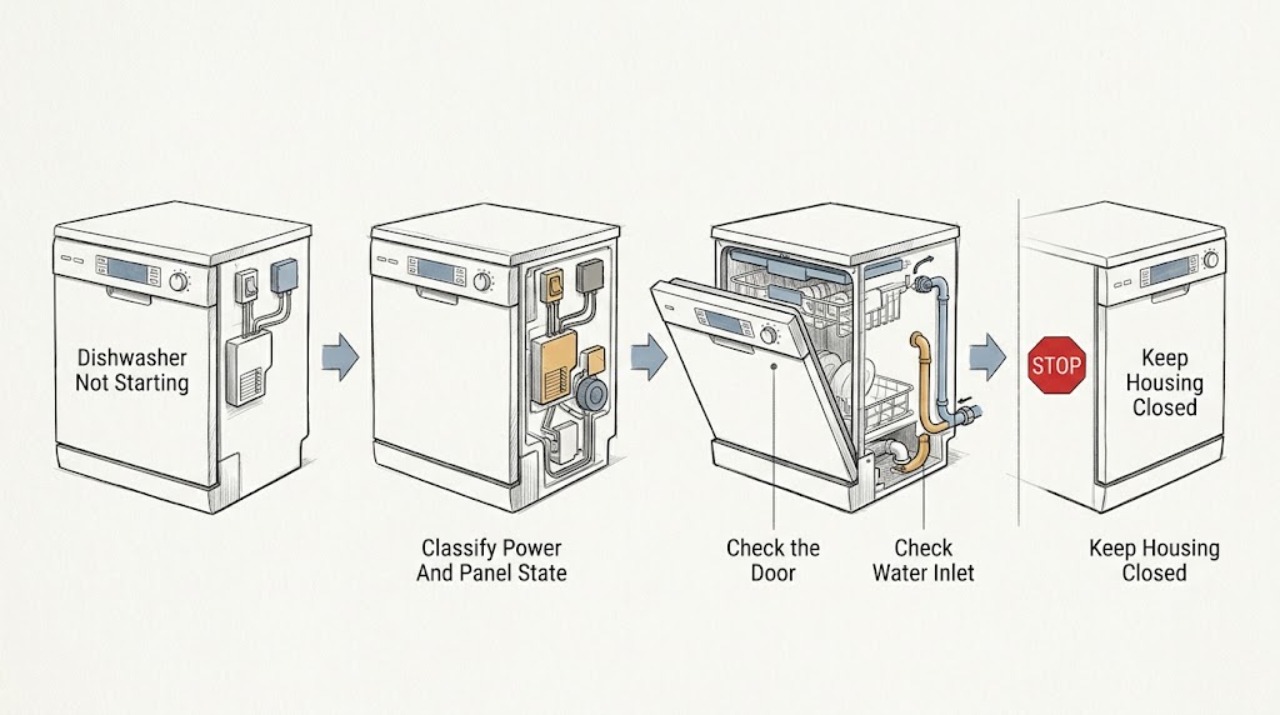
Work through in order
Diagnostic checks
Use only checks that match the exact appliance or system and its official guide.
-
Check 1
From a dry, normal-access position, check whether the dishwasher has any display or indicator response. Confirm the accessible plug or isolating switch is on, and test the outlet with a small known-working appliance only when the outlet and dishwasher cord show no damage. Do not pull out a built-in dishwasher or open an electrical cover.
Expected result: The dishwasher is completely dark, the outlet is dead, the outlet works but the dishwasher stays dark, or the panel responds normally.
Next step: Restore only an obviously switched-off isolator or disconnected plug when there are no warning signs, then make one normal control check. If the outlet is hot, wet, loose, discoloured, or repeatedly trips, leave it off and arrange qualified electrical help; if the outlet works but the dishwasher remains dark, arrange appliance service after recording the model.
Stop if: Do not energize a damaged cord or outlet, remove covers, bypass a fuse or protective device, or continue after smoke, arcing, burning smell, or unusual heat.
Why this matters
Why: A dead outlet or isolator points to the household supply. A working outlet with a dark dishwasher keeps the appliance-side power path in view. A responding panel shifts the next checks toward the programme, door, water, and drainage sequence.
-
Check 2
With the panel responding, check that no dish, basket, or utensil prevents the door from closing. Close the door firmly without slamming it, then use the exact model manual's normal On/Off, programme-selection, and Start/Stop sequence. Do not force the latch or use a button combination from another model.
Expected result: The door will not close or latch, the controls show a delay or pause, the control sequence begins a cycle, or the controls respond but no cycle starts.
Next step: Remove only an obvious loading obstruction and follow the model-specific start or cancellation instructions once. If the door remains misaligned, the latch is damaged, or a valid start command produces no cycle, stop and arrange qualified Blomberg service.
Stop if: Do not defeat or bypass the door latch, force a warped door, dismantle the control panel, or repeatedly restart an appliance that leaks or trips power.
Why this matters
Why: An open or unlatched door can intentionally prevent a start, while a delay or pause can look like a dead cycle. A correctly closed door and valid start command with no response make a latch-sensing, control, or another internal fault more likely.
-
Check 3
Switch the dishwasher off and unplug it before inspecting the accessible water connection. Confirm that the dishwasher tap is fully open and look along the visible inlet hose for a kink, crush point, blockage, or damage. Do not loosen a connection or move a fixed appliance to reach a hidden hose.
Expected result: The tap is closed or partly closed, the inlet hose is visibly restricted or damaged, household water is unavailable, or the visible inlet path looks normal.
Next step: Restore only a plainly closed tap when the hose and connection are dry and undamaged, then make one controlled start attempt. Close the tap and arrange service if the hose leaks or is damaged, or if the dishwasher still does not start after the supply is restored.
Stop if: Do not operate with a leaking or damaged hose, handle water near electrical parts, or dismantle the inlet valve, hose filter, or appliance panels.
Why this matters
Why: A closed tap, water interruption, or restricted inlet can leave a powered dishwasher waiting for water and appearing not to start. A normal visible inlet path does not rule out an inlet valve, sensor, or control fault if the cycle still will not begin.
-
Check 4
With power disconnected, look for standing water in the tub and inspect only the accessible drain hose route and removable filters described by the exact manual. Check for a visible kink, blockage, or food residue; clean and refit removable filters correctly without reaching into a pump or using tools inside the drain path.
Expected result: Water remains in the tub, a filter contains debris, the drain hose is kinked or blocked, or the accessible drain path is clear and the tub is empty.
Next step: Clear only reachable residue, refit every filter securely, correct an accessible hose position, and make one test. If water remains, the hose cannot be safely accessed, or the no-start returns, leave the appliance off and arrange qualified service.
Stop if: Do not run the dishwasher without its filters, reach into a pump, tilt the appliance, use drain chemicals, or continue when there is backflow, a leak, or water near electrical components.
Why this matters
Why: Standing water or a restricted filter or hose can prevent the dishwasher from moving through its fill and programme checks. A clear path with a repeated no-start makes a deeper pump, sensor, latch, or control issue more likely, but does not identify a replaceable part by itself.
-
Check 5
Read the model and serial information from the appliance label without removing panels, and compare the controls and any indicator pattern with that model's Blomberg manual. Record whether the panel is dark or lit, whether the door latches, whether water remains, and what happens after one documented start attempt.
Expected result: The exact manual provides a model-specific remedy that restores a normal start, or the appliance still will not start after power, door, water, and drain checks.
Next step: Use only the documented model remedy once. If the symptom persists, keep the dishwasher switched off and provide the model, serial information, indicator state, water level, and checks already completed to qualified Blomberg service.
Stop if: Do not perform live electrical tests, remove panels, bypass safety switches, or order an internal part without model-specific diagnosis and fitment confirmation.
Why this matters
Why: A model-specific control or cancellation instruction may resolve an incorrect programme state. A persistent no-start after the visible checks is evidence for further diagnosis, not proof that a particular pump, latch, valve, or board should be replaced.
Use your observations
Decision map
Find the observation that best matches what you see, then follow the next safe action.
-
PATH 01Safety boundary
What you see
The dishwasher and its indicators remain dark even though the accessible outlet or isolator appears to work.
Do this next
Leave the appliance disconnected and arrange qualified appliance service with the model and serial information.
Why this path and its safety boundary
Why it matters: The appliance-side power path, cord, protection, or control is more likely than a water or filter restriction; the exact failed component cannot be identified from an external check.
Safety stop: Stop immediately for a hot or damaged cord, burning smell, smoke, sparking, or a supply that trips repeatedly.
-
PATH 02Safety boundary
What you see
The panel lights, but the dishwasher does not begin after a button press; the door is not fully latched, a loading item obstructs it, or a delay/pause state is visible.
Do this next
Clear the visible obstruction and follow the exact model start or cancellation instructions once; escalate if the latch or controls remain abnormal.
Why this path and its safety boundary
Why it matters: A door or programme state is more likely than an absent household supply. If the door closes correctly and the documented start sequence still fails, an internal latch-sensing or control fault becomes more likely.
Safety stop: Do not defeat the latch, force the door, or repeatedly cycle a machine that leaks or loses power.
-
PATH 03Safety boundary
What you see
The panel responds and the door latches, but the dishwasher remains silent or does not progress while the tap is closed, the inlet hose is restricted, or water is left in the tub.
Do this next
With power isolated, correct only an accessible tap or hose position and clean/refit the removable filters; test once and call service if the machine still does not start or drain.
Why this path and its safety boundary
Why it matters: The water-inlet or drainage path is more likely than a simple control-setting issue. Clearing a visible tap, hose, or filter condition may restore normal operation, but a clear path with a recurring symptom needs diagnosis.
Safety stop: Close the water tap and stop for a damaged hose, active leak, backflow, or water near electrical components.
-
PATH 04Safety boundary
What you see
Power, door closure, model-specific controls, water tap, visible inlet hose, drain route, and accessible filters are normal, but the dishwasher still will not start.
Do this next
Keep the appliance off and arrange qualified Blomberg service, supplying the model, serial information, indicator state, water level, and result of the one controlled test.
Why this path and its safety boundary
Why it matters: An internal latch sensor, inlet valve, pump, electronic control, or another appliance fault is more likely than a user-accessible obstruction; the symptom does not justify selecting a particular replacement part.
Safety stop: Do not open panels, test energized components, bypass safety devices, or keep resetting a fuse or protection device.
Helpful context
Understand the symptom
Start by distinguishing no power from no cycle
A dishwasher with no lights or display has a different diagnostic path from one that powers up but will not begin washing. The opened Blomberg GSN9123 manual separates basic power, water, door, and On/Off checks under its no-start troubleshooting. Do not assume that a particular internal part has failed until the visible supply and control state are known.
Water and drainage can block a start or fill stage
A powered dishwasher still needs the door state, water inlet, and drain path to be acceptable before a programme can progress. Blomberg's support pages advise checking that the water tap is fully open, the inlet hose is not kinked or damaged, and the drain hose and accessible filters are clear. Disconnect power before cleaning or handling a hose, and use the exact manual for filter access and control details.
Keep the service boundary clear
Blomberg's manual says the appliance should be unplugged for installation, maintenance, cleaning, and repair, and that damaged power leads should be handled by authorised service. Visible checks are appropriate for the plug or supply state, door closure, tap, accessible hoses, and removable filters. Internal wiring, a latch switch, inlet valve, pump, control, or any live test requires qualified appliance service.
Safety boundary
Stop conditions
- Stop using the dishwasher for smoke, burning smell, sparking, a damaged or hot cord, repeated fuse or breaker trips, an active leak, or water near electrical components.
- Unplug the appliance before cleaning filters or handling an accessible hose, and close the water tap when a water connection may be disturbed.
- Do not bypass the door latch or another safety device, remove panels, perform live electrical testing, or force a built-in appliance out of its installation.
- Do not run the dishwasher without correctly fitted filters or continue repeated start attempts after a visible fault remains.
When checks do not resolve it
Need a professional?
Safety scope: This article covers normal-access power observations, model-specific controls, door closure, the water tap, accessible hose routing, removable filters, and symptom recording. A qualified technician must handle live electrical testing, panels, internal wiring, latch switches, pumps, valves, sensors, controls, leaks, and dismantling.
Common questions
FAQ
Why is my Blomberg dishwasher completely dark?
Check the accessible outlet or isolator and the dishwasher's normal power connection without opening the appliance. If the outlet works but the dishwasher remains dark, or if the supply is hot, damaged, or repeatedly trips, leave it disconnected and arrange qualified service.
Can an open door stop a Blomberg dishwasher from starting?
Yes. Blomberg's opened GSN9123 manual lists an open door as a no-start condition. Check that no item obstructs the door and that it latches normally; do not bypass or dismantle the latch.
Can a closed water tap make the dishwasher seem not to start?
It can prevent the dishwasher from filling or progressing. With power disconnected, confirm the tap is fully open and the visible inlet hose is not kinked or damaged. If the appliance still will not start, arrange service rather than opening the inlet system.
Should I clean the filter if my Blomberg dishwasher will not start?
If standing water is present, a blocked filter or drain path can contribute to the problem. Unplug the appliance, clean only the removable filters described by the exact model manual, refit them correctly, and test once. Persistent water or no-start needs professional diagnosis.
What information should I give Blomberg service?
Provide the full model and serial information, whether the panel is dark or lit, the programme and indicator state, whether the door latches, whether water remains, and what happened after the visible checks. Blomberg says the model and serial number are needed for manual and repair services.
Read the exact guide
Official sources
- Contact UsBlomberg · Official Blomberg support contact page; provide model and serial information when requesting repair or technical assistance.
- Product ManualsBlomberg · Official Blomberg manual-support page; the model number should be used to select the applicable dishwasher manual.
- Dishwasher User manual GSN9123Blomberg · Official Blomberg PDF for the GSN9123 family; use the exact model manual because controls and details can vary by model.
- Why is my Blomberg dishwasher not filling with water, and how can I fix it?Blomberg · Official Blomberg dishwasher FAQ; follow the exact model manual for model-specific access and controls.
- Find Your Model & Serial NumberBlomberg · Official Blomberg support page; use the appliance's own model and serial information before model-specific troubleshooting or service.
- What should I do if water is not draining from my Blomberg dishwasher?Blomberg · Official Blomberg dishwasher FAQ; follow the exact model manual for filter location and safe access.
Community feedback
Share a repair observation
Share a plain-text repair observation. Accepted observations are published automatically; this page may take a moment to update.