
On this page
Start here
Quick answer
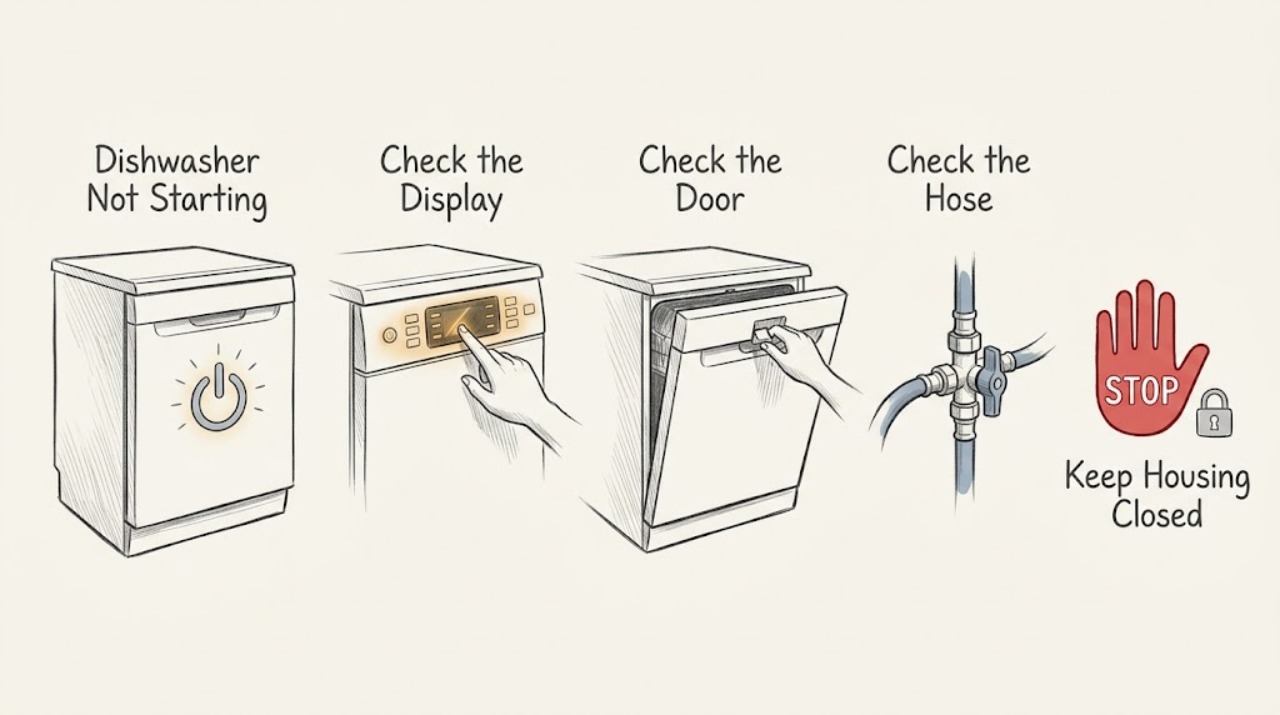
Start by separating a power problem from a start-command or safety-interlock problem. If the control panel is dark, check whether other nearby electrical devices work and whether the dishwasher's supply has tripped; do not keep resetting a breaker that trips. If the panel is lit, select a program, press Start/Pause, and close the door firmly so the latch engages. Also confirm that the water supply tap is open and that any inlet hose is not kinked. A delay setting, an interrupted cycle, or a failed door latch can leave a Beko dishwasher appearing ready but not running. If the dishwasher still will not start after these model-appropriate checks, or the latch, wiring, or electrical supply is damaged, stop and use an authorized service agent.
Before you begin
Safety first
- Do not bypass the door interlock, open electrical compartments, remove an inlet valve or control board while connected, or pull out a hard-wired dishwasher over a wet floor.
Work through in order
Diagnostic checks
Use only checks that match the exact appliance or system and its official guide.
-
Check 1
Check the power state without opening the appliance: press the power control once and compare the dishwasher display or indicator lights with another nearby electrical device.
Expected result: The panel is completely dark, the panel lights normally, or the household supply or dishwasher breaker trips again after being reset.
Next step: Restore a confirmed household supply if needed. If only the dishwasher is affected, or a breaker trips again, leave it off and contact a qualified electrician or authorized appliance service; do not repeatedly reset it.
Stop if: Stop immediately for a burning smell, heat, water at the electrical connection, damaged cord, or repeated breaker trips.
Why this matters
Why: A dark panel with other devices also off points to a household outage. A dark panel while other devices work points to the dishwasher supply, plug, isolator, or fuse. A breaker that trips again indicates an electrical fault rather than a normal no-start condition.
-
Check 2
With the panel powered, select a simple program, press Start/Pause, and close the door firmly; remove any dish, rack, or trim that prevents the door from sitting squarely.
Expected result: The start indicator changes and the latch clicks, the door springs back or remains visibly ajar, or the panel gives an open-door warning or no response.
Next step: Re-seat the racks and close the door firmly once. If the latch still will not engage, the door is cracked or misaligned, or the dishwasher only runs when the door is held, stop and arrange authorized service rather than bypassing the interlock.
Stop if: Never tape, wedge, or electrically bypass the door latch.
Why this matters
Why: A start indicator and latch click show that the command and door interlock were recognized. A gap, no click, or open-door indication makes an obstruction, door alignment, latch, or door-sensor problem more likely.
-
Check 3
Verify the water path at the user-accessible points: confirm that the household water tap feeding the dishwasher is open and that the visible inlet hose is not kinked or crushed.
Expected result: The tap supplies water normally and the hose is relaxed, or the tap is closed, the hose is bent, or the appliance shows a no-water indication after a valid start command.
Next step: Open the tap fully and straighten only a visible kink without pulling on the connection. If the tap has no supply, the hose or connection leaks, or the no-water condition remains, stop and use the model manual or authorized service; do not remove the inlet valve while connected.
Stop if: Stop if a hose connection leaks, the floor becomes wet, or access requires moving a hard-wired built-in appliance.
Why this matters
Why: A closed tap or restricted inlet can prevent the dishwasher from progressing after the start command, which can look like a no-start. A clear water path shifts attention back to the door interlock, program state, or a technical fault.
-
Check 4
Read the panel for a delayed-start, paused, or interrupted-cycle indication, then cancel or restart the program only using the button sequence in the exact Beko manual for the model.
Expected result: A delay indicator or remaining program is displayed, the dishwasher responds to a cancel or restart sequence, or the controls remain lit but ignore every command.
Next step: Clear the delay or resume the interrupted cycle according to the model manual, then press Start/Pause and close the door as directed. If controls remain unresponsive, record any displayed code and arrange authorized service.
Stop if: Do not guess at a multi-button reset or repeatedly cycle power when the appliance shows an electrical fault.
Why this matters
Why: A selected delay or an interrupted cycle can make a working dishwasher appear not to start. If the panel remains unresponsive after a model-approved restart, the issue is more likely a control, power, or other technical fault.
-
Check 5
After the power, door, water, and program-state checks, listen only from outside the closed appliance for a brief fill or drain response when a valid start is given.
Expected result: The dishwasher begins a normal fill or drain sequence, clicks or hums briefly and stops, or makes no response while the panel and door appear normal.
Next step: If it starts, let the cycle run while watching for leaks or a repeated stop. If it remains unresponsive or stops immediately, keep it off and give service the model, displayed indications, and the exact point at which it stopped.
Stop if: Stop if there is smoke, burning odor, unusual electrical noise, leaking water, or a tripping protective device.
Why this matters
Why: A normal initial response means the original no-start condition was likely a command, interlock, delay, or supply issue. A brief attempt followed by silence, or no response with all user checks correct, points to a model-specific inlet, pump, control, or wiring fault that cannot be confirmed safely from the outside.
Use your observations
Decision map
Find the observation that best matches what you see, then follow the next safe action.
-
PATH 01Next step
What you see
The display is dark but other household devices work.
Do this next
Leave the appliance off and have the supply, fuse, cord, isolator, and appliance tested by a qualified electrician or authorized service agent.
Why this path and its safety boundary
Why it matters: The fault is upstream of the start command or inside the dishwasher's electrical supply. A no-start article should not treat this as a door-latch or pump diagnosis.
-
PATH 02Next step
What you see
The panel is lit, but pressing Start/Pause and closing the door produces an open-door indication, no latch click, or a door that springs open.
Do this next
Clear the obstruction and try one firm closure. If the condition remains, stop using the dishwasher and arrange authorized service; do not bypass the latch.
Why this path and its safety boundary
Why it matters: The door interlock is the leading branch: Beko says the dishwasher will not start when it detects an open door. If the door is closed but not recognized, the latch or sensor may need service.
-
PATH 03Next step
What you see
The door confirms closed, but the dishwasher does not move into a fill or drain response.
Do this next
Correct only the visible tap or hose issue, then retry using the exact manual sequence. If the condition persists, keep the appliance off and call authorized service rather than opening the inlet or control assembly.
Why this path and its safety boundary
Why it matters: A restricted water path can prevent the program from progressing. If water access is confirmed, the remaining possibilities are model-specific control, inlet, or other technical faults.
-
PATH 04Safety boundary
What you see
Power, water, door closure, and program state all check out, but the dishwasher still gives no valid start response or stops immediately.
Do this next
Stop troubleshooting at the user-accessible level and contact an authorized service agent. Provide the model identification, indicators or codes, and whether any water entered before it stopped.
Why this path and its safety boundary
Why it matters: A control, inlet, pump, sensor, or wiring fault is now more likely than a simple operating mistake; the exact failed component cannot be identified from this symptom alone.
Safety stop: Professional diagnosis is required before further use.
Helpful context
Understand the symptom
Why a Beko dishwasher can look ready but not start
A dishwasher may have lights but still refuse to run because the start command was not registered, the door-safety interlock does not see a closed door, a delayed or interrupted program is still selected, or the appliance cannot begin its water-fill sequence. The correct diagnosis is based on what the panel does after you press Start/Pause and close the door, not on replacing a pump or control board first. Beko's general support article separates power, water supply, door closure, and technical failure as different checks.
Safety before testing
Keep hands away from the underside, wiring, and a wet floor. Do not open an electrical box, bypass the door latch, or pull out a built-in dishwasher while it is connected. If there is a burning smell, heat at the plug or isolator, visible water at an electrical connection, or a breaker that trips again, leave the appliance off and use qualified service.
Only after diagnosis
Potential parts
- door latch or door-interlock assembly
Consider this only when the door is aligned and unobstructed but the dishwasher still reports an open door or the latch never confirms closure.
Confirm the exact Beko model and fit information before ordering; do not bypass the interlock as a test. - water inlet hose or inlet-screen component
Consider this only when the household tap is open, a visible hose restriction or leak is confirmed, and the model manual identifies the component as replaceable.
Verify the exact model, connection type, and manufacturer's compatibility information; do not infer fit from appearance alone.
When checks do not resolve it
Need a professional?
Arrange service when the dishwasher does not respond after the power, door, water, and program-state checks, or when any panel, latch, wiring, inlet, or pump component would need to be opened.
Safety scope: Do not bypass the door interlock, open electrical compartments, remove an inlet valve or control board while connected, or pull out a hard-wired dishwasher over a wet floor.
Have this ready
- The exact model and serial information from the dishwasher identification label
- Whether the panel is dark, lit, flashing, or showing a code
- Whether the door closes and the latch clicks
- Whether the water tap is open and the visible inlet hose is kink-free
- What the dishwasher does immediately after Start/Pause is pressed
Common questions
FAQ
Why does my Beko dishwasher have lights but still not start?
A lit panel does not prove that the start command and door interlock were accepted. Select a program, press Start/Pause, close the door firmly, and look for the latch confirmation or start response. Then check the water tap and visible inlet hose. If the panel remains unresponsive, use the model manual and arrange authorized service.
Can a closed door still stop a Beko dishwasher from starting?
Yes. If the latch or door sensor does not recognize the closed position, the dishwasher can behave as though the door is open. Clear obstructions and try one firm closure; do not tape or bypass the latch. A persistent failure needs authorized service.
Could the water supply make the dishwasher seem like it will not start?
Yes. A closed supply tap or kinked inlet hose can prevent the program from progressing after the start command. Correct only a visible tap or hose issue, and stop if a connection leaks or the supply problem remains.
Should I replace the pump or control board because my Beko dishwasher will not start?
Not from the symptom alone. First separate power, door closure, water supply, and program state. If those checks pass, the exact fault needs model-specific diagnosis; replacing a part based only on a community suggestion can leave the original problem unresolved.
When should I stop trying to start the dishwasher?
Stop for burning odor, smoke, exposed wiring, water at an electrical connection, a damaged latch or cord, or repeated breaker trips. Keep the dishwasher off and contact a qualified electrician or authorized appliance service.
Read the exact guide
Official sources
- How to fix a dishwasher that won’t startBeko · Beko dishwasher no-start troubleshooting: power, water supply, door closure, latch, and authorized service
- Help with Beko dishwasherr/Appliances community · Community report involving a Beko DIS35023 that stopped during a cycle and then would not start normally
- Help Center ResultBeko · Beko dishwasher help-center guidance on delayed programs and model-specific user manuals
- TROUBLESHOOTINGBeko · Beko dishwasher instruction documentation covering start sequence, door closure, water inlet, and troubleshooting
Community feedback
Share a repair observation
Share a plain-text repair observation. Accepted observations are published automatically; this page may take a moment to update.