
On this page
Start here
Quick answer
If a Bosch dishwasher will not start, first determine whether the control panel is dark or powered but refusing to run. With the dishwasher safe to handle, check the outlet or breaker, make sure the door closes and latches without a rack or dish blocking it, and confirm that child lock, delay start, or a previous incomplete cycle is not active. Bosch's troubleshooting guidance also calls for a water supply check. Use the exact model manual for the correct cycle-selection and reset sequence, then try one normal start. If the panel remains unresponsive, the latch feels loose, the breaker trips, water leaks, an error returns, or the dishwasher still will not start after these visible checks, leave it unused and arrange qualified service. Do not bypass the door switch, open hardwired connections, remove the built-in unit, or test live parts.
Before you begin
Safety first
- This article covers visible door and rack clearance, safe supply checks, user-accessible filter inspection, and model-documented control or reset steps. Qualified service must handle cabinet removal, latch circuits, pumps, valves, controls, junction boxes, and energized testing.
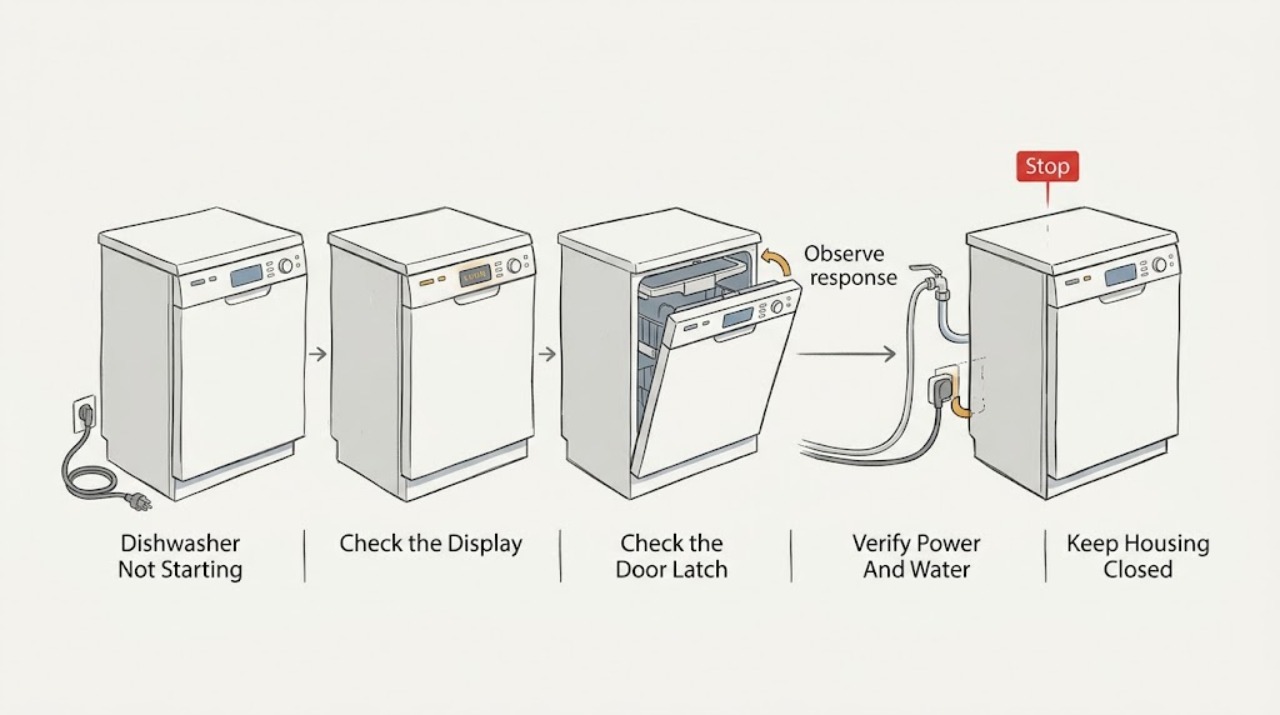
Work through in order
Diagnostic checks
Use only checks that match the exact appliance or system and its official guide.
-
Check 1
Press the power control once and note whether the display or status light responds, whether buttons accept input, and whether a lock, delay, error, or previous-cycle indication is visible. Do not repeatedly press Start or guess at a reset combination.
Expected result: The panel is dark, the panel is lit but locked or delayed, the panel shows a prior-cycle or error state, or the panel responds normally but Start does nothing.
Next step: Record the display and use the exact model manual's documented power, lock, delay, or reset procedure once. Arrange service if the panel stays dark, remains locked, or will not accept the documented command.
Stop if: Do not bypass a child lock or safety state, open the control panel, or continue if smoke, burning odor, arcing, or water near electrical parts is present.
Why this matters
Why: A dark panel makes power, door sensing, or control supply more likely. A lit panel with a lock, delay, or previous-cycle state can block a new start without a failed motor; a responsive panel with no start narrows concern toward the door latch or control path.
-
Check 2
With the dishwasher stopped and safe to handle, inspect the door seal, latch area, racks, and front of the load. Confirm that no dish, utensil, hose holder, cabinet edge, or loose hardware prevents the door from closing and latching fully; do not push on the door to simulate a switch while powered.
Expected result: The door does not latch, a rack or dish obstructs it, the latch or door feels loose, the cabinet installation is visibly misaligned, or the door closes and latches normally.
Next step: Remove only the accessible obstruction and reseat the rack, then follow the model's documented start sequence. Arrange service for a loose, damaged, misaligned, or intermittently sensing latch or door.
Stop if: Do not force or brace the door, bend the latch, remove the door front, or operate the dishwasher if the door cannot close securely.
Why this matters
Why: Bosch says an improperly closed or faulty-latch door can prevent starting. A clear load and secure latch make power, water supply, cycle state, or internal control faults more likely.
-
Check 3
Check that the dishwasher's plug or documented supply is present, the household breaker has not tripped, and the accessible water-supply valve is open with no visible kink or leak. Test a receptacle only with a small known-good device if it is safe to do so; do not touch hardwired connections or pull out a built-in dishwasher.
Expected result: The panel has no power, the breaker has tripped, the water valve is closed or the line is kinked, a leak is visible, or power and water supply look normal.
Next step: Restore only an obvious supply connection or accessible valve when safe and allowed, then use the model manual's start procedure once. Stop for a repeated breaker trip, damaged cord, leak, or hardwired fault and arrange qualified service.
Stop if: Do not reset a breaker repeatedly, energize a wet appliance, disconnect a water line, or open a junction box.
Why this matters
Why: A power or water interruption can stop a start command before the wash motor runs. A recurring breaker trip or visible leak is a safety and service issue; normal accessible supplies move the diagnosis toward the door, controls, or internal components.
-
Check 4
If the controls indicate an earlier cycle was interrupted or standing water is present, stop the appliance, switch off power, and let the water cool. Clean only the user-accessible filter and pump-cover area described by the model manual, and use its documented cancel, drain, or reset sequence; do not reach into the pump.
Expected result: A previous cycle remains active, the filter or pump-cover area has visible loose debris, water drains after the documented cancel procedure, or water remains despite a clear accessible path.
Next step: Complete only the model-documented filter and reset or drain steps once. Arrange service if the dishwasher will not clear the earlier cycle, water remains, or internal drain access is needed.
Stop if: Do not run a cycle with a leak or unsafe standing water, force a pump impeller, dismantle the drain system, or reach into energized parts.
Why this matters
Why: Bosch lists an unreset previous cycle as a reason a dishwasher may not start and links standing water with a drain problem. Persistent water after accessible cleaning points toward a drain pump, hose, float, or control fault rather than a simple start-setting issue.
-
Check 5
After the visible checks are normal, select a documented wash cycle, press Start as the exact model manual shows, and close the door fully. Observe one start attempt for a response from the panel, latch, fill, or drain without opening the cabinet or touching the underside.
Expected result: The cycle starts, the panel responds but no cycle begins, the dishwasher beeps or shows an error, the pump runs without filling, or the panel loses power.
Next step: Record the exact program, display, sound, and whether water entered, then stop repeated attempts and arrange qualified service for any continued no-start, error, fill failure, or power loss.
Stop if: Do not keep cycling power, hold the door shut, bridge a switch, or continue through smoke, burning odor, leaks, or repeated breaker trips.
Why this matters
Why: A normal start supports a control-state or door-clearance issue that has been corrected. No start with a responsive panel makes the latch, water inlet, control, or previous-cycle state more likely; an error or power loss requires model-specific diagnosis.
Use your observations
Decision map
Find the observation that best matches what you see, then follow the next safe action.
-
PATH 01Safety boundary
What you see
The door will not latch, the cycle responds when the door is repositioned, a rack or dish blocks closure, or the latch feels loose.
Do this next
Clear the accessible obstruction and use the exact model start sequence. Arrange service for a loose, damaged, or intermittent latch or door alignment.
Why this path and its safety boundary
Why it matters: A door-sensing, latch, alignment, or loading issue is more likely than a failed wash motor.
Safety stop: Do not brace or force the door, bypass the switch, or remove the door panel.
-
PATH 02Safety boundary
What you see
The panel is dark, a breaker has tripped, a lock or delay is active, or a previous cycle remains selected.
Do this next
Check the safe accessible supply and use the model-specific lock, delay, or reset instructions once. Arrange service for repeated power loss, an unresponsive panel, or a returning fault.
Why this path and its safety boundary
Why it matters: A supply interruption or control state is more likely than a water or pump fault.
Safety stop: Do not repeatedly reset the breaker, open hardwired connections, or defeat a lock or protection state.
-
PATH 03Safety boundary
What you see
The water valve is closed or restricted, the dishwasher does not fill, standing water remains, or an accessible filter or drain path is blocked.
Do this next
Correct only the accessible supply or filter condition described by the manual, then use its cancel or reset procedure once. Arrange service for a leak, persistent water, or internal drain access.
Why this path and its safety boundary
Why it matters: A water inlet, filter, drain, or overflow-protection condition is more likely than a simple Start-button fault.
Safety stop: Do not disconnect hoses, dismantle the pump, force an impeller, or keep operating with water leaking into the cabinet or floor.
-
PATH 04Safety boundary
What you see
Power, water supply, door clearance, controls, and accessible filter checks are normal, but the dishwasher still will not start, loses power, or returns an error.
Do this next
Leave the dishwasher unused and arrange qualified Bosch appliance service. Provide the exact model, display, program, door result, supply result, water level, and reset behavior.
Why this path and its safety boundary
Why it matters: A latch circuit, inlet valve, control, sensor, pump, or internal wiring fault is more likely and cannot be safely confirmed through visible checks.
Safety stop: Do not remove the built-in unit, test live components, open the control or pump, or replace a part based only on a similar symptom.
Helpful context
Understand the symptom
First separate no power from a powered no-start
A completely dark panel points toward the electrical supply, door state, or control path. A lit panel that ignores Start points more toward an active lock or delay, an unfinished previous cycle, an unlatched door, or a control or latch fault. Bosch also notes that the dishwasher may not start if the water supply is off, so a no-start symptom is not automatically an electronic failure.
Follow the exact Bosch model instructions
Bosch dishwashers differ in button labels, child-lock controls, delay-start behavior, cycle selection, and reset methods. Find the complete model or E-Nr and use its owner manual before holding buttons or cancelling a program. The opened Bosch manual specifically directs users to the operating and delay-start sections for reset steps rather than giving one sequence for every model.
Keep the checks accessible and de-energized
Inspect the door, racks, visible supply, controls, and household breaker only. If cleaning the accessible filter or looking for standing water becomes necessary, stop the dishwasher, switch off power, and let hot water cool first. Do not remove a cabinet panel, open a junction box, defeat the door switch, probe the control board, or work beneath the unit while energized.
Safety boundary
Stop conditions
- Stop using the dishwasher for smoke, burning odor, arcing, repeated breaker trips, exposed wiring, a hot or damaged cord, or water reaching electrical parts.
- Turn off the water supply for an active leak and do not pull out a built-in unit or disconnect a pressurized hose as a first check.
- Do not bypass a child lock, door switch, float, or other safety device; do not force the latch or hold the door shut during operation.
- If the dishwasher remains unable to start after the model-documented visible checks and one reset attempt, leave it unused and arrange qualified service.
When checks do not resolve it
Need a professional?
Safety scope: This article covers visible door and rack clearance, safe supply checks, user-accessible filter inspection, and model-documented control or reset steps. Qualified service must handle cabinet removal, latch circuits, pumps, valves, controls, junction boxes, and energized testing.
Common questions
FAQ
Why is my Bosch dishwasher completely dark and not starting?
Check the safe accessible power supply, outlet, breaker, and door closure. If the panel remains dark with a normal supply, leave the dishwasher unused and arrange qualified service rather than opening a hardwired connection.
Why does my Bosch dishwasher have power but not start?
Check whether child lock, delay start, an incomplete previous cycle, or an unlatched door is preventing the start command. Use the exact model manual once; a responsive panel with no start after that needs service diagnosis.
Can a door latch stop a Bosch dishwasher from starting?
Yes. Bosch states that the door must be properly latched and its support guide identifies the latch as a no-start cause. Clear only accessible loading obstructions and arrange service for a loose or intermittent latch; never bypass it.
Can a closed water valve make a Bosch dishwasher not start?
Yes. Bosch lists the water supply as a possible reason a dishwasher does not start or fill. Check only the accessible valve and visible line for an obvious closed valve, kink, or leak; persistent no-fill needs service.
Should I reset a Bosch dishwasher that will not start?
Use the exact model manual's cancel or reset procedure once after recording the symptom. If the panel remains unresponsive, the breaker trips, water remains, or the no-start returns, leave the dishwasher unused and arrange qualified service.
Read the exact guide
Official sources
- Bosch Dishwasher doesn't start and seems stuckr/bosch community · Community report from a Bosch SMU4ECS24E owner about blinking controls and a door-lock-related no-start symptom; not a manufacturer diagnosis or bypass instruction.
- Bosch Dishwasher Troubleshooting & Repair Guide | Bosch – Fix Common Dishwasher ProblemsBosch · Official Bosch US dishwasher owner-support guide; exact model manuals control button sequences and installation details.
- Troubleshooting GuideBosch · Opened Bosch dishwasher troubleshooting guide; model-specific manuals control differences and reset instructions.
Community feedback
Share a repair observation
Share a plain-text repair observation. Accepted observations are published automatically; this page may take a moment to update.