
On this page
Start here
Quick answer
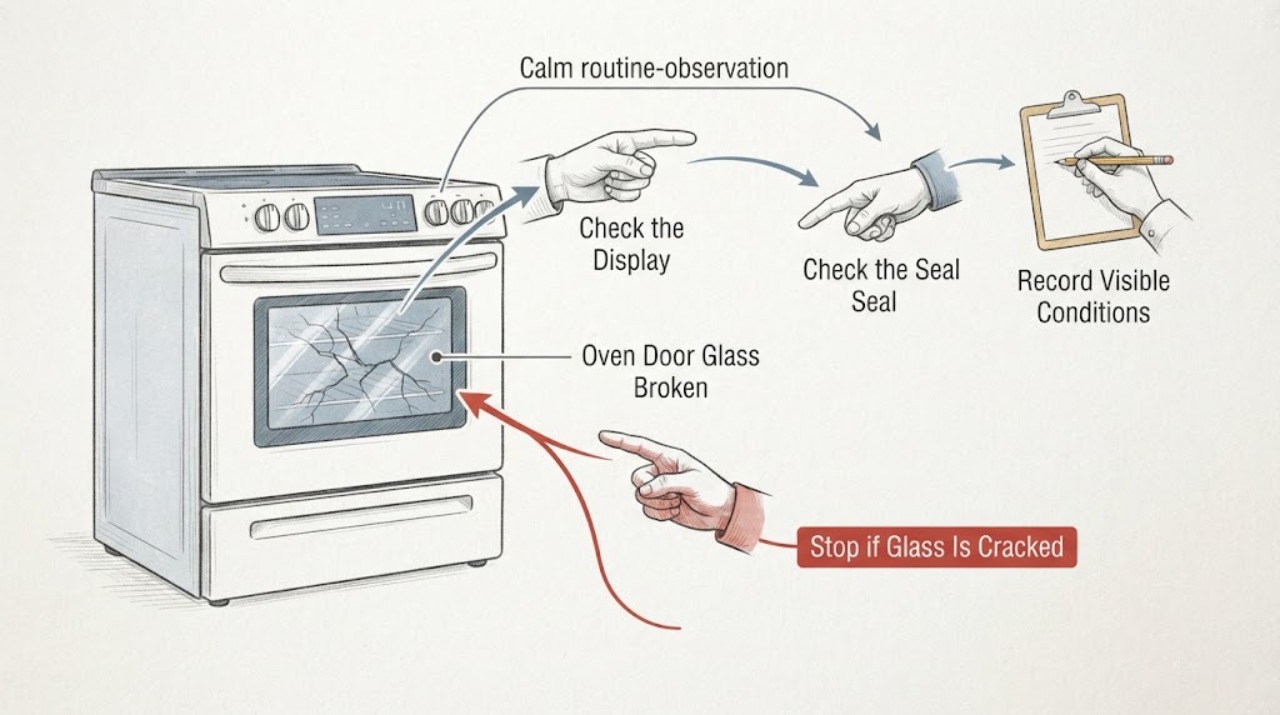
Do not operate a Viking VDSC305 with a cracked, shattered, loose or missing oven-door glass panel. Keep the range and door closed, keep people away from fragments, and do not start baking or self-cleaning to test it. Viking's VDSC305 documentation identifies this as a discontinued 30-inch open-burner dual-fuel range, warns that glass surfaces and the oven door need careful handling, and says the controls must be off and the oven cool before cleaning. Photograph the damage and the model plate, then use Viking's support and authorized-service path to identify the correct door/glass assembly. Do not tape the panel in place, remove the door or hinge, use the oven with exposed glass, or order a generic replacement by appearance alone.
Work through in order
Diagnostic checks
Use only checks that match the exact appliance or system and its official guide.
-
Check 1
Turn every oven and surface control to OFF and stop using the range. From a safe distance, note whether the door glass is cracked but retained, shattered, loose in its frame, missing, or dropping fragments. Do not touch or press the panel, open an unstable door, or move the range.
Expected result: The glass is stable and intact enough to observe, or fragments are loose/missing and the door or frame is unstable.
Next step: Keep the range out of service, keep children and pets away, and photograph the damage without handling it. If fragments are falling or the door cannot remain safely closed, restrict access to the appliance and arrange service.
Why this matters
Why: A retained crack still leaves a heat and fragment hazard; loose, missing or unstable glass means the door assembly cannot be treated as a normal cooking surface. The observation does not identify which panel or retainer needs replacement.
-
Check 2
Once the oven is completely cool, inspect only from outside for heat damage, a distorted frame, exposed sharp edges, a loose handle, a door that no longer closes squarely, or damage near the gasket. Do not wipe across fragments or run a finger along any edge.
Expected result: Only a superficial mark is visible, or there is a crack, exposed edge, frame distortion, loose hardware, or a door that does not close normally.
Next step: Do not cook or self-clean. Provide these observations and clear photos to Viking support or an authorized servicer; do not infer a glass panel, hinge or gasket part from appearance alone.
Why this matters
Why: A superficial mark may still require model-specific assessment, while a crack, exposed edge, distorted frame or abnormal closure indicates the door/glass assembly is not safe to validate by operating the oven. Viking's manual treats the door as glass and requires the oven cool before cleaning.
-
Check 3
Read the complete identification label without removing covers or moving the range, and record the model, any suffix, serial information and finish. Compare it with the official VDSC305 documentation before contacting parts or service.
Expected result: The label confirms VDSC305 with a suffix/finish, or the label is missing, unreadable or identifies another Viking model.
Next step: Send the exact label information and photos to Viking support or an authorized servicer. If the label cannot be confirmed, describe the appliance as unidentified rather than ordering a replacement panel.
Why this matters
Why: Viking's documentation groups VDSC305 as a discontinued dual-fuel range and supplies model-specific documents. A missing suffix or different model can change the door construction and part identity, so a generic glass listing cannot be assumed to fit.
-
Check 4
Check only for an independent emergency symptom, such as gas odor, flame or smoke escaping around the damaged door, or an electrical smell. Do not light burners, use switches, operate the oven, or use a phone inside the building if gas is smelled.
Expected result: There is no gas, smoke or electrical emergency symptom, or one of those symptoms is present.
Next step: If gas is smelled, leave the building and contact the gas supplier or emergency services from a safe location; do not operate switches or try to light an appliance. For smoke or electrical smell, keep the appliance off and request qualified service when safe.
Why this matters
Why: A broken glass panel already requires service; gas odor, smoke or electrical symptoms add an immediate fuel, fire or shock hazard and are not a door-glass troubleshooting branch.
Use your observations
Decision map
Find the observation that best matches what you see, then follow the next safe action.
-
PATH 01Next step
What you see
The glass is cracked, shattered, loose, missing or the door no longer closes squarely.
Do this next
Keep the range out of service and request model-confirmed Viking or authorized-service assessment. Do not tape, glue, remove or replace the glass using a generic procedure.
Why this path and its safety boundary
Why it matters: The oven door cannot be treated as a safe heat shield, and the visible symptom does not identify the correct panel, retainer, hinge or gasket part.
-
PATH 02Next step
What you see
The glass appears intact and the issue is only a smudge or residue on a cool, stable surface.
Do this next
Clean only the stable intact surface with the controls off and oven cool, using a soft method from the manual. Stop immediately if a crack, sharp edge or looseness is found.
Why this path and its safety boundary
Why it matters: The VDSC305 manual permits detergent and warm water for an intact glass surface, but that care instruction does not apply to a crack, chip, loose edge or damaged frame.
-
PATH 03Next step
What you see
The exact identification label cannot be read or the appliance is another Viking model or size.
Do this next
Do not order a panel. Send the complete label and photos to Viking support or an authorized servicer for model-specific identification.
Why this path and its safety boundary
Why it matters: VDSC305 glass or door fitment has not been established; model-family resemblance is insufficient for a parts decision.
-
PATH 04Next step
What you see
Gas odor, smoke, flame escaping around the door, or an electrical smell is present.
Do this next
For gas odor, leave immediately and contact the gas supplier or emergency services from outside without using switches, appliances or a phone inside. For smoke or electrical smell, stay away from the appliance and arrange qualified service; do not re-energize it to test.
Why this path and its safety boundary
Why it matters: This is an emergency or immediate service condition in addition to the broken glass; continued operation could cause fire, shock or gas exposure.
Helpful context
Understand the symptom
Stop using the range and identify the damaged area
A broken door window is a physical safety problem, not a cooking-setting problem. On the VDSC305, the glass may be the outer window, inner window, edge area or a fragment around the frame; the task does not establish which layer is damaged. With the oven off and cool, look from outside without pressing the door, and record whether the panel is cracked, shattered, loose, missing, or only cosmetically marked. Do not open a door that is unstable or shedding fragments.
Use only the documented cleaning boundary
The VDSC305 manual permits careful glass-surface cleaning with detergent and warm water, and says the controls must be off and the oven cool before cleaning. That guidance applies to an intact surface. It is not permission to wipe across sharp fragments, wet a damaged door, scrape the frame, use abrasive products, or start the self-clean cycle. The manual also warns against commercial oven cleaners inside the self-cleaning oven and on raised portions of the door.
Confirm the exact model before a parts request
The official Viking documentation page identifies VDSC305 as discontinued and links a VDSC305 installation guide and use-and-care manual. Record the complete identification label, including any suffix or finish marking, before requesting a replacement door or glass assembly. A similar-looking Viking range or a glass listing for VGSC, VDSC307 or another width is not evidence of fitment.
The safe owner tasks end at turning controls off, allowing the oven to cool, keeping people away from fragments, recording the model and damage, and contacting Viking or an authorized service provider. Do not remove the oven door, release hinge locks, dismantle the door, handle broken glass, disconnect gas tubing, open the rear access area, or test the oven with a cracked or missing panel. Viking's installation guide requires service work to be performed by a qualified installer, service agency or gas supplier and gives gas-odor emergency instructions; those boundaries are especially important for this dual-fuel range.
When checks do not resolve it
Need a professional?
Do not use the oven and request Viking or authorized service for any cracked, shattered, loose or missing door glass, a door that will not close normally, frame or hinge damage, or fragments in the door. Treat gas odor, smoke, flame escape or electrical smell as an immediate safety issue and do not test the appliance.
Common questions
FAQ
Can I keep using the Viking VDSC305 if only the outer door glass is cracked?
No. The task does not establish that the damage is limited to a cosmetic layer, and the door is part of the oven's heat and fragment barrier. Keep the range out of service until Viking or an authorized servicer confirms the correct assembly and repair boundary.
Can I replace the VDSC305 oven glass myself?
Do not use a generic replacement procedure. Viking's official documents identify the discontinued model and show model-specific documentation, but the user manual does not establish a universal door-glass replacement method. Provide the full identification label and request model-confirmed service instead of removing the door or manipulating its hinges.
Can I run the self-clean cycle to remove glass fragments or make the door safe?
No. The VDSC305 manual requires the oven to be cool before cleaning and warns about extreme self-clean temperatures; it also says not to use commercial oven cleaners inside or on raised door portions. A damaged door must remain out of service until inspected.
What information should I give Viking service?
Give the complete model and suffix, serial information, finish, photos of the damage, whether the door closes squarely, whether glass is loose or missing, and any gas, smoke or electrical symptom. Do not remove fragments or covers to obtain the information.
Read the exact guide
Official sources
- Viking Customer Support / Authorized ServiceViking Range, LLC · Official Viking support page used to direct a damaged VDSC305 to model-specific support and authorized service; no phone number or commercial destination is reproduced in the article.
- Viking Range, LLC | Support and Docs | DocumentationViking Range, LLC · Opened Viking's official documentation page; lines 914-921 identify the discontinued VDSC305 as a 30-inch open-burner dual-fuel range and link its installation and use-and-care manuals.
- Viking Use and Care Manual: F20143F ENViking Range Corporation · Exact use-and-care manual linked by Viking's VDSC305 documentation page; used for intact glass cleaning and the no-operation/cleaning boundaries, not for a generic replacement procedure.
- Viking Installation Guide: Dual Fuel RangesViking Range Corporation · Exact manual linked by Viking's VDSC305 documentation page; used for gas-odor emergency instructions, qualified service requirements and the VDSC305 dual-fuel range context, not for user glass replacement.
Community feedback
Share a repair observation
Share a plain-text repair observation. Accepted observations are published automatically; this page may take a moment to update.