
On this page
Start here
Quick answer
Stop using the KitchenAid oven until you know which glass is damaged and the exact model's instructions have been checked. Keep the oven off and completely cool, keep people away from loose fragments, and do not run a bake, broil or self-clean cycle with damaged door glass. Do not tape, glue, drill or disassemble the door to make a temporary repair. KitchenAid says door removal varies by hinge design, the door is heavy, and cleaning between door panes may require disassembly that is not advised; identify the model and arrange qualified service for the correct glass and installation. If the damaged glass is a light cover or another separate part, use only the exact manual's replacement procedure and keep power disconnected while the appliance is being serviced.
Before you begin
Safety first
- Keep the oven off and cool. Do not handle shards unnecessarily, run bake/broil/self-clean, press or bend damaged glass, remove hinge hardware, disassemble the door, glue or tape a pane, or open electrical panels. Use qualified service for model-specific glass identification and installation.
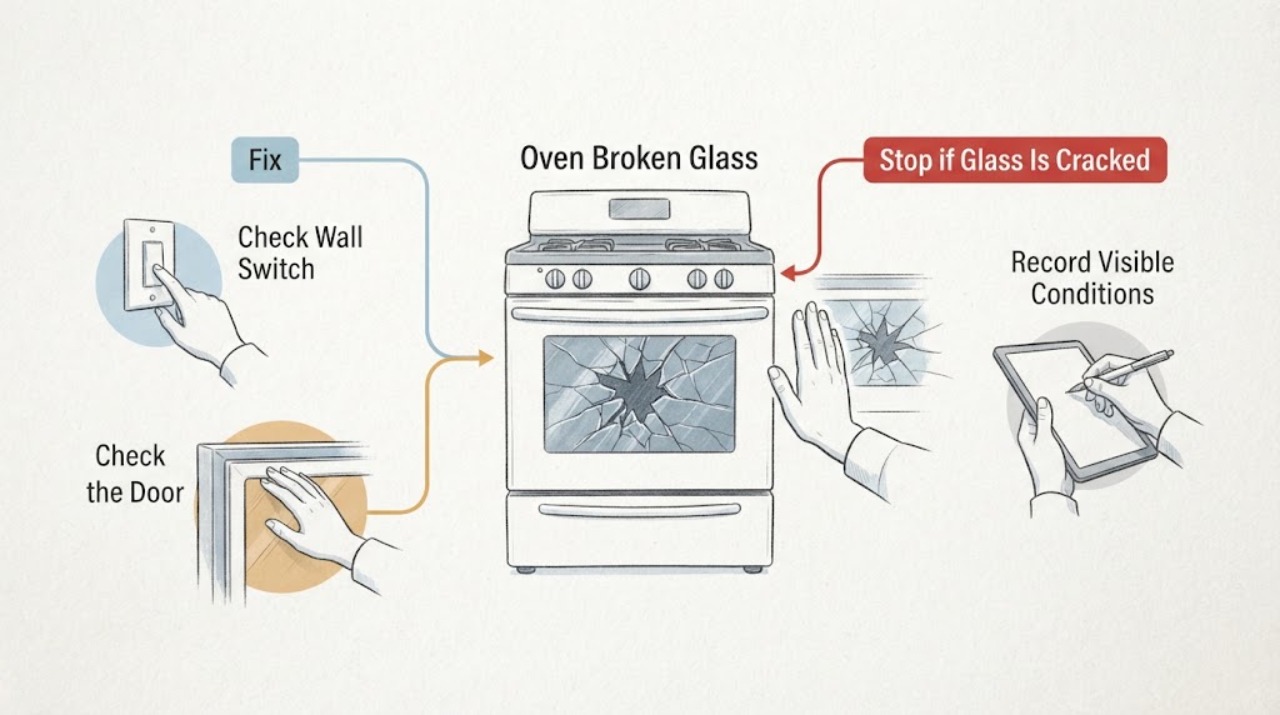
Work through in order
Diagnostic checks
Use only checks that match the exact appliance or system and its official guide.
-
Check 1
Switch the oven off from its normal control, keep it closed if fragments are inside, and wait until the oven and door are completely cool before approaching the damaged area.
Expected result: The oven is still hot, a self-clean cycle is active, glass is loose, or the appliance is already cool and inactive.
Next step: If it is hot or a cleaning cycle is active, stay clear, do not force the door or cancel by prying, and wait for the model's cool-down behavior. If fragments are falling or the door cannot stay safely closed, keep people away and arrange service from a safe position.
Stop if: Once cool and inactive, continue only with a visual inspection from outside. Do not power the oven for a test.
Why this matters
Why: KitchenAid says glass should not be wiped before the oven has completely cooled and that door work begins with the oven off and cool; heat can make handling and further inspection unsafe.
-
Check 2
Without touching shards or pressing on the door, identify which glass surface is damaged: outer door pane, inner door pane, space between intact panes, light-cover glass, or another surface.
Expected result: There is a visible crack, missing glass, loose fragment, a door that will not close evenly, or only temporary-looking moisture/fogging with no crack visible.
Next step: For cracked, missing or loose glass, keep the oven out of service and give the location and photographs to qualified service. For intact glass with only moisture, wait for the cool-down and follow the exact model's cleaning guidance; do not disassemble between panes.
Stop if: If the location cannot be identified safely, do not handle the door or run the oven; provide the model and a description to service.
Why this matters
Why: A crack, missing piece or loose fragment is physical damage and cannot be treated as ordinary cleaning. KitchenAid separately documents temporary moisture on or between door glass, but moisture does not explain a real fracture.
-
Check 3
Record the full KitchenAid model and serial information and consult that model's owner manual or service channel for the damaged glass location before ordering a part.
Expected result: The exact model documentation identifies the door construction or glass component; only a family name is available; or no model information can be found.
Next step: If the manual gives a model-specific part or service procedure, use it only after the oven is off and cool. If only a family name or no model is available, have service identify the correct glass and installation instead of guessing.
Stop if: Do not order a pane or hardware from another model, and do not remove the door based on a generic video or photograph.
Why this matters
Why: KitchenAid documents different hinge-latch designs and model-dependent door procedures. A family name or visual similarity is insufficient to establish glass compatibility or a safe removal sequence.
-
Check 4
Check the door alignment and latch only visually, without lifting the door, pressing on damaged glass, or attempting hinge removal.
Expected result: The door is hanging unevenly, cannot close, has exposed fragments, or appears closed and intact apart from a confirmed damaged pane.
Next step: If the door is uneven, cannot close, or exposes fragments, keep the oven out of service and arrange qualified repair. If the door is intact but a pane is cracked, still do not run the oven or press the pane to test it.
Stop if: A normal-looking alignment does not make broken glass safe to heat. Continue with the service and model-identification branch.
Why this matters
Why: KitchenAid says a correctly installed door should close with an even gap and that the door is heavy; a misaligned or damaged door needs model-specific handling rather than force.
-
Check 5
Keep bake, broil and self-clean disabled until the glass issue is resolved; if the damage is near a light cover or wiring, isolate power from a safe accessible point before any service visit or manual-approved work.
Expected result: The glass is broken near the heated cavity or door, a light-cover piece is missing, the oven was recently self-cleaned, or no hazard beyond the glass is visible.
Next step: Keep the appliance out of service and arrange qualified service. Do not glue, tape, drill, bend the frame, remove door layers, or run a cleaning cycle. Report any smoke, burning odor, electrical damage or gas odor as a safety escalation.
Stop if: Even if the damage looks cosmetic, wait for the exact model's manual or service assessment before using the oven.
Why this matters
Why: KitchenAid describes self-cleaning as a very high-temperature cycle and warns that model behavior varies; the public guidance does not support using heat to test or cure damaged glass.
Use your observations
Decision map
Find the observation that best matches what you see, then follow the next safe action.
-
PATH 01Next step
What you see
The door glass has a crack, missing section, loose shard, or the door cannot close evenly.
Do this next
Leave the oven unused and arrange qualified KitchenAid service. Do not tape, glue, press or heat the door to test it.
Why this path and its safety boundary
Why it matters: This is physical damage, not a cleaning issue, and the supplied topic has no model-specific part or repair procedure.
-
PATH 02Next step
What you see
The glass is intact and only temporary moisture or fogging appears on or between the panes after cooking.
Do this next
Allow the oven to cool and follow the exact model's cleaning guidance. If a crack, loose pane or missing piece becomes visible, stop use and switch to the service branch.
Why this path and its safety boundary
Why it matters: KitchenAid documents moisture on or between door glass as a possible temporary effect, especially with gas ovens or high-moisture foods; that does not establish broken glass.
-
PATH 03Next step
What you see
The damaged glass is between door panes or the proposed fix requires taking the door apart.
Do this next
Do not disassemble the door. Give the exact model and the pane location to a professional and request the model-approved repair.
Why this path and its safety boundary
Why it matters: KitchenAid says cleaning between panes may require removal or disassembly and that this is not advised; door construction also varies by model.
-
PATH 04Next step
What you see
The damage is accompanied by smoke, burning odor, exposed wiring, an electrical event, or a hot/active self-clean cycle.
Do this next
Stop use, isolate power only from a safe accessible point if needed, keep clear of fragments and heat, and contact qualified appliance service or emergency help as appropriate. Do not reset and retry the oven.
Why this path and its safety boundary
Why it matters: The situation has a heat or electrical safety concern beyond a cosmetic pane, and normal troubleshooting is not appropriate.
Helpful context
Understand the symptom
Treat broken glass as a stop-use condition
Do not turn the oven on to see whether it still works. If glass is loose, cracked through, shattered, or missing, keep the appliance off and allow it to cool completely. Keep children and pets away from the area and do not sweep fragments toward the oven door or vent. The safe repair path depends on whether the damaged piece is a door pane, a light cover, or another glass component, so do not assume one replacement or door procedure applies to every KitchenAid model.
Identify the glass location without handling fragments
From a safe position, note whether the damage is on the outer door, inner door pane, glass between panes, a separate oven-light cover, or another surface. A cloudy or wet appearance between intact panes is not the same as a crack: KitchenAid describes some moisture between door glass as temporary during cooking. Do not treat a real crack, missing piece or loose shard as condensation, and do not touch it to confirm.
Use the exact model before ordering or removing anything
Record the model and serial information from the appliance or documentation before requesting glass or service. KitchenAid's door guidance covers both doors with hinge latches and doors without them, and says the removal method differs. A model-specific manual is therefore needed to identify the door construction and any approved replacement procedure. Do not select a glass pane by width, appearance or a part number from another KitchenAid oven.
When checks do not resolve it
Need a professional?
Arrange qualified KitchenAid service for any cracked, shattered, loose or missing oven glass, a door that will not close evenly, damage between panes, or a glass part whose exact model cannot be identified. Escalate immediately for smoke, burning odor, exposed wiring, electrical damage or an active high-temperature cycle. Do not use the oven, run self-clean, glue or tape the pane, force the door, disassemble the door, or live-test the appliance.
Safety scope: Keep the oven off and cool. Do not handle shards unnecessarily, run bake/broil/self-clean, press or bend damaged glass, remove hinge hardware, disassemble the door, glue or tape a pane, or open electrical panels. Use qualified service for model-specific glass identification and installation.
Common questions
FAQ
Can I still use a KitchenAid oven with a cracked door glass pane?
Do not use it until the exact model and damage are assessed. Keep the oven off and cool, keep people away from loose fragments, and arrange qualified service rather than testing the pane with heat.
Is moisture between KitchenAid oven door panes the same as broken glass?
No. KitchenAid describes temporary moisture on or between door glass as possible during cooking, especially with high-moisture foods or gas heat. A visible crack, missing piece or loose pane is physical damage and needs the oven kept out of service.
Can I replace KitchenAid oven door glass without removing the door?
Do not assume that. KitchenAid documents more than one hinge design and says between-pane cleaning may require door removal or disassembly that is not advised. Use the exact model manual or qualified service instead of a generic removal sequence.
Should I run self-clean after the oven door glass breaks?
No. Keep the oven out of service until the glass is assessed. KitchenAid describes self-cleaning as a very high-temperature cycle and says cycle behavior varies by model; it is not a safe diagnostic or temporary repair for damaged glass.
How do I order the right KitchenAid replacement glass?
Start with the complete model and serial information and identify which glass surface is damaged. Do not match a pane by appearance or width alone; KitchenAid's door construction and procedures vary by model, so service or the exact manual should confirm the correct part and installation path.
Read the exact guide
Official sources
- How to Clean a Self-Cleaning Oven in 4 StepsKitchenAid · KitchenAid self-cleaning ovens and ranges; used to establish that self-clean is a high-temperature cycle and not a diagnostic for damaged glass.
- Moisture On Door - RangeKitchenAid · KitchenAid ranges with door-glass moisture; used only to distinguish temporary moisture from a reported crack or missing glass.
- Double Oven Gas Range Use & Care GuideKitchenAid · Opened KitchenAid owner manual for model KGRS505X; used as an example of the manufacturer's glass and door safety boundaries, not as a universal part or control specification for an unidentified oven.
- Removing and Replacing the Oven DoorKitchenAid · KitchenAid range and wall-oven door guidance; exact model is not supplied, so it is used to show that hinge design and removal method vary.
- How to Clean Oven Door GlassKitchenAid · KitchenAid oven door glass guidance; cleaning instructions are used only for intact, cool glass and the professional boundary for between-pane work.
Community feedback
Share a repair observation
Share a plain-text repair observation. Accepted observations are published automatically; this page may take a moment to update.