
On this page
Start here
Quick answer
Do not treat every Viking oven odor as normal. First stop the oven and identify whether the smell is a short-lived new-appliance or first-use burn-off, food or grease residue, cleaner residue, a fuel-gas odor, or an electrical/plastic burning odor. Viking manuals say first-use odors and some self-clean curing odors can occur, but they also warn against commercial oven cleaners and require qualified service for problems outside the manual. If you smell gas, see smoke or flame, hear abnormal ignition, smell scorched wiring or plastic, or cannot turn the oven off, stop using it and leave the hazardous area as appropriate; do not relight, operate switches, or repeat a test. For a low-risk residue odor, wait until the oven is fully cool, remove loose food and packaging, clean only as the exact Viking manual permits, ventilate, and arrange appliance service if the odor persists.
Before you begin
Safety first
- Keep the oven off for gas, smoke, fire, electrical, abnormal flame, uncontrolled heat, or repeated-breaker symptoms. Do not relight, use switches during a suspected gas leak, open panels, perform live measurements, or run another cleaning cycle until the hazard is cleared.
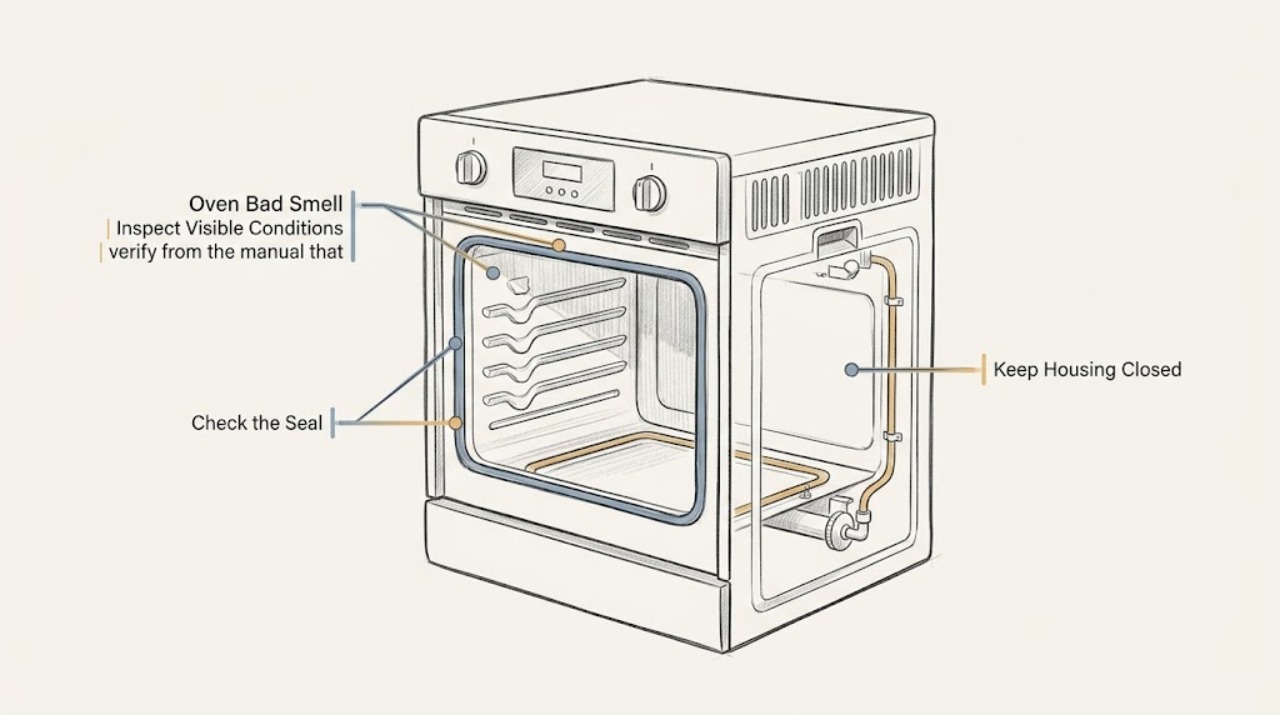
Work through in order
Diagnostic checks
Use only checks that match the exact appliance or system and its official guide.
-
Check 1
Turn the oven controls off and observe from a safe position. Record the exact odor description, whether it is present with the oven off, the selected mode, the fuel type shown on the rating information, any smoke or flame, and whether the control responds. Do not open panels, reach toward a hot element, or keep operating the oven to identify the smell.
Expected result: There is a fuel-gas odor, visible flame outside the normal burner pattern, smoke that is increasing, arcing, a hot or melting control, a sharp electrical smell, or the oven will not turn off.
Next step: Stop immediately. If gas is suspected, do not light anything or touch switches; leave and contact emergency or gas service from outside. For fire or smoke, keep the oven door closed, evacuate if it does not go out, and call emergency services. For electrical or control failure, leave the oven off and arrange qualified service.
Stop if: Do not relight, reset, open the control panel, or repeat a heat test after a hazardous odor, smoke, flame, arcing, or uncontrolled heating.
Why this matters
Why: This is a gas, fire, electrical, or runaway-heat hazard rather than ordinary food residue or first-use burn-off.
-
Check 2
If the odor is present only during the first few uses of a new Viking oven or after an exact-model-approved curing or self-clean process, verify from the manual that all packaging and shipping materials have been removed and that ventilation is available. Do not cook food during a manual-directed burn-off if the instructions prohibit it.
Expected result: The odor is mild, appears only while new materials or a self-clean cycle heat, there is no gas smell or electrical odor, and it decreases after the oven cools; or it is strong, worsening, or unchanged after the approved first-use process.
Next step: For a documented low-risk first-use odor, ventilate and allow the cavity to cool. If the odor persists, produces unusual smoke, affects people or pets, or the manual does not describe the process for this model, stop use and arrange Viking or qualified appliance service.
Why this matters
Why: A short-lived first-use or insulation-curing odor can be a documented condition for some Viking models, while a persistent or worsening odor needs inspection. The exact temperature, duration, and cleaning process are model-specific.
-
Check 3
When the oven is fully cool and no hazard sign is present, inspect the cavity, racks, broiler area, door edge, and vent area for spilled grease, burned food, plastic, foil, or remaining packaging. Do not scrape heating elements, move a gasket, block the vent, or use a cleaner that the exact Viking manual does not approve.
Expected result: A visible spill or foreign material is at the odor location, the smell began after a spill or cleaner use, the vent is obstructed, or the cavity looks clean but the odor returns when heat is applied.
Next step: Remove only loose residue from a cool cavity using the exact manual's method, keep the vent unobstructed, and perform at most one supervised normal-use check only if the odor was clearly low-risk. Stop and service the oven if the odor returns or any smoke, scorched smell, or abnormal heat appears.
Stop if: Do not use commercial oven cleaner in a self-clean oven, spray a hot surface, damage the door gasket, or use water near energized controls.
Why this matters
Why: Residue or an obstructed vent may explain a food or chemical odor, but a clean cavity with a returning heat-related odor raises the possibility of a heating, wiring, insulation, ignition, or control fault.
-
Check 4
If the odor resembles gas, note whether it occurs while the oven is off, during ignition, or after a failed ignition, but do not attempt another ignition or inspect the burner with tools. Keep the oven and any gas appliance off and follow the Viking gas-emergency instructions.
Expected result: The smell is present while off, persists after an ignition attempt, is accompanied by hissing, delayed ignition, an abnormal flame, or is not clearly distinguishable from a food or cleaner odor.
Next step: Do not touch switches, use a phone inside, light the oven, or search for the leak. Leave the building and contact the local gas supplier, fire service, or emergency service from a safe location; arrange qualified appliance service after the area is declared safe.
Why this matters
Why: An actual gas leak or unburned gas cannot be ruled out from smell alone, and a delayed or abnormal ignition can create a fire or explosion hazard.
-
Check 5
If the odor is sharp, electrical, plastic-like, or accompanied by a breaker trip, inspect only the accessible plug, cord, outlet, and surrounding cabinet from a dry safe position. Do not pull out a hard-wired oven, remove covers, reset a repeatedly tripping breaker, or touch a hot or damaged connection.
Expected result: The outlet or cord is hot or discolored, a breaker trips again, the smell comes from the control or wiring area, moisture is present, or accessible power appears normal but the odor returns with heat.
Next step: Leave the oven off. If power can be isolated from a dry safe location without approaching a hazard, do so; otherwise keep clear. Arrange qualified appliance or electrical service and do not perform a live test.
Stop if: Stop for smoke, arcing, a hot outlet, damaged insulation, moisture near controls, or repeated breaker trips.
Why this matters
Why: The condition may involve an electrical connection, heating circuit, insulation, or control fault that cannot be confirmed by an external check and can cause shock or fire.
-
Check 6
Prepare the service handoff with the exact Viking model, fuel type, mode, start time, odor description, whether the oven was new or recently cleaned, visible residue, smoke or flame behavior, control response, breaker history, and what the manual says about the model's cleaning or first-use process. Do not claim a component failed unless a qualified technician confirms it.
Expected result: The odor persists after the documented low-risk cleaning or first-use procedure, returns on more than one mode, appears with the oven off, or cannot be safely reproduced.
Next step: Keep the oven out of service and request Viking-authorized or qualified appliance service. Report gas, smoke, electrical, or control symptoms explicitly so the technician can plan a safe inspection.
Why this matters
Why: A persistent or cross-mode odor needs model-specific diagnosis of the cavity, vent, ignition or heating system, wiring, insulation, and controls rather than another cleaning cycle.
Use your observations
Decision map
Find the observation that best matches what you see, then follow the next safe action.
-
PATH 01Next step
What you see
The odor occurs only during the first few uses, is mild, and decreases after cooling with no gas, smoke, or electrical symptoms.
Do this next
Follow only the exact model's first-use and ventilation instructions. Stop and arrange service if the odor persists, worsens, or produces unusual smoke.
Why this path and its safety boundary
Why it matters: First-use burn-off or insulation curing is possible on models whose Viking manual documents it.
-
PATH 02Next step
What you see
The odor follows a spill, burned food, packaging, foil, or cleaner use and is localized to a cool, visibly contaminated cavity.
Do this next
Clean only the cool surfaces and parts permitted by the Viking manual, keep the vent clear, and stop if smoke, scorching, or an electrical smell returns.
Why this path and its safety boundary
Why it matters: Food, grease, packaging, or cleaner residue is more likely than an internal failure, but the cleaning method is model-dependent.
-
PATH 03Next step
What you see
The smell resembles gas, occurs while the oven is off, follows failed ignition, or is accompanied by hissing or abnormal flame.
Do this next
Do not operate switches or flames. Leave and contact gas or emergency service from a safe location, then obtain qualified appliance service before reuse.
Why this path and its safety boundary
Why it matters: Treat it as a possible gas emergency; do not try to distinguish it by relighting or searching for a leak.
-
PATH 04Next step
What you see
The smell is electrical, scorched, plastic-like, or accompanied by smoke, arcing, a hot outlet, or a breaker trip.
Do this next
Stop using the oven, leave if smoke or fire continues, and arrange qualified appliance or electrical inspection. Do not re-energize until it is cleared.
Why this path and its safety boundary
Why it matters: A fire or shock hazard is possible and ordinary cleaning or repeated testing is unsafe.
-
PATH 05Next step
What you see
The cavity is clean, the odor returns with heat, the odor occurs in multiple modes, or the exact model manual does not support a first-use explanation.
Do this next
Keep the oven off and request model-specific Viking or qualified appliance service. Provide the mode, timing, odor type, and safety observations.
Why this path and its safety boundary
Why it matters: A heating, ignition, vent, insulation, wiring, or control fault remains possible and cannot be identified safely from smell alone.
Helpful context
Understand the symptom
Classify the odor before cleaning
A new Viking oven, a self-clean cycle, a spill, a cleaner residue, a gas ignition fault, and an electrical fault can all be described as a “bad smell,” but the safe response is different. Record when it starts, which mode is selected, whether the oven is electric, gas, or dual fuel, whether there is smoke or visible residue, and whether the smell remains after the controls are off. Use the exact model manual for controls and cleaning surfaces; a different Viking model may have different instructions.
Gas and burning-electrical odors are stop conditions
A gas odor is not a cleaning problem. Do not try to light the oven, operate an electrical switch, or use a phone inside the building. Leave by a safe route and contact local emergency or gas service from outside. For smoke, flame, arcing, a hot control, or a sharp electrical or melting-plastic odor, stop the oven if it is safe to do so, keep the door closed for an oven fire, leave if the hazard continues, and do not reuse it until qualified service checks it.
Ventilate only for a confirmed low-risk odor
If there is no gas smell, smoke, flame, electrical odor, or abnormal heating, a brief residue or first-use odor may be handled after the oven is cool. Remove visible food or packaging only from a cool cavity, use only the cleaner and surfaces permitted by the Viking manual, and keep the vent clear. Do not mask an unresolved odor with fragrance, run repeated empty cycles, or start self-clean on an oven with heavy residue without following its model instructions.
Safety boundary
Stop conditions
- Stop immediately for gas odor, hissing, delayed ignition, abnormal flame, smoke, flame outside the normal burner area, arcing, or an oven that continues heating after controls are off. Do not relight or repeat the test.
- For suspected gas, do not operate electrical switches, use a phone inside, or search for a leak. Leave by a safe route and contact local emergency or gas service from outside.
- For an oven fire, turn off heat only if safe and keep the door closed; evacuate if the fire does not go out and have the oven inspected before reuse. Never pour water on a grease fire.
- Do not touch hot elements, spray cleaner on a hot surface, use commercial oven cleaner in a self-clean oven, damage the door gasket, open live wiring, or reset a repeatedly tripping breaker.
Only after diagnosis
Potential parts
- oven door gasket
Consider this only if qualified inspection finds a damaged gasket that is allowing unusual heat or smoke behavior; an odor alone does not establish gasket failure.
Viking gaskets are model-specific and must be confirmed against the exact oven and manual before replacement. - heating element or ignition component
Consider this only after qualified diagnosis links the odor to a damaged electric heating component or a gas ignition fault.
Electric elements and gas ignition parts differ by oven type and model. Do not select or install one from appearance or odor alone. - oven control or wiring component
Consider this only when qualified service identifies a scorched, failed, or heat-damaged control or wiring component after the oven is isolated.
Electrical components require exact model verification and qualified installation; never open the control area as a user odor check.
When checks do not resolve it
Need a professional?
Request service for a persistent or recurring Viking oven odor, any odor from the control or wiring area, a returning smell after a spill is removed, a smell with a breaker trip or abnormal heating, or any uncertainty about whether the odor is gas.
Safety scope: Keep the oven off for gas, smoke, fire, electrical, abnormal flame, uncontrolled heat, or repeated-breaker symptoms. Do not relight, use switches during a suspected gas leak, open panels, perform live measurements, or run another cleaning cycle until the hazard is cleared.
Common questions
FAQ
Is a bad smell from a new Viking oven normal?
A mild first-use burn-off odor can be documented for some Viking models, but it should follow the exact manual's first-use instructions and decrease. Gas, smoke, electrical, melting-plastic, or worsening odors are not normal burn-off; stop using the oven and arrange the appropriate emergency or qualified service response.
Can I use oven cleaner to remove a Viking oven smell?
Do not use a commercial oven cleaner in or around a Viking self-clean oven unless the exact manual explicitly permits it. Wait until the oven is cool and follow the model's approved cleaning method; stop if the odor or smoke returns.
What should I do if my Viking oven smells like gas?
Do not light the oven, touch electrical switches, or search for the leak. Leave the building and contact local gas or emergency service from a safe location. Do not use the oven again until qualified service confirms it is safe.
What if the oven smells electrical or starts smoking?
Stop using it and do not repeat a heating test. For an oven fire, keep the door closed after turning off heat if safe and evacuate if it continues; arrange qualified inspection before reuse. A hot outlet, arcing, scorched wiring smell, or repeated breaker trip requires qualified appliance or electrical service.
Read the exact guide
Official sources
- Educational Messages Desk ReferenceNational Fire Protection Association · General home-fire-safety guidance; follow local emergency instructions and the exact appliance manual.
- Viking Use & Care Manual: Designer Freestanding 30” Dual Fuel Self-Clean Sealed Burner RangeViking Range Corporation · Specific Viking F20648 manual for a Designer Freestanding 30-inch dual-fuel range; use the exact manual for a different model or fuel configuration.
Community feedback
Share a repair observation
Share a plain-text repair observation. Accepted observations are published automatically; this page may take a moment to update.