
On this page
Start here
Quick answer
If a Frigidaire oven has a bad smell, first classify it as food or grease residue, fumes from the room, a new-appliance odor, gas, or an electrical burning smell. With the oven off and fully cool, inspect the cavity, racks, bottom, door area, and any air-fry tray or catch pan for fallen crumbs, grease, or spills; Frigidaire notes that residue on the oven bottom can burn and cause odors or smoke. Use only a model-supported Steam Clean or Self Clean procedure and follow the Use and Care Guide. Never continue heating a strong or worsening smell, smoke, sparking, abnormal heat, or gas odor. If the odor persists after visible residue and environmental causes are removed, leave the oven off and arrange qualified service rather than opening panels or testing live gas or electrical parts.
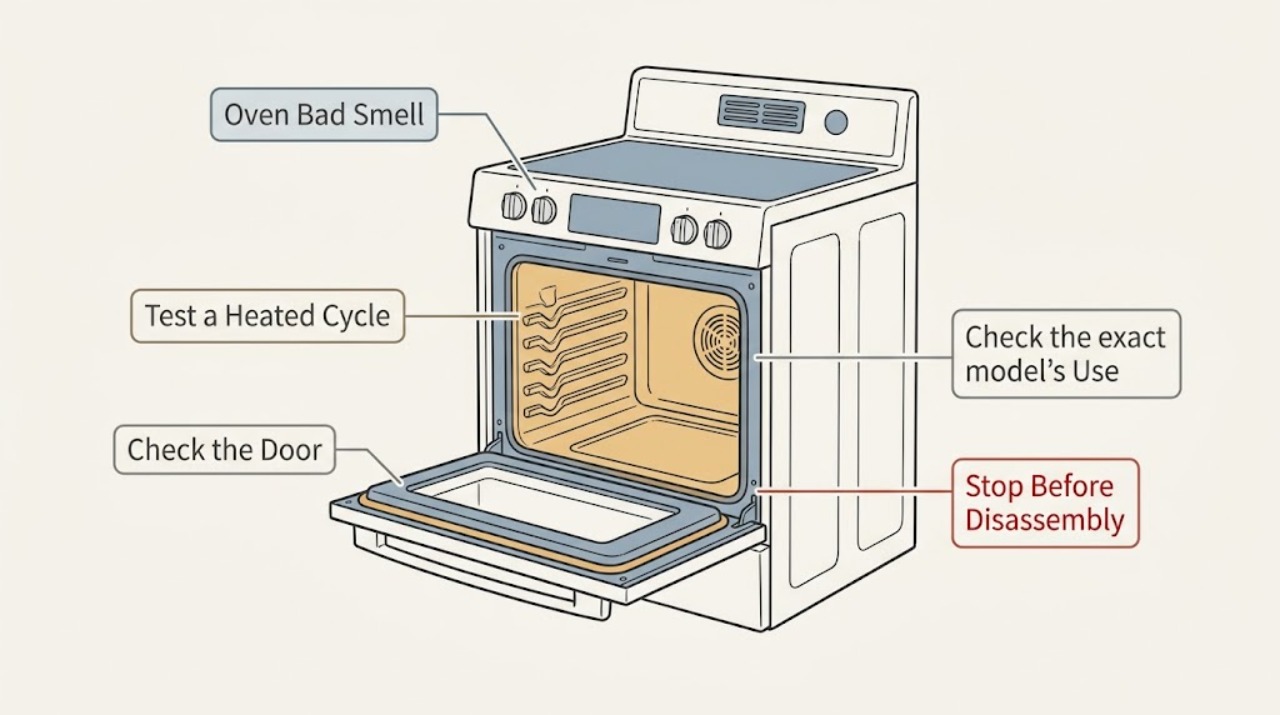
Work through in order
Diagnostic checks
Use only checks that match the exact appliance or system and its official guide.
-
Check 1
Turn the oven off and let it cool completely. From outside the appliance, identify whether the odor is strongest inside the cavity, at the vent, around the control area, on the cookware or food, or in the surrounding room. Do not perform a heat test for gas odor, smoke, sparking, or a strong burning smell.
Expected result: The smell resembles burned food or grease, appears after a new installation, follows painting or refinishing nearby, smells like gas, or resembles hot plastic or electrical insulation.
Next step: Record when the odor began, the cooking mode or feature in use, any spill or food residue, and whether the smell remains with the oven off. Follow the matching branch rather than repeatedly preheating the oven.
Why this matters
Why: The odor category separates removable cooking residue and environmental fumes from gas or electrical safety conditions that require an immediate stop.
-
Check 2
When the oven is cold, remove the racks and inspect the cavity bottom, rack supports, door area, air-fry tray or catch pan, and visible vent opening for crumbs, grease, foil, parchment, or a spill. Do not place pans directly on the oven bottom, scrape a hot surface, or remove the oven floor or heating elements.
Expected result: Fallen food, grease, or a tray spill is visible; the oven bottom is clean but the smell occurs during a specific feature; or no visible residue is present.
Next step: Clean cooled, accessible surfaces according to the Use and Care Guide and use the proper catch-tray arrangement for the feature. If residue cannot be removed safely or the smell returns without residue, stop and continue with the model-cleaning or service branch.
Why this matters
Why: Frigidaire identifies fallen bits and grease as material that can burn or create smoke and odors, especially with high-heat air frying. A clean cavity shifts attention to the room, a model-specific component, or a safety fault.
-
Check 3
Check the exact model's Use and Care Guide for Steam Clean or Self Clean. If the feature exists and there is no gas odor, smoke, electrical smell, abnormal heat, or known component fault, remove only the accessories the guide specifies and follow that complete procedure; never combine cleaning chemicals or run a feature your model does not support.
Expected result: Steam Clean is available for light soil, Self Clean is available, the model has neither feature, or the cleaning cycle produces heavy smoke, a fault, or a worsening odor.
Next step: Wipe the cooled cavity as directed after the cycle and allow the oven to cool before checking the result. Stop the cleaning attempt and arrange service if the oven overheats, smokes heavily, displays an error, or the odor remains unexplained.
Why this matters
Why: Frigidaire states that cleaning features vary by model. A supported completed cycle can address baked-on residue, but heavy smoke, a fault, or a worsening odor is not evidence that another cleaning cycle is needed.
-
Check 4
If the odor started after painting, staining, varnishing, or refinishing near the oven, stop using the oven while fumes remain and ventilate the room. If the smell is only a food-related smoke from an air-fry tray, wait until the oven is cool and inspect the catch surface and bottom for grease or crumbs; do not open the door to an active flame.
Expected result: The odor disappears after the room is ventilated, returns only with a particular greasy food or feature, or remains even after the room is clear and the cavity is clean.
Next step: Follow the appliance and food-safety instructions, clean cooled accessible residue, and do not cook while fumes are present. If the smell persists with no environmental or residue source, leave the oven off and arrange qualified service.
Why this matters
Why: Room fumes and cooking drips can produce similar odors but require different corrections. Persistence without either source makes an internal oven, vent, gas, or electrical diagnosis more likely.
-
Check 5
Inspect the visible door gasket, control display, and normal vent area after the oven is cool. Note any damaged or detached gasket, error code, temperature warning, unusual fan or electrical sound, or failure to heat normally. Do not pull the gasket, remove panels, open gas fittings, or perform energized electrical measurements.
Expected result: The gasket is damaged, a thermal or other error appears, the oven overheats or does not regulate, or the visible controls and gasket are normal while the smell continues.
Next step: Record the model number, display message, cooking mode, odor timing, visible residue, and room conditions. Stop using the oven and provide that record to qualified Frigidaire service, especially for a gas or electrical model.
Why this matters
Why: A damaged seal or error can accompany a temperature-control problem, but the odor alone cannot identify a sensor, element, igniter, valve, fan, wiring, or control fault.
Use your observations
Decision map
Find the observation that best matches what you see, then follow the next safe action.
-
PATH 01Next step
What you see
The odor follows a visible food or grease spill, fallen crumbs, or an air-fry drip, and there is no abnormal heat, gas odor, or electrical smell.
Do this next
Let the oven cool, remove or clean accessible residue according to the model guide, and use the correct catch-tray arrangement for future air-fry cooking. Stop if smoke is heavy or the odor returns with a clean cavity.
Why this path and its safety boundary
Why it matters: Burning cooking residue is the most supported explanation.
-
PATH 02Next step
What you see
The model has Steam Clean or Self Clean and the smell is consistent with baked-on soil without a safety symptom.
Do this next
Follow the exact Use and Care Guide, remove only the specified accessories, and allow the oven to cool before wiping. Do not add unapproved chemicals or repeat the cycle for smoke or overheating.
Why this path and its safety boundary
Why it matters: A model-supported cleaning cycle may address the residue, but cleaning features and accessory requirements vary.
-
PATH 03Next step
What you see
The odor occurs while the room is being painted, stained, varnished, or refinished, and the oven cavity has no matching residue.
Do this next
Ventilate and keep the oven off until the fumes are gone. If the odor remains after the room is clear, arrange service rather than assuming it is environmental.
Why this path and its safety boundary
Why it matters: The surrounding fumes may be entering the oven area or being carried through its vent.
-
PATH 04Next step
What you see
The oven has gas odor, smoke with an active flame, sparking, a burning electrical smell, abnormal heat, or a damaged power cord.
Do this next
Do not operate controls or switches around gas odor. Leave the area and follow local emergency guidance; for electrical or smoke symptoms, stop using the oven and arrange qualified service when safe. Do not open the door to an active flame unless emergency guidance directs otherwise.
Why this path and its safety boundary
Why it matters: This is an immediate gas, fire, or electrical safety stop.
-
PATH 05Next step
What you see
The cavity is clean, the room has no fumes, and the odor returns whenever the oven heats or an error or temperature problem appears.
Do this next
Leave the oven off and arrange qualified Frigidaire service. Provide the exact model, cooking mode, odor description, timing, display state, and all visible checks; do not open the appliance to identify a part.
Why this path and its safety boundary
Why it matters: An internal heating, gas, sensor, fan, wiring, vent, or control issue is possible.
Helpful context
Understand the symptom
The smell source changes the first step
A food or grease smell normally follows a spill or high-fat cooking and is usually strongest in the cavity. Paint, stain, or other fumes come from the surrounding room and may be drawn through an oven vent. A gas odor or hot electrical smell is not a cleaning problem. Identify the source while the oven is off rather than repeatedly heating it to reproduce the symptom.
Clean only the features your model supports
Frigidaire offers different cleaning features by model. Steam Clean is intended for light soil when equipped, while Self Clean is available only on some ovens and has a locking, high-heat cycle. Remove the specified accessories and follow the exact Use and Care Guide; do not improvise a cleaning cycle or place cleaner on a hot element.
Smoke and gas override troubleshooting
If you smell gas, do not press buttons, operate switches, light a flame, or keep trying to start the oven. Leave the area and follow local emergency gas guidance. For smoke, sparking, a burning electrical odor, or abnormal heat, stop using the oven and arrange qualified service after it is safe to do so.
Only after diagnosis
Potential parts
- oven door gasket
Consider this category only if qualified diagnosis confirms a damaged or detached gasket is contributing to heat loss or abnormal operation after the cavity and control checks.
Confirm the complete Frigidaire model and manufacturer fit information before ordering; an odor does not identify a gasket fault. - oven heating or ignition component
Consider this category only when qualified service confirms a heater, igniter, burner, or related component fault after residue and environmental causes are excluded.
Gas and high-voltage oven components require model-specific professional diagnosis; do not open panels or select a component from an odor alone. - oven temperature sensor or control component
Consider this category only when a repeatable temperature error or regulation problem is confirmed by qualified diagnosis.
Verify the exact model and manufacturer compatibility through qualified service; do not test live wiring.
When checks do not resolve it
Need a professional?
Request qualified Frigidaire oven service when the smell persists after cooled-residue and room-fume checks, returns with a clean cavity, accompanies an error or temperature-control problem, or requires access to gas, heating, fan, sensor, wiring, or control parts. Stop immediately for gas odor, smoke with an active flame, sparking, a burning electrical smell, abnormal heat, or a damaged cord.
Common questions
FAQ
Why does my Frigidaire oven smell like something is burning?
Check the cooled oven bottom, racks, air-fry tray, and catch pan for grease, crumbs, foil, or a spill. Frigidaire notes that fallen bits can burn and create smoke or odors. Stop for smoke, sparking, abnormal heat, or a strong electrical smell.
Can I use Self Clean to remove a bad smell from a Frigidaire oven?
Only if the exact model has Self Clean and its Use and Care Guide supports it. Remove the specified racks or accessories and follow the model procedure. Do not use an unsupported cycle or repeat it because of heavy smoke, overheating, an error, or an unexplained odor.
Why does my Frigidaire oven smell after using Air Fry?
High-fat food can drip onto the oven bottom and smoke or create an odor. Use the model's recommended catch surface below the Air Fry Tray, keep the oven bottom clear, and clean cooled residue according to the guide.
What should I do if my Frigidaire oven smells like gas?
Stop using the oven and do not operate switches, press controls, or create a flame around the odor. Leave the area and follow local emergency gas guidance. Arrange qualified service before using the oven again.
Read the exact guide
Official sources
- Ovens - How do I keep my air frying oven clean?Frigidaire · Frigidaire ovens, including air-fry models, and the relationship between fallen food, oven-bottom residue, and odors.
- Oven Error Codes and Alarms GuideFrigidaire · Frigidaire standard range and wall ovens, including thermal alerts, door-lock conditions, reset boundaries, and service escalation.
- Air Fry Tray - How do I limit the amount of smoke when using the ReadyCook™ Air Fry Tray?Frigidaire · Frigidaire high-heat cooking, grease drips, catch-tray, oven-bottom, and ventilation guidance relevant to smoke or odor complaints.
- Oven - Is Not Hot EnoughFrigidaire · Frigidaire electric range and wall ovens; door-gasket and temperature-control observations used to define service escalation.
- Ovens - When and how do I use steam clean?Frigidaire · Frigidaire ovens equipped with Steam Clean and model-specific light-soil cleaning instructions.
- Ovens - How do I set my oven or range to self-clean?Frigidaire · Frigidaire models equipped with Self Clean and their accessory-removal, control, lock, and cooling boundaries.
Community feedback
Share a repair observation
Share a plain-text repair observation. Accepted observations are published automatically; this page may take a moment to update.