
On this page
Start here
Quick answer
Treat an Electrolux oven odor as a safety question first. Turn the oven off and leave the area if there is smoke, a flame, a gas-like odor, a sharp electrical or melting-plastic smell, a repeated breaker trip, or an unusual temperature. Do not open panels or continue heating to burn off an unknown residue. Once the cavity is completely cool and there is no active hazard, inspect the floor, racks, door area, vent, and any air-fry tray for spilled food, grease, packaging, or foil. Electrolux notes that fallen crumbs and drips can burn and cause odors, and says not to place pans directly on the oven bottom. Use only the cleaning method allowed by the model's Use and Care guide; Steam Clean is model-dependent and intended for light soil. If the odor returns, the oven overheats, an alert such as F10 appears, or the smell suggests gas or an electrical fault, keep it off and arrange qualified appliance service.
Before you begin
Safety first
- A homeowner may inspect and clean accessible residue only when the oven is cold and safe. Gas work, live electrical diagnosis, panel removal, temperature-control diagnosis, and safety-component replacement require a qualified technician.
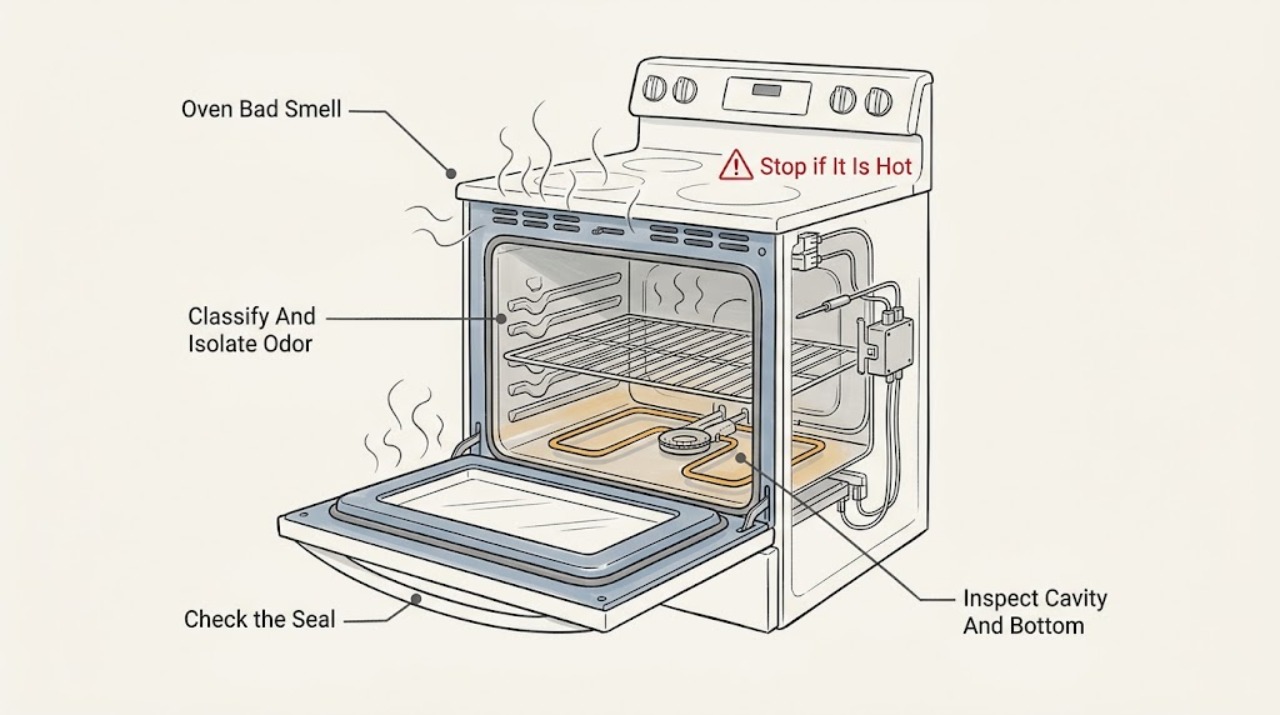
Work through in order
Diagnostic checks
Use only checks that match the exact appliance or system and its official guide.
-
Check 1
Turn the oven off using its normal control and assess the odor from a safe distance without opening panels or placing your face at the vent.
Expected result: Record whether the smell is food or grease, gas-like, acrid electrical, melting plastic, smoke, or accompanied by a flame, visible sparking, unusual heat, or a repeated breaker trip.
Next step: For an active hazard, leave the area as appropriate, avoid flames and electrical switching, keep the oven off, and use the local emergency or qualified service route. For a mild food or grease odor with no hazard signs, wait until the oven is completely cool before inspecting it.
Stop if: Stop immediately for gas odor, flame, smoke from wiring, visible damage, electric shock, or a breaker that trips again.
Why this matters
Why: Gas-like odor, smoke, flame, electrical odor, melting material, or abnormal heat is an active safety condition rather than a cleaning task.
-
Check 2
When the oven is cold, use ordinary lighting to inspect the cavity floor, corners, rack supports, and the space below an air-fry tray for food, grease, foil, packaging, or other residue.
Expected result: Look for a fresh spill, baked-on grease, crumbs or drips beneath the tray, foil or a pan on the cavity floor, or material that has melted or charred.
Next step: Remove only loose accessories permitted by the model guide and clean the residue with the approved method. Keep any catch sheet one or two racks below an air-fry tray, never directly on the oven bottom. Arrange service if wiring, insulation, a coating, or an unidentified component is damaged.
Stop if: Stop if the cavity, coating, insulation, cable, or accessory is damaged, if residue cannot be removed without force, or if the smell is not consistent with food or grease.
Why this matters
Why: Residue in a hot zone can explain a food or burnt smell. A melted, charred, or unidentified object can indicate more than a routine spill and should not be heated again to test it.
-
Check 3
With power and heat off, inspect the racks, door edge, door glass area, vent opening, and gasket for grease, trapped food, protective film, displacement, cuts, or scorching; do not pull or rub the gasket.
Expected result: Note whether the odor is strongest at the door or vent, whether the door closes evenly, whether the gasket is seated and intact, and whether the vent is blocked by an object or heavy soil.
Next step: Clean accessible residue only as directed by the owner's guide and remove external obstructions without dismantling the oven. If the gasket is damaged, the door does not close, or heat escapes abnormally, stop using the oven and request service.
Stop if: Do not continue if inspection would require removing a panel, disconnecting wiring, forcing the door, or disturbing the gasket.
Why this matters
Why: Residue at the door or vent can carry an odor into the room. A loose or damaged gasket, blocked vent, or scorched material can also affect heat control and requires more caution than ordinary cleaning.
-
Check 4
Use the exact model's Use and Care guide to decide whether ordinary wiping, Steam Clean, or another supported cleaning method is appropriate; remove racks and accessories only as the guide directs.
Expected result: Confirm whether the model has Steam Clean, whether the soil is light or baked-on, and whether all active smoke, gas, electrical, overheating, and melting symptoms have stopped.
Next step: For light soil and no hazard, follow the model-specific Steam Clean procedure, stand aside for vapor, then wipe the cavity and bottom. For heavier soil, follow the model guide or use qualified service rather than improvising with chemicals or heat.
Stop if: Do not start any cleaning cycle if the model is unknown, the instructions are unavailable, there is an active hazard, or the odor returns before the cycle is complete.
Why this matters
Why: Steam Clean is model-dependent and intended for light soils. It is not a safe diagnostic response to an active hazard, and a high-heat cycle can worsen an electrical or overheating fault.
-
Check 5
Only after the cavity is clean, dry, intact, and free of safety symptoms, perform one supervised normal preheat with the room ventilated and no food inside.
Expected result: Record whether the odor is absent, returns immediately, appears only as residue warms, or is accompanied by uneven heating, an error, abnormal fan behavior, smoke, or a protection trip.
Next step: Turn the oven off and arrange qualified appliance service if the smell returns or any operating symptom is abnormal. If the test is normal, keep monitoring and follow the model's routine care instructions.
Stop if: Turn it off immediately for smoke, flame, gas-like odor, electrical or melting smell, extreme heat, a repeated trip, or an error such as F10; do not repeat the test.
Why this matters
Why: An odor that returns from a clean cavity, especially with an alert or abnormal heat, points toward a gasket, sensor, element, burner, control, or wiring problem rather than remaining food alone.
-
Check 6
Before arranging service, document the exact model and serial information, the odor description and location, when it occurs, any error code, what was cleaned, and whether the breaker or other protection operated.
Expected result: Check whether the symptom is repeatable without exposing anyone to gas, smoke, live electricity, or excessive heat; do not remove covers to gather more information.
Next step: Keep the oven off and provide the notes and photographs to a qualified appliance technician. Follow the model guide and service instructions for any further checks.
Stop if: Do not attempt live voltage tests, gas-line work, control-board access, or replacement of a safety component as a do-it-yourself smell test.
Why this matters
Why: A precise symptom history helps a technician distinguish residue from a temperature-control, burner, element, gasket, or electrical fault while preserving the safety boundary.
Use your observations
Decision map
Find the observation that best matches what you see, then follow the next safe action.
-
PATH 01Safety boundary
What you see
The odor is gas-like, electrical, melting-plastic, or accompanied by smoke, flame, abnormal heat, or repeated protection trips.
Do this next
Keep the oven off, move away from the hazard as appropriate, avoid flames and electrical switching, and use the local emergency or qualified service route.
Why this path and its safety boundary
Safety stop: Do not clean, run a heating cycle, or open the appliance while the hazard is active.
-
PATH 02Safety boundary
What you see
The oven is cold and the smell is consistent with food or grease, with visible crumbs, drips, foil, packaging, or spill residue.
Do this next
Remove permitted accessories and clean the affected area using the model's care instructions; keep pans off the cavity bottom.
Why this path and its safety boundary
Safety stop: Stop if material is charred, melted, unidentified, or cannot be removed without force.
-
PATH 03Safety boundary
What you see
The odor is concentrated near the door or vent, the door does not close evenly, or the gasket is cut, displaced, or scorched.
Do this next
Clean only accessible residue and remove external obstructions; do not pull, rub, or replace the gasket without model-specific guidance.
Why this path and its safety boundary
Safety stop: Keep the oven off and arrange service for a damaged gasket, door, vent, insulation, or abnormal heat escape.
-
PATH 04Safety boundary
What you see
The cavity has only light soil, no active hazard is present, and the model guide confirms Steam Clean.
Do this next
Follow the model-specific Steam Clean procedure, stand aside for vapor, and wipe the cavity afterward.
Why this path and its safety boundary
Safety stop: Do not use a cleaning cycle when the model is unknown, the instructions are unavailable, or the odor indicates an active fault.
-
PATH 05Safety boundary
What you see
The smell returns after safe cleaning, appears during preheat, or is paired with F10, uneven heating, or another persistent alert.
Do this next
Turn the oven off, allow it to cool, record the alert and symptoms, and arrange qualified appliance service.
Why this path and its safety boundary
Safety stop: Do not repeat the heating test or attempt to bypass temperature protection.
Helpful context
Understand the symptom
Classify the odor before cleaning
A food or grease smell that appears after a spill is a different problem from gas, hot insulation, melting plastic, or a burning electrical smell. A small amount of smoke from residue still warrants switching the oven off and allowing it to cool; do not put your face near the door or vent. If the smell is gas-like, leave the area, avoid flames and electrical switches, and follow the local gas-emergency procedure. If there is smoke from wiring, a visible flame, or a breaker that trips again, leave the appliance isolated and have it assessed.
Look for residue in the places that heat up
With the oven cold, remove only the racks and accessories that the owner's guide allows you to remove. Look for cooked-on food, grease, foil, cardboard, protective film, or a pan resting on the cavity floor. Electrolux specifically connects fallen crumbs and drips below an air-fry tray with burning and odors, and advises placing a catch sheet one or two racks below the tray rather than directly on the bottom. Wipe loose residue with a method approved for the finish; do not scrape, flood controls, or use a chemical mixture whose compatibility is unknown.
Use a cleaning cycle only when the model and symptoms allow it
Check the exact model's Use and Care guide before choosing Steam Clean or Self Clean. Electrolux says Steam Clean is not fitted to every oven and is for light soil; its instructions call for removing racks and accessories, wiping loose debris and grease first, standing aside for escaping vapor, and wiping the cavity after the cycle. Do not start a cleaning cycle while there is an active gas, electrical, smoke, overheating, or melting smell, and do not use a high-heat cycle to investigate an unknown fault.
A recurring odor needs a fault check
After residue has been removed and the door area is clean, note whether the odor returns during a normal supervised preheat. A damaged or displaced gasket can affect heating performance, and a control or temperature fault can make an oven run too hot. Do not rub or pull the gasket, remove the rear cover, or test live wiring. If the oven reports F10 or another persistent alert, does not regulate temperature, smells electrical, trips protection, or produces odor with a clean cavity, stop using it and arrange service.
Only after diagnosis
Potential parts
- door gasket
Consider only when the door seal is visibly damaged or displaced, heat escapes abnormally, or heating performance changes; an odor alone does not identify this part.
Verify the exact model and revision from the appliance documentation before any part decision. - temperature sensor or thermal protection
Consider only when the oven overheats, shows a persistent temperature alert such as F10, or fails to regulate after safe residue checks.
A qualified technician must confirm the fault and model compatibility; do not bypass a thermal safety device. - heating element, burner, or control component
Consider only after service diagnosis when the odor persists with a clean cavity or an element, burner, control, or wiring symptom is present.
Do not open the appliance or choose a replacement from the symptom alone; model-specific diagnosis is required.
When checks do not resolve it
Need a professional?
Arrange qualified appliance service if the odor is gas-like, electrical, or melting; if there is smoke, flame, repeated protection trip, damaged insulation or gasket, abnormal heat, a persistent alert such as F10, or an odor that returns after safe cleaning.
Safety scope: A homeowner may inspect and clean accessible residue only when the oven is cold and safe. Gas work, live electrical diagnosis, panel removal, temperature-control diagnosis, and safety-component replacement require a qualified technician.
Have this ready
- Provide the exact model and serial information, odor description and location, when it occurs, any alert code, photographs of visible residue or damage, and the cleaning or operating steps already completed.
Common questions
FAQ
Why does my Electrolux oven smell after cooking?
A spill, grease, crumbs, or drips can heat again and create an odor. With the oven cold, inspect the cavity floor, racks, door area, and the space below an air-fry tray. If the smell is electrical, gas-like, or accompanied by smoke or abnormal heat, keep the oven off and arrange service.
Should I run Self Clean to remove a burning smell?
Not while the smell could be gas, electrical, melting, smoke, overheating, or an unknown material. Check the model guide first; Electrolux describes Steam Clean as model-dependent and intended for light soil.
Can a pan or foil on the oven floor cause an odor?
Yes, an item on the cavity floor can heat in an unintended way. Electrolux advises keeping pans off the bottom so heat can circulate, and recommends positioning a catch sheet below an air-fry tray rather than on the floor.
What does F10 mean with an oven smell?
Electrolux's error guide describes F10 as thermal runaway for applicable ovens. Turn the oven off and let it cool; if the condition persists, keep it off and seek support rather than repeating a heat test.
When is an oven odor an emergency?
Treat gas-like odor, smoke, flame, a sharp electrical or melting smell, unusual heat, or repeated protection trips as a stop condition. Leave the area as appropriate, avoid flames and electrical switching, keep the oven off, and use the local emergency or qualified service route.
Read the exact guide
Official sources
- Ovens - When and how do I use steam clean?Electrolux · Applies only to Electrolux models equipped with Steam Clean; consult the exact model instructions.
- Oven - Is Not Hot EnoughElectrolux · Applies to Electrolux oven heating checks; exact construction and checks vary by model.
- Oven Error Codes and Alarms GuideElectrolux · Applies to the Electrolux oven error codes covered by the guide; displayed codes and reset behavior vary by model.
- Ovens - How do I keep my air frying oven clean?Electrolux · Applies to Electrolux oven models with an air-fry tray or air-fry function; confirm the model guide.
Community feedback
Share a repair observation
Share a plain-text repair observation. Accepted observations are published automatically; this page may take a moment to update.