
On this page
Start here
Quick answer
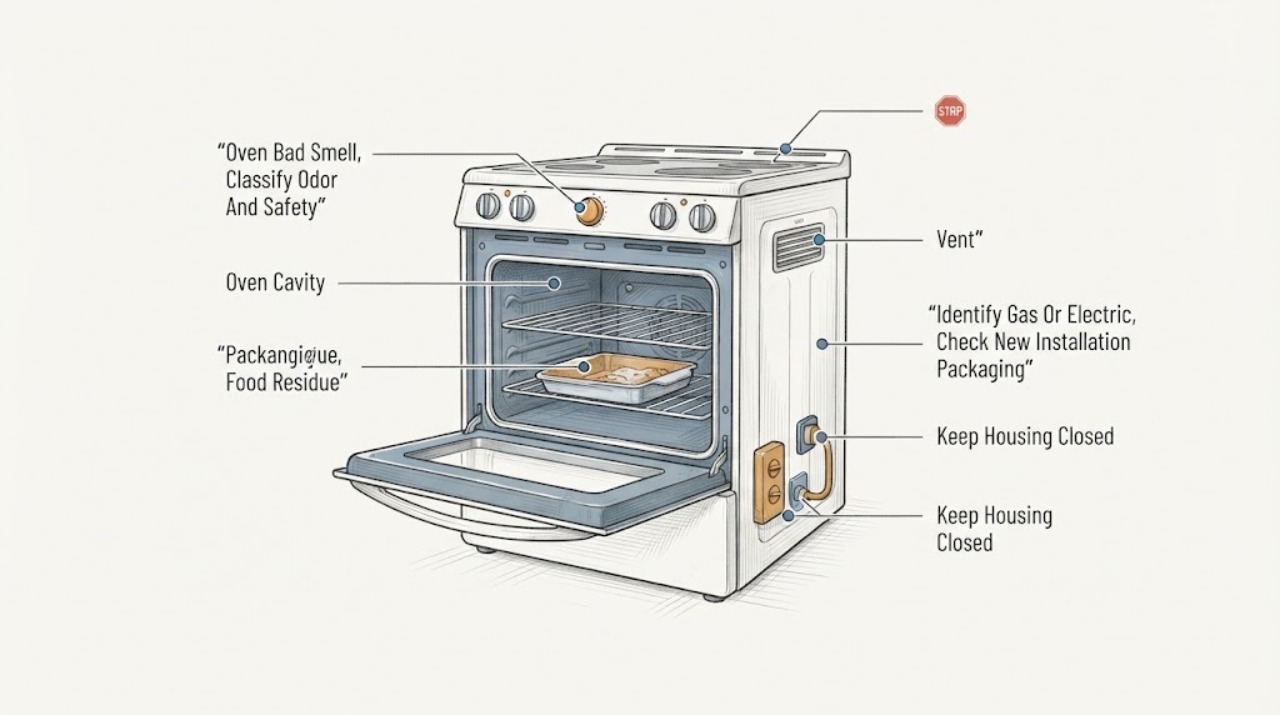
Treat a JennAir oven smell as a classification problem before cleaning or running another cycle. First identify the exact model and whether it is gas or electric. A mild odor during the first few uses of a new oven can come from manufacturing materials or shipping tape and should fade after the documented empty burn-in, but a gas odor, electrical or melting-plastic smell, smoke, sparks, scorching, uncontrolled heat, or a breaker that trips again is an immediate stop condition. If the oven is cool and there is no hazard, look for remaining packaging, foil or liners, food spillover, grease, or residue from a recent high-temperature or steam-clean cycle. Clean only with the exact model guidance; do not open panels, relight a gas appliance, test live wiring, or use a cleaner that the manual does not permit. If the smell remains after one safe external cleaning or returns without a visible source, arrange qualified JennAir appliance service.
Work through in order
Diagnostic checks
Use only checks that match the exact appliance or system and its official guide.
-
Check 1
Switch the oven off and record when the odor appeared, the selected function, whether the oven was new or recently cleaned, where the odor is strongest, and whether there is smoke, a spark, scorch mark, visible flame outside the intended burner area, unusual heat, a code, or a breaker event.
Expected result: The smell is mild and new-unit related, food or grease-like, cleaner or self-clean related, melting-plastic or electrical, gas-like, or accompanied by smoke, flame, sparks, scorching, or uncontrolled heat.
Next step: For any hazard symptom, keep the oven off and use the urgent stop path. Otherwise record the exact model and continue to identify whether it is gas or electric before choosing a check.
Stop if: Stop immediately for gas odor, smoke, flame outside the intended burner area, sparks, arcing, melting-plastic or electrical odor, scorching, an unusually hot control or cord, or a breaker that opens again.
Why this matters
Why: A mild first-use odor or visible food residue can follow a low-risk cleaning branch only when no hazard is present. Gas, electrical, plastic, smoke, spark, scorch, or uncontrolled-heat symptoms can indicate fire, gas, or shock risk and are not a cleaning problem.
-
Check 2
Read the model and rating label and compare it with the JennAir manual to confirm gas or electric operation. Check only that the oven is the expected appliance; do not open a terminal area, inspect a gas connection, or infer the type from the smell or burner appearance.
Expected result: The oven is confirmed as gas, confirmed as electric, or the type and model cannot be confirmed.
Next step: Use the exact model documentation for all later checks. If the type cannot be confirmed, stop at identification and arrange JennAir support or qualified service rather than testing the appliance.
Stop if: Stop for a missing or damaged label, gas odor, exposed wiring, wet controls, smoke, sparks, or any need to remove a panel to identify the type.
Why this matters
Why: A gas odor requires a different emergency response from an electrical odor, while packaging and food-residue checks can apply to either type. An unconfirmed type makes ignition, power, and cleaning instructions uncertain.
-
Check 3
Only if the oven is new or has just been installed and there is no hazardous symptom, let the cavity cool and inspect for removable packaging, tape, labels, plastic, shipping inserts, or protective material that the installation instructions say to remove. Do not touch a hot surface or probe behind trim.
Expected result: Packaging remains, the cavity is clear, or the odor is sharp, persistent, or accompanied by smoke or irritation despite correct removal.
Next step: Remove only clearly removable packaging described by the manual, ventilate the room, and use the exact model's empty first-use procedure if no hazard is present. If the smell persists or becomes electrical, plastic-like, smoky, or unusually strong, stop and arrange service.
Stop if: Stop for smoke that increases, gas odor, sparks, scorching, melting material, a hot control, or any packaging that is stuck behind a panel or near wiring.
Why this matters
Why: JennAir attributes a mild first-use odor to new parts, insulation, manufacturing oil, or shipping tape and says it should fade after the first few uses. Remaining packaging can continue to smell, but a sharp or persistent odor is not established as normal by the first-use guidance.
-
Check 4
When the cavity is fully cool, inspect the oven floor, rack edges, door area, and visible surfaces for baked-on food, grease, sugar, sauce, foil, or a liner that may be trapping residue. Wipe routine spills only with the JennAir-approved gentle method for the exact surface; do not scrape aggressively, wet electrical slots, or use an unapproved oven cleaner.
Expected result: A visible spill, grease film, foil or liner, cleaner residue, or no visible residue is present.
Next step: Remove only accessible foil or liners and clean routine residue after cooling with warm water, mild detergent, and a soft cloth if the manual permits. Allow the cavity to dry, then make no more than one supervised test; request service if odor returns without visible residue.
Stop if: Stop for smoke, scorch marks, liquid near controls, damaged glass or insulation, a melted liner, gas odor, electrical odor, or any need to remove a panel or heating element.
Why this matters
Why: Food and trapped debris can smoke or smell when heated, and JennAir warns that foil or liners can trap spills and debris and create odors. No visible residue does not rule out a hidden electrical, gas, insulation, or control fault.
-
Check 5
If the odor began during or after Self-Clean, Steam Clean, or another cleaning function, record the function and let the oven cool fully. Check that racks, pans, foil, loose soil, and accessories were handled as the exact manual requires; never force a locked door or block the vent.
Expected result: The odor is limited to a cleaning cycle, the oven was heavily soiled, loose soil or an accessory was left inside, or the smell continues during ordinary Bake or Broil.
Next step: Follow the exact model cleaning and cool-down instructions, ventilate the kitchen, and keep sensitive birds away from fumes. Do not run another cleaning cycle until the cause is understood; arrange service if the odor persists outside the cleaning function or any hazard appeared.
Stop if: Stop for growing smoke, visible flame outside the intended area, sparks, melting plastic, a hot control, a door that will not release normally after cooling, or any need to force the door or block the vent.
Why this matters
Why: JennAir explains that high-temperature self-cleaning can create heat, smoke, and odors, with heavy soil producing more smoke. An odor that continues during ordinary cooking, grows after cleaning, or comes with smoke, scorching, or a control fault is not resolved by repeating Clean.
-
Check 6
If the smell is gas-like, do not light the oven or touch electrical switches; leave the area and follow gas-emergency instructions from a safe location. If it is electrical or like melting plastic, switch the oven off, keep it off, and visually note only whether the accessible plug, cord, controls, or surrounding material is discolored or hot; do not touch or test it.
Expected result: A gas odor is present, an electrical or melting-plastic odor is present, a connection is hot or discolored, or none of those symptoms can be confirmed.
Next step: For gas, stay out of the area and contact the gas supplier or fire department as appropriate. For electrical or plastic odor, keep the oven off and arrange qualified appliance or electrical service; do not perform a reset or re-test.
Stop if: Stop for any gas odor, smoke, spark, arc, scorch, hot or damaged connection, repeated breaker trip, or smell that intensifies when power or heat is applied.
Why this matters
Why: JennAir's gas guidance treats an unexplained gas odor as an emergency requiring no ignition or electrical switching. Electrical or melting-plastic odor, heat, scorch, or discoloration can indicate a wiring, control, insulation, or connection fault and requires qualified diagnosis.
-
Check 7
Arrange qualified JennAir appliance service when the smell remains after one safe model-specific cleaning or first-use procedure, returns without visible residue, occurs during ordinary cooking on an established oven, or is paired with a code, abnormal heating, fan or control behavior, or a door problem. Give the technician the exact model and odor timeline.
Expected result: The odor persists, returns after a clean empty test, comes from behind the controls or cabinet, or the oven has any code, unusual heat, electrical symptom, gas symptom, smoke, or spark.
Next step: Keep the oven off and use JennAir model-based support or a qualified appliance service route. Preserve the model, type, function, cavity condition, cleaning history, and safety observations; do not open panels or repeat the symptom for demonstration.
Stop if: Do not continue testing after gas odor, smoke, flame, sparks, scorching, electrical or melting-plastic odor, uncontrolled heat, repeated breaker operation, or any need to access internal parts.
Why this matters
Why: The remaining possibilities can include heating, ignition, wiring, insulation, sensor, control, vent, or door-seal faults. Odor alone cannot identify a compatible component, and internal oven diagnosis is not a safe user repair.
Use your observations
Decision map
Find the observation that best matches what you see, then follow the next safe action.
-
PATH 01Next step
What you see
Gas odor, electrical or melting-plastic smell, smoke, flame outside the intended area, sparks, scorching, a hot connection, or repeated breaker operation is present.
Do this next
Arrange qualified service and follow the exact model guidance.
Why this path and its safety boundary
Why it matters: Keep the oven off. For gas, do not light anything or touch nearby electrical switches; leave the area and contact the gas supplier or fire department from a safe location. For electrical symptoms, keep clear and arrange qualified service.
-
PATH 02Next step
What you see
The oven is new, packaging has been removed, and the odor is mild with no smoke, irritation, scorch, spark, gas, or electrical symptom.
Do this next
Arrange qualified service and follow the exact model guidance.
Why this path and its safety boundary
Why it matters: Use JennAir's exact first-use empty Bake procedure, ventilate the room, keep birds away from fumes, and do not cook food during the odor-removal cycle. A persistent or sharp odor needs service.
-
PATH 03Next step
What you see
A cooled cavity contains accessible food, grease, foil, liner, or cleaner residue that can explain the smell.
Do this next
Arrange qualified service and follow the exact model guidance.
Why this path and its safety boundary
Why it matters: Remove only accessible residue or liner material and clean with the exact model method. Make one supervised test after drying; recurring odor or hidden residue needs service.
-
PATH 04Next step
What you see
The smell occurs only during or just after Self-Clean or Steam Clean and matches the documented cleaning context.
Do this next
Arrange qualified service and follow the exact model guidance.
Why this path and its safety boundary
Why it matters: Allow the oven to cool, ventilate, and follow the model cleaning procedure. Do not repeat a cleaning cycle while smoke or an unexplained odor persists; arrange service if it occurs in ordinary cooking.
-
PATH 05Next step
What you see
The oven is gas and the odor is gas-like or the source cannot be ruled out safely.
Do this next
Arrange qualified service and follow the exact model guidance.
Why this path and its safety boundary
Why it matters: Do not light the oven, use electrical switches near the odor, or relight the appliance. Leave the area and follow the gas supplier or fire-department emergency path; do not inspect the gas line yourself.
-
PATH 06Next step
What you see
The oven is electric and the smell is electrical, plastic-like, smoky, or associated with heat, scorch, code, or a connection problem.
Do this next
Arrange qualified service and follow the exact model guidance.
Why this path and its safety boundary
Why it matters: Switch the oven off and keep it off. Do not touch or test wiring, reset a tripping circuit repeatedly, or remove panels; arrange qualified appliance or electrical service.
-
PATH 07Next step
What you see
The cavity is clean and the odor persists or returns without a clear first-use or cleaning explanation.
Do this next
Arrange qualified service and follow the exact model guidance.
Why this path and its safety boundary
Why it matters: Stop using the oven and arrange qualified JennAir appliance service for the heating, ignition, insulation, control, vent, or wiring system. Do not select a part from odor alone.
Helpful context
Understand the symptom
Classify the smell before choosing a remedy
A new-oven manufacturing odor, a food or grease smell, a cleaner or steam-clean residue, a melting-plastic smell, an electrical odor, and a gas odor do not share the same safe next step. Record when the smell starts, whether it occurs only during Bake, Broil, or Clean, where it is strongest, and whether it comes with smoke, sparks, heat, or a display problem. Do not run another cycle just to make the symptom easier to identify.
Gas and electric models have different stop paths
Use the rating label and JennAir model documentation to identify the appliance type. A gas oven has a gas supply and ignition path; an electric oven does not. If you smell gas, do not try to light anything or operate electrical switches near the odor. If the smell is electrical or like melting plastic, switch the oven off and keep it off; do not inspect energized wiring or remove a panel.
Food residue and cleaning cycles can create odor
Spilled sugar, fat, sauce, or food under a rack can smoke when heated. JennAir recommends cleaning routine spills after the cavity cools with warm water, mild detergent, and a soft cloth, while high-temperature self-cleaning can itself create smoke and odor. Do not line the cavity with foil or use an unapproved oven cleaner.
When a normal first-use smell stops being normal
JennAir says a small amount of first-use odor should fade after the first few uses. That does not cover a persistent sharp electrical smell, a melting-plastic smell, gas odor, smoke that grows, visible flame outside the burner area, scorching, or an oven that continues heating when switched off. Those symptoms require immediate shutdown and qualified help.
Safety boundary
Stop conditions
- Gas odor, smoke, flame outside the intended burner area, sparks, arcing, scorching, or a melting-plastic or electrical smell.
- A hot, damaged, loose, wet, or discolored cord, plug, outlet, control, gas connection, insulation, or cabinet.
- A breaker that opens again, an oven that continues heating when switched off, or a control or door that cannot operate normally.
- Cracked glass, damaged insulation, liquid near electrical parts, or a door that is locked or stuck and would require force.
- Any need to remove a panel, inspect live wiring or gas tubing, bypass a safety device, force a cleaning door, or repeat a hazardous test.
- An unexplained smell that persists after one safe, model-specific first-use or cooled-cavity cleaning check.
Only after diagnosis
Potential parts
- oven temperature sensor or thermal control
Consider this category only after qualified testing links persistent odor, abnormal heat, or a control code to a temperature or thermal-control fault on the exact model.
Confirm the complete JennAir model, sensor position, connector, and manufacturer fit information; odor alone does not identify this component. - oven heating or ignition component
Consider this category only after qualified diagnosis confirms a heater or gas-ignition fault and rules out packaging, food residue, cleaning-cycle, and supply causes.
Confirm the exact JennAir model and gas or electric configuration with the manufacturer or technician; do not test or replace an ignition or heating component as a live repair. - oven control or wiring component
Consider this category only after qualified diagnosis identifies a control, harness, insulation, or connection fault associated with a persistent electrical odor or code.
Confirm the complete JennAir model, electrical specification, connector, and approved fit information; do not open energized panels or bypass safety controls.
When checks do not resolve it
Need a professional?
The oven has gas odor, smoke, flame outside the intended burner area, sparks, arcing, scorching, melting-plastic or electrical odor, or repeated breaker operation., A mild first-use odor does not fade after the model's documented empty cycle or returns during ordinary cooking., A cooled, cleaned cavity has no visible source but the odor returns, intensifies, or comes from behind the controls or cabinet., The oven overheats, continues heating when off, displays a code, has an abnormal fan or control, or has a door or seal problem with odor., The exact gas or electric type, model manual, cleaning method, or safe stop procedure cannot be confirmed.
Common questions
FAQ
Is a smell from a new JennAir oven normal?
A small amount of odor or smoke during the first few uses can be normal, according to JennAir, because new parts, insulation, manufacturing oil, or shipping tape are heating. Remove packaging and follow the exact model's empty first-use procedure. Gas odor, electrical or melting-plastic smell, growing smoke, scorching, or a persistent sharp odor is not a normal first-use assumption.
Why does my JennAir oven smell like food or grease?
A spill, grease film, sugar, sauce, foil, or a liner can leave residue that smells when heated. Let the oven cool, remove only accessible residue, and use the model-approved routine cleaning method. If the cavity is clean but the odor returns, arrange service instead of repeatedly heating it.
Can self-cleaning cause a JennAir oven to smell?
Yes. JennAir says high-temperature self-cleaning can create heat, smoke, and odors, especially when the oven is heavily soiled. Ventilate, keep the vent clear, remove accessories as the model manual directs, and let the oven cool. Do not repeat the cycle if smoke grows or the smell occurs during ordinary cooking.
What should I do if my JennAir oven smells like gas?
Do not light the oven or any other appliance, and do not operate nearby electrical switches. Leave the area and contact the gas supplier or fire department from a safe location, following their instructions. Do not relight the oven or inspect the gas line yourself.
What does an electrical or melting-plastic smell mean in a JennAir oven?
Treat it as a possible electrical, insulation, or control fault. Switch the oven off and keep it off. Do not touch hot or damaged connections, reset a tripping circuit repeatedly, remove panels, or run another cycle; arrange qualified appliance or electrical service.
Read the exact guide
Official sources
- Routine Oven Cleaning - Wall OvenJennAir · Supports cleaning accessible routine food residue after cooling with warm water, mild detergent, and a soft cloth, subject to the exact model surface instructions.
- Oven Not Working - GasJennAir · Supports identifying a gas oven and keeping gas-supply and ignition work within qualified service; it does not authorize user gas-line repair.
- Odors and Smells of Newly Installed Range or OvenJennAir · Supports distinguishing mild first-use odor from persistent or hazardous odor and following the empty first-use procedure for a new oven.
- Oven Not Working - ElectricJennAir · Supports identifying an electric oven and keeping electrical-supply and control work within qualified service.
- Steam Cleaning the OvenJennAir · Supports distinguishing steam-clean odor or residue from an ordinary-cooking odor and following model-dependent cool-down and spill instructions.
- Odors or SmellsJennAir · Supports the gas-odor stop path; this page is for a JennAir gas cooktop, so the gas-safety response is used here without asserting that every JennAir oven has the same gas layout.
- Cleaning and Maintenance of RangeJennAir · Supports cooled-cavity spill cleaning, avoiding foil or liners, high-temperature cleaning odor, ventilation, and model documentation.
- High Temperature Self-Clean Cycle InformationJennAir · Supports interpreting smoke or odor during a documented high-temperature cleaning cycle and stopping for abnormal conditions.
Community feedback
Share a repair observation
Share a plain-text repair observation. Accepted observations are published automatically; this page may take a moment to update.