
On this page
Start here
Quick answer
On the Viking DDBB363, a nighttime alarm should first be identified by what the panel shows and what the compartments are doing, not by the time of day. Viking's DDBB363 documentation identifies this model as a 36-inch Designer bottom-mount refrigerator/freezer, and the linked built-in refrigerator/freezer manual separates a door-open alarm, a high-temperature alarm, and a thermistor alarm. Record whether a door or freezer drawer was actually open, whether a door-open or high-temperature indicator is lit or blinking, and the refrigerator and freezer temperatures. Check only the visible gasket, closure path, vents, and recent power history. If the alarm continues with doors fully closed, normal visible closure, unstable temperatures, or scrolling thermistor indicators, protect food as needed and arrange authorized Viking service; the nighttime pattern alone does not justify a control-board or sensor part.
Before you begin
Safety first
- Do not remove the top grille while energized, open the control or cooling enclosure, probe live wiring, bypass a door or alarm circuit, or disconnect the alarm speaker. Viking's installation guide says to disconnect power before removing the top grille and requires qualified electrical work. Stop for smoke, burning odor, hot or damaged electrical parts, water near electrics, repeated breaker operation, exposed wiring, or unsafe cooling.
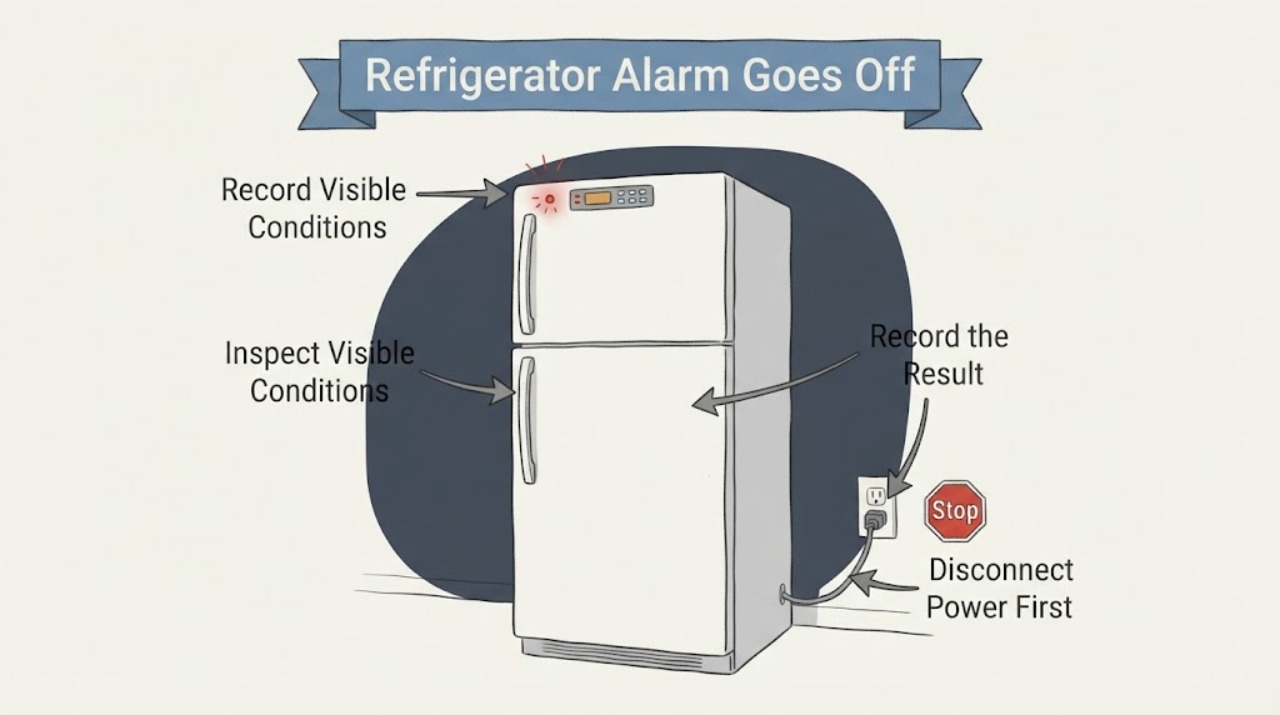
Work through in order
Diagnostic checks
Use only checks that match the exact appliance or system and its official guide.
-
Check 1
At the next safe occurrence, identify the alarm without opening any grille or panel. Note the exact indicator behavior: a door-open light, a high-temperature light, scrolling indicator lights, or only a sound. Record whether the refrigerator door or bottom freezer drawer had just been opened, whether the sound stops when the door or drawer is closed, and whether the alarm repeats at a regular interval.
Expected result: The alarm follows a door or drawer that was open, a high-temperature indicator is glowing or blinking, the indicator lights scroll, or there is no visible indicator and the sound cannot be classified.
Next step: Write down the full display pattern and model label, then continue only with the matching branch below. If the indication cannot be identified, arrange service rather than borrowing an alarm meaning from another Viking product.
Stop if: Do not remove the top grille, defeat a door switch, unplug internal wiring, or enter an unverified diagnostic mode to force the alarm to recur.
Why this matters
Why: The DDBB363 manual assigns different next steps to door-open, high-temperature, and thermistor indications. A nighttime occurrence without a captured indicator is not enough to choose a sensor, control, or other component.
-
Check 2
With the appliance closed and power left in its normal state, inspect the visible closure path on both the refrigerator door and the bottom freezer drawer. Look for a container, shelf, drawer, ice buildup, folded gasket, or dirty gasket surface that could hold the closure slightly open. Wipe only the accessible gasket surface with a suitable clean cloth; do not heat, stretch, or remove the gasket.
Expected result: A bin or food package contacts the door, the drawer is not fully seated, ice interferes with closure, the gasket is visibly folded or damaged, or both closures look even and complete.
Next step: Reposition only a plainly visible obstruction and close the appliance gently. If the gasket is damaged, the door is misaligned, or the alarm returns with an unobstructed closure, request Viking service with the affected side and a description of the gap.
Stop if: Do not force the door or drawer, adjust hinges, remove panels, or keep running the unit if a damaged seal allows food temperatures to become unsafe.
Why this matters
Why: A door-open indication that stops after a visible obstruction is removed is consistent with incomplete closure. A fully closed appliance with a recurring alarm needs the temperature and indicator branches checked; it does not prove that the door sensor or control is defective.
-
Check 3
Check both compartment temperatures without touching wiring or removing covers. Place a suitable thermometer between frozen packages in the freezer and another in a glass of water in the middle of the refrigerator, then allow the five-to-eight-hour stabilization period specified by the Viking manual before recording the readings. Also note whether the high-temperature indicator remains lit or whether the unit is warming, unusually quiet, or cycling normally.
Expected result: The freezer is around 0 to 2 degrees Fahrenheit and the refrigerator is around 38 to 40 degrees Fahrenheit, one compartment is outside that range, both are warming, or the reading is not yet stabilized.
Next step: Protect perishable food if a compartment is unsafe, keep the doors closed, and arrange qualified refrigeration service if the high-temperature indication persists or readings remain abnormal. Do not adjust controls repeatedly while trying to silence the alarm.
Stop if: Do not open the sealed cooling system, remove an evaporator or control cover, or probe live circuits to verify a sensor or temperature reading.
Why this matters
Why: Normal stabilized temperatures make a current high-temperature event less likely, but they do not rule out an intermittent alarm or sensing problem. A compartment outside the manual's checking range gives the alarm a real temperature consequence and should not be dismissed as a nighttime nuisance.
-
Check 4
Review the hours before the nighttime event for a power interruption or installation/environment change. Note a tripped breaker, an outage, a reset clock or display, recent loading of a large amount of warm food, a long door opening, unusually warm room conditions, or a change in how the unit is surrounded by cabinetry. Do not repeatedly reset the breaker or unplug and reconnect the refrigerator as a test.
Expected result: The display or clock reset, an outage or breaker event occurred, the alarm followed a long door opening or warm loading event, or there was no corresponding event and temperatures were stable.
Next step: Record the event and temperature trend. If the alarm clears as temperatures stabilize after a known event, continue monitoring without repeated resets. If it recurs under stable conditions, provide the log to authorized Viking service.
Stop if: Stop using the appliance and seek qualified help for a hot or damaged cord, burning smell, smoke, water near electrical parts, repeated breaker operation, or loss of safe cooling.
Why this matters
Why: The manual identifies high temperature as a response to a compartment being too warm and notes that the alarm ends when the temperature returns to a proper setting. A power or heat-load history can explain a delayed alarm; no such history with normal closure and temperatures leaves an intermittent sensing or alarm path unresolved.
-
Check 5
Make one service-ready record rather than trying to prove the fault by leaving the appliance unattended overnight. Include the exact DDBB363 rating-label identity, alarm sound and indicator pattern, first and repeat times, door and drawer state, refrigerator and freezer readings, visible gasket or frost observations, recent power events, and whether pressing the manual's ALARM OFF control only silenced the sound or changed the indicator.
Expected result: The alarm is reproducible with a specific indicator, occurs at changing times with no visible trigger, persists after ALARM OFF, or cannot be documented beyond an audible sound.
Next step: Arrange authorized Viking service for a recurring, unclassified, or persistent alarm and provide the record. Ask the technician to verify the exact alarm path and its input before proposing a door sensor, temperature sensor, wiring, or control part.
Stop if: Do not disconnect the alarm speaker, bypass a switch, remove the grille while energized, or order a component from a generic Viking alarm table.
Why this matters
Why: A repeatable indicator and context give a technician a way to separate door closure, temperature recovery, and thermistor sensing. Silencing the sound is not proof that the underlying event is fixed, and a nighttime-only pattern still does not identify a control assembly.
Use your observations
Decision map
Find the observation that best matches what you see, then follow the next safe action.
-
PATH 01Next step
What you see
The door-open indicator appears after the refrigerator door or freezer drawer was open, and the alarm stops when the closure is complete or a visible obstruction is removed.
Do this next
Keep bins, shelves, ice, and the gasket clear; monitor whether the same closure produces another alarm. Request service if the alarm returns with an even, undamaged closure.
Why this path and its safety boundary
Why it matters: This is most consistent with the documented door-open alarm and a closure-path issue, not evidence of a failed control board.
-
PATH 02Next step
What you see
A high-temperature indicator is active, one or both compartment readings remain outside the manual's checking ranges, or the alarm follows an outage, breaker event, or prolonged warm loading.
Do this next
Keep doors closed, protect food according to its measured temperature, document the recovery trend, and arrange qualified refrigeration service if the alarm or abnormal reading persists.
Why this path and its safety boundary
Why it matters: The alarm has a temperature-preservation branch. The nighttime timing may simply be when the delayed temperature condition becomes apparent; it does not isolate a cooling or control component.
-
PATH 03Next step
What you see
The indicator lights scroll, the alarm continues after the ALARM OFF control, or the alarm repeats at night while doors are closed, gaskets are intact, temperatures are stable, and no power event is documented.
Do this next
Keep a time-and-indicator log and arrange authorized Viking service. Ask for the exact measured input and confirmed failed component before approving parts.
Why this path and its safety boundary
Why it matters: This pattern leaves the thermistor or alarm-sensing path as a service question. Viking's manual says a continuing thermistor alarm requires an authorized technician; it does not authorize selecting a sensor or control part from the sound alone.
-
PATH 04Safety boundary
What you see
The alarm is accompanied by smoke, a burning odor, a hot or damaged cord, water near electrical parts, repeated breaker operation, exposed wiring, or loss of safe cooling.
Do this next
If safe, disconnect power from an accessible dry location, keep clear of the hazard, protect food, and seek qualified appliance or electrical service. For active smoke or fire, leave the area and contact emergency services.
Why this path and its safety boundary
Why it matters: The issue has crossed the ordinary alarm-observation boundary and may involve an electrical, refrigeration, or food-safety hazard.
Safety stop: No restart, repeated breaker reset, grille removal, live measurement, or bypass of an alarm or door circuit.
Helpful context
Understand the symptom
The DDBB363 is a Viking Designer 36-inch bottom-mount refrigerator/freezer, not a generic Viking refrigerator platform. Its official documentation list links the model to a built-in refrigerator/freezer use-and-care manual, while the matching installation guide names DDBB363 in the Designer bottom-mount specifications. That identity matters because the alarm controls and indicator meanings are platform-specific.
The linked Viking manual gives three different alarm paths. A door-open alarm sounds and blinks an indicator when either door is open for more than three minutes. A high-temperature alarm sounds when the refrigerator or freezer is too warm for two hours, with a blinking light identifying the affected section. A thermistor alarm makes the indicator lights scroll when the temperature-sensing device is not operating properly. Those observations should be captured before anyone considers a part.
Only after diagnosis
Potential parts
- door-ajar sensing or closure hardware
Consider only if a qualified technician proves that the documented door-open indication persists with an unobstructed closure and the model-specific door sensing or alignment test identifies the fault.
Do not order a door switch, magnet, hinge, or control from the alarm sound or from another Viking refrigerator. Verify the full DDBB363 rating-label identity and the documented failed path first. - door gasket, hinge alignment, or drawer closure assembly
Consider only when the visible seal or closure assessment and a qualified inspection show a damaged gasket, misalignment, or hardware that prevents the documented door-open condition from clearing.
Match the exact DDBB363 configuration and hinge/door arrangement; an apparently similar Viking gasket or hinge is not established as compatible by the model name alone. - temperature-sensing or thermistor assembly
Consider only after the scrolling-indicator or recurring temperature evidence is confirmed and a technician measures the DDBB363 sensing path or its wiring as failed or intermittent.
A thermistor-style alarm identifies a sensing path for service, not a guaranteed replacement sensor. Confirm the exact part revision and connector from Viking service documentation before ordering. - alarm or electronic control assembly
Consider only after door sensing, temperature sensing, wiring, power history, and cooling behavior have been checked and the technician documents a control or alarm-output failure.
Nighttime recurrence alone is not evidence for a control assembly. Do not bypass the alarm or substitute a board from a related Viking series.
When checks do not resolve it
Need a professional?
Call authorized Viking refrigeration service for a persistent thermistor-style alarm, recurring alarm with closed doors and normal visible closure, unexplained high-temperature events, or any diagnosis requiring access to sensors, wiring, controls, or the cooling system.
Safety scope: Do not remove the top grille while energized, open the control or cooling enclosure, probe live wiring, bypass a door or alarm circuit, or disconnect the alarm speaker. Viking's installation guide says to disconnect power before removing the top grille and requires qualified electrical work. Stop for smoke, burning odor, hot or damaged electrical parts, water near electrics, repeated breaker operation, exposed wiring, or unsafe cooling.
Have this ready
- Provide the complete rating-label model and serial details, the exact alarm and indicator pattern, first and repeat times, door or drawer state, refrigerator and freezer thermometer readings after stabilization, gasket or frost observations, recent outage or breaker history, and what happened when the documented ALARM OFF control was used.
Common questions
FAQ
Why does my Viking DDBB363 alarm seem to go off only at night?
Nighttime is a timing observation, not a fault definition. First capture the indicator: the DDBB363 manual separates a door-open alarm, a high-temperature alarm, and a thermistor alarm. Log door state, compartment temperatures, recent power events, and the exact repeat pattern before considering service parts.
Can I silence the Viking DDBB363 alarm and keep using the refrigerator?
The manual describes an ALARM OFF control for the documented alarm functions, but silencing the sound does not prove the cause is gone. If the high-temperature indicator remains, temperatures are abnormal, or the thermistor-style indicator continues, protect food and arrange authorized service rather than repeatedly silencing or resetting the appliance.
Does a repeated nighttime alarm mean the control board is bad?
No. A control assembly is only one possible service path. A door that is not fully closed, a high-temperature event after an outage or long opening, a temperature-sensing fault, wiring, or cooling problem can produce different alarm evidence. Have the exact DDBB363 alarm indication and measured conditions checked before selecting a part.
What temperatures should I record on this Viking refrigerator?
The linked Viking manual says to place a thermometer between frozen packages in the freezer and wait five to eight hours, then check for 0 to 2 degrees Fahrenheit. For the refrigerator, place a thermometer in a glass of water in the middle, wait five to eight hours, and check for 38 to 40 degrees Fahrenheit. These readings help classify a high-temperature event; they do not authorize live electrical or sensor testing.
Read the exact guide
Official sources
- Viking Installation Guide: Side-By-Side & Bottom-Mount Refrigerator/FreezerViking Range Corporation · This official Viking PDF was opened through the DDBB363 installation link. Its Designer Bottom-Mount section identifies DDBB363 and gives the model's dimensions and electrical requirements; its safety pages provide the boundary for grille removal and qualified electrical work.
- Viking Range, LLC | Support and Docs | Product DocumentationViking Range, LLC · Official Viking refrigeration documentation page opened for the assigned model. It lists DDBB363 as a discontinued 36-inch bottom-freezer refrigerator and links the installation and use-and-care documents used here.
- Viking Use & Care Manual: Built-In Refrigerator/FreezerViking Range Corporation · This official Viking use-and-care PDF was opened from the DDBB363 model entry on Viking's documentation page. It is the linked built-in refrigerator/freezer manual and is used for the alarm distinctions, ALARM OFF behavior, temperature-check method, and thermistor-service boundary; it is not used to select a part.
Community feedback
Share a repair observation
Share a plain-text repair observation. Accepted observations are published automatically; this page may take a moment to update.