
On this page
Start here
Quick answer
For a Viking refrigerator with door not closing, start with the external control, closure, setting and user-accessible path checks for this model. Note exactly when the symptom appears and what changes after one safe check. If the appliance shows smoke, sparking, a burning smell, abnormal heat, flooding near electrics, damaged wiring or repeated breaker operation, stop using it and arrange qualified service.
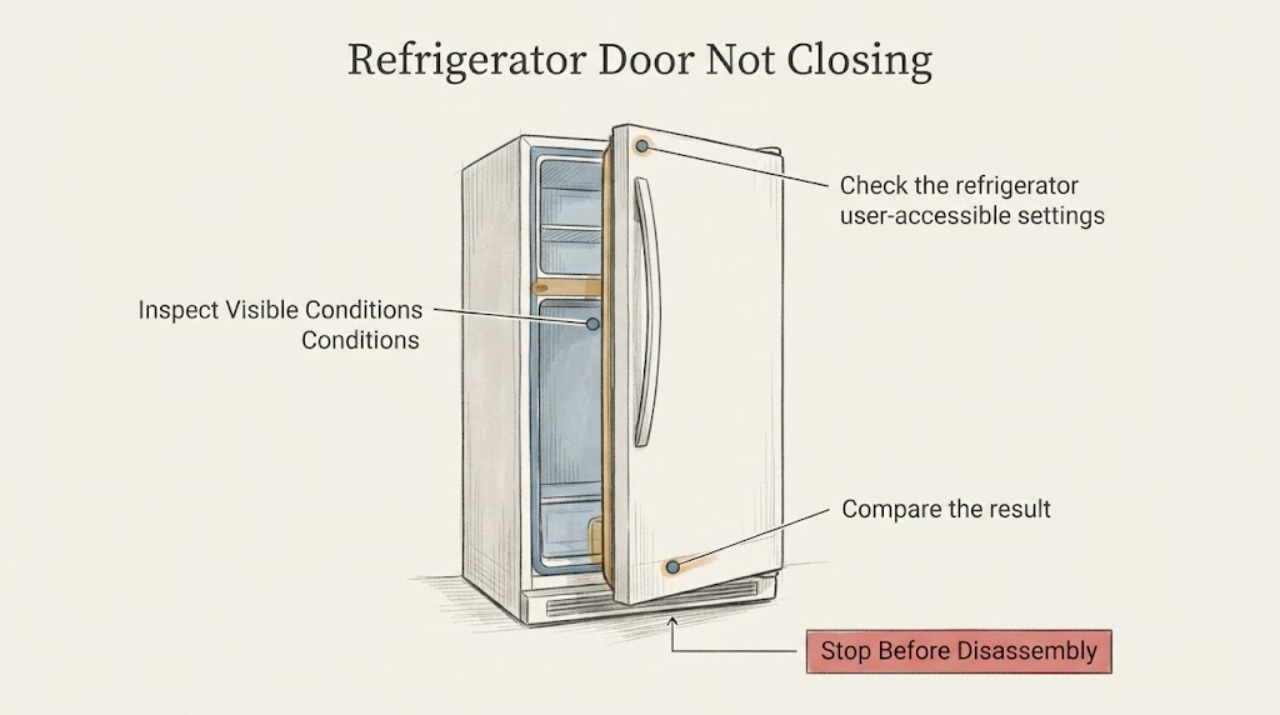
Work through in order
Diagnostic checks
Use only checks that match the exact appliance or system and its official guide.
-
Check 1
Observe the refrigerator during the first stage where the problem appears.
Expected result: The symptom occurs immediately, only after warm-up or water entry, or only near the end of the cycle.
Next step: Record the exact stage and any indicator or code.
Why this matters
Why: The stage separates a supply or control issue from a process-stage restriction or component fault.
-
Check 2
Check the refrigerator user-accessible settings, closure and external paths relevant to the symptom.
Expected result: A setting, latch, filter, vent, drain, tray or hose is visibly out of position or obstructed.
Next step: Correct the obvious user-serviceable condition according to the manual and retry once.
Why this matters
Why: An external restriction or closure issue can prevent the expected result without proving an internal part failure.
-
Check 3
Compare the result with a simple, lightly loaded operation of the refrigerator when safe.
Expected result: The simple operation completes, repeats the symptom, or stops with a code.
Next step: Keep the exact code and conditions for service.
Why this matters
Why: A successful simple run points to loading, mode or setup; a repeat points toward model-specific service diagnosis.
-
Check 4
Check for signs that make continued operation unsafe.
Expected result: There is smoke, sparking, burning odor, overheating, exposed wiring, flooding near electrics or repeated breaker operation.
Next step: Stop use and arrange qualified service.
Why this matters
Why: A hazard sign means the appliance should not be tested further by the user.
Use your observations
Decision map
Find the observation that best matches what you see, then follow the next safe action.
-
PATH 01Next step
What you see
The refrigerator completes a simple correctly loaded operation after the external path and settings are corrected.
Do this next
Use the normal operating instructions and monitor the next cycle.
Why this path and its safety boundary
Why it matters: The original symptom may have been caused by setup, loading, closure or a blocked user-accessible path.
-
PATH 02Next step
What you see
The refrigerator repeats door not closing with the path clear, correct settings selected, or a code displayed.
Do this next
Stop repeated tests, preserve the exact code and arrange qualified service.
Why this path and its safety boundary
Why it matters: A component, sensor, control or installation fault is more likely than a simple setup issue.
Helpful context
Understand the symptom
What the symptom can tell you
The same door not closing symptom can come from setup, airflow or drainage, a closure or control state, or an internal fault. The useful distinction is the stage and pattern: whether the refrigerator is powered, whether the expected path is clear, and whether a simple operation changes the result. Exact controls and service steps vary by model, so use the owner manual linked by Viking when a check depends on a model-specific feature.
When checks do not resolve it
Need a professional?
Arrange qualified Viking appliance service when the external checks do not restore normal operation, when a code repeats, or when the symptom involves sealed systems, internal wiring, refrigerant, pumps, heaters, motors or controls.
Common questions
FAQ
Can I keep using the refrigerator while it shows door not closing?
Only for a brief observation when there is no safety symptom and the manual permits it. Stop immediately if the symptom escalates, water reaches electrical parts, or heat, smoke, sparking or a burning odor appears.
What information should I have ready for service?
Record the full model and serial information, the exact symptom, when it appears, what you observed at the external checks, and any displayed code. Viking support or the owner manual can then identify the correct model-specific procedure.
Read the exact guide
Official sources
- Viking Range, LLC | Owners | Support FAQs for OwnersViking Range, LLC · Viking owner support, authorized service, dishwasher loading/noise and ice-machine support information
- Viking Use & Care ManualViking Range, LLC · Viking dishwasher use, troubleshooting, drain errors, fill errors, level, filters, cycles and service boundary
Community feedback
Share a repair observation
Share a plain-text repair observation. Accepted observations are published automatically; this page may take a moment to update.