
On this page
Start here
Quick answer
A Viking refrigerator that is not working should first be separated into a dark unit with no power, a powered unit that is not cooling, or a one-compartment, door, airflow, or control problem. Check the safe outlet and breaker path, verify the exact model’s controls and cool-down guidance, then inspect visible door, grille, and condenser conditions without removing panels. Move food to safe cold storage and stop for a repeated trip, damaged wiring, a leak, smoke, heavy concealed ice, or persistent warming after these checks.
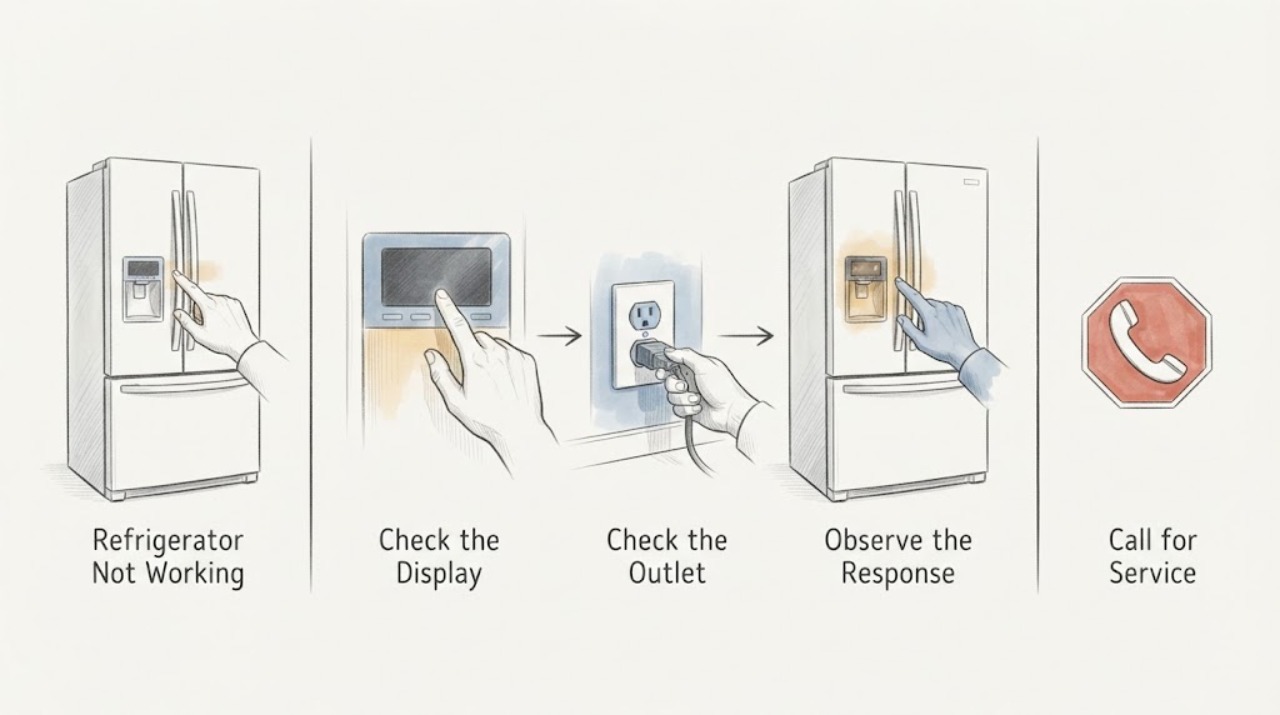
Work through in order
Diagnostic checks
Use only checks that match the exact appliance or system and its official guide.
-
Check 1
Define what “not working” means before changing settings: check whether the interior light or display is on, whether the refrigerator and freezer are both warm, whether the motor or fans are silent, and whether a recent power outage, move, or installation occurred. Move temperature-sensitive food to safe cold storage if the cabinet is warming.
Expected result: The whole unit is dark, the controls work but both compartments are warm, only one compartment is warm, or the compressor is silent while lights remain on.
Next step: Record the exact model, display or alarm, compartment temperatures, and timing, then follow the matching checks below instead of choosing a part from “not working.”
Why this matters
Why: A dark unit keeps the electrical supply in scope; a powered but warm unit needs control, airflow, door-seal, or cooling-system triage. One warm compartment can have a different air-distribution or setting issue than a total no-operation symptom.
-
Check 2
From a dry, safe location, check that the refrigerator plug is fully seated in its grounded outlet and inspect the accessible breaker or fuse. Test the outlet with another suitable appliance only if safe, and do not use an extension cord or remove the grounding prong.
Expected result: The outlet is dead, the breaker or fuse is open, the cord or receptacle is damaged, or household power is normal but the refrigerator remains dark.
Next step: Stop for heat, moisture, damage, or a breaker that trips again and arrange qualified electrical or appliance service. Continue only when the supply is safe and stable.
Why this matters
Why: Viking troubleshooting identifies the plug, live outlet, household fuse or breaker, and power switch as first checks for a refrigerator that will not operate. A repeat trip or damaged connection is an electrical fault boundary.
-
Check 3
Verify the refrigerator controls are on and set to a normal temperature according to the exact manual. If the unit was newly installed or has just been powered after a move, allow the model’s documented cool-down period before judging performance; do not force the coldest setting as a shortcut.
Expected result: The control is off or in a showroom/demo state, a temperature setting was changed, the unit is newly installed, or the controls are normal but the cabinet remains warm after the documented wait.
Next step: Correct only the documented control state and wait the specified period. If the refrigerator remains warm afterward, continue to airflow and door checks and prepare for service.
Why this matters
Why: A control state or normal post-installation pull-down can look like a failure. Viking manuals state that a newly installed refrigerator may need time to cool and that a colder setting does not make the compartments cool faster.
-
Check 4
Inspect door closure and the visible gasket perimeter, then look inside for food blocking the rear air grille or the compartment’s designed air passages. Close both doors fully and keep packages away from vents; do not remove interior panels or scrape hidden ice.
Expected result: A door is ajar, the gasket is dirty or visibly damaged, a package blocks a grille, frost is confined to an accessible surface, or the doors and grilles are clear.
Next step: Reposition food and clean a gasket with the manual-approved method. Request service for a torn gasket, heavy or concealed frost, or a door that will not align.
Why this matters
Why: Viking troubleshooting links warm food temperature to door closure, gasket seal, blocked rear grilles, and control settings. An obstruction can limit air distribution; concealed frost or a damaged seal needs model-specific service guidance.
-
Check 5
Check only the model-approved exterior condenser or rear grille area for dust and obstructions; keep ventilation clear and observe whether the refrigerator makes normal motor or fan sounds. Do not remove covers, touch sealed-system tubing, or use a tool inside the cabinet.
Expected result: The condenser area is visibly obstructed, airflow is restricted, the unit is quiet with normal power, or the compressor pauses and later restarts.
Next step: Clean only the accessible area described by the exact manual and observe once. If there is no recovery, an unusual sound, repeated warm alarms, or a persistent silent compressor, arrange qualified Viking service.
Why this matters
Why: Viking manuals list a dirty or obstructed condenser as a possible cooling problem, while some models can pause during defrost or vary run time with room and load conditions. These observations do not identify a sealed-system or control part.
Use your observations
Decision map
Find the observation that best matches what you see, then follow the next safe action.
-
PATH 01Next step
What you see
The unit is dark, the outlet has no power, or the breaker trips again after reset.
Do this next
Stop resetting the circuit, disconnect the refrigerator only if safe, protect the food, and obtain qualified electrical or appliance service.
Why this path and its safety boundary
Why it matters: An external electrical supply or appliance electrical fault is more likely than a temperature setting.
-
PATH 02Next step
What you see
The panel and lights work, but both compartments remain warm after the exact control setting and documented cool-down period are complete.
Do this next
Keep the doors closed, transfer food to safe cold storage, and request qualified Viking service with temperatures, sounds, model, and checks completed.
Why this path and its safety boundary
Why it matters: A cooling, airflow, sensor, compressor, or sealed-system fault is more likely than a simple no-power condition.
-
PATH 03Next step
What you see
One compartment is warm and a door gasket, blocked grille, control setting, or accessible condenser obstruction is found.
Do this next
Correct the visible condition using the exact manual and allow the documented recovery time; service a damaged seal or recurring warm condition.
Why this path and its safety boundary
Why it matters: A localized airflow, closure, setting, or maintenance condition is more likely and may be correctable without parts.
-
PATH 04Next step
What you see
There is a refrigerant-like odor, oil or water leak, burning odor, smoke, damaged wiring, heavy concealed ice, or a repeated temperature alarm after safe checks.
Do this next
Keep the appliance out of service, disconnect power or water only if safe, move food to safe storage, and arrange qualified Viking service.
Why this path and its safety boundary
Why it matters: The symptom has crossed the safe owner-check boundary or may threaten food safety, property, or electrical safety.
Helpful context
Understand the symptom
Separate no power from no cooling
The refrigerator’s lights and controls can work while the cabinet remains warm, and a completely dark cabinet has a different first check. Viking troubleshooting separates the plug, outlet, fuse or breaker, controls, door seal, condenser, and grille conditions, so record the visible symptom before changing temperature settings.
Keep model-specific details scoped
Viking publishes documentation for many built-in, freestanding, integrated, and discontinued refrigerator families. Use the exact model manual for control states, alarm meanings, access panels, and cool-down timing; this page stays at safe external triage.
Only after diagnosis
Potential parts
- Viking refrigerator door gasket
Consider only when inspection confirms a torn or deformed gasket and the exact model identifies the correct seal.
Match the full model and revision; do not infer fit from refrigerator width or brand alone. - Viking refrigerator temperature sensor or control
Consider only after power, control, door, grille, and condenser checks are normal and qualified diagnosis identifies a sensor or control fault.
Confirm the exact model and service documentation before ordering or opening the cabinet.
When checks do not resolve it
Need a professional?
Use Viking authorized or qualified appliance service when safe external checks do not restore operation or a cooling, compressor, sensor, wiring, or sealed-system fault is suspected.
Have this ready
- Provide the full model and serial, display or alarm, compartment temperatures, power status, control setting, door and gasket observations, condenser or grille condition, motor sounds, and food-preservation steps taken.
Common questions
FAQ
How long should a newly installed Viking refrigerator take to cool?
Use the exact model manual. One Viking manual says to allow 24 hours after installation for complete cooling, and turning the control to its coldest setting does not cool either compartment faster.
Does a silent compressor prove that the compressor has failed?
No. Viking troubleshooting notes that a refrigerator can pause during a defrost period and that run time changes with room temperature, load, and door openings. If it stays warm after the documented checks or a model-specific defrost interval, arrange service rather than diagnosing a part by sound alone.
Read the exact guide
Official sources
- Viking Range, LLC | Refrigeration Product DocumentationViking Range, LLC · Use to locate the manual and installation instructions for the exact Viking refrigerator SKU or product name.
- Viking Use & Care Manual: Refrigerator TroubleshootingViking Range, LLC · Applies to the refrigerator family covered by this manual; controls, grilles, and service access vary by Viking model.
- Viking Range, LLC | Support and Docs | Support CenterViking Range, LLC · Use for Viking support or authorized service when safe external checks do not restore operation; provide the exact product identity.
- Viking Use & Care Manual: Refrigerator Operation and TroubleshootingViking Range, LLC · Applies to the manual’s Viking refrigerator family; use the exact model documentation for controls and installation conditions.
Community feedback
Share a repair observation
Share a plain-text repair observation. Accepted observations are published automatically; this page may take a moment to update.