
On this page
Start here
Quick answer
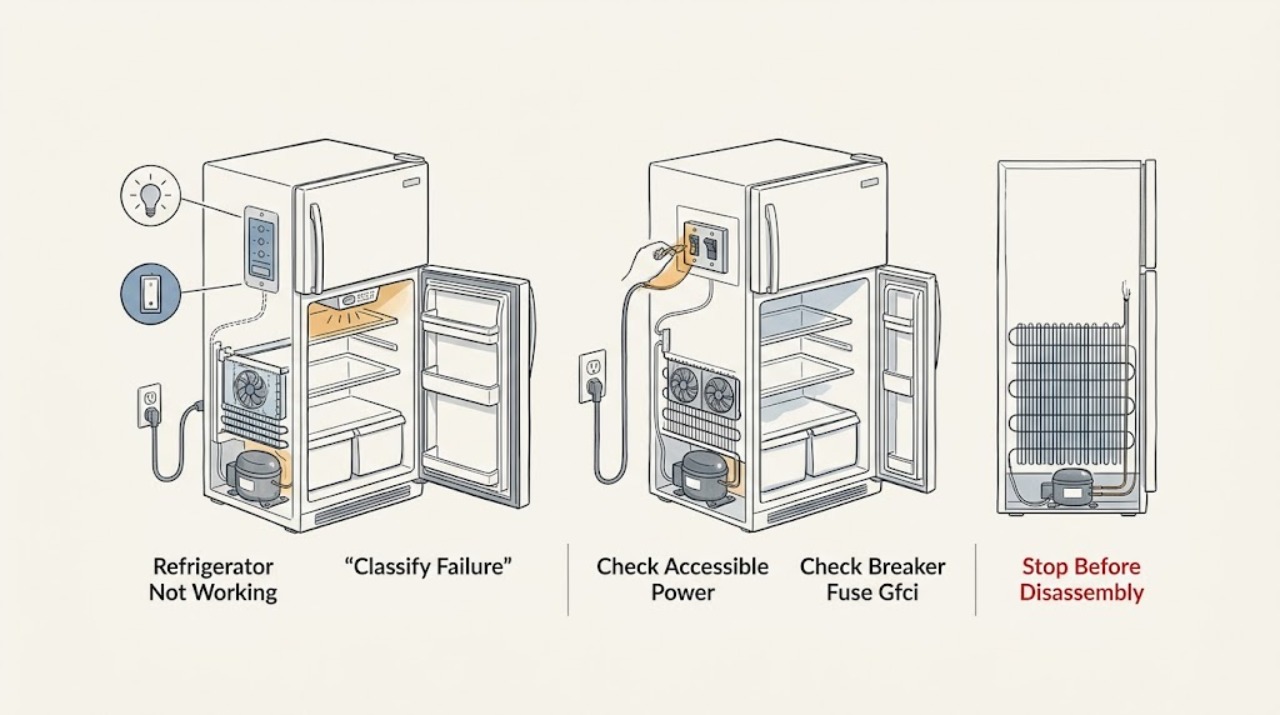
First separate a completely dead Amana refrigerator from one that has lights or controls but is not cooling. Check the accessible power cord and outlet, then look for a tripped breaker, GFCI, or fuse; do not use an extension cord. Confirm the refrigerator controls and cooling function are on, and check the model manual if a power-outage, Showroom, Sabbath, or other mode is displayed. If the control panel is unresponsive, Amana documents turning the refrigerator off at the breaker or unplugging it for one minute, restoring power, and ensuring cooling is on. If lights work but cooling is temporarily quiet, a defrost period may be possible on some models; do not assume that explains persistent warm food. Keep doors closed to protect food and arrange qualified service for a repeated power trip, persistent no-power/no-cooling condition, unusual heat, burning odor, water near electricity, or any repair requiring panels or sealed-system access.
Work through in order
Diagnostic checks
Use only checks that match the exact appliance or system and its official guide.
-
Check 1
With the refrigerator doors closed as much as practical, record whether the interior light, display, dispenser, and fans respond; whether the freezer or fresh-food compartment is warm; whether you hear a compressor or fan; and whether the problem began after a power outage, cleaning, moving, or temperature adjustment.
Expected result: Nothing responds; lights or display work but both compartments are warm; the unit is quiet only temporarily; the display shows a mode or power-outage message; or one compartment is warm while the other still cools.
Next step: Use the power check for a dead unit, the mode/control check for a display or control symptom, and the cooling/environment checks when lights work but temperatures are high. Keep doors closed and protect perishable food if cooling is lost.
Stop if: Do not keep opening the doors or restart the refrigerator repeatedly if there is smoke, burning odor, water near electricity, unusual heat, or a tripping circuit.
Why this matters
Why: No lights or control response makes a supply or control path more likely. Lights with warm food point to a cooling, setting, airflow, door-seal, defrost, or internal refrigeration path. A model-specific display message can change which controls are available. One warm compartment does not prove a complete refrigerator power failure.
-
Check 2
From an accessible location, check that the refrigerator power cord is fully seated in its intended grounded outlet and that the outlet is not controlled by a wall switch. If the outlet's status is uncertain and it is safe to reach, test it with a small known-working lamp or appliance; do not use an extension cord or open the refrigerator's electrical enclosure.
Expected result: The plug is loose, the outlet is dead, the outlet works, the refrigerator is hardwired or inaccessible, or a cord or outlet shows heat or damage.
Next step: Restore only a safely accessible loose plug. If the outlet is dead, stop and have the circuit checked. If power is present at the outlet but the refrigerator remains dead, continue to the breaker, controls, and one-time reset checks.
Stop if: Do not use an extension cord, bypass grounding, remove a plug or junction-box cover, or handle a hot or damaged connection.
Why this matters
Why: Amana identifies an unpowered outlet or disconnected cord as a cause of no operation. A dead outlet points to household electrical supply rather than an immediately proven refrigerator component. Heat, damage, or an inaccessible connection requires an electrician or technician rather than improvised testing.
-
Check 3
Check the household electrical panel and any accessible GFCI outlet for a tripped refrigerator circuit. Reset a tripped breaker or GFCI once, or replace a blown fuse only with the same type and rating specified for the household circuit; do not work inside the refrigerator.
Expected result: The breaker or GFCI was tripped and stays on; a fuse was blown; nothing was tripped; or the protection device trips again immediately or when the refrigerator starts.
Next step: If the circuit stays on, proceed to the controls and one-minute reset check. If it trips again, leave the refrigerator circuit off and contact a qualified electrician or appliance technician; keep doors closed and move food if needed.
Stop if: Do not increase fuse or breaker capacity, repeatedly reset a tripping circuit, or touch exposed wiring.
Why this matters
Why: Amana lists a tripped breaker, GFCI, or household fuse as a no-operation check. Recovery without another symptom supports a supply interruption. A repeated trip points to an electrical fault or overload and is not a reason to keep resetting the circuit.
-
Check 4
Use the exact Amana Owner's Manual to confirm that the refrigerator controls and cooling function are on. If the display shows a power-outage confirmation, Showroom or Demo mode, Sabbath mode, or another model-specific state, follow only that manual's exit procedure; do not infer a button combination from another model.
Expected result: The control is off; a showroom/demo or Sabbath state is shown; a power-outage message blocks other functions; the cooling function is off; or the controls are on but the refrigerator remains warm or unresponsive.
Next step: Restore the control or exit the mode using the model manual, then allow the appliance to operate normally. If the display remains unresponsive, continue to the one-minute reset; if cooling is on but temperatures stay high, perform the environment and sealing checks.
Stop if: Do not repeatedly change temperature settings, use an undocumented mode sequence, or open the control panel.
Why this matters
Why: Amana says controls may be turned off accidentally and that Showroom/Demo or Sabbath mode can disable cooling, controls, lights, or other functions on some models. A control that is on with persistent no response or no cooling needs a power reset and then service if unresolved.
-
Check 5
If there is no smoke, water near electricity, or repeated breaker trip, turn the refrigerator off at its breaker or unplug it for one minute, then restore power. Confirm the cooling function is turned on and test the control panel and cooling response once; do not use this as a repeated cycle.
Expected result: The display and cooling return; only the display returns; the refrigerator remains dead or warm; or the breaker trips during the reset or restart.
Next step: Monitor a refrigerator that recovers. If it remains dead, warm, or repeatedly loses operation, stop troubleshooting and arrange qualified service; if the circuit trips, leave it off and contact an electrician or technician.
Stop if: Do not reset repeatedly or restart a refrigerator with burning odor, unusual heat, water near electrical parts, or a repeated protection-device trip.
Why this matters
Why: Amana documents this one-minute reset for a control panel that is not responding. Recovery supports a temporary control or power state. Persistent no power, no cooling, or another trip leaves an internal or household fault possible without identifying the failed part.
-
Check 6
Only when the lights and controls work but the refrigerator is warm, check that the controls are not set incorrectly, the appliance is not beside an oven, radiator, or other heat source, accessible air paths are not blocked, and doors close against clean, intact gaskets. Do not remove panels or attempt sealed-system work.
Expected result: The refrigerator is near a heat source; a door does not seal or is misaligned; an air path is blocked; settings were changed recently; or the surroundings and controls are normal but food remains warm.
Next step: Remove only a safe external obstruction, restore the model-approved setting, and allow the refrigerator time to stabilize rather than repeatedly changing controls. If the seal, airflow, and settings are normal but cooling does not recover, arrange service and protect food.
Stop if: Do not force a door, remove gaskets or panels, clean energized components, or diagnose refrigerant or compressor problems yourself.
Why this matters
Why: Amana identifies heat exposure, incorrect controls, blocked airflow, and poor door sealing as possible contributors to temperature problems. A normal exterior environment with persistent warm food makes an internal cooling, fan, compressor, defrost, or control fault more likely, but not a specific failed component.
-
Check 7
If lights work but the fans and compressor are quiet, compare the timing with the exact Owner's Manual and observe only one normal operating period. Some Amana manuals describe a temporary defrost period as one possible explanation; if the refrigerator remains warm, the quiet period repeats abnormally, or frost, water, noise, or heat appears, stop testing and record the details for service.
Expected result: Cooling resumes normally after the model-appropriate operating period; the refrigerator remains warm and silent; frost or water is present; or the unit has unusual noise, heat, odor, or a display alert.
Next step: Monitor normal recovery. Otherwise leave the refrigerator running only if it is electrically and physically safe, keep doors closed, transfer perishable food, and arrange qualified Amana or appliance service.
Stop if: Do not remove frost with sharp or heated tools, bypass a defrost control, or open the sealed system.
Why this matters
Why: A temporary defrost explanation is model- and symptom-dependent; it does not explain persistent no cooling. Continued warm food or a safety/performance symptom requires internal diagnosis rather than a guessed fan, heater, thermostat, or compressor replacement.
Use your observations
Decision map
Find the observation that best matches what you see, then follow the next safe action.
-
PATH 01Safety boundary
What you see
The interior light, display, controls, and cooling response are all absent, and the accessible plug, outlet, breaker, GFCI, or fuse has not restored operation.
Do this next
Perform the one-minute reset once only if no unsafe symptom is present. If the refrigerator remains dead, or the circuit trips again, leave it off and arrange qualified electrician or appliance service.
Why this path and its safety boundary
Why it matters: A household supply, cord, control-supply, wiring, or internal electrical fault is more likely than a temperature-setting problem.
Safety stop: Do not repeatedly reset protection devices, open wiring covers, or use an extension cord.
-
PATH 02Safety boundary
What you see
The refrigerator has power, but the control panel shows a power-outage, Showroom/Demo, Sabbath, or cooling-off state, or the cooling function is turned off.
Do this next
Use the exact Amana Owner's Manual to confirm the event or exit the mode, ensure cooling is on, and observe normal operation. Escalate if the controls remain locked or cooling does not return.
Why this path and its safety boundary
Why it matters: A model-specific control state is more likely than a proven compressor or sealed-system failure.
Safety stop: Do not copy an undocumented mode sequence or open the control panel.
-
PATH 03Safety boundary
What you see
Lights and controls work, the refrigerator is not in a special mode, and the unit is warm with a nearby heat source, blocked airflow, door misalignment, dirty gasket, or recent setting change.
Do this next
Correct only an accessible external condition, restore the model setting, and allow time for temperature stabilization. If food stays warm with normal surroundings and sealing, arrange service.
Why this path and its safety boundary
Why it matters: An external cooling condition is more likely than an immediately proven internal part failure.
Safety stop: Do not remove panels, force the door, or change settings repeatedly.
-
PATH 04Safety boundary
What you see
Power and controls are confirmed, one reset did not help, and the refrigerator remains warm, silent, frosted, leaky, unusually hot, or otherwise abnormal.
Do this next
Stop repeated testing, protect food, and arrange qualified Amana or appliance service with the model number, temperatures, sound pattern, display status, and checks completed.
Why this path and its safety boundary
Why it matters: An internal fan, compressor, defrost, control, wiring, airflow, or sealed-system issue remains possible; the public checks cannot identify a safe replacement part.
Safety stop: Do not open the sealed system, bypass controls, chip away frost with sharp tools, or order a compressor, fan, heater, or control board by symptom alone.
Helpful context
Understand the symptom
“Not working” has two different starting paths
If the interior lights, display, and cooling response are all absent, start with the electrical supply and controls. If lights or controls work but food is warm, start with cooling settings, operating modes, airflow, door sealing, and heat exposure. A refrigerator that is quiet for a short defrost period is not the same as one that remains warm and silent; record the symptom before changing settings or ordering a compressor.
Amana models do not share one control sequence
The task contains no model number. Amana says that Showroom, Sabbath, power-outage, and cooling-control behavior—and the way to exit a mode—varies by model. Use the exact Owner's Manual for the control layout and any mode reset. The checks below are limited to accessible power, controls, doors, temperature surroundings, and one documented reset.
Do not diagnose the sealed system from a warm cabinet
Warm food can follow a power interruption, an off or demonstration setting, a door-seal problem, heat exposure, airflow or condenser maintenance, a defrost condition, or an internal refrigeration fault. These symptoms overlap. Do not remove panels, probe live wiring, handle refrigerant, or buy a compressor, fan, thermostat, or control board without a model-specific diagnosis.
When checks do not resolve it
Need a professional?
The refrigerator remains dead or warm after one model-appropriate reset and the outlet/circuit is known to have power., A breaker, GFCI, or fuse trips again, a cord or outlet is hot or damaged, or hardwired electrical access is needed., Cooling remains abnormal with normal settings, doors, seals, and surroundings, or there is smoke, burning odor, unusual heat, water near electricity, heavy frost, or a leak.
Have this ready
- The complete Amana model and serial information, installation type, and whether the unit is cord-connected or hardwired.
- Whether lights, display, dispenser, fans, and compressor respond; current compartment temperatures; and any mode, alert, frost, leak, odor, or noise.
- Outlet, breaker/GFCI, control, one-minute reset, door-seal, heat-source, and airflow observations, plus any recent outage, move, cleaning, or setting change.
Common questions
FAQ
What should I check first when my Amana refrigerator will not work?
Determine whether the lights and controls are also dead. For no power, check the accessible plug and outlet, then the breaker, GFCI, or fuse. For warm food with lights on, check the controls, special modes, door sealing, heat exposure, and airflow instead of assuming the refrigerator has no power.
How do I reset an Amana refrigerator?
If there is no unsafe symptom and the circuit is not repeatedly tripping, turn the refrigerator off at its breaker or unplug it for one minute, restore power, ensure cooling is on, and test once. Amana says to schedule service if the control panel remains unresponsive.
Why is my Amana refrigerator warm but the lights still work?
Amana lists controls that are off or set incorrectly, Showroom or Demo mode, a nearby heat source, and power-supply history among initial checks. Also check that doors close and gaskets seal. If settings and surroundings are normal but food remains warm, arrange service rather than ordering a compressor or fan by guesswork.
Can an Amana refrigerator be quiet during a defrost period?
Some Amana manuals describe a temporary defrost period as a possible reason lights work while fans and the compressor are not operating. That explanation is model- and timing-dependent; persistent warmth, repeated quiet periods, heavy frost, water, or an unusual odor needs service.
When should I stop troubleshooting an Amana refrigerator?
Stop when the breaker or GFCI trips again, the refrigerator remains dead after one reset, cooling stays abnormal after the external checks, or there is smoke, burning odor, unusual heat, water near electrical parts, heavy frost, a leak, or a need to open panels. The symptom does not identify a safe replacement part.
Read the exact guide
Official sources
- Use & Care GuideAmana · This specific manual's normal operating sounds, defrost-period note, no-operation checks, door seals, and service escalation; not a universal model procedure
- Control Panel Not Working - RefrigeratorAmana · Power-outage indication, Showroom/Demo mode, Sabbath mode, cooling function, and control reset; exact sequences vary by model
- 5 Reasons Why Your Refrigerator May Not Be CoolingAmana · Off state, power supply, controls, heat sources, Showroom/Demo mode, and professional-repair escalation when a refrigerator is warm
- No Operation - Will Not Turn On - RefrigeratorAmana · Accessible cord/outlet, breaker/GFCI/fuse, and refrigerator controls for a French-door bottom-freezer architecture; use the exact model manual when different
- Refrigerator Troubleshooting Door Light Leakage IssuesAmana · Leveling, door alignment, gasket condition, and sealing checks that can affect temperature stability
Community feedback
Share a repair observation
Share a plain-text repair observation. Accepted observations are published automatically; this page may take a moment to update.