
On this page
Start here
Quick answer
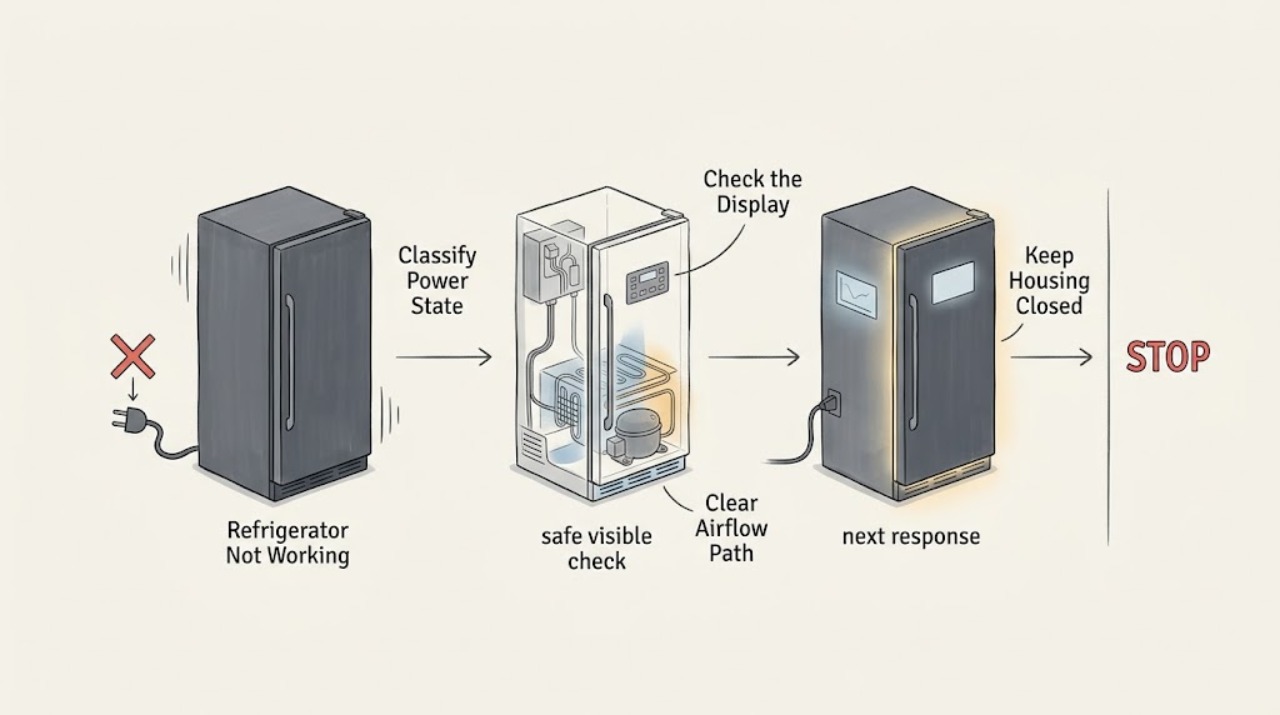
First decide whether the Daewoo refrigerator is completely without power or is powered but not cooling. Check the plug, outlet, fuse or breaker, and any display or interior light from a dry, accessible position; do not open the electrical compartment. If power is present, check the temperature control or mode, door closure, airflow around the cabinet, condenser dust, and whether the cabinet is overloaded. Daewoo's opened fridge-freezer manual lists power, plug, fuse, socket, door closure, condenser dust, clearance, and overload as separate first checks, while its alarm guidance treats a continuing cooling failure as a service matter. A compressor, fan, defrost, control, sealed-system, or internal wiring diagnosis requires qualified service. Stop for a damaged cord, burning odor, smoke, sparks, abnormal heat, water near electrical parts, or a repeated protection trip.
Before you begin
Safety first
- This article covers external power observation, model lookup, ordinary control or mode checks, door and gasket inspection, load and clearance checks, and permitted visible external cleaning. A qualified professional must handle internal electrical parts, motors, fan, defrost system, controls, sensors, compressor, sealed refrigeration circuit, inaccessible wiring, and energized testing.
Work through in order
Diagnostic checks
Use only checks that match the exact appliance or system and its official guide.
-
Check 1
From a dry, accessible position, check whether the display, interior light, or any normal operating sound is present. Inspect the plug and cord for obvious looseness or damage without opening the appliance. If the outlet is safely accessible, confirm its operation using a known-good appliance or the home's normal electrical check; do not remove an outlet cover.
Expected result: The refrigerator is completely dark and silent, the display or interior light works, the plug or outlet is loose or damaged, or a fuse or breaker has operated.
Next step: For a safe, resettable household protection event with no damage, follow the home's normal reset procedure once and observe without opening the appliance. If the refrigerator remains dead, or any cord, outlet, heat, odor, smoke, spark, or repeat-trip symptom appears, leave it off and arrange qualified service.
Stop if: Do not touch damaged electrical parts, use an adapter or extension cord as a workaround, remove covers, or keep resetting a protection device.
Why this matters
Why: No light, display, or sound makes a supply, plug, outlet, fuse, or control-power problem more likely. A working light or display means the refrigerator is receiving at least some power, so a cooling or subsystem problem is more likely. A damaged cord, warm outlet, or repeated protection operation is a safety issue.
-
Check 2
If the refrigerator has power, read the full model number and check the matching manual for the temperature control, cooling mode, holiday or standby mode, child lock, and alarm indicators. Confirm that the control is not set to an off or standby state and note any displayed warning rather than guessing its meaning.
Expected result: The control is off or in a non-cooling mode, an alarm or error indicator is present, the setpoint appears normal, or the model's control behavior is unclear.
Next step: Use only the matching manual to exit an unintended user mode or record the warning. If the warning returns or the control is normal but cooling does not resume, keep the appliance in service hands and continue with the external checks or arrange service.
Stop if: Do not enter a service test, bypass a lock or sensor, or repeatedly reset an unexplained error.
Why this matters
Why: An off, standby, or model-specific mode can make a powered refrigerator appear not to work. An alarm or error indicator may point to a cooling or sensor condition, but its meaning is model-specific. A normal control state does not prove the compressor or sealed system is sound.
-
Check 3
Inspect the door gasket and closure, food packages that may hold the door open, cabinet loading, and the clear space around the rear and sides. Look for visible external condenser dust only where the manual allows access; do not pull out a built-in unit or remove a rear cover.
Expected result: The door is not sealing, the cabinet is overloaded, the rear or side clearance is restricted, or visible dust is obstructing the permitted external condenser area; or these checks look normal.
Next step: Remove only a package blocking closure, restore the manual's required clearance, and clean only the accessible external area described by the manual. Then allow the appliance to stabilize under normal operation; if it remains warm, arrange service.
Stop if: Do not scrape coils with sharp tools, use heat or chemicals to defrost, move a heavy built-in refrigerator, or open the machine compartment.
Why this matters
Why: A door that remains open, heavy loading, restricted airflow, or external condenser dust can make cooling poor without proving a compressor or refrigerant failure. Normal exterior conditions make a fan, defrost, control, compressor, sensor, or sealed-system fault more likely but do not identify one.
-
Check 4
With the appliance closed and operating normally from the exterior, note which subsystem is affected: the refrigerator compartment, freezer compartment, interior light, display, fan sound, ice maker or water function, or all functions. Record unusual noises, frost or ice visible without dismantling, temperature change, and any alarm indicator.
Expected result: Only one compartment or function is affected, both compartments are warming while controls still work, the light or display is the only failure, frost blocks visible airflow, or an alarm remains active.
Next step: Use the model manual for the affected function and report the exact pattern to Daewoo technical service. Do not remove panels, force a fan, dismantle the ice maker, or perform electrical or refrigeration tests.
Stop if: Stop using the refrigerator and arrange prompt help for smoke, burning odor, unusual heat, leaking water near electrical parts, repeated trips, or a rapidly worsening temperature loss.
Why this matters
Why: A single-compartment or single-function symptom points toward that subsystem or its control path. Both compartments warming with power present raises concern about airflow, defrost, compressor, control, or sealed-system operation. A light-only or display-only failure does not prove the cooling system is off. Visible frost may be relevant, but it does not identify a defrost component without service diagnosis.
-
Check 5
After one safe correction of an unintended mode, blocked door, load, clearance, or permitted external dust condition, observe whether normal cooling and controls return. Keep the refrigerator supervised and note whether the compressor or fan sound is absent, abnormal, or cycling with no temperature improvement.
Expected result: The refrigerator returns to normal, remains powered but warm, repeatedly enters an alarm state, becomes noisier, or loses power again.
Next step: If the problem persists or returns, turn the controls to the safe state described by the manual, unplug only from a safe dry position if needed, protect food, and arrange Daewoo or qualified appliance service with the model and observations.
Stop if: Do not dismantle the compressor or fan, open the sealed system, add refrigerant, bypass a sensor, or perform an energized electrical test.
Why this matters
Why: Recovery after an external condition supports that condition as the immediate cause. Continued warming with power present, repeated alarms, abnormal or absent compressor/fan operation, or recurring power loss makes an internal control, motor, defrost, compressor, or sealed-system problem more likely.
Use your observations
Decision map
Find the observation that best matches what you see, then follow the next safe action.
-
PATH 01Safety boundary
What you see
The display, interior light, and operating sounds are absent, or the plug, outlet, fuse, or breaker shows a supply problem.
Do this next
Use only the home's safe outlet or protection reset procedure once when there is no damage. If power does not return or any electrical warning remains, leave the refrigerator off and arrange qualified appliance or electrical service.
Why this path and its safety boundary
Why it matters: A household supply, plug, cord, fuse, outlet, or appliance power-input problem is more likely than a cooling-only fault.
Safety stop: Do not use a damaged cord, bypass grounding, remove outlet or appliance covers, or keep resetting protection devices.
-
PATH 02Safety boundary
What you see
The light or display works, but food is warming or both compartments cool poorly, while the control is set normally.
Do this next
Check the door, load, clearance, and permitted external condenser area once. If cooling does not recover after the appliance has had time to stabilize, arrange service and protect perishable food.
Why this path and its safety boundary
Why it matters: Door closure, overload, condenser dust, restricted clearance, airflow, defrost, fan, compressor, control, or sealed-system issues are possible; the manual's exterior checks do not diagnose the internal cause.
Safety stop: Do not remove rear covers, force a fan, scrape internal ice, test live wiring, or open the refrigeration circuit.
-
PATH 03Safety boundary
What you see
Power is present but the symptom is limited to one compartment, the light or display, an ice or water function, or a model-specific mode or alarm.
Do this next
Record the affected function and exact indicator, then follow only the matching manual's ordinary user guidance. If the indicator returns or the function remains inoperative, contact technical service.
Why this path and its safety boundary
Why it matters: A subsystem control, sensor, door-related condition, or model-specific setting is more likely than complete refrigerator power loss, but the affected function must be matched to the exact manual.
Safety stop: Do not copy an error procedure from another Daewoo model, enter service mode, or bypass a sensor or lock.
-
PATH 04Safety boundary
What you see
The safe external checks are normal but cooling does not return, the compressor or fan is abnormal or absent, an alarm recurs, or there is heat, odor, smoke, water near electrical parts, or repeated protection operation.
Do this next
Stop using the refrigerator, isolate power only if safe, protect food, and arrange prompt Daewoo or qualified appliance service.
Why this path and its safety boundary
Why it matters: An internal motor, defrost, control, sensor, compressor, wiring, sealed-system, or safety fault is more likely and operation may cause further damage or a hazard.
Safety stop: Do not open panels, handle refrigerant tubing, bypass protection, reset repeatedly, or perform any energized test.
Helpful context
Understand the symptom
Not working can mean two different failures
A Daewoo refrigerator with no display, no interior light, and no operating sound has a different first path from one whose light and controls work but whose food is warming. Record what still works: display, interior light, fan sound, compressor sound, and any alarm indicator. That observation prevents a cooling diagnosis from being applied to a supply problem, or a power reset from masking a real cooling fault.
Use the model manual for controls and alarms
Daewoo sells multiple refrigerator and fridge-freezer families with different cooling technologies and configurations. The official product catalog lists direct-cooling, frost-free, no-frost, single-door, side-by-side, and multi-door products, so a control setting or alarm meaning from one model cannot be assumed for another. Find the full model number before interpreting an indicator or changing a mode.
Keep the repair boundary at the cabinet exterior
The safe user checks are limited to the plug and outlet area, controls, door and gasket, visible clearance, external dust, and the matching manual's ordinary user settings. Do not remove rear covers, access a compressor or fan, clear internal ice with sharp tools or heat, test energized wiring, add refrigerant, or bypass a sensor. Daewoo directs persistent breakdowns to its technical service network, and a qualified appliance professional can separate compressor, fan, defrost, control, and sealed-system faults.
Safety boundary
Stop conditions
- Stop using the refrigerator for smoke, sparks, burning odor, abnormal heat, a damaged cord or outlet, water near electrical parts, exposed wiring, or a breaker or other protection device that trips again; isolate power only if safe and arrange prompt professional help.
- Keep user checks at the plug and outlet area, controls, door and gasket, visible clearance, external dust, and the exact model manual's ordinary settings. Do not remove rear covers or enter service modes.
- Do not dismantle the compressor, fan, defrost system, control, or sealed refrigeration circuit; do not add refrigerant, bypass a sensor, or perform an energized electrical test.
- If the refrigerator remains powered but warm, an alarm recurs, or a safe external correction does not restore operation, protect food and arrange Daewoo or qualified appliance service.
Only after diagnosis
Potential parts
- Daewoo model-matched door gasket or external condenser-care component
Consider this category only when the matching manual and inspection identify a damaged gasket or a service-approved external component after confirming the door or airflow symptom; a refrigerator that is not working does not by itself justify a part purchase.
Confirm the complete Daewoo model and the manufacturer's fit information before ordering; do not remove panels or sealed components for this check. - Daewoo model-matched fan, defrost, control, or compressor-related component
Consider this category only after qualified service identifies the failed internal component following the power, control, door, load, clearance, and cooling observations; the symptom alone cannot select a part.
Confirm the full model and professional diagnosis before ordering; internal electrical, compressor, defrost, and sealed-system work is service work.
When checks do not resolve it
Need a professional?
Safety scope: This article covers external power observation, model lookup, ordinary control or mode checks, door and gasket inspection, load and clearance checks, and permitted visible external cleaning. A qualified professional must handle internal electrical parts, motors, fan, defrost system, controls, sensors, compressor, sealed refrigeration circuit, inaccessible wiring, and energized testing.
Common questions
FAQ
Why is my Daewoo refrigerator completely dead?
Start by separating a power problem from a cooling problem. If the display, interior light, and operating sounds are all absent, check the plug, outlet, fuse or breaker, and cord from a safe accessible position. If power does not return or any electrical warning is present, leave the refrigerator off and arrange qualified service.
What if the light and display work but the Daewoo refrigerator is warm?
That is a powered-but-poor-cooling path, not proof of complete power loss. Check the temperature mode, door closure, cabinet loading, rear and side clearance, and only the external condenser area the matching manual permits. If both compartments remain warm, arrange service for airflow, defrost, fan, compressor, control, or sealed-system diagnosis.
Can a Daewoo refrigerator mode make it look like it is not working?
Yes, a model-specific off, standby, holiday, lock, or alarm state can change operation, but controls and indicators differ across Daewoo families. Use the exact model manual and do not copy a mode or error procedure from another refrigerator.
Should I remove the rear cover to check the compressor or fan?
No. A compressor, fan, defrost component, control, wiring, or sealed-system diagnosis requires qualified service. Keep checks to the plug, controls, door, load, clearance, and any manual-approved visible external cleaning, and stop for heat, odor, smoke, sparks, or a protection trip.
What information should I give Daewoo service?
Provide the complete model number, whether the display and interior light work, which compartment is warm, the exact alarm or error indicator, and the results of the power, control, door, load, clearance, and permitted external checks. Also report any unusual sound, odor, heat, smoke, spark, water, or protection-device symptom.
Read the exact guide
Official sources
- COOLING – DaewooDaewoo · Official Daewoo product catalog opened for current cooling products; it supports model and technology variation, not a diagnosis for a particular appliance.
- Technical Service and WarrantyDaewoo · Official Daewoo support page opened for the brand's European appliance network; availability and terms vary by country, so use the applicable local service route.
- Fridge - Freezer / User ManualDaewoo · Official Daewoo-hosted manual for the FTL213FRT0RS family; use its troubleshooting checks as a family example and confirm the full model before applying controls or alarms.
Community feedback
Share a repair observation
Share a plain-text repair observation. Accepted observations are published automatically; this page may take a moment to update.