
On this page
Start here
Quick answer
First classify what has stopped: the display and interior light, cooling, water/ice dispensing, or normal operation accompanied by noise or an alarm. For a powered Bosch refrigerator that is warm, check the temperature setting, make sure external and internal air vents are not blocked, and confirm the doors close and seal; Bosch lists these as simple checks. For water or ice, check the door/lock state, supply valve, visible hose, exact model filter, ice setting, bin, and chute without reaching into mechanisms. A completely dead unit, persistent error, repeated breaker trip, damaged cord, leak, abnormal heat, or a refrigerator that remains warm after the accessible checks needs Bosch service or a qualified electrician. Do not open sealed refrigeration or electrical systems.
Before you begin
Safety first
- Do not open the sealed refrigeration circuit, remove electrical covers, probe live wiring, force a fan/valve, reach into the ice maker, disconnect a pressurized water line, or install a guessed part. Use only the exact Bosch manual's accessible checks. If a cord is damaged, water reaches electrical parts, smoke/heat is present, or a breaker repeatedly trips, isolate the appliance only from a safe position and use qualified help.
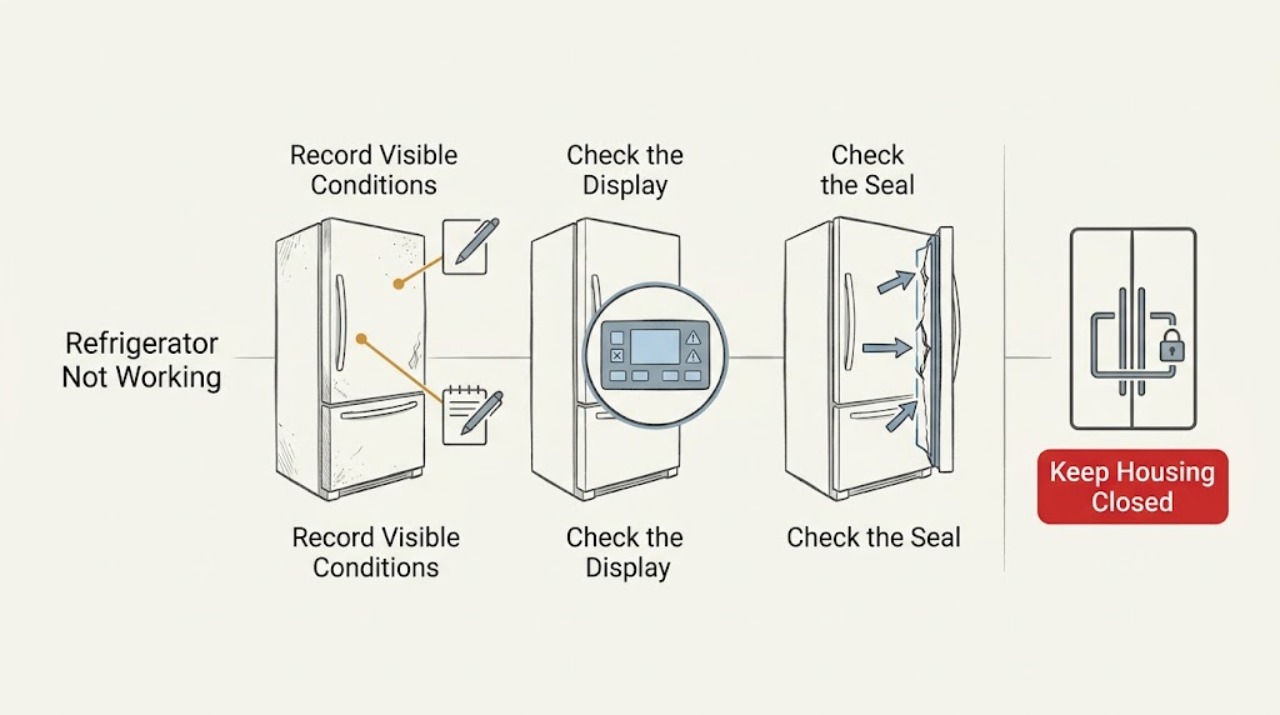
Work through in order
Diagnostic checks
Use only checks that match the exact appliance or system and its official guide.
-
Check 1
Classify the failure before changing settings: note whether the display and interior light are dark, the unit has power but is warm, only water or ice fails, or an alarm, code, or unusual noise is present. Record the full Bosch model number so the exact manual and support path can be used.
Expected result: The refrigerator is completely unpowered, cooling is absent with lights on, a dispenser/ice function alone fails, or a code/noise/alarm accompanies the complaint.
Next step: Follow only the matching branch below. If the symptom is unclear, an error persists, or there is a leak, heat, smoke, or damaged cord, stop at the safe checks and arrange service.
Why this matters
Why: These symptoms point to different branches. A shared power problem is different from a cooling-airflow issue, and an isolated dispenser failure should not be diagnosed as a compressor fault.
-
Check 2
For a dark display and interior light, make only a safe visual check of the appliance's visible power connection and household breaker or fuse position, provided the area is dry and there is no odor, heat, or damaged cord. Do not repeatedly reset a breaker, pull a damaged plug, or remove a panel.
Expected result: The breaker is visibly tripped, the cord or plug is damaged, the outlet area is hot/wet/discolored, or the supply appears normal but the refrigerator remains dark.
Next step: Leave the appliance isolated and use a qualified electrician for a damaged or repeatedly tripping supply. Contact Bosch-authorized service for the refrigerator; do not open the electrical compartment or restore power as a test.
Why this matters
Why: A trip or damaged connection makes the household supply or power cord a priority; a normal-looking panel does not rule out an internal power-board or control fault. Repeated resets can turn an unresolved fault into a hazard.
-
Check 3
For a refrigerator with power but poor or absent cooling, check the temperature setting, confirm that food is not blocking the internal or external vents, and verify that the doors close without an obvious obstruction and the accessible gasket is intact. Do not remove interior covers or service the compressor, fan, or refrigerant circuit.
Expected result: The setting was changed, vents were blocked, a door or seal was not closing, or all accessible airflow and door checks are normal but the compartments remain warm.
Next step: Correct only the visible obstruction or setting allowed by the manual and monitor according to the model instructions. If temperatures do not recover, an alarm persists, or food safety is at risk, contact Bosch service promptly rather than adjusting the sealed system.
Why this matters
Why: A corrected setting, clear vent, or properly closed door can explain a recoverable cooling complaint. Persistent warmth with those conditions normal makes an airflow, sensor, fan, compressor, sealed-system, or control problem more likely.
-
Check 4
For water or ice that will not dispense, check whether the door is fully closed and the dispenser/keylock is active, then inspect the accessible water valve position, visible hose, model-specific filter status, ice-production setting, ice bin seating, and chute for a visible frozen-together blockage. Do not reach into the ice maker or disconnect a pressurized water line.
Expected result: Only water fails, only ice fails, both fail, the filter is blocked/overdue, the hose or supply is abnormal, or the ice bin/chute is obstructed.
Next step: Use the exact model manual for a filter change, lock control, or accessible chute correction. If flow does not return, a connection leaks, both functions fail, or an internal mechanism is suspected, stop using the affected function and arrange Bosch service.
Why this matters
Why: Bosch manuals treat water supply, pressure, hose, filter, door/lock, ice setting, bin, and chute conditions as separate causes. A clear water path with water-only failure can involve an internal valve or dispenser; a clear ice path with ice-only failure can involve the ice maker or auger.
-
Check 5
For noises, alarms, or a displayed refrigeration code, record the exact sound, alarm indicator, code, and when it occurs, then compare it with the model manual or Bosch error-code list. Do not remove panels or run a self-test to make the sound or code recur.
Expected result: The sound is a documented hum/click or valve/defrost noise, the alarm clears after its documented condition ends, or the noise/code is loud, persistent, unexplained, or returns.
Next step: Follow only the model-specific user instruction for a documented alarm. If the alarm/code or abnormal noise persists, the refrigerator is warm, or a hazard symptom appears, keep it out of service as appropriate and contact Bosch-authorized service.
Why this matters
Why: Bosch notes that several hums, clicks, bubbles, and similar sounds can be normal operating noises. A persistent abnormal sound or returning code is more consistent with a fan, compressor, sensor, dispenser interface, or other internal fault.
Use your observations
Decision map
Find the observation that best matches what you see, then follow the next safe action.
-
PATH 01Next step
What you see
The display and interior light are both dark, especially with a tripped breaker, damaged cord, or heat/water at the connection.
Do this next
Keep power off when the connection is unsafe and call a qualified electrician for supply faults. Arrange Bosch service for the refrigerator; do not repeatedly reset or bypass the electrical protection.
Why this path and its safety boundary
Why it matters: The first pattern makes the household electrical supply or cord more likely. A normal-looking supply with a dead appliance makes an internal power or control fault more likely and cannot be confirmed by opening the unit.
-
PATH 02Next step
What you see
The lights and display work but one or both compartments are warm.
Do this next
Use the refrigerator only according to the exact manual while it recovers. If it remains warm or an alarm returns, contact Bosch service promptly; do not adjust refrigerant or remove cooling covers.
Why this path and its safety boundary
Why it matters: Improvement after the matching visible correction supports a setting, door, or airflow cause. Persistent warmth with power and airflow normal makes a cooling-system, fan, sensor, compressor, or sealed-system fault more likely.
-
PATH 03Next step
What you see
The refrigerator cools normally but water or ice does not dispense.
Do this next
Apply only the model-approved accessible correction. If dispensing remains unavailable, a leak occurs, or the mechanism is internal, stop using that function and arrange Bosch service.
Why this path and its safety boundary
Why it matters: An isolated dispenser failure with a normal refrigerator points toward the matching water or ice path rather than whole-appliance cooling. A normal visible path with persistent failure makes an internal valve, filter head, auger, ice maker, or interface fault more likely.
-
PATH 04Next step
What you see
An alarm, error code, or persistent unusual noise accompanies the failure.
Do this next
Record the exact code and symptom and contact Bosch-authorized service when it persists. Isolate power or water only when safe if there is a damaged cord, leak near electrical parts, smoke, or heat; do not run a self-test or open the appliance.
Why this path and its safety boundary
Why it matters: A documented operating sound or alarm condition may not be a fault. Persistence or a combination with cooling, water, or electrical symptoms makes an internal sensor, fan, compressor, valve, interface, or control problem more likely.
Helpful context
Understand the symptom
“Not working” can mean a dead refrigerator, a refrigerator that has power but is warm, or one whose dispenser, ice maker, controls, or alarm is the only failing function. Start with the symptom that changed, not with a part name. Bosch's cooling guidance points to power, temperature settings, and blocked vents; its refrigeration manuals add model-specific water, ice, lock, filter, and hose checks.
Keep user checks visible and low risk. Do not cut into the sealed refrigerant circuit, remove an electrical cover, probe live wiring, force a fan or valve, reach into the ice maker, or use a guessed replacement part. A normal light or a quiet compressor does not prove the cooling system is healthy; an error that returns or a refrigerator that stays warm after the matching checks needs professional diagnosis.
When checks do not resolve it
Need a professional?
Arrange Bosch-authorized service for a refrigerator that stays warm after the power, setting, door, and vent checks; a persistent error or abnormal noise; a dead appliance with normal visible supply; an internal dispenser, ice-maker, valve, fan, compressor, sensor, or control fault; or a leak. Use a qualified electrician for the household supply, breaker, receptacle, or damaged cord and a qualified installer for plumbing pressure or hose problems.
Safety scope: Do not open the sealed refrigeration circuit, remove electrical covers, probe live wiring, force a fan/valve, reach into the ice maker, disconnect a pressurized water line, or install a guessed part. Use only the exact Bosch manual's accessible checks. If a cord is damaged, water reaches electrical parts, smoke/heat is present, or a breaker repeatedly trips, isolate the appliance only from a safe position and use qualified help.
Have this ready
- Provide the full Bosch model number, which functions work, display/light status, compartment temperatures or alarms, door/vent observations, water/ice mode and filter status, hose/supply observations, ice-bin/chute condition, exact error code or sound, and any leak, heat, odor, or breaker behavior.
Common questions
FAQ
What should I check first when my Bosch refrigerator is not working?
Classify the symptom as dead display/light, no cooling, no water/ice, or noise/alarm. Then use the matching Bosch manual checks for power, settings, vents, doors, supply, filter, lock, ice bin, and chute. Do not open electrical or refrigeration systems.
Why is my Bosch refrigerator powered on but not cooling?
Bosch recommends checking the temperature setting and making sure vents are not blocked; also confirm the doors close and seal. If the refrigerator remains warm after those visible checks, contact Bosch service rather than touching the compressor, fan, or sealed system.
Why are my Bosch refrigerator water and ice dispensers not working?
Separate water from ice. Check the door/lock state, supply valve, visible hose, exact model filter, ice setting, bin seating, and accessible chute condition. Bosch treats these as different causes; persistent failure or any leak needs service.
Is a humming or clicking Bosch refrigerator always broken?
No. Bosch says humming and some operating noises can be normal, but loud, persistent, or changing noise may involve the evaporator fan or compressor. Record the sound and contact Bosch service if it remains concerning or accompanies warmth or an alarm.
Read the exact guide
Official sources
- Is your fridge making a lot of noise?Bosch Home Appliances · Bosch refrigerator normal and abnormal noise routing
- Installation and Using InstructionsBosch · Bosch B36CL-series power, cooling, water dispenser, filter, hose, and ice-maker troubleshooting
- What to do if your refrigerator isn't cooling properlyBosch Home Appliances · Bosch refrigerator power, temperature setting, ventilation, and cooling-service guidance
- Information for Use KFD96..Bosch · Bosch KFD96-series door/lock, water, ice, filter, pressure, hose, chute, bin, and dispenser-fault troubleshooting
- Bosch Refrigeration Error CodesBosch · Bosch refrigeration error-code meanings, dispenser interface faults, and service routing
Community feedback
Share a repair observation
Share a plain-text repair observation. Accepted observations are published automatically; this page may take a moment to update.