
On this page
Start here
Quick answer
If a Beko refrigerator is not working, first determine whether it is completely without power or has power but is not cooling. Check the household supply and the refrigerator's accessible controls, then measure the actual cabinet temperature rather than relying on a door display. Also check that the door seal closes, air can circulate, and the room is suitable for the exact model. If the socket has power but the refrigerator remains dark, the cabinet stays warm after these checks, or there is a damaged cable, burning smell, or water near electrical parts, keep it isolated and arrange qualified service.
Before you begin
Safety first
- The user should not remove covers, handle refrigerant tubing, bypass controls, or work on live wiring.
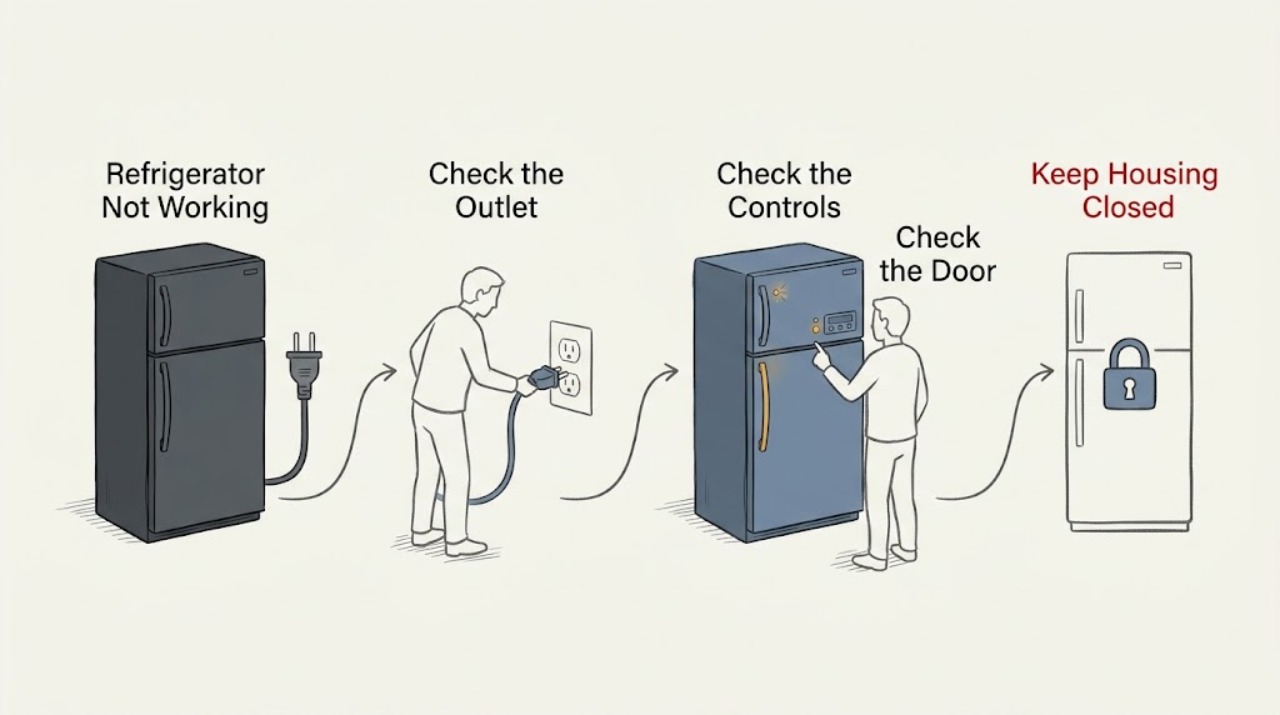
Work through in order
Diagnostic checks
Use only checks that match the exact appliance or system and its official guide.
-
Check 1
Check whether the refrigerator is plugged in, whether its accessible power switch is on, and whether lights or another known-good appliance work on the same household supply; do not open the refrigerator cabinet.
Expected result: The household supply is dead, the refrigerator has no light or display while the supply works, or the refrigerator has power indications.
Next step: Restore a tripped household supply only if it is safe to do so. If the supply works but the refrigerator stays dark, leave it isolated and arrange qualified service rather than removing a panel.
Why this matters
Why: A dead household supply points away from the refrigerator itself. A working supply with no refrigerator response makes an appliance-side power or control fault more likely, while visible power indications move the investigation toward settings or cooling.
-
Check 2
Use the exact Beko manual to check that the temperature control is not switched off and that no refrigerator-compartment-off or vacation setting is active; change only the setting described for that model.
Expected result: The control was off or a cooler-compartment-off mode was active, or the controls are set for normal operation and the refrigerator still does not cool.
Next step: Restore normal operation using the model instructions and monitor cooling. If the refrigerator remains warm with normal settings, continue without guessing at a replacement control or sensor.
Why this matters
Why: An intentional off setting can make a functioning appliance appear broken. If the settings are normal, the control state does not explain the loss of cooling and an actual-temperature check is needed.
-
Check 3
Measure the refrigerator compartment with a thermometer in a glass of water on the middle shelf, allowing the reading to stabilise according to Beko's temperature guidance; compare it with any temperature shown on the door.
Expected result: The measured temperature is cooling normally, or the measured compartment is warmer than expected even though the display shows a cold set temperature.
Next step: If the compartment is warm, keep the door closed as much as practical and protect perishable food while arranging service if the other checks do not restore cooling. Do not diagnose a compressor or sensor from the display alone.
Why this matters
Why: A door display may show the set temperature rather than the actual cabinet temperature. A normal measurement makes a temporary condition or display misunderstanding more likely; a warm measurement confirms that the refrigerator is not maintaining cooling.
-
Check 4
Inspect the door seal and the visible interior loading: check for gaps or damaged seal material, food blocking the door, hot food recently added, or items packed against air vents.
Expected result: The door does not close evenly, the seal is cracked or raised, the cabinet is overpacked, or air can circulate and the door closes correctly.
Next step: Remove only obstructions and allow hot food to cool before loading. Do not dismantle or stretch a damaged seal; arrange service if the door cannot seal or the temperature remains high.
Why this matters
Why: A door gap lets warm air in, while overpacking or blocked vents can limit internal circulation. If the seal and airflow are normal, those external causes are less likely to explain persistent warmth.
-
Check 5
Check the refrigerator's surroundings and model guidance: note whether it is in an unusually cold garage or near a heat source, and record the model number and any warning icon or unusual sound.
Expected result: The ambient location is outside the exact model guidance, the appliance has recently been installed or heavily loaded, or the environment and installation are ordinary but cooling is still absent.
Next step: Follow the model manual for placement and allow a recently disturbed appliance to stabilise without repeatedly opening the door. If it remains warm or makes an abnormal sound, provide the model and observations to a qualified technician.
Why this matters
Why: Ambient conditions, a recent warm load, or a long-open door can temporarily affect operation. Persistent loss of cooling in an ordinary environment is more consistent with a technical problem than with a location effect.
Use your observations
Decision map
Find the observation that best matches what you see, then follow the next safe action.
-
PATH 01Next step
What you see
The household supply works for other appliances, but the Beko refrigerator has no light, display, or other response.
Do this next
Keep the appliance isolated and arrange qualified service. Do not remove covers or test live wiring.
Why this path and its safety boundary
Why it matters: The installation has power, so a refrigerator-side power or control fault is more likely than a temperature-setting or airflow issue.
-
PATH 02Next step
What you see
The refrigerator has lights or a display, but the measured cabinet temperature is warm.
Do this next
Check the setting, seal, loading, and environment once. If the measured temperature remains warm, protect food and arrange service rather than replacing a cooling part based on symptoms alone.
Why this path and its safety boundary
Why it matters: Power is present, but the appliance is not achieving cooling. Settings, door sealing, airflow, ambient conditions, and then a technical cooling fault should be considered in that order.
-
PATH 03Next step
What you see
The refrigerator became warm immediately after a long-open door, a large warm load, or a recent installation, and the door now seals normally.
Do this next
Keep the door closed as much as practical and monitor the actual temperature. Escalate if recovery does not occur or the warning repeats under ordinary use.
Why this path and its safety boundary
Why it matters: The temperature rise may be temporary, especially if cooling can be heard or the measured temperature begins to recover; it does not by itself prove a failed component.
-
PATH 04Next step
What you see
The appliance is in a cold outbuilding or garage and the exact model is not rated for that ambient condition.
Do this next
Check the exact manual or product specification before relocating or changing settings. If the model is suitable for its location but remains warm, arrange service.
Why this path and its safety boundary
Why it matters: Some Beko refrigerator types may not maintain normal operation in low ambient temperatures; the environment can therefore mimic a refrigerator fault.
-
PATH 05Next step
What you see
The supply, settings, seal, airflow, and environment are normal, but the refrigerator remains warm or develops repeated unusual sounds.
Do this next
Keep the door closed, protect perishable food, and arrange qualified refrigerator service. Do not open the sealed system or attempt compressor, fan, or control repairs.
Why this path and its safety boundary
Why it matters: The pattern is less consistent with a simple user setting or placement issue and more consistent with a technical cooling fault that requires professional diagnosis.
Helpful context
Understand the symptom
Start with the symptom you can see
Not working can mean no interior light or display, a running appliance that is not cold, or a compartment that became warm after a door was left open or the refrigerator was heavily loaded. These patterns lead to different checks. Record the model number before changing a setting because Beko controls and manuals vary between models.
Keep the inspection external
Do not remove covers, work on wiring, handle refrigerant tubing, or bypass a door switch or temperature control. Unplug the appliance before any cleaning that the exact manual permits. If food has become warm, use local food-safety guidance and avoid relying on the set temperature shown on the door.
Only after diagnosis
Potential parts
- refrigerator door seal
Consider this only if the seal is visibly damaged or a technician confirms that a failed seal is causing warm air to enter; a warm cabinet alone does not prove the seal is the cause.
Confirm the exact Beko model and approved seal fit information before ordering. - refrigerator temperature control or sensor
Consider this only after the supply, settings, actual temperature, door seal, and airflow checks are complete and a technician confirms a control or sensor fault.
Controls and sensors vary by exact Beko model and revision; verify the model-specific part specification before ordering.
When checks do not resolve it
Need a professional?
A technician should assess a Beko refrigerator that has power but does not cool, remains warm after external checks, or has a recurring warning or abnormal sound.
Safety scope: The user should not remove covers, handle refrigerant tubing, bypass controls, or work on live wiring.
Common questions
FAQ
Why is my Beko refrigerator completely silent and dark?
Check the household supply and accessible power switch first. If other appliances work but the Beko refrigerator has no light or display, leave it isolated and arrange qualified service instead of opening the cabinet.
Why does my Beko fridge have power but not get cold?
Check the temperature setting, measure the actual cabinet temperature, then inspect the door seal, loading, airflow, and ambient location. If the cabinet remains warm after those checks, the issue needs professional diagnosis.
Is the number on my Beko door display the actual fridge temperature?
Not necessarily. Beko notes that some external displays show the set temperature rather than the actual cabinet temperature. Use a thermometer in a glass of water on the middle shelf according to the manufacturer's guidance.
Can a cold garage make a Beko refrigerator stop working?
It can affect some refrigerator types, but suitability depends on the exact model. Check the manual or product specification for the appliance instead of assuming that every Beko refrigerator has the same ambient-temperature range.
Read the exact guide
Official sources
- Fridge RepairsBeko UK · Beko refrigerator not working when external checks do not restore operation
- Can I use my Beko fridge freezer in a garage or low temperature environment?Beko UK · Beko refrigerator not working when installed in a garage, outbuilding, or other low-temperature environment
- Control Panel of the ProductBeko · Beko refrigerator not working when a display state or cooler-compartment-off mode may be active
- Why is my fridge not cooling?Beko UK · Beko refrigerator not working when the appliance has power but the cabinet is warm
- How to fix a refrigerator that won't workBeko · Beko refrigerator not working, including no power, incorrect setting, poor airflow, and persistent technical problems
- I want to check the temperature is correct in my Beko fridge, how would I do this?Beko UK · Beko refrigerator not working when a displayed setting must be distinguished from actual cabinet temperature
Community feedback
Share a repair observation
Share a plain-text repair observation. Accepted observations are published automatically; this page may take a moment to update.