
On this page
Start here
Quick answer
If a Whirlpool dehumidifier trips a breaker, turn it off and unplug it before investigating. Check whether other appliances share the circuit, whether the cord or plug is pinched or damaged, and whether the unit is connected directly to the correct grounded outlet described by its model manual. Do not keep resetting a breaker, use an extension cord or adapter, or open the dehumidifier. A breaker that trips again with the dehumidifier isolated, or any heat, burning smell, water near electrical parts, or cord damage, needs an electrician or Whirlpool service.
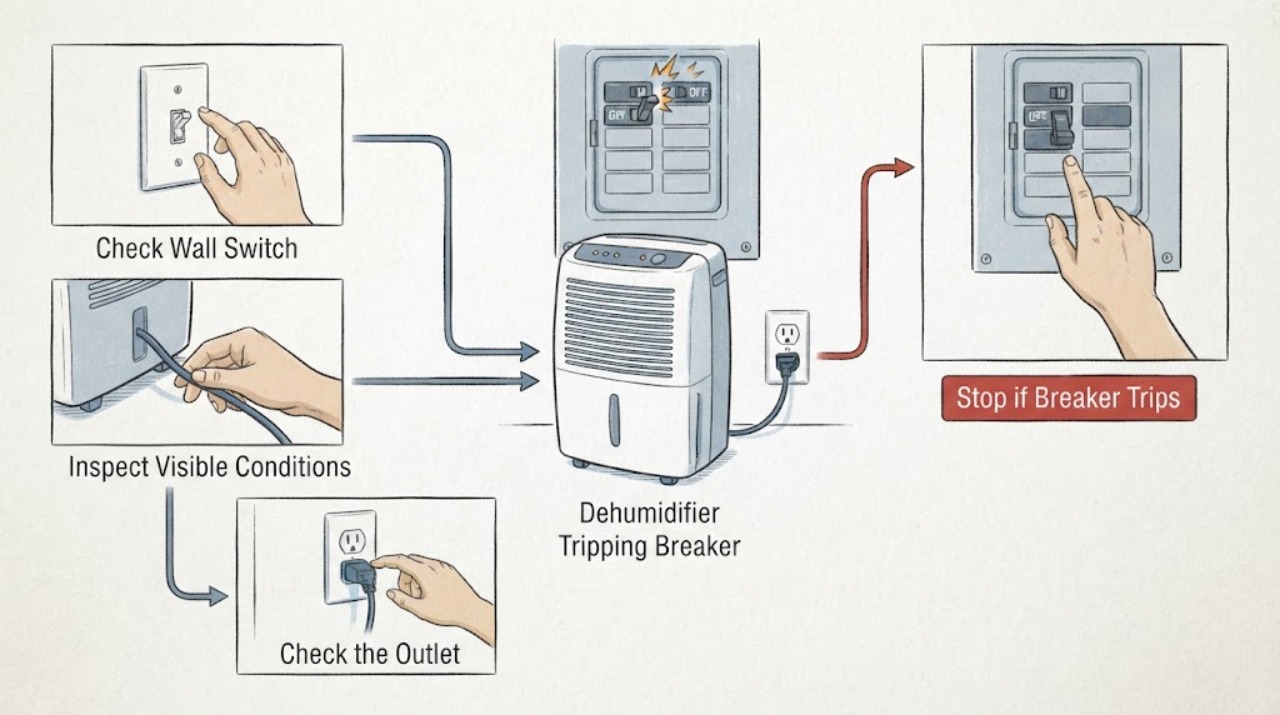
Work through in order
Diagnostic checks
Use only checks that match the exact appliance or system and its official guide.
-
Check 1
Switch the dehumidifier off and unplug it. Note when the breaker trips: immediately on plug-in, when the compressor starts, after the unit runs, or only when other appliances are operating.
Expected result: The breaker trips with the unit disconnected, only when the dehumidifier starts, or only when the shared load is high.
Next step: Leave the unit unplugged and continue with the safe cord and circuit checks; do not repeatedly reset the breaker.
Stop if: Stop immediately for smoke, burning odor, melted plastic, moisture at the outlet, or a hot plug.
Why this matters
Why: A trip with the unit disconnected points to the household circuit. A trip linked to this appliance suggests its cord, plug, startup load, or internal electrical system; a shared-load pattern suggests overload.
-
Check 2
Check the outlet and cord visually while disconnected. Look for a loose receptacle, scorch mark, bent or missing ground pin, crushed insulation, or a cord pinched behind furniture. Do not test by moving the cord while energized.
Expected result: The cord, plug, or outlet is damaged, wet, loose, or visibly overheated, or all accessible parts look sound.
Next step: Have a damaged outlet or household wiring checked by an electrician; replace a damaged manufacturer cord through service and keep the dehumidifier unplugged.
Stop if: Do not tape a damaged cord, remove the ground pin, or use an adapter.
Why this matters
Why: Visible damage or moisture can create shock or fire risk and cannot be corrected by resetting the breaker. A sound exterior leaves a circuit-load or internal fault possible.
-
Check 3
Identify every appliance on the same circuit and remove unnecessary loads. Confirm the dehumidifier is connected directly to the grounded outlet and not an extension cord or power strip, then consult the exact Whirlpool manual for its electrical requirements.
Expected result: The circuit was heavily loaded or an extension device was used, or the dehumidifier was already isolated on the model-approved outlet.
Next step: After correcting only the accessible setup, make one supervised restart. If it trips again, unplug it and arrange service.
Stop if: Do not install a larger breaker or continue resets to keep the unit running.
Why this matters
Why: Whirlpool identifies shared loads, extension cords, and cord overloading as causes of protection trips. If the appliance is already isolated and trips continue, a simple overload is less likely.
-
Check 4
If the model manual permits a restart after the circuit is safe, observe one brief run without touching the plug or cord. Record whether the trip occurs at startup, when the compressor engages, or after water collection begins.
Expected result: The unit runs without a trip, trips at startup, or trips after operating for a while.
Next step: Stop the test after any repeat trip and give the model, timing, outlet, and cord observations to Whirlpool service.
Stop if: Do not remove covers or measure live components unless you are a qualified technician following the service documentation.
Why this matters
Why: A successful isolated run supports a shared-load or setup issue but does not prove the appliance is healthy. A repeat trip at a consistent operating stage points to an appliance electrical or refrigeration component that needs diagnosis.
Use your observations
Decision map
Find the observation that best matches what you see, then follow the next safe action.
-
PATH 01Next step
What you see
The breaker trips even with the dehumidifier unplugged or with other loads removed.
Do this next
Leave the appliance disconnected and call a qualified electrician.
Why this path and its safety boundary
Why it matters: The household circuit or outlet is more likely than the dehumidifier itself.
-
PATH 02Next step
What you see
The trip follows the dehumidifier on a model-approved direct outlet after shared loads and extension devices are removed.
Do this next
Stop resetting the breaker and schedule Whirlpool service with the exact model and trip timing.
Why this path and its safety boundary
Why it matters: An appliance cord, startup component, compressor, control, or wiring fault is possible.
-
PATH 03Next step
What you see
The plug or cord is hot, damaged, wet, or scorched, or there is a burning smell.
Do this next
Keep the unit unplugged if safe to do so, keep the area clear, and use an electrician or qualified appliance service.
Why this path and its safety boundary
Why it matters: There is an immediate electrical or fire hazard.
Helpful context
Understand the symptom
Treat a repeated trip as an electrical fault
A single trip can follow a shared-circuit overload, but repeated trips after the load is reduced are not a normal operating condition. Whirlpool's electrical guidance asks users to check shared appliances, extension cords, and a pinched or overloaded cord, then use service if the issue continues. The exact dehumidifier manual controls the outlet and protection requirements for that model.
Keep the boundary outside the cabinet
The accessible checks are power isolation, circuit load, cord and plug condition, and model-manual setup. Internal compressor, capacitor, wiring, or control diagnosis requires qualified service; do not substitute a breaker or defeat the ground connection.
When checks do not resolve it
Need a professional?
Provide the dehumidifier model and serial information, outlet and circuit details, what else was operating, cord and plug condition, and when the breaker trips. Internal electrical and compressor diagnosis belongs to qualified service.
Common questions
FAQ
Can I use an extension cord temporarily?
Whirlpool electrical guidance says not to use an extension cord with the appliance. Use the grounded outlet and electrical requirements in the exact model manual.
Should I keep resetting the breaker?
No. One safe reset after correcting an obvious shared-load issue may be appropriate, but a repeat trip means the appliance or circuit needs qualified diagnosis.
Read the exact guide
Official sources
- Whirlpool Manuals & LiteratureWhirlpool Corporation · Finding the exact Whirlpool appliance manual and model-specific electrical requirements
- Trips Circuit Breaker or Fuse - Whirlpool Product HelpWhirlpool Corporation · Whirlpool portable-appliance electrical trip checks including shared circuits, extension cords, power-cord damage, and service boundary
Community feedback
Share a repair observation
Share a plain-text repair observation. Accepted observations are published automatically; this page may take a moment to update.