
On this page
Start here
Quick answer
If a dehumidifier trips the breaker, unplug it and first determine whether the trip follows the receptacle, the cord, or the appliance. Do not use an extension cord or power strip. Once the circuit is stable and the unit is cool, check only external airflow, filter, and room conditions. A repeat trip or hot, wet, or damaged unit needs qualified service.
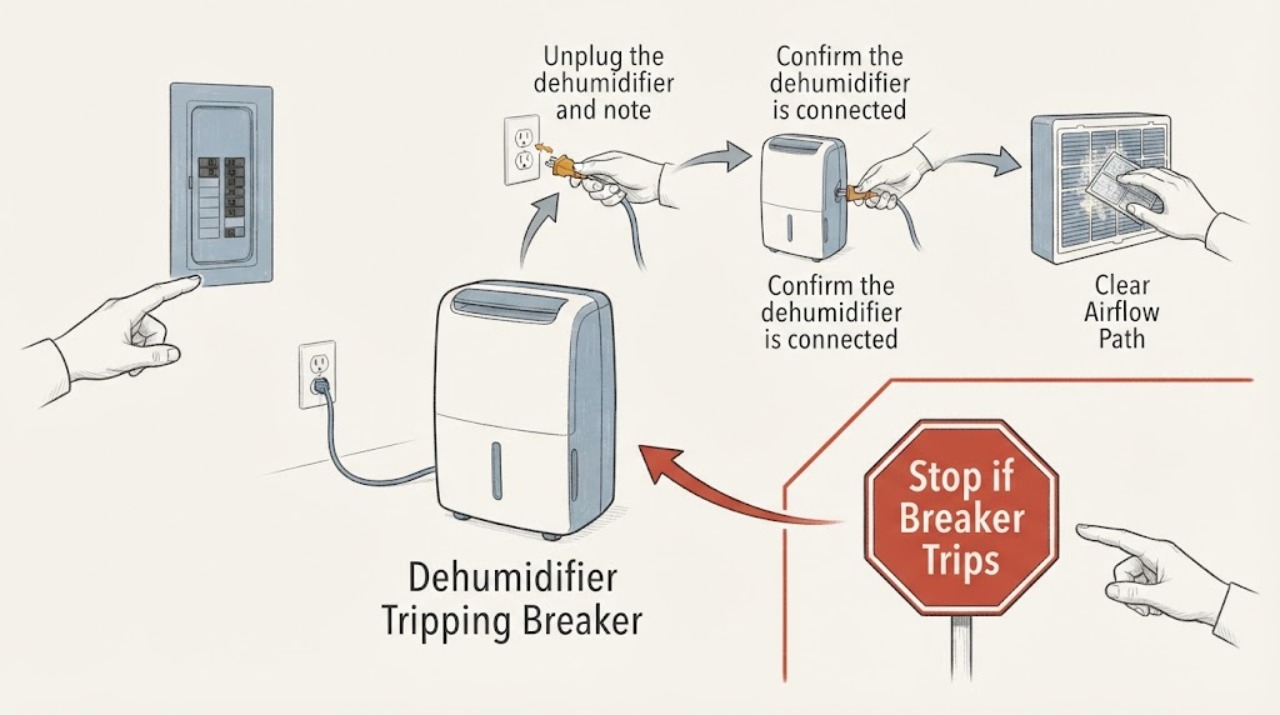
Work through in order
Diagnostic checks
Use only checks that match the exact appliance or system and its official guide.
-
Check 1
Unplug the dehumidifier and note whether the breaker trips with other loads on the same circuit. From a dry position, inspect the plug and cord for heat, cuts, melting, or water.
Expected result: The breaker trips with other loads, only with this unit, or the cord or plug is damaged.
Next step: Leave the unit disconnected for damage, moisture, or a repeat trip and do not test with a live voltage probe.
Why this matters
Why: A shared overload or damaged supply needs electrical attention; an appliance-specific trip keeps the dehumidifier in scope.
-
Check 2
Confirm the dehumidifier is connected directly to a properly grounded receptacle without an extension cord or power strip, then verify the GFCI or AFCI state.
Expected result: The outlet or protection is abnormal, or the circuit appears stable.
Next step: Restore a tripped receptacle or breaker once only if safe; stop if it trips again.
Why this matters
Why: Frigidaire identifies poor connection, breaker, and GFCI/AFCI conditions as accessible causes of no power; repeated protection operation is not a reset invitation.
-
Check 3
With power disconnected, clean the accessible filter and clear the front and rear airflow path; confirm suitable clearance and allow the unit to cool if it was hot.
Expected result: The filter or grille is blocked, the unit is hot or frosted, or airflow and temperature are suitable.
Next step: Do not scrape ice, use a heat source, open panels, or touch the compressor.
Why this matters
Why: Restriction and overload conditions can raise operating stress; suitable external conditions with a repeat trip make internal diagnosis more likely.
-
Check 4
After stable power and a cool, dry, unobstructed unit are confirmed, make at most one supervised start attempt and record when the protection trips.
Expected result: The unit runs without a trip, trips immediately, or trips when the compressor starts.
Next step: Keep the trip record and exact model for service; do not keep resetting the breaker.
Why this matters
Why: Recovery supports an external condition; immediate or compressor-start trips require electrical or appliance service diagnosis.
Use your observations
Decision map
Find the observation that best matches what you see, then follow the next safe action.
-
PATH 01Next step
What you see
The circuit or GFCI/AFCI trips with multiple loads or the dehumidifier cord is damaged.
Do this next
Leave the unit off and obtain qualified electrical help.
Why this path and its safety boundary
Why it matters: The building supply or cord is the leading safety issue.
-
PATH 02Next step
What you see
The outlet is stable but the dehumidifier trips immediately or when the compressor starts after airflow and cool-down checks.
Do this next
Stop resetting protection and arrange Frigidaire or qualified appliance service.
Why this path and its safety boundary
Why it matters: An appliance power, overload, compressor, or sealed-system fault is more likely.
-
PATH 03Next step
What you see
The trip does not recur after one safe correction of an overloaded circuit, blocked airflow, or excessive heat.
Do this next
Monitor cautiously and stop if any trip returns.
Why this path and its safety boundary
Why it matters: The external operating condition was the leading cause, but recurrence should be treated as a fault.
Helpful context
Understand the symptom
A breaker trip is an electrical symptom with a safety priority. Frigidaire directs owners to check a grounded outlet, cord, breaker, and GFCI/AFCI while avoiding extension cords and power strips.
A trip that occurs only when the compressor starts can involve overload or sealed-system stress, but the event does not identify a capacitor, compressor, or control part for the reader to replace.
Only after diagnosis
Potential parts
- model-specific cord, control, compressor, or overload component
Consider a part only after circuit, cord, airflow, cool-down, and trip timing are documented and a qualified diagnosis identifies the component.
A breaker trip does not establish a compressor or control part fit.
When checks do not resolve it
Need a professional?
Contact a qualified electrician or appliance service when the dehumidifier trips a stable circuit, trips again after one reset, or shows heat, frost, water, cord damage, or compressor-start symptoms.
Common questions
FAQ
Can I run a dehumidifier on an extension cord after it trips?
No. Frigidaire says not to use an extension cord or power strip because the connection can be unreliable and hazardous. Use the properly installed receptacle specified by the manual.
Does a breaker trip prove the dehumidifier compressor is bad?
No. Check the circuit, outlet, cord, GFCI or AFCI, airflow, filter, and cool-down conditions once. A repeat trip needs service diagnosis.
Read the exact guide
Official sources
- Dehumidifier - No PowerFrigidaire · Opened official Frigidaire support; it specifically addresses a dehumidifier that will not turn on and circuit protection.
- Dehumidifier Error Code H3 or E5Frigidaire · Opened official Frigidaire support; it links overload symptoms to clearance, filter, operating temperature, and cool-down before service.
- Dehumidifiers Error Code GuideFrigidaire · Opened official Frigidaire error guide; it sends sensor, sealed-system, and control failures to assistance.
Community feedback
Share a repair observation
Share a plain-text repair observation. Accepted observations are published automatically; this page may take a moment to update.