
On this page
Start here
Quick answer
If a Whirlpool gas oven will not ignite, first stop if you smell gas, hear hissing, see smoke or an abnormal flame, or hear a delayed bang. Otherwise, confirm the selected bake or broil function, the door position, the display and control state, and the household power connection from a safe, dry position. Confirm that the home's gas supply is available without moving a hard-piped range or opening a gas connection. A recent installation or reconnection can leave air in the supply, while a working cooktop does not prove that the oven regulator shutoff is open. After these external checks, make no more than one normal ignition attempt while observing from a safe position. If there is still no ignition, continuous clicking, delayed ignition, an unusual flame, a returning fault, or any need to access an igniter, burner, regulator, wiring, or control, leave the oven off and arrange qualified appliance service.
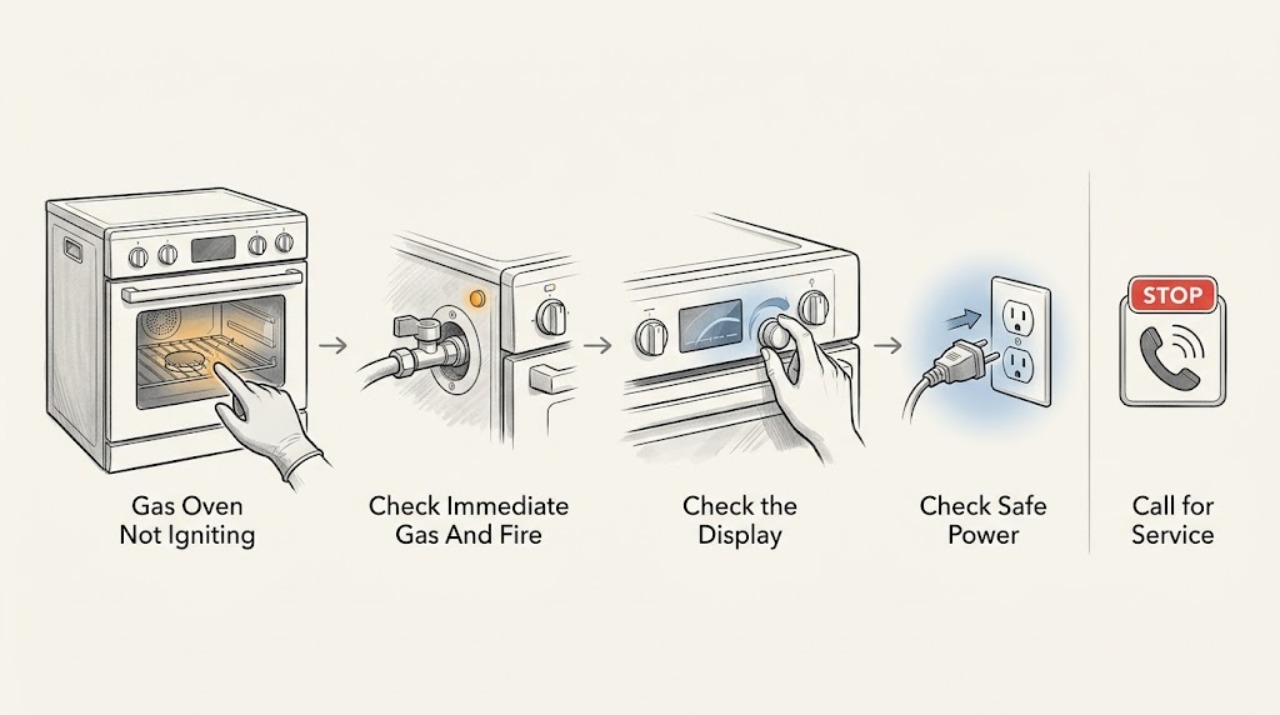
Work through in order
Diagnostic checks
Use only checks that match the exact appliance or system and its official guide.
-
Check 1
Before touching the controls, remain at a safe distance and check whether there is a gas odor, a hissing sound, smoke, an electrical or burning odor, a CO or smoke alarm, or a visible flame outside the normal burner area. Do not use a match, lighter, switch, or phone to investigate a suspected leak.
Expected result: There is no warning symptom, or gas, hissing, smoke, an alarm, an abnormal flame, or an electrical odor is present.
Next step: If any warning is present, stop using the oven, leave without operating electronics inside, and contact emergency help, the gas authority, or a qualified professional from outside. If none is present, continue to the external control and power checks.
Stop if: Stop immediately for gas odor or hissing, smoke, visible arcing, a CO or smoke alarm, an uncontrolled flame, or a strong burning or electrical smell.
Why this matters
Why: A gas or fire warning takes priority over troubleshooting. An oven that merely fails to ignite can be investigated only when there is no immediate hazard.
-
Check 2
Read the model information if it is safely visible, then check that the oven door is fully closed, the desired Bake or Broil function is selected, a temperature is set, and Start has been pressed as the model requires. Look for Control Lock, Demo mode, a delayed start, a cooling or cleaning state, or a displayed code; do not force the door or bypass a lock.
Expected result: The display is dark, a lock or delay indicator is active, the oven is in a different mode, a code is displayed, or the selected function and temperature are ready with no control warning.
Next step: Follow the model manual to cancel a delay or release a control lock once. If the display remains dark, the code returns, the door will not close normally, or the controls do not respond, stop and arrange appliance service.
Stop if: Do not force the door, defeat a control or door interlock, repeatedly clear a fault, or continue if the oven is hot, smoking, arcing, or showing an unsafe flame.
Why this matters
Why: A locked, delayed, demonstration, or incomplete control state can prevent an ignition request. The exact model manual controls the meaning of an error or lock; a generic code interpretation is unsafe.
-
Check 3
From a dry, stable position, inspect the visible power cord and plug without removing panels. Confirm the range is connected to the grounded supply specified by its installation instructions and observe whether the household breaker or fuse has operated. Do not use an extension cord or an adapter, and do not open the electrical compartment.
Expected result: The display and outlet appear powered, or the display is dark, the breaker or fuse is off, the plug or receptacle is loose or warm, or the cord is damaged.
Next step: Only from a dry, safe position, correct an obvious one-time breaker or fuse state if there is no damage or warning, then do not keep resetting if it trips again. A persistent power fault or a dark display needs an electrician or appliance technician.
Stop if: Do not touch a wet, hot, loose, scorched, or damaged outlet, cord, or plug. Stop for a repeated trip, smoke, arcing, or any need to test live wiring or remove a panel.
Why this matters
Why: The igniter and controls need the correct electrical supply. A working surface burner does not prove that the oven's electrical ignition path is healthy, and a warm or damaged receptacle is an electrical hazard.
-
Check 4
Without moving the range or touching a gas connection, confirm from the normal user-accessible position that the home's main gas supply is intended to be on and that no recent work has left the appliance disconnected. Look only for an obvious closed accessible supply control described by the model instructions; never loosen a fitting or try to purge air.
Expected result: The household supply is available and no recent connection work is known, the appliance was recently installed or reconnected, an accessible supply control is closed, or the supply status is uncertain.
Next step: If the supply status is uncertain, the appliance was recently connected, or the range is hard-piped, stop and have the installer or qualified gas appliance technician verify the installation. Do not slide or overextend the range to reach a valve.
Stop if: Stop for gas odor, hissing, a damaged or kinked flexible line, a disconnected fitting, any need to move a hard-piped range, or any request to loosen or test a gas connection.
Why this matters
Why: Whirlpool identifies a closed main valve and trapped air after reconnection as possible reasons for no oven ignition. A recent installation also raises an installation and regulator check, not a reason to repeatedly light the burner.
-
Check 5
If the cooktop works but the oven does not and the model installation instructions clearly identify a user-visible oven regulator shutoff position, compare it with the instruction without removing the regulator cover or moving the appliance. If the position cannot be seen safely, leave it for a professional.
Expected result: The regulator shutoff appears in the position specified by the instructions, it appears closed, or it cannot be safely identified without moving the range or opening a gas assembly.
Next step: Do not change an uncertain regulator position yourself. Ask a qualified installer or appliance technician to verify the regulator, gas pressure, flexible line routing, and oven supply for the exact model.
Stop if: Do not slide a hard-piped range, overextend or kink a flexible gas line, remove a regulator cover, loosen a fitting, or continue if there is an odor or hissing sound.
Why this matters
Why: Whirlpool explains that an oven regulator shutoff can stop gas to the oven while surface burners still work. It is an installation component, so an uncertain or inaccessible position is a service clue rather than a reason to improvise.
-
Check 6
Only when all prior checks are normal and there is no warning symptom, start the correct oven function once according to the model manual and observe from a safe position. Keep the door in its normal operating position, do not reach through the bottom panel, and do not repeat the start to reproduce a sound.
Expected result: The oven ignites normally, there is a click but no flame, the igniter continues clicking, ignition is delayed, a bang occurs, the flame is yellow or unstable, or the oven stops with a code.
Next step: If it does not ignite normally, turn the control off, keep the oven off, record the sound, timing, display, and flame behavior, and arrange qualified appliance service. Do not make another ignition attempt.
Stop if: Stop at once for continuous clicking without flame, a delayed ignition or bang, yellow or lifting flame, gas odor, smoke, CO alarm, electrical odor, arcing, or an oven that continues heating after the control is off.
Why this matters
Why: Normal ignition ends the diagnostic path. Clicking without flame can indicate a gas-supply, igniter, burner, or control issue; delayed ignition or an abnormal flame can allow unburned gas or unsafe combustion and is not a DIY adjustment.
-
Check 7
Prepare a service handoff without opening the oven: record the full model and fuel configuration if safely visible, the Bake or Broil setting, display code, whether the cooktop works, power observations, gas-supply or recent-installation history, the exact click or ignition timing, and any safe external photos.
Expected result: The technician has a reproducible symptom description without a second ignition test, gas-line check, live electrical test, or cabinet disassembly.
Next step: Keep the oven off until qualified appliance service reviews the information. If the evidence points to the household circuit or gas supply rather than the appliance, use the appropriate licensed electrician or gas professional.
Stop if: Stop documenting and leave if gas, smoke, heat, arcing, an uncontrolled flame, or another immediate hazard appears.
Why this matters
Why: The symptom sequence distinguishes a control request, supply or regulator issue, igniter or burner failure, and unsafe combustion clue better than a guessed replacement part.
Use your observations
Decision map
Find the observation that best matches what you see, then follow the next safe action.
-
PATH 01Next step
What you see
Gas is smelled or heard leaking, or a leak is suspected.
Do this next
Do not operate switches, lights, the oven, or a phone inside. Leave immediately and contact local gas authorities or emergency help from outside; do not return to test the appliance until it is cleared.
-
PATH 02Next step
What you see
There is smoke, flame outside the normal burner area, a CO or smoke alarm, visible arcing, a strong electrical odor, a hot receptacle, or a repeated breaker trip.
Do this next
Stop using the appliance and move to a safe location. Use emergency help for active fire or alarm conditions, an electrician for a confirmed supply issue, and qualified appliance service for the oven after the area is safe.
-
PATH 03Next step
What you see
The display is dark, the breaker or fuse is off, Control Lock or a delay is active, the door will not close normally, or the selected mode does not accept Start.
Do this next
Follow the exact Whirlpool model instructions for one safe control or power check. If the display, lock, circuit, or door problem remains, stop and arrange appliance or electrical service.
-
PATH 04Next step
What you see
The oven was recently installed or reconnected, the gas supply status is uncertain, or the cooktop works but the oven may not have gas through its regulator shutoff.
Do this next
Do not purge the line or move a hard-piped range. Have the installer or qualified gas appliance technician verify the main supply, regulator shutoff, line routing, and model-specific installation.
-
PATH 05Next step
What you see
Controls and external supply appear normal but the oven clicks without flame, ignites late, bangs, shows an abnormal flame, or stops with a code.
Do this next
Turn the control off, do not attempt another ignition, and request appliance service to test the igniter, burner, gas path, wiring, and control with the exact model procedure.
-
PATH 06Next step
What you see
The oven ignites normally after the external checks and has no abnormal odor, sound, flame, heat, or electrical symptom.
Do this next
Use the oven normally while following the owner's manual. If the no-ignition symptom returns, record the stage and stop repeated testing; arrange service if it persists.
Helpful context
Understand the symptom
Start with the gas and electrical safety boundary
A gas oven needs both a gas path and electrical power for its controls and ignition system. Do not diagnose a suspected leak by lighting a match, using a lighter, or repeatedly starting the oven. If gas is smelled or a leak is heard, leave immediately without operating lights, switches, or a phone inside; contact local gas authorities or emergency help from outside. If smoke, an electrical odor, visible arcing, a CO alarm, or a fire appears, stop using the appliance and get to a safe location. The CPSC also says never to ignore a CO or smoke alarm.
A working cooktop does not clear the oven gas path
On some Whirlpool ranges, the surface burners can work while the oven does not receive gas because the regulator shutoff valve is closed. Whirlpool notes that this valve can be turned off during handling and that a hard-piped range should not be slid or overextended to reach it. Treat the valve and regulator as installation components: use only the exact model instructions and a qualified professional when safe access is not obvious. Never loosen a gas connection or remove a regulator cover as a home check.
One controlled observation is enough
Once the external checks are safe, a single normal bake or broil start can distinguish a control or supply symptom from an ignition symptom. Watch and listen from outside the oven opening; do not put a hand near the burner or reach through the bottom panel. A click with no flame, a flame that lights late, a bang, or a flame that is yellow, lifting, or unstable is a stop condition. Do not keep cycling the control to make the symptom repeat. An appliance technician can test the igniter, burner, regulator, wiring, and control using the model's service procedure.
Safety boundary
Stop conditions
- If gas is smelled or heard leaking, leave immediately without operating electronics inside and contact local gas authorities or emergency help from outside.
- Stop for delayed ignition, a bang, continuous clicking without flame, an abnormal yellow or unstable flame, smoke, a CO or smoke alarm, visible arcing, or a strong burning or electrical odor.
- Do not use a match or lighter to test for gas, repeatedly start the oven, purge a gas line, loosen a fitting, adjust gas pressure, or disassemble the burner, regulator, igniter, or control.
- Do not move a hard-piped range, overextend a flexible gas line, open an electrical panel, test live wiring, bypass a door or control lock, or reach through the oven bottom panel.
When checks do not resolve it
Need a professional?
Request qualified appliance service for persistent no-ignition, continuous clicking, delayed ignition, an abnormal flame, a returning code, an uncertain regulator shutoff, or any diagnosis beyond the external checks. Use a licensed electrician for the household circuit and a qualified gas professional for gas-supply or installation work.
Have this ready
- Provide the Whirlpool model and fuel configuration, Bake or Broil setting, display code, whether the cooktop works, power and supply observations, recent installation or reconnection history, exact click or ignition timing, flame description, and safe external photos.
Common questions
FAQ
Why does my Whirlpool gas oven not ignite when the cooktop works?
The cooktop can work while the oven regulator shutoff or oven ignition path has a problem. Check only the model-approved external controls and supply conditions; do not move a hard-piped range or open a gas assembly. If the oven still will not ignite, arrange qualified appliance service.
What should I do if my Whirlpool oven clicks but there is no flame?
Turn the control off and do not keep trying. Record whether the click is continuous, whether a flame ever appears, and whether an odor, delayed ignition, bang, or abnormal flame occurs. Any gas odor, delayed ignition, or abnormal flame is an immediate stop condition; otherwise the igniter, burner, gas path, wiring, or control needs qualified diagnosis.
Can a Whirlpool gas oven fail after it was installed or reconnected?
Yes. Whirlpool identifies recent installation or reconnection as a clue because the supply may contain trapped air or an installation valve may not be in the required position. Do not purge the line or repeatedly ignite the oven; have the installer or qualified gas appliance technician verify the connection and regulator safely.
What power checks are safe for a Whirlpool gas oven that will not ignite?
From a dry position, look for a dark display, an operated breaker or fuse, or visible cord or receptacle damage. Use the grounded supply specified by the installation instructions and do not use an extension cord or adapter. Do not touch a hot or damaged receptacle, reset a recurring trip, or open a panel.
When should I stop using a Whirlpool gas oven immediately?
Stop for gas odor or hissing, delayed ignition or a bang, continuous clicking without flame, an abnormal flame, smoke, a CO or smoke alarm, visible arcing, a burning odor, or repeated breaker trips. Leave for a suspected gas or fire emergency and use qualified gas, electrical, or appliance service from a safe location.
Read the exact guide
Official sources
- How to Check the Gas Regulator Shut-Off Valve on an OvenWhirlpool Product Help · Official Whirlpool installation support; access and valve details vary by model and installation, so inaccessible work belongs to a qualified professional.
- Oven Not Working - Cooktop Working - Not ClickingWhirlpool Product Help · Official Whirlpool guidance for a gas oven that does not work while the cooktop works; model-specific installation and service instructions still apply.
- Oven Not Working - GasWhirlpool Product Help · Official Whirlpool Product Help guidance for gas ranges and ovens; exact model instructions control where equipment differs.
- CPSC Issues Winter Weather Safety Tips to Prevent Fires and Carbon Monoxide PoisoningU.S. Consumer Product Safety Commission · Official U.S. CPSC household gas and carbon-monoxide safety guidance applied to suspected gas odor or leak around an appliance.
- Nothing is Working - GasWhirlpool Product Help · Official Whirlpool Product Help guidance for gas ranges where controls or the whole appliance appear not to work.
Community feedback
Share a repair observation
Share a plain-text repair observation. Accepted observations are published automatically; this page may take a moment to update.