
On this page
Start here
Quick answer
When a Whirlpool ice maker is not working, check the water supply and line, freezer temperature, ice-maker ON state, and water filter before assuming the ice maker itself failed. Whirlpool identifies restricted water, a freezer that is too warm, an ice maker that is turned off, and filter installation as common causes. Confirm the exact model before using a reset, removing a filter, or considering a valve or ice-maker part; persistent leaks, electrical faults, or no production after these checks need service.
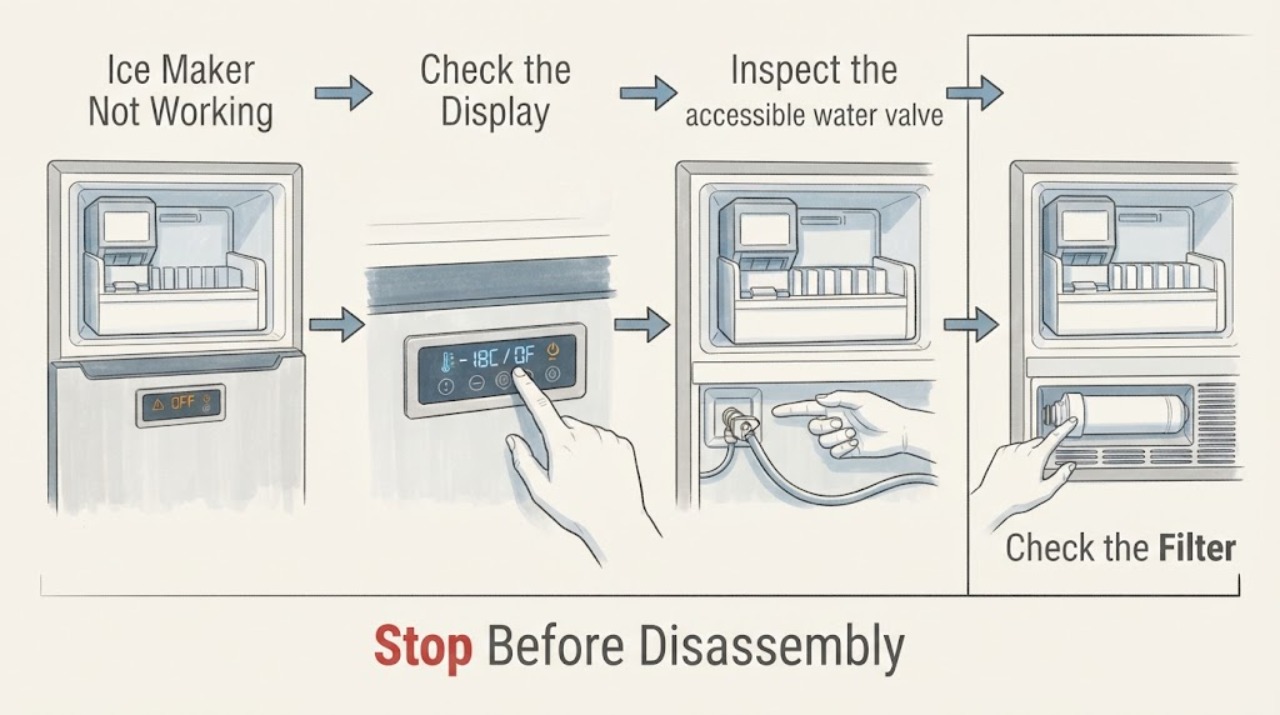
Work through in order
Diagnostic checks
Use only checks that match the exact appliance or system and its official guide.
-
Check 1
Check that the ice-maker control is ON and that the freezer is at the model's normal ice-making temperature.
Expected result: The ice maker is Off, the freezer is warmer than the official range, or the control and temperature are normal.
Next step: Turn the control on or correct the documented temperature setting, then allow the unit time to make ice. Do not force a harvest cycle.
Why this matters
Why: Whirlpool identifies an Off ice maker or warm freezer as common reasons for no ice. Normal temperature and ON state shift attention to water flow, filter, or the ice-maker mechanism.
-
Check 2
Inspect the accessible water valve and line for being turned off, kinked, pinched behind the appliance, or visibly leaking. Do not disconnect the line under pressure.
Expected result: Water is off/restricted, the line is kinked, or water supply appears normal.
Next step: Open the valve normally and straighten only an accessible gentle kink. Arrange plumbing/service help for leaks, damaged lines, or inaccessible connections.
Why this matters
Why: Restricted or absent water can prevent fill and ice production. A normal supply leaves filter, inlet, or ice-maker diagnosis possible.
-
Check 3
If a filter was recently changed, verify from the model manual that it is the correct filter and fully locked/sealed.
Expected result: The filter is loose, wrong, overdue, or the water dispenser flow is also reduced; or filter installation is normal.
Next step: Reinstall or replace only with model-confirmed instructions. Do not order a valve or ice-maker module from the symptom alone.
Why this matters
Why: Whirlpool says an improperly installed or clogged filter can reduce or stop flow to the ice maker. A normal filter result shifts attention to temperature or the ice-maker assembly.
-
Check 4
Observe one normal ice-making interval for water fill, ejector movement, and bin level without touching moving parts.
Expected result: The unit fills but does not freeze/eject, remains silent, makes thin ice, or leaks/overflows.
Next step: Stop testing for leaks, overflow, unusual noise, or a jammed mechanism and arrange Whirlpool service.
Why this matters
Why: These patterns separate water delivery from freezing or mechanism issues, but they do not prove which internal component failed.
-
Check 5
Record the model, freezer temperature, ON state, water/filter history, fill/eject observation, bin condition, and any error or leak.
Expected result: A model guide gives a matching reset; no reset exists; or production remains absent after water, temperature, ON, and filter checks.
Next step: Provide the record to Whirlpool service. Disconnect power before any professional service access.
Why this matters
Why: Model identity controls reset access and drain-pump/filter details. Persistent no production after accessible checks requires service.
Use your observations
Decision map
Find the observation that best matches what you see, then follow the next safe action.
-
PATH 01Next step
What you see
The ice maker is Off, the freezer is too warm, or the water valve is closed/kinked.
Do this next
Correct only the documented setting/accessible valve or line and allow time for production; call service if it does not resume.
Why this path and its safety boundary
Why it matters: A user-level operating or supply condition is more likely than an immediately proven failed ice-maker module.
-
PATH 02Next step
What you see
Freezer temperature, ON state, water supply, and filter are normal, but no fill or harvest occurs.
Do this next
Stop forcing the mechanism and arrange Whirlpool service with the recorded pattern.
Why this path and its safety boundary
Why it matters: An inlet, sensor, motor, or control fault remains possible and cannot be identified safely from observation alone.
-
PATH 03Next step
What you see
The filter was replaced recently and dispenser flow also fell or leaks.
Do this next
Use the exact model instructions to reseat/confirm the filter; service persistent leaks or flow loss.
Why this path and its safety boundary
Why it matters: Filter seating or fitment is more likely than a separate ice-maker failure.
-
PATH 04Next step
What you see
There is an active leak, overflow, damaged line, electrical odor, or exposed wiring.
Do this next
Turn off the water supply and disconnect power only if safe, then obtain qualified appliance/plumbing service.
Why this path and its safety boundary
Why it matters: This is a water/electrical safety stop.
Helpful context
Understand the symptom
“Not working” can mean no harvest, no water fill, a warm freezer, or a filter-related flow restriction. Note whether the ice maker is silent, cycles but produces no ice, makes thin ice, or leaks, and whether the dispenser still has water.
Some Whirlpool ice makers use drain pumps or different controls. Use the model manual and disconnect power before any service work; do not probe live wiring or force an ejector mechanism.
When checks do not resolve it
Need a professional?
Arrange Whirlpool service when no ice is produced after the ON, freezer-temperature, water-supply, and filter checks, when the maker fills but cannot harvest, or when a leak/overflow or model-specific fault persists. Provide model, freezer temperature, filter history, valve/line result, and fill/eject observation. Do not force the mechanism or order a valve/module from the symptom alone.
Common questions
FAQ
What are the first checks for a Whirlpool ice maker that stopped working?
Check that the ice maker is ON, the freezer is cold enough, the water valve is open and line is not kinked, and the filter is correctly installed.
Can a Whirlpool water filter stop ice production?
Yes. Whirlpool says a clogged or incorrectly installed filter can reduce or stop water flow to the ice maker. Confirm fitment with the model instructions.
Should I force the Whirlpool ice maker to cycle?
No. Observe one normal cycle without touching moving parts. Persistent no fill or harvest needs service diagnosis.
Read the exact guide
Official sources
- Whirlpool Product Manuals and ServiceWhirlpool · Official Whirlpool model-resource and service entry point for refrigerator and ice-maker documentation.
- Ice Maker Not Working - TroubleshootingWhirlpool Product Help · Whirlpool refrigerator ice-maker water, temperature, ON-state, filter, and reset guidance.
- Owner's ManualWhirlpool · Whirlpool ice-maker manual safety and model-specific water/drain/temperature guidance.
Community feedback
Share a repair observation
Share a plain-text repair observation. Accepted observations are published automatically; this page may take a moment to update.