
On this page
Start here
Quick answer
First decide whether the overflow is excess ice or liquid water. For an ice-filled bin, empty some ice, keep the bin sensor clear and clean, level the ice maker, and turn off Max/Fast/Accelerated Ice unless needed. For water in the bin or on the floor, inspect the fill-cup alignment and accessible water fittings with the maker off. If water continues entering, the bin sensor does not stop production, or a fitting leaks, stop and arrange service.
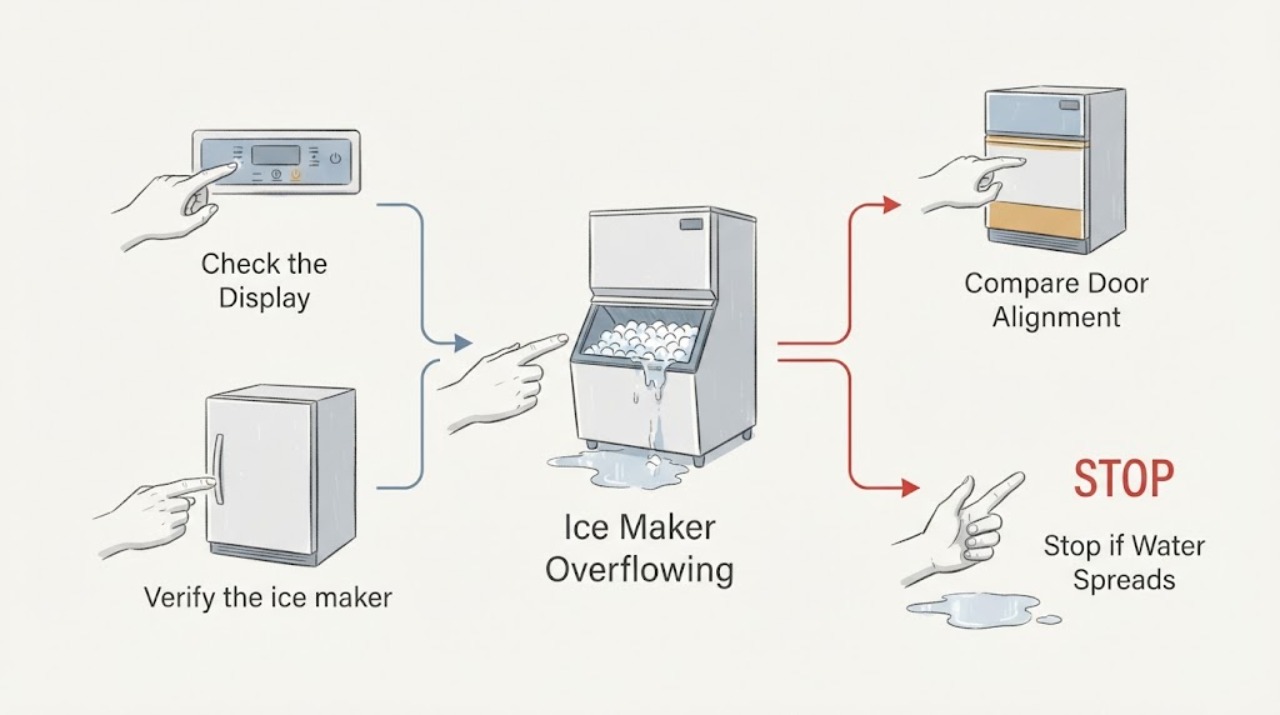
Work through in order
Diagnostic checks
Use only checks that match the exact appliance or system and its official guide.
-
Check 1
Turn the ice maker off using its control and remove excess ice safely. Inspect the bin sensor/arm or side-wall sensor for ice-scoop blockage, mineral film, or foreign objects; clean only with a soft towel and warm soapy water.
Expected result: The sensor is blocked/dirty, or the sensor path is clear but ice production continues.
Next step: Restore only the supplied scoop to its holder and test once after the bin is positioned correctly; service recurrence.
Why this matters
Why: Whirlpool says a blocked or dirty sensor can cause too much ice. Continued production with a clear sensor makes a sensor, control, or harvest fault more likely.
-
Check 2
Verify the ice maker and bin are level and that Max Ice, Fast Ice, or Accelerated Ice is off unless deliberately needed.
Expected result: The unit is unlevel or accelerated mode was on, or both were already correct.
Next step: Correct accessible leveling/settings and monitor one production cycle.
Why this matters
Why: Level and production-rate settings can explain solid-ice overflow. Correct settings with continued overflow points to sensing or fill control.
-
Check 3
If water is present, inspect the spigot-to-fill-cup alignment, ice tray seating, and accessible supply connections with water/ice maker off. Do not loosen a pressurized line.
Expected result: Water misses the cup, a fitting is wet, or alignment and fittings are dry.
Next step: Correct only a documented accessible alignment/fitting; stop if water returns.
Why this matters
Why: Misaligned fill parts or unsecured fittings can put liquid into the bin or floor. A dry accessible path makes an internal valve or fill-control problem more likely.
-
Check 4
After one sensor, level, mode, and fill-path correction, run a supervised fill/harvest and record whether the water stops, the bin sensor pauses production, and ice drops normally.
Expected result: The bin fills to its normal level, ice continues past the sensor, or water keeps entering.
Next step: Turn the ice maker off and contact Whirlpool service with model and photos.
Why this matters
Why: Normal shutoff supports a corrected sensor/setting state. Continued ice or water overflow needs component diagnosis.
Use your observations
Decision map
Find the observation that best matches what you see, then follow the next safe action.
-
PATH 01Next step
What you see
Solid ice overflow stops after clearing the sensor, leveling the maker, or disabling accelerated ice.
Do this next
Keep the sensor path clear and use accelerated mode only when the bin has room.
Why this path and its safety boundary
Why it matters: A sensor obstruction, level, or mode state was more likely.
-
PATH 02Next step
What you see
Liquid water misses the fill cup or a supply fitting leaks.
Do this next
Stop production, correct only the accessible documented fitting, and service any repeat leak.
Why this path and its safety boundary
Why it matters: Water-entry alignment or connection is the leading cause.
-
PATH 03Next step
What you see
The sensor and fill path are clear/correct but ice or water continues overflowing.
Do this next
Leave the maker off and arrange model-specific service.
Why this path and its safety boundary
Why it matters: A sensor, inlet valve, fill control, or ice-maker module fault is more likely.
Helpful context
Understand the symptom
“Overflowing” can describe ice spilling over the bin or water entering the tray/bin. Empty the bin enough to see the sensor and fill area, then record whether the overflow is solid ice, pooled water, or both.
Whirlpool uses both refrigerator ice makers and freestanding/undercounter units. Confirm the product layout and model before touching a sensor, water line, or drain.
Only after diagnosis
Potential parts
- bin sensor or ice-maker control
Consider only after the sensor is clear and service confirms the sensing/control fault.
Refrigerator and freestanding ice makers use different architectures. - water inlet valve or fill-cup component
Consider only when liquid overflow is traced to fill control/alignment and the exact model is confirmed.
Do not infer valve fit from water overflow alone.
When checks do not resolve it
Need a professional?
Contact Whirlpool service when overflow returns after sensor, level, mode, and fill checks; when water enters continuously; or when a valve, sensor, or module diagnosis is needed. Provide model, solid-versus-liquid pattern, sensor condition, and photos.
Common questions
FAQ
Does an overflowing ice bin always mean a bad water valve?
No. Whirlpool lists blocked/dirty sensor, leveling, and accelerated-ice mode for too much ice, while liquid overflow can involve fill-cup alignment or fittings. Separate solid ice from water first.
Can I clean the ice-level sensor?
Whirlpool says a soft towel with warm, soapy water can clean mineral buildup. Keep the maker off and do not scrape or open the sensor.
Should I leave Max Ice on?
Accelerated modes produce more ice in a period and should be used when the bin is low or empty. Turn them off while diagnosing overflow.
Read the exact guide
Official sources
- Making Too Much IceWhirlpool · Official Whirlpool ice-maker guidance; sensor location and controls vary by model.
- Ice Maker Leaking Water: Causes and FixesWhirlpool · Official Whirlpool consumer guidance; refrigerator and freestanding architectures differ.
Community feedback
Share a repair observation
Share a plain-text repair observation. Accepted observations are published automatically; this page may take a moment to update.