
On this page
Start here
Quick answer
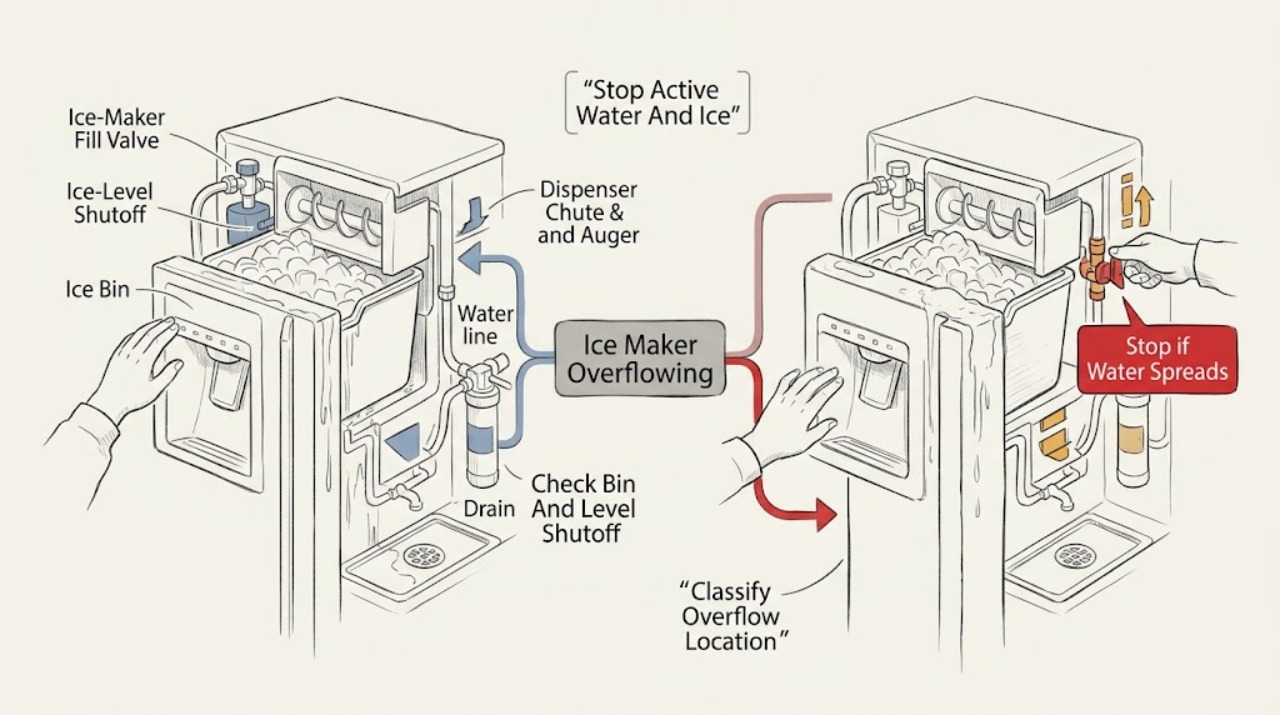
If water is still entering the ice maker or pooling around the refrigerator, turn the ice maker off using the exact model's control or raise its wire signal arm if that is the documented control, then close the refrigerator's water shutoff from a safe, dry location. Do not keep dispensing or run an ice-making test while water is escaping. First separate four patterns: water entering after the bin is full suggests the level shutoff or fill control is not stopping; a full bin pushing cubes out is a storage/dispensing problem; water appearing only after thawing can be meltwater from frost, a chute, or a catch area; and water that continues with the ice maker off points toward a supply line, filter, valve, or internal leak. Frigidaire's refrigerator guidance says the ice maker turns off automatically when a top-freezer bin is full, while its leak guidance links chute ice, door-open frost, water connections, and filter condition to water leaks. If water continues, the unit trips power, or a valve, sensor, wiring, or internal ice-maker mechanism would need access, leave the water and ice maker off and arrange qualified service.
Before you begin
Safety first
- This article covers stopping ice making, safe water isolation, identifying the visible leak pattern, checking a removable bin/chute and visible connection only as the exact guide permits, and recording model information. Internal valves, sensors, ice-maker mechanisms, wiring, controls, water lines, and live electrical tests require qualified service.
Work through in order
Diagnostic checks
Use only checks that match the exact appliance or system and its official guide.
-
Check 1
If water is actively flowing, pooling, or repeatedly entering the ice maker, stop dispensing ice, switch the ice maker OFF using the exact model control or raise its wire signal arm only if that is the documented control, and close the refrigerator water shutoff from a safe dry location. Keep the refrigerator connected only if there is no electrical hazard and the model requires power for food safety.
Expected result: Water stops when the ice maker is turned off; water continues with the ice maker off; the shutoff cannot be found or closed safely; or water is near a plug, outlet, or electrical component.
Next step: Keep the ice maker and water supply off and arrange service if water continues or isolation is unsafe. Do not restart to confirm the pattern.
Stop if: Do not touch wet electrical parts, unplug through water, pull the refrigerator out, or reset a valve/control while water is escaping.
Why this matters
Why: Stopping with the ice maker control suggests the fill cycle or ice-maker mechanism is involved. Continued flow with the ice maker off shifts attention to a supply line, filter, inlet valve, or leak outside the ice-making cycle. Water near electricity is an immediate safety boundary.
-
Check 2
After water is stopped and the area is dry, identify where the excess is located without removing covers: water in the ice mold or under the fill area, cubes spilling over the bin, water at the dispenser chute/door, water below the ice maker, or a wet supply/filter connection. Note whether the bin was full and whether the ice maker had been recently installed or the filter changed.
Expected result: Liquid is in the mold; solid cubes are piled above the bin; water is concentrated at the chute; water is below the unit; or a supply/filter connection is wet.
Next step: Use the matching branch and preserve photos. Inspect only the user-accessible bin, chute opening, and visible connection permitted by the model guide; leave internal valve, sensor, and mechanism diagnosis to service.
Stop if: Do not reach into the fill tube, rotate an auger, pry ice from a valve, or remove the ice-maker housing.
Why this matters
Why: Liquid in the mold points toward fill shutoff or ice-maker control. Cubes above the bin point toward storage/level handling. Chute water can follow melted/refrozen ice, while water below or at a connection points toward frost melt or a plumbing/filter leak.
-
Check 3
With the ice maker OFF and no active leak, check that the ice bin/container is seated in the position shown by the exact model guide, is not overfilled with cubes, and is not blocked by a large clump. For a top-freezer wire-arm model, verify from outside that the arm can move to its documented OFF position; do not force it.
Expected result: The bin is full or displaced; cubes are bridged or piled into the mechanism; the wire arm is held down or obstructed; the bin and arm are correctly positioned; or the model uses electronic sensing instead.
Next step: Remove only loose excess cubes or a removable bin according to the model guide, dry it, and reseat it. If the bin refills with liquid or overflow returns despite correct placement, keep the ice maker off and arrange service.
Stop if: Do not force the arm, disassemble the bin, rotate a dispenser auger, or power the ice maker while a clump blocks its level mechanism.
Why this matters
Why: A full, displaced, or clumped bin can make cubes spill and can prevent a mechanical signal arm from reaching its stop position. Correct placement removes a storage/sensing cause but does not prove an electronic sensor, valve, or ice-maker motor is healthy. Electronic models need their own guide.
-
Check 4
Inspect only the visible dispenser chute, door area, filter housing, and rear/accessible water connections described by the exact model guide. Look for frost or ice in the chute, a filter that is not seated or is visibly cracked, and moisture at a connection. Do not remove a filter or move the refrigerator if water is near electrical equipment or the procedure is not model-approved.
Expected result: Ice/frost is visible in the chute; the filter or connection is wet or damaged; the door was left open and frost formed; or all visible areas are dry and clear.
Next step: Follow only the exact model's safe bin/chute/filter procedure, dry accessible surfaces, and leave water off if the source is not clear. Arrange service for an internal leak or continued water entry.
Stop if: Do not chip chute ice with a sharp object, tighten a wet connection while energized, remove internal tubing, or use heat to melt hidden frost.
Why this matters
Why: Frigidaire links chute ice, filter installation/damage, loose connections, and door-open frost to leaks around the refrigerator/ice-maker area. A dry visible path with continued mold overfill makes the internal fill valve or level-control path more likely.
-
Check 5
Record the full model and serial information, ice-maker architecture (top-freezer wire arm, door dispenser, or electronic control), whether water entered with the ice maker OFF, bin fullness, filter/change timing, and the exact location of the leak. Do not power the ice maker solely to recreate the overflow.
Expected result: The model and pattern are clear; the overflow recurs as soon as water is supplied; water stops but ice spills; the source is hidden; or the model/architecture is unknown.
Next step: Keep the ice maker and water supply off for recurring or unexplained overflow and arrange qualified service. Give the technician the model, photos, water-isolation status, bin position, and timing.
Stop if: Do not bypass a level sensor, force a fill cycle, perform live voltage tests, or order a valve/control from the word overflow alone.
Why this matters
Why: A repeatable fill-with-control-off pattern points to a supply or valve issue; a dry mold with cubes spilling points toward bin/level handling; hidden or unknown patterns require model-specific service rather than a guessed part.
Use your observations
Decision map
Find the observation that best matches what you see, then follow the next safe action.
-
PATH 01Safety boundary
What you see
Water continues to flow or the area keeps becoming wet after the ice maker is turned off, or the water source is a visible supply/filter connection rather than the mold.
Do this next
Close the refrigerator water shutoff if safe, keep the ice maker off, and arrange qualified appliance/plumbing service. Do not restore water to test the valve.
Why this path and its safety boundary
Why it matters: A supply line, filter, inlet valve, or plumbing leak is more likely than a full-bin problem; an internal valve can remain a service issue even when the user command is OFF.
Safety stop: Do not touch wet electrical equipment, move the refrigerator through water, or repeatedly toggle the ice-maker control.
-
PATH 02Safety boundary
What you see
Liquid is found in or around the ice mold/fill area after a cycle, the bin is not simply overfilled with cubes, and water stops only after the water supply or ice maker is disabled.
Do this next
Leave water and ice making off and schedule model-specific service. Provide the exact model and whether the event occurred with the bin full or empty.
Why this path and its safety boundary
Why it matters: Failure to stop the fill, a level shutoff problem, or an internal ice-maker/valve control fault is more likely. The observation does not identify the valve versus sensor versus control.
Safety stop: Do not remove the fill valve, jumper a level sensor, or run another harvest/fill test.
-
PATH 03Safety boundary
What you see
The mold is not overflowing with liquid, but cubes are piled above the bin, spilling at the front, or obstructing the wire arm/door dispenser.
Do this next
Turn the ice maker off, remove only loose excess cubes or the removable bin according to the model guide, dry and reseat it, and do not assume the top-freezer wire-arm procedure applies to another architecture.
Why this path and its safety boundary
Why it matters: A full, displaced, or clumped storage bin is more likely than excess fill water. Frigidaire documents automatic shutoff when a top-freezer bin is full, but an electronic or dispenser model may use a different arrangement.
Safety stop: Do not force the signal arm, rotate an auger to clear a jam, or restart while cubes block the mechanism or door.
-
PATH 04Safety boundary
What you see
Water is concentrated at the dispenser chute or below the ice maker after frost, a door-open event, infrequent use, temperature fluctuation, or a power interruption, with no ongoing fill into the mold.
Do this next
Keep the ice maker off while the area returns to a dry state; use only the exact model's removable-bin/chute procedure. Arrange service if the chute repeatedly refreezes, water returns with no frost explanation, or hidden ice must be accessed.
Why this path and its safety boundary
Why it matters: Meltwater from chute ice or evaporator frost is more likely than an overfilling valve. Frigidaire says ice/frost in the chute can melt and leak, and door-open air can ice the evaporator and leak near the ice maker.
Safety stop: Do not chip ice with metal, use a heat gun/hair dryer, or open the door liner or dispenser housing.
-
PATH 05Safety boundary
What you see
The model/ice-maker architecture is unknown, the leak source is hidden, water is near electricity, the refrigerator trips power, or overflow returns after the documented external checks.
Do this next
Keep the ice maker and water supply off, isolate power only if it can be done safely from a dry location, and arrange qualified service. Do not move or disassemble the refrigerator to improve access.
Why this path and its safety boundary
Why it matters: Evidence is insufficient for a safe owner repair. A recurring leak or hidden fill-control fault requires an exact-model inspection; the presence of water near electricity makes continued operation unsafe.
Safety stop: Do not restore water, run a fill test, remove panels, bypass controls, or order a generic ice-maker/valve part.
Helpful context
Understand the symptom
Stop the water before looking for the cause
Overflowing means water or ice is escaping its intended path, not simply that ice production is low or the dispenser is jammed. If water is actively entering, turn the ice maker off and close the refrigerator water shutoff if it is safely accessible. Keep hands and plugs dry. Do not remove an energized valve, reach behind the refrigerator, or restart the ice maker to see whether it overfills again.
The location of the water changes the diagnosis
Water in the ice mold while the bin is full suggests a failure to stop filling or a level-sensing problem. Cubes spilling over the bin can be a full-bin or dispensing arrangement issue rather than excess water. Water at the front chute may come from ice that has melted and refrozen around the chute, while water under the ice-maker area can follow frost or a loose connection. Observe only from a dry, accessible position; do not dismantle the ice maker or chute.
Why model identity matters
Frigidaire supports refrigerators with top-freezer, French-door, and side-by-side arrangements, and not every top-freezer refrigerator has an ice maker. Some models use a wire signal arm, while others use electronic controls, a door dispenser, a dedicated bin, or a filter and internal water path. Confirm the full model number before using a button sequence or ordering a valve, sensor, bin, or ice-maker assembly.
Only after diagnosis
Potential parts
- ice-maker water inlet valve
Consider this only after qualified diagnosis confirms that water enters or continues after the exact model's ice-maker OFF command and the supply line/filter path is sound.
Valve ports, electrical connectors, and refrigerator architecture vary by model; match the complete model number. - ice-level signal arm or sensor assembly
Consider this only when a model-specific diagnosis shows that a full bin is not reaching the documented shutoff state and the bin is correctly seated and unobstructed.
Mechanical wire arms and electronic level sensors are not interchangeable; confirm the exact architecture and fit. - ice maker assembly
Consider this only after service isolates the internal ice-maker mechanism or control as the cause of liquid overfill rather than a supply leak or bin spill.
Ice-maker assemblies differ among top-freezer, French-door, and side-by-side models; do not order from the overflow symptom alone. - ice bin or dispenser chute component
Consider this only if the exact model's removable bin or chute is cracked, distorted, or cannot seat after safe cleaning and clump removal.
Bin, auger, chute, and door-dispenser dimensions are model-specific and may be architecture-dependent.
When checks do not resolve it
Need a professional?
Safety scope: This article covers stopping ice making, safe water isolation, identifying the visible leak pattern, checking a removable bin/chute and visible connection only as the exact guide permits, and recording model information. Internal valves, sensors, ice-maker mechanisms, wiring, controls, water lines, and live electrical tests require qualified service.
Common questions
FAQ
What should I do first if my Frigidaire ice maker is overflowing?
Stop the ice maker and, if water is actively entering or pooling, close the refrigerator water shutoff from a safe dry location. Do not run another fill cycle. Then determine whether liquid is in the mold, cubes are spilling from a full bin, or water is coming from the chute or a connection.
Why does water continue after I turn the Frigidaire ice maker off?
Continued water with ice making off points away from a simple full-bin spill and toward a supply line, filter, inlet valve, or other leak. Close the refrigerator water shutoff if safe, keep the ice maker off, and arrange service; do not restore water to test it.
Can a full Frigidaire ice bin cause an overflow?
It can cause cubes to spill or obstruct a level mechanism. Frigidaire says a top-freezer ice maker turns off automatically when its bin is full, but a displaced or clumped bin can still create a spill, and electronic or dispenser models may use a different arrangement. Do not force the wire arm or assume the top-freezer procedure fits another model.
Why is water leaking from the Frigidaire ice dispenser chute?
Frigidaire says ice or frost in the chute can melt and leak, including after infrequent use, temperature fluctuation, or a power outage. Keep ice making off while the area is dry, use only the exact model's removable-bin/chute procedure, and do not chip hidden ice or open the door liner.
When does an overflowing Frigidaire ice maker need service?
Arrange service when water continues with the ice maker off, liquid overfill returns after the bin and visible supply path are correct, the leak is hidden, water reaches electrical parts, the breaker trips, or diagnosis would require a valve, sensor, control, wiring, or internal ice-maker access. Keep water and ice making off until inspected.
Read the exact guide
Official sources
- My refrigerator was just installed and the ice maker is not working, how do I fix it?Frigidaire · Frigidaire refrigerator ice-maker support article covering several architecture families; it does not establish one universal control or bin design.
- What should I do if the dispenser on my refrigerator is not dispensing ice?Frigidaire · Refrigerators equipped with a door ice dispenser; not applicable to a simple top-freezer bin without a dispenser.
- Refrigerators - How do I use my ice maker in my Top-Freezer refrigerator?Frigidaire · Top-freezer refrigerator ice-maker architecture only; do not generalize its wire-arm procedure to French-door, side-by-side, or electronic ice-maker models.
- Refrigerator Water LeaksFrigidaire · Frigidaire refrigerator support article; use only the applicable leak section and the exact refrigerator guide for component access.
Community feedback
Share a repair observation
Share a plain-text repair observation. Accepted observations are published automatically; this page may take a moment to update.