
On this page
Start here
Quick answer
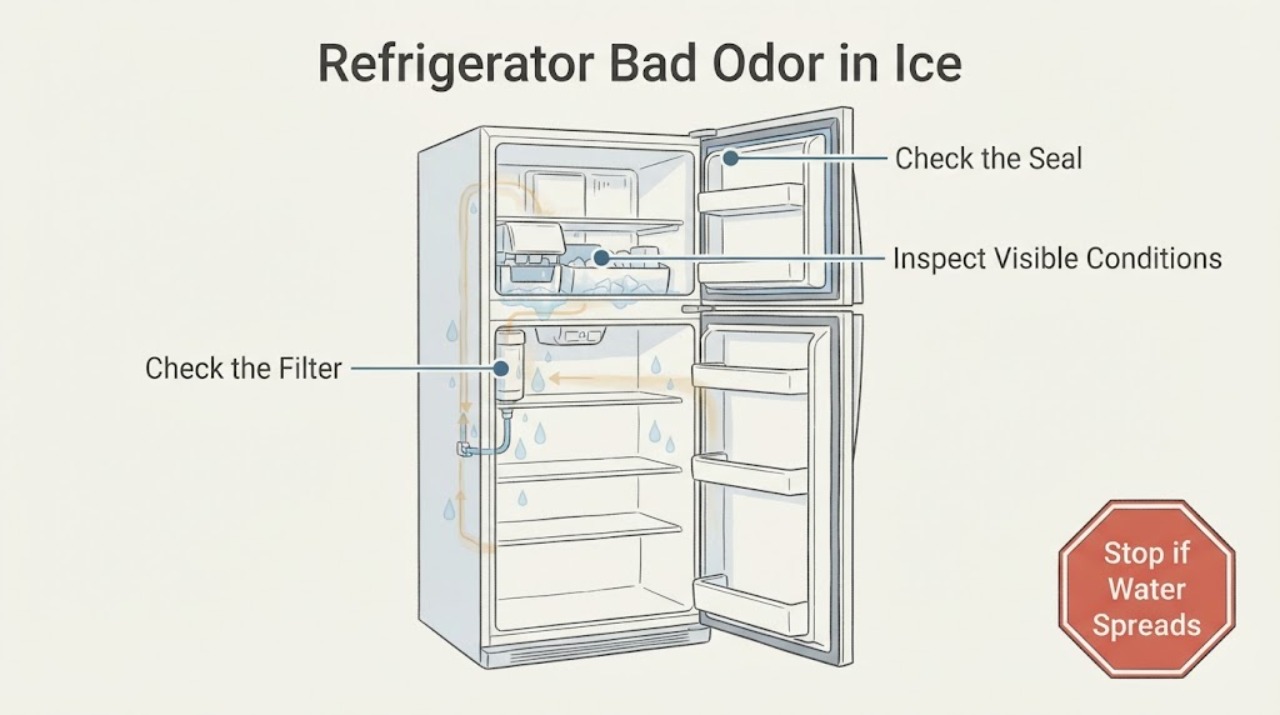
Stop using ice or dispensed water that has a rotten or sharp odor, and discard the affected ice. Whirlpool explains that food odors can transfer between the refrigerator and freezer and into ice, while old ice, water-supply materials, filters and ice-maker leaks can create separate taste or leak symptoms. First separate an odor in the ice from a visible water leak: check the ice bin, dispenser chute, food packaging, filter area and visible water path without opening panels. If water is pooling inside or beneath the refrigerator, shut off the water supply when safe and arrange service rather than assuming the odor is only food. After the leak source is corrected, clean both sections, flush the water system according to the model guide and make fresh ice before using it.
Before you begin
Safety first
- Do not taste contaminated ice, use bleach or flammable/harsh cleaners, open the freezer liner, pierce ice, force a hidden drain, bypass a water or electrical safety, or replace a filter/valve/line without the model's fit and installation instructions. Whirlpool's public pages support visible checks and cleaning, while recurring internal leaks require qualified inspection.
Work through in order
Diagnostic checks
Use only checks that match the exact appliance or system and its official guide.
-
Check 1
Stop consuming the ice and dispensed water while the odor is present. Empty the ice bin into a sealed waste bag, note whether the odor is in the ice, the dispensed water, or both, and keep food that has absorbed the odor separate from food that remains normal.
Expected result: Only old ice smells, both ice and water smell, or the odor has transferred to food in both compartments.
Next step: Discard affected ice and do not use it as a diagnostic sample. Continue with the visible leak and food checks before making fresh ice.
Why this matters
Why: Whirlpool says old ice, food odor transfer, water-supply conditions and filter state can produce off-taste or odor. This observation narrows the source but does not identify a leak or a failed filter head.
-
Check 2
Inspect the ice bin and dispenser chute from the user-accessible side. Look for wet clumps, melted ice, a puddle under the bin, a blocked chute, or a fill-cup area that is visibly misaligned. Do not insert sharp tools or remove internal covers.
Expected result: Ice is clumped or wet, water is collecting in or below the bin/chute, or no ice-maker-area moisture is visible.
Next step: For a loose, accessible ice blockage, follow the model guide and allow the bin or chute to thaw naturally. If water returns, the bin is damaged, or the path is not clear, stop and schedule service.
Why this matters
Why: Whirlpool identifies jammed ice, warm-air melting, an unlevel ice maker and fill-cup misalignment as possible ice-maker leak paths. A dry bin does not rule out a defrost drain or water-line leak elsewhere.
-
Check 3
Trace visible moisture with the refrigerator powered safely and without moving it into an unsafe position: check the freezer/refrigerator floor, filter cap area, under-door area, rear water connection and floor beneath the appliance. If water is near electrical parts, disconnect power only if it is safe and close the household water shutoff.
Expected result: Water is inside the cabinet, behind the refrigerator, under a filter connection, at the dispenser line, or nowhere except the ice bin.
Next step: For a rear or filter-area leak, leave the water supply off and arrange repair. For an internal puddle or recurring leak, do not dismantle the freezer liner; request professional inspection.
Why this matters
Why: Whirlpool separates defrost-drain puddling from filter, water-line and ice-maker leaks. The location changes the service path; it does not prove a specific valve, drain or tube has failed.
-
Check 4
Check the visible food, shelves, drawers, gaskets and freezer floor for spoiled items, spills, trapped residue or standing water. Remove only user-removable parts and clean both refrigerator and freezer sections with a soft cloth and mild, non-abrasive cleaner; do not spray vents or electronics.
Expected result: A spoiled item or spill is found, the odor is in both sections, or surfaces are clean but the odor persists.
Next step: Dry all cleaned surfaces and replace only sound food. If the odor persists or water returns, stop escalating the cleaning chemicals and arrange service.
Why this matters
Why: Whirlpool says food odors can move between both sections and recommends cleaning all interior areas to remove the source. A persistent odor after cleaning can reflect a leak, trapped moisture or an inaccessible source rather than a need for harsher chemicals.
-
Check 5
Once the leak is controlled and the interior is clean, follow the assigned model's Use and Care Guide for filter replacement or water-system flushing. Discard the first ice made after the applicable flush or filter change and observe whether new ice and dispensed water are odor-free.
Expected result: Fresh ice and water are normal, or the odor returns with new ice or the leak reappears.
Next step: Use fresh ice only after it is odor-free. If the odor or leak returns, keep the ice maker/water supply off as appropriate and request Whirlpool or qualified appliance service with the leak location and cleaning/flush result.
Why this matters
Why: Whirlpool explains that new plumbing, a recently installed filter, stale ice and water quality can affect odor, but recurring odor with a recurring leak needs source repair rather than repeated flushing.
Use your observations
Decision map
Find the observation that best matches what you see, then follow the next safe action.
-
PATH 01Next step
What you see
The ice smells but the water, bin and visible refrigerator surfaces are dry, and the odor improves after discarding old ice and removing a spoiled or uncovered food.
Do this next
Clean both sections, keep food sealed, allow fresh ice to form and discard any new batch that still smells.
Why this path and its safety boundary
Why it matters: Food transfer or stale ice is more consistent with the observation than an internal water leak, although the smell alone cannot prove that distinction.
-
PATH 02Next step
What you see
The odor is in both ice and water, or it returns after a filter change or water-system flush.
Do this next
Keep affected ice and water out of use, verify the filter is the correct model-approved type and fully seated, and arrange service or qualified plumbing review if the odor persists.
Why this path and its safety boundary
Why it matters: A water-supply, filter, plumbing-material or persistent interior-source issue remains possible; repeated flushing has not established a repair.
-
PATH 03Next step
What you see
Water or ice is collecting in the bin or chute, or a visible ice clump melts and returns as a leak.
Do this next
Use only the model's user-level ice-bin/chute procedure and natural thawing for an accessible blockage. If the leak repeats or the ice maker is not safely accessible, turn off its water supply and call service.
Why this path and its safety boundary
Why it matters: Whirlpool identifies ice clumps, warm-air melting, level/alignment and fill-cup conditions as possible ice-maker leak paths.
-
PATH 04Next step
What you see
A puddle forms inside the refrigerator/freezer or beneath it, especially after the unit has been cleaned or the ice maker has been used.
Do this next
Document the puddle location, close the water shutoff if the leak is from the water system, disconnect power only when safe, protect flooring and arrange qualified inspection. Do not open the liner or force a hidden drain clear.
Why this path and its safety boundary
Why it matters: Whirlpool lists defrost-drain, filter, water-line and ice-maker paths; the location alone cannot select a blocked drain or failed part.
-
PATH 05Next step
What you see
There is a chemical, sewage-like or burning odor, water is near electrical parts, food temperatures are unsafe, or the leak is large or uncontrollable.
Do this next
Stop using the affected ice and water, disconnect power and shut off the water supply only if safe, keep people away from the spill, protect or discard food as appropriate, and obtain qualified appliance or electrical service.
Why this path and its safety boundary
Why it matters: This is a safety and food-protection stop condition, not a routine odor-cleaning problem.
Helpful context
Understand the symptom
Treat the ice as contaminated until the odor source is known
Do not taste-test ice or water that smells rotten, sharp or chemical. Whirlpool says to throw away ice with an odd odor and allow the ice maker time to produce fresh ice. An odor can come from food transferred through the shared air space, stale ice, the water supply or filter, or a dirty ice bin; the report's internal leak adds a separate path that must be found before odor treatment is considered complete.
Find the leak path before trying to mask the smell
Check where moisture is actually appearing: in the freezer or refrigerator floor, in the ice bin or chute, at the filter area, behind the refrigerator or on the floor. Whirlpool notes that clogged defrost drains can cause interior puddling, while water-line, filter and ice-maker conditions have different symptoms. A recurring internal puddle is not a reason to open the liner or force a drain clear without the model's instructions; arrange a professional inspection when the path is not plainly external.
Clean only with Whirlpool's gentle method
After the water source is controlled, remove spoiled or leaking food, discard affected ice, and clean both sections because air circulates between them. Whirlpool's cleaning guidance calls for a mild, non-abrasive method and warns against bleach, flammable fluids, petroleum cleaners and harsh tools on liners and gaskets. Dry removable parts and surfaces completely, then use the model-specific guide for water-system flushing and ice-maker restart.
When checks do not resolve it
Need a professional?
Request Whirlpool or qualified appliance service when an internal puddle recurs, the leak path is behind a panel or inside the liner, a water-line or filter connection continues to leak, the odor returns in fresh ice after cleaning and flushing, or food/electrical safety is affected. Give the refrigerator model from its label, the odor description, whether water also smells, the leak location and what was discarded or cleaned.
Safety scope: Do not taste contaminated ice, use bleach or flammable/harsh cleaners, open the freezer liner, pierce ice, force a hidden drain, bypass a water or electrical safety, or replace a filter/valve/line without the model's fit and installation instructions. Whirlpool's public pages support visible checks and cleaning, while recurring internal leaks require qualified inspection.
Common questions
FAQ
Can a bad smell in ice prove that the refrigerator has mold or a refrigerant leak?
No. Whirlpool lists food transfer, old ice, water-supply materials, minerals and filter condition as possible odor sources. A smell with an internal leak needs the leak path identified; it does not prove mold, refrigerant or a specific failed part.
Should I keep using ice after cleaning the bin?
No. Discard ice with an odd odor. After the leak and odor source are addressed, clean the bin and both refrigerator sections, flush the water system as the model guide requires, and use fresh ice only after it is odor-free.
Is an internal freezer leak always a clogged drain?
No. Whirlpool describes several possible paths, including defrost-drain blockage, water-line or filter connections, and ice-maker clumps or fill-cup alignment. Recurrent water inside or beneath the refrigerator should be inspected professionally rather than assigned to one part from the symptom alone.
What should I tell the technician?
Provide the model from the refrigerator label, whether the smell is in ice, water or food, where moisture appears, whether the ice bin or chute is wet, whether a filter was recently changed, and what happened after cleaning or flushing. Do not dismantle the freezer to collect internal evidence.
Read the exact guide
Official sources
- Removing and Preventing OdorsWhirlpool · The opened Whirlpool Product Help page supports cleaning both sections, removing spoiled food and using mild, non-abrasive methods. It warns against harsh, flammable, petroleum and bleach-type cleaners; it does not establish the source of an internal leak.
- How to Fix a Refrigerator That Is Leaking WaterWhirlpool · The opened Whirlpool article is general refrigerator leak guidance. It supports distinguishing internal puddles, water-line/filter checks and professional inspection, and says to unplug and close the water shutoff before inspecting a water line when safe. It does not identify a hidden drain or part for an unspecified model.
- What to Do if There is Water on the FloorWhirlpool · The opened Whirlpool Product Help page supports visible filter-cap, supply-line and connection checks for water on the floor. It does not establish the source of a leak inside the freezer or refrigerator liner.
- Cleaning the Interior of the RefrigeratorWhirlpool · The opened Whirlpool Product Help page supports gentle cleaning of removable interior parts, walls and gaskets, with power/cooling precautions and no direct spray on electronics. It is family-level cleaning guidance and not a repair procedure for the hidden leak.
- Ice Cubes are Off Colored or DebrisWhirlpool · The opened Whirlpool Product Help page addresses off-colored or off-odor ice and water-system conditions at the Whirlpool refrigerator/freezer family level. It supports discarding odd-smelling ice, checking food packaging, plumbing/materials and filter state; it does not diagnose the assigned home's internal leak.
- Owner's ManualWhirlpool · The opened Whirlpool owner manual is used only for family-level precautions visible in the manual: odors transfer between sections, clean with power disconnected and nonflammable/non-harsh methods, discard or flush ice after water-system work, and do not generalize its model-specific instructions to an unspecified appliance.
- Ice Maker Troubleshooting: How to Fix an Ice MakerWhirlpool · The opened Whirlpool article supports user-visible ice-bin/chute observations and explains that clumps, warm-air melting, an unlevel ice maker and fill-cup alignment can produce leaks. It does not authorize model-unknown disassembly or prove a particular ice-maker part.
- How to Flush the Water System in a RefrigeratorWhirlpool · The opened Whirlpool Product Help page supports flushing after water-system or filter work and explains that trapped air can affect water and ice. Exact container counts and model steps must follow the assigned refrigerator's own guide when they differ.
Community feedback
Share a repair observation
Share a plain-text repair observation. Accepted observations are published automatically; this page may take a moment to update.