
On this page
Start here
Quick answer
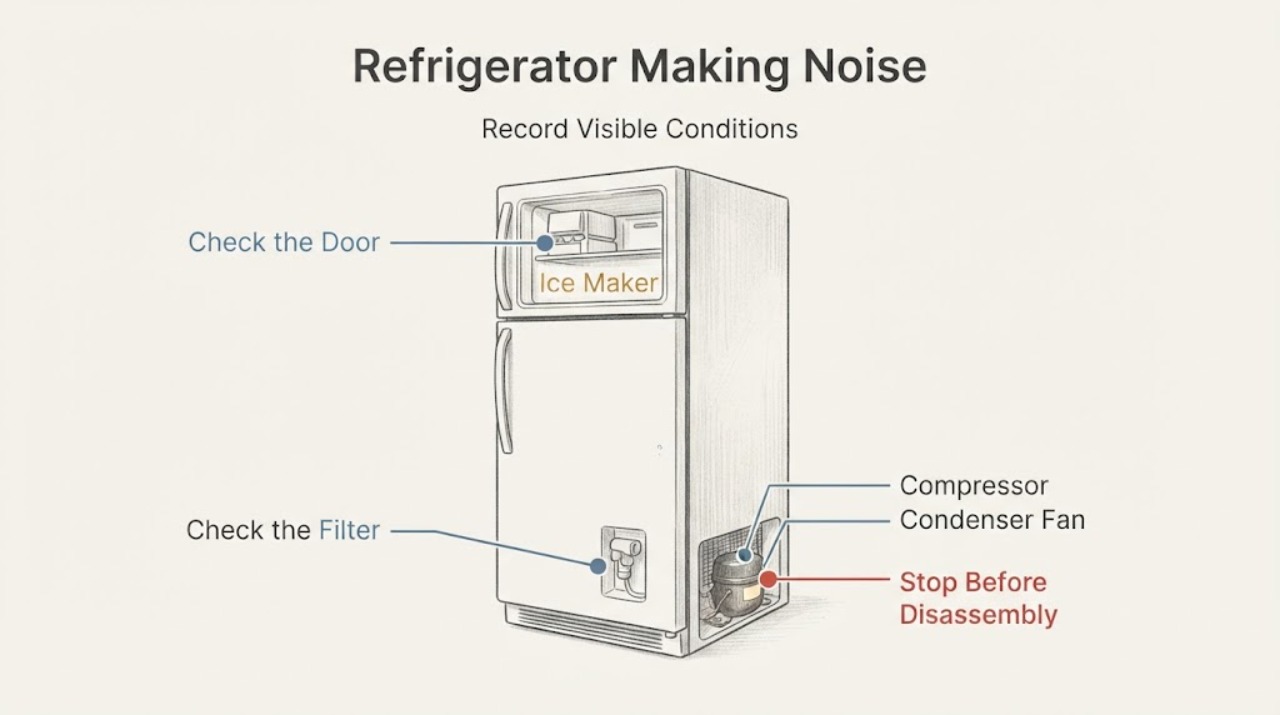
First record the sound and when it occurs. A brief hum, soft airflow, gurgle, hiss, click, or occasional pop can be part of normal cooling, defrost, refrigerant flow, or ice-maker operation. If the sound is a rattle or vibration, check that the cabinet is stable and level and that nothing on top is vibrating. If buzzing happens during ice-maker filling or dispensing, check the water supply, line, filter, and the model's ice-maker setting. Stop using the refrigerator and arrange qualified service for persistent grinding, excessive noise with cooling loss or water spillage, a hot or damaged cord, burning odor, smoke, sparks, or repeated breaker trips.
Work through in order
Diagnostic checks
Use only checks that match the exact appliance or system and its official guide.
-
Check 1
From a safe position, record the sound in plain words and note its location and timing: hum, buzz, click, gurgle, hiss, whoosh, rattle, vibration, squeak, grinding, or thump; and whether it occurs after a door opening, during cooling, defrosting, dispensing, or ice-maker filling. Check that both compartments are cooling normally without deliberately creating another cycle.
Expected result: The sound is brief and soft with a regular cooling or defrost event, changes with dispensing or ice making, changes when the cabinet vibrates, or is continuous, harsh, and accompanied by warming or water outside the unit.
Next step: Use the matching branch below. Photograph or record the sound if it is safe to do so; stop using the refrigerator for smoke, sparks, burning odor, a hot or damaged cord, uncontrolled water, or repeated electrical trips.
Why this matters
Why: A cycle-linked soft sound is more consistent with normal compressor, fan, refrigerant, defrost, or water-system operation. A location or timing linked to the ice maker, cabinet, or level changes the first external check. A persistent harsh sound or a sound with cooling loss or water spillage requires service rather than repeated listening tests.
-
Check 2
With the refrigerator closed and stable, check from outside that the cabinet is not rocking, the floor is solid, and items on top or against the sides are not touching and vibrating. Follow the owner's manual for any leveling-leg adjustment; do not drag a loaded refrigerator or remove doors to level it.
Expected result: The noise changes when a loose item is removed or the cabinet is stabilized, the cabinet rocks or is visibly out of level, or the sound is unchanged with a stable cabinet and clear surroundings.
Next step: Secure or remove only loose external items and correct leveling only as the exact manual permits. Arrange service if the cabinet cannot be stabilized, the noise is grinding, or the sound continues with normal level and clearances.
Why this matters
Why: A change after removing a vibrating item or stabilizing the cabinet supports an external vibration source. An unchanged noise makes refrigerant, fan, compressor, water, or an internal mechanical source more relevant, but does not identify a failed part.
-
Check 3
If the noise is a buzz, hum, chatter, or thump, note whether it starts during ice-maker filling, water dispensing, or only when the compressor or fans run. If the refrigerator has an ice maker but is not connected to water, use the exact manual to turn the ice maker off; if it is connected, inspect the accessible water line for a kink and check the filter installation only as the manual permits.
Expected result: The sound occurs during an ice-maker fill or dispensing event, the ice maker is on without a water supply, the line is kinked or the filter is restricted, or the sound occurs independently of the water system.
Next step: Correct only a visible kink or documented ice-maker setting, and let the refrigerator stabilize. If the valve continues to buzz, water spills, the line is damaged, or the sound remains unexplained, stop troubleshooting and arrange qualified service.
Why this matters
Why: Water-valve, line, filter, and ice-maker conditions are more likely when the sound follows filling or dispensing. A buzz that continues during ordinary cooling or is independent of water use shifts attention back to compressor, fan, cabinet, or another model-specific source.
-
Check 4
If the sound seems to come from behind or beneath the cabinet, use the model manual to determine whether the condenser area is accessible and user-cleanable. Unplug the refrigerator before permitted cleaning, gently remove dust as directed, and reinstall any access panel before restoring power; do not touch wiring, fans, the compressor, or refrigerant tubing.
Expected result: The manual permits external condenser cleaning and dust is visible, the area is already clean, or the sound continues after a permitted cleaning and the refrigerator is level.
Next step: Restore the panel and power only after the permitted external cleaning is complete. If the noise persists, cooling worsens, the compressor or fan appears abnormal, or any cover would need removal, leave internal work to qualified service.
Why this matters
Why: Dust around an accessible condenser area can contribute to restricted airflow and louder operation, but cleaning does not prove that a noisy compressor or fan is healthy. Persistent noise after external checks needs model-specific diagnosis.
-
Check 5
Monitor the refrigerator without repeatedly opening the doors and record whether the noise is brief, regular, or continuous and whether temperature remains normal. Check only for visible water spillage, a damaged cord or plug, scorch marks, smoke, burning odor, or a breaker that trips again; do not remove panels or run a refrigerator with exposed parts.
Expected result: The noise remains excessive or becomes grinding, cooling is lost, water spills beyond the normal drain-pan area, the cord or plug is hot or damaged, or smoke, odor, sparks, or repeated trips occur.
Next step: Stop using the refrigerator and arrange qualified Whirlpool or appliance service. If safe, isolate power without touching a hot or damaged connection; do not repeatedly reset a breaker, test with panels removed, or order a compressor, fan, valve, or control part from the sound alone.
Why this matters
Why: Whirlpool advises professional investigation when noise is excessive or its cause cannot be determined. Cooling loss, water spillage, and electrical or fire symptoms raise the urgency and cannot be safely distinguished by a homeowner's sound test.
Use your observations
Decision map
Find the observation that best matches what you see, then follow the next safe action.
-
PATH 01Next step
What you see
The refrigerator makes a brief, soft hum, gurgle, hiss, click, whoosh, pop, or short high-pitched tone during cooling, defrosting, door opening, or pressure equalization, and it continues to cool normally.
Do this next
Monitor the pattern and use the model manual for normal operating sounds. Escalate if the sound becomes excessive, continuous, harsh, or is joined by warming, water spillage, or another fault symptom.
Why this path and its safety boundary
Why it matters: Whirlpool describes these cycle-linked sounds as common effects of the compressor, fans, refrigerant, defrost water, relays, or changing cabinet temperature.
-
PATH 02Next step
What you see
The sound is a rattle or vibration, and it changes after a loose item is removed, the cabinet is stabilized, or the refrigerator is leveled according to its manual.
Do this next
Keep the unit stable and clear of surrounding contact. Arrange service if it cannot be leveled safely or the rattle continues after the external vibration source is corrected.
Why this path and its safety boundary
Why it matters: The observed change makes cabinet movement, a flexible floor, or an item touching the refrigerator more likely than a confirmed internal part failure.
-
PATH 03Next step
What you see
Buzzing, chattering, or thumping starts during water dispensing or ice-maker filling, especially when the ice maker is on without a water connection or the accessible line or filter has a documented restriction.
Do this next
Turn off an unconnected ice maker and correct only the visible, manual-approved water-line or filter condition. Arrange service for a persistent valve noise, damaged line, or water leak.
Why this path and its safety boundary
Why it matters: The water valve, ice-maker fill, water line, or filter path is a stronger explanation than a compressor diagnosis for that timing.
-
PATH 04Next step
What you see
The noise is persistent, loud, or grinding, remains after the refrigerator is stable and the water source is excluded, or occurs with poor cooling, water spillage, smoke, burning odor, sparks, a hot cord, or repeated breaker trips.
Do this next
Stop using the refrigerator and arrange qualified service. Keep it unplugged when a hazard is present and do not open the cabinet, test live parts, or select a replacement component from the sound alone.
Why this path and its safety boundary
Why it matters: A simple normal operating sound or external vibration is no longer a sufficient explanation. The combination can involve a fan, compressor, water system, electrical condition, or another fault that requires qualified diagnosis.
Helpful context
Understand the symptom
Why the sound and timing matter
A refrigerator can sound different after a door opening, a cooling cycle, defrosting, dispensing, or an ice-maker fill. Whirlpool identifies the compressor, evaporator and condenser fans, refrigerant flow, water line, ice maker, relays, and cabinet movement as possible sources. A brief, soft sound that follows a normal cycle is different from a new continuous noise, a grinding sound, or noise paired with warming or water outside the cabinet.
Keep checks external
Use the complete model number for the owner's manual because layout, leveling instructions, accessible condenser areas, water connections, and ice-maker controls differ by model. Unplug the refrigerator before any permitted cleaning, keep the doors and seals intact, and do not remove covers or reach near fans, wiring, or the sealed refrigeration system.
When checks do not resolve it
Need a professional?
Arrange qualified Whirlpool or appliance service when the noise stays excessive after the cabinet, surrounding items, water source, and any model-permitted external cleaning checks are complete; when cooling worsens or water spills outside the normal drain path; or when the sound is persistent, harsh, or grinding. Provide the model number, a recording if safe, the sound location, timing relative to cooling, defrost, dispensing, and ice making, and any temperature or water observations. Stop using the refrigerator immediately for smoke, sparks, burning odor, a hot or damaged cord or plug, uncontrolled water near electrics, or repeated breaker trips.
Common questions
FAQ
Is a humming Whirlpool refrigerator always failing?
No. Whirlpool says the compressor and fans can produce a low, steady hum during normal temperature control, especially after doors are opened. A new or excessive hum, or one accompanied by poor cooling, needs service evaluation.
Why does my Whirlpool refrigerator buzz when the ice maker is not connected?
Whirlpool says an unconnected ice maker can make the water valve buzz or click while it tries to fill. Use the exact owner's manual to turn the ice maker off when there is no water supply. A damaged line, water spill, or persistent valve noise needs service.
What should I do about a rattling or vibrating refrigerator?
Check from outside that the floor and cabinet are stable, remove loose items touching or sitting on the refrigerator, and use the model manual for leveling adjustments. If the noise continues after those external checks, arrange qualified diagnosis.
Read the exact guide
Official sources
- Why Is My Refrigerator Making Noise?Whirlpool · Whirlpool consumer guidance on common refrigerator noises, compressor operation, water spillage, and when excessive noise warrants professional investigation.
- Refrigerator Normal Sounds and NoisesWhirlpool Product Help · Whirlpool full-size refrigerator normal sounds, noise sources, leveling, and external noise-reduction guidance.
- Refrigerator Noise - Rattling or VibratingWhirlpool Product Help · Whirlpool refrigerator rattling and vibration causes involving refrigerant, water line, items on top, cabinet level, and floor stability.
- Refrigerator Noise - BuzzingWhirlpool Product Help · Whirlpool refrigerator buzzing sources and user-level checks for leveling, accessible condenser cleaning, settings, water lines, filters, and ice makers.
- Refrigerator Noise - High-Pitched or PulsatingWhirlpool Product Help · Whirlpool refrigerator high-pitched and pulsating sound sources, including fans, refrigerant flow, and variable-speed compressor changes.
Community feedback
Share a repair observation
Share a plain-text repair observation. Accepted observations are published automatically; this page may take a moment to update.