
On this page
Start here
Quick answer
For a Whirlpool refrigerator with a bad smell, first remove spoiled or leaking food and identify whether the odor is in the refrigerator, freezer, or both. Disconnect power before removing shelves and bins, hand-wash them with mild detergent and warm water, clean the interior and the area underneath, then dry and reconnect. If your model has a FreshFlow air filter, use its indicator to decide when it needs replacement. Strong odors can take weeks to dissipate; a burning, chemical, or electrical smell is a stop-and-service condition.
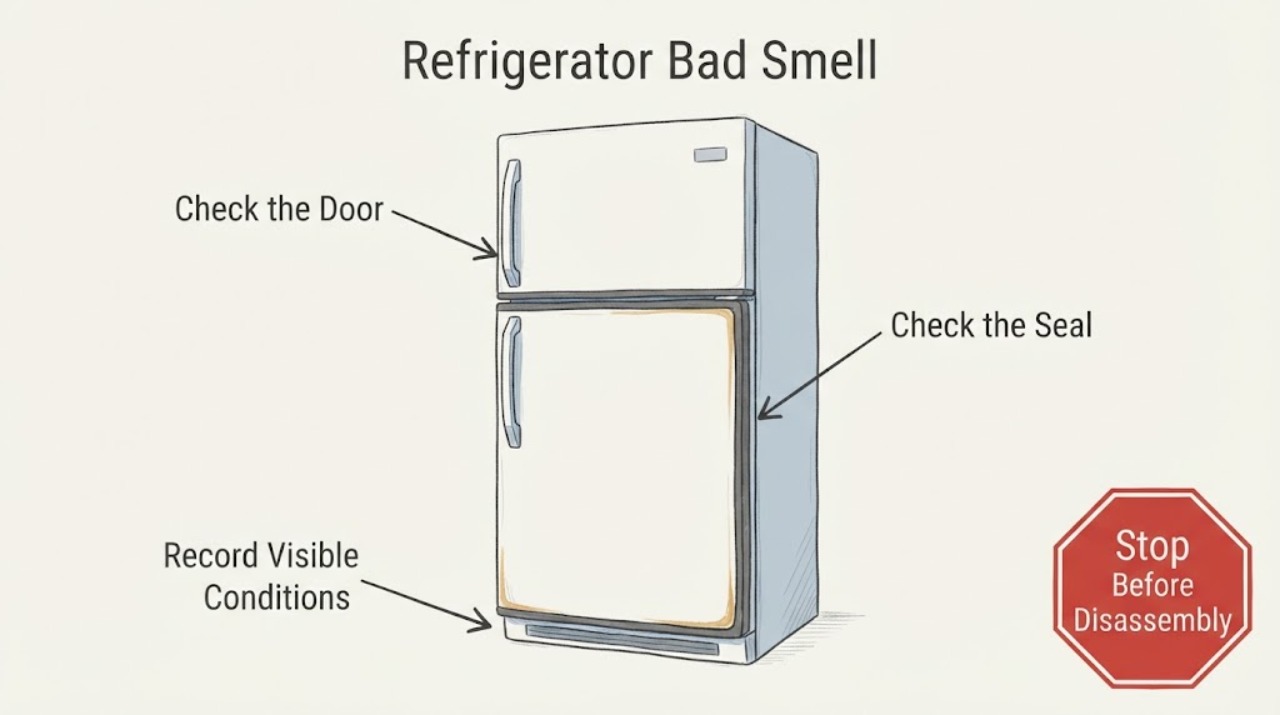
Work through in order
Diagnostic checks
Use only checks that match the exact appliance or system and its official guide.
-
Check 1
Remove food from both compartments and inspect dated, opened, leaking, or uncovered packages, drawers, ice containers, and door bins. Note whether the smell follows a particular item or remains with the empty cabinet.
Expected result: The smell disappears with one item or container, is strongest in a drawer or bin, or remains in both compartments after food is removed.
Next step: Discard the suspect food, wash the affected removable part, and continue if the odor remains. Do not taste food to identify the source.
Why this matters
Why: A localized change points to contaminated food or a removable surface; a smell that remains in an empty cabinet calls for a complete clean and an external-source check.
-
Check 2
With food removed and the refrigerator stopped, disconnect power, remove only removable shelves, bins, and drawers, and hand-wash, rinse, and dry them. Wipe the interior walls and bottom with mild detergent and warm water; do not use abrasive, harsh, or flammable cleaners on plastic, liners, or gaskets.
Expected result: Residue, slime, or a spill is found on a removable part, wall, bottom, or gasket, or all cleaned surfaces are visibly free of residue.
Next step: Reinstall only fully dry parts and reconnect power. If the smell is still strong, move to the filter and room-source checks rather than using stronger chemicals.
Why this matters
Why: Residue confirms a surface source; a clean cabinet with persistent odor suggests absorbed odor or a source outside the food compartment.
-
Check 3
Look under and around the refrigerator for trapped dirt or a spill, and check whether the model has a FreshFlow air filter with an indicator tab. Record the indicator state and the model number before selecting a filter or manual instruction.
Expected result: Debris is found underneath, the filter indicator calls for replacement, or no filter is fitted and the smell remains.
Next step: Clean accessible debris safely and follow the exact model literature for any filter. Do not infer a filter fit from appearance alone.
Why this matters
Why: Debris or an exhausted model-specific filter can sustain odor; no filter or a normal indicator shifts attention to absorbed odor, food residue, or room air.
-
Check 4
Consider the room environment: note whether painting, staining, or varnishing occurred near the refrigerator and whether the smell enters when doors open or during cooling.
Expected result: The odor is present in the room and refrigerator after recent paint, stain, or varnish work, or it is confined to the refrigerator despite normal room air.
Next step: Ventilate the area and allow the source to clear. If the smell is burning, chemical, or electrical, disconnect power when safe and arrange service instead of continuing to operate.
Why this matters
Why: Whirlpool says paint, stain, and varnish odors can enter through door opening or the cooling process; a confined odor after cleaning needs further model-specific service assessment.
Use your observations
Decision map
Find the observation that best matches what you see, then follow the next safe action.
-
PATH 01Next step
What you see
The smell disappears when one leaking, spoiled, or uncovered item is removed.
Do this next
Discard it, clean the contact surface, and monitor the cabinet after restocking with covered food.
Why this path and its safety boundary
Why it matters: The food or container was the likely source rather than a confirmed refrigerator fault.
-
PATH 02Next step
What you see
The empty refrigerator still smells after the complete mild-detergent cleaning.
Do this next
Check the filter indicator and nearby paint or varnish source; use the stubborn-odor process only as Whirlpool describes and expect that it may take weeks.
Why this path and its safety boundary
Why it matters: Absorbed odor, a model-dependent air-filter issue, or an external room source is more likely than a remaining visible spill.
-
PATH 03Next step
What you see
The smell is burning, electrical, chemical, or accompanied by heat, smoke, or a damaged cord.
Do this next
Stop using the refrigerator, disconnect power only if safe, keep clear of smoke, and arrange qualified appliance or electrical service.
Why this path and its safety boundary
Why it matters: This is outside food-odor cleaning and may be an electrical or equipment safety issue.
-
PATH 04Next step
What you see
The smell remains for weeks or months despite an empty, cleaned cabinet and the documented filter and room checks.
Do this next
Keep the model information and cleaning history, then contact Whirlpool or qualified appliance service.
Why this path and its safety boundary
Why it matters: A persistent absorbed odor or an unresolved appliance condition needs model-specific assessment; the cleaning steps do not prove a failed part.
Helpful context
Understand the symptom
A smell that is strongest near one shelf or drawer usually starts with a spill, leaking package, or uncovered food. Check both the refrigerator and freezer because odor can be trapped in bins, seals, and packaging even after the original food is gone.
Cleaning is a removal process, not proof that a component has failed. Whirlpool says stubborn penetrating odors may remain for weeks or months, while an odor associated with burning, chemicals, or electrical heating needs service rather than repeated cleaning.
When checks do not resolve it
Need a professional?
Call qualified appliance service for a persistent odor after the documented cleaning and filter or room-source checks, or for a smell associated with burning, chemicals, heat, smoke, sparking, or a damaged cord. Disconnect power only when it is safe to reach the plug; do not open sealed refrigeration or electrical compartments.
Common questions
FAQ
Why does my Whirlpool refrigerator still smell after I cleaned it?
Whirlpool says strong penetrating odors can take weeks or months to dissipate. Repeat the empty-cabinet process described in its odor guidance, replace a model-dependent air filter only when the indicator or exact manual calls for it, and escalate if the odor is burning, chemical, or electrical.
Should I use bleach or a strong cleaner for a refrigerator odor?
No. Whirlpool recommends mild detergent and warm water and warns against harsh, abrasive, flammable, and petroleum-containing cleaners on interior plastics, liners, and gaskets.
Can paint fumes make a refrigerator smell?
Yes. Whirlpool identifies recent paint, stain, or varnish work as a possible room source and recommends ventilating the area.
Read the exact guide
Official sources
- Removing and Preventing OdorsWhirlpool · Whirlpool refrigerator odor prevention and cleaning
- Removing Odor from All RefrigeratorWhirlpool · Whirlpool all-refrigerator odor reduction and service boundary
Community feedback
Share a repair observation
Share a plain-text repair observation. Accepted observations are published automatically; this page may take a moment to update.