
On this page
Start here
Quick answer
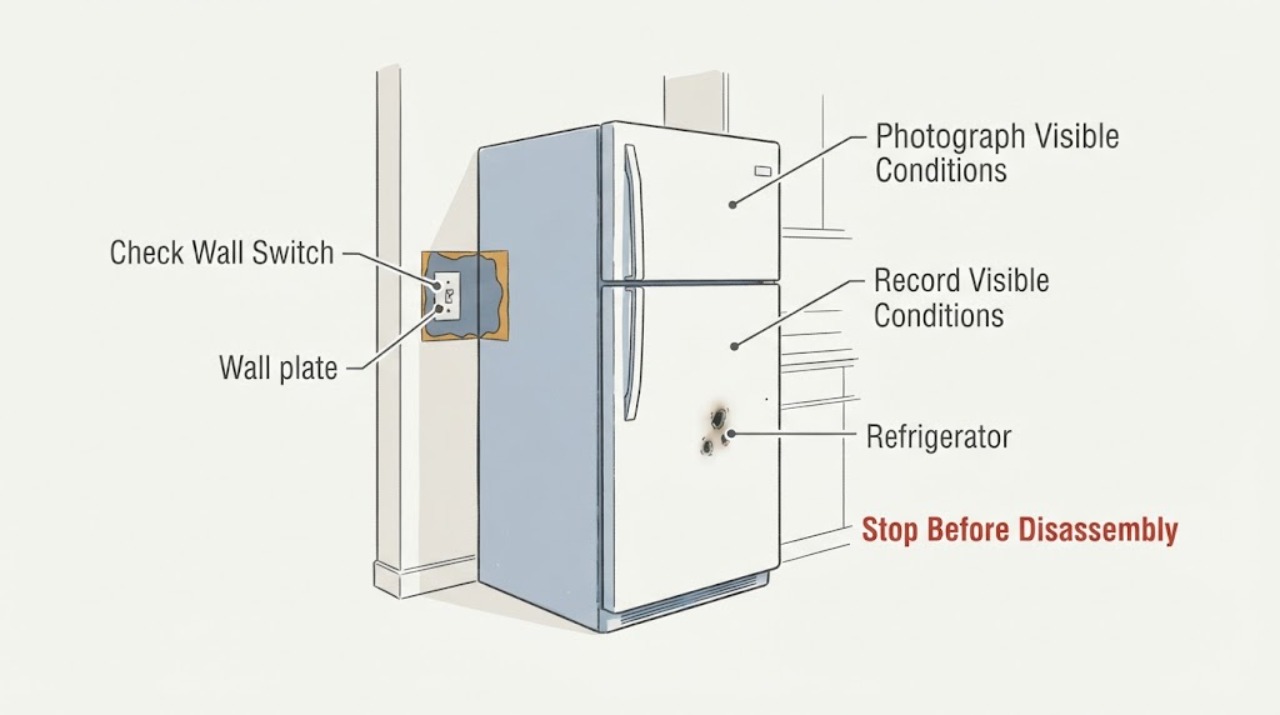
Treat burned or melted holes in a Whirlpool WRT316SFDM01 refrigerator as unknown heat or impact damage, not as an ordinary cosmetic hole. The opened Whirlpool model-family material identifies WRT316SFDM as a 16 cu. ft. top-freezer refrigerator, while the exact WRT316SFDM01 suffix still needs the matching service literature. Do not scrape, drill, sand, heat, fill, or tape over a hole until a qualified technician has confirmed that no wiring, refrigerant tubing, insulation, or food-compartment surface has been damaged. If there is smoke, a burning smell, warmth, sparking, a damaged cord, liquid near electrical parts, or continuing heat, keep people away and disconnect power only if the plug or switch is safely accessible; otherwise leave it alone and get urgent qualified help. Once the unit is cool and safe to approach, photograph every hole, note whether it is in the door, inner liner, freezer, fresh-food section, rear cabinet, or base, preserve the complete model and serial labels, and notify the apartment's landlord or manager. Move food to a verified safe appliance and arrange an inspection before deciding whether the refrigerator can remain in service.
Work through in order
Diagnostic checks
Use only checks that match the exact appliance or system and its official guide.
-
Check 1
Before touching the damage, look and smell from a safe distance for smoke, a burning odor, warmth, sparking, a damaged power cord or plug, liquid near electrical parts, or any continuing source of heat. If no hazard is active and the plug or wall switch is safely accessible, isolate power without moving the appliance; if reaching it would require pulling a hot, smoking, wet, or unstable refrigerator, leave it in place and get qualified help.
Expected result: The appliance is cool and quiet with no odor or electrical symptom, or there is active heat, smoke, odor, sparking, cord damage, liquid near electrical parts, or another continuing hazard.
Next step: For a safe appliance, keep it isolated while arranging inspection. For an active hazard, keep people away, notify the landlord or building manager, and use appropriate emergency or qualified electrical help; do not restart it to reproduce the event.
Stop if: Do not touch melted plastic, exposed material, wet electrical areas, wiring, terminals, or the damaged cord; do not pull the refrigerator out through a narrow apartment space while a hazard may be active.
Why this matters
Why: A cool, inactive appliance permits only documentation and external identification. An active or electrical-looking symptom changes the decision to immediate safety isolation and professional or emergency assistance; it is not a patching problem.
-
Check 2
When the appliance is cool and safe to approach, photograph each hole and the surrounding area without scraping or probing it. Record whether it is on the freezer liner, fresh-food liner, door liner, removable trim, rear cabinet, base, or another location; note blackening, blistering, melted edges, residue, an opening into insulation, a visible tube or wire, and whether the hole is through the surface.
Expected result: The damage is limited to a removable trim piece or appears to be a shallow surface mark, or it penetrates a fixed liner/cabinet, exposes insulation or another material, has blackened residue, or its depth cannot be determined.
Next step: Keep the photographs and do not alter the damaged area. Arrange model-specific inspection before applying any adhesive, sealant, plastic patch, heat, sanding, or other repair material.
Stop if: Do not insert a probe, knife, screw, drill, file, scraper, or thermometer into a hole and do not remove an interior panel to see behind it.
Why this matters
Why: A removable trim mark can be assessed separately from a liner or cabinet breach. A penetration, blackened area, unknown depth, or hidden material makes the cause and consequences uncertain; the visible appearance cannot establish that insulation or a refrigerant circuit is intact.
-
Check 3
Record the complete model and serial labels, the apartment location, when the damage was discovered, what was nearby or operating at the time, whether the refrigerator was powered, and whether cooling, lights, or the cord changed afterward. Preserve the label rather than cleaning over it, and use Whirlpool's model lookup/manual workflow with the full WRT316SFDM01 identity.
Expected result: The full label is readable and the event timeline is known, or only the WRT316SFDM family is visible, the suffix is missing, or the cause and timing are unknown.
Next step: Give the landlord, Whirlpool support, and the technician the full label, photographs, location map, timeline, and any odor or electrical observations. Do not substitute a different WRT, Whirlpool, or top-freezer manual for the exact model.
Stop if: Do not remove labels, open the back, pull panels, or continue diagnosis to compensate for missing model documentation.
Why this matters
Why: Whirlpool's owner support and manuals workflow relies on model and serial information. A base-family match can identify the top-freezer platform but cannot prove suffix-specific liner construction, wiring, refrigerant routing, or an approved repair method.
-
Check 4
Check only the surrounding area from the outside of the refrigerator: note whether the damaged spot is close to the power cord, rear cabinet, base, condenser area, freezer air path, door gasket, or a water connection. Do not move the refrigerator unless it is cool, dry, stable, and safe to move with another person, and do not remove the base grille or any cover for this check.
Expected result: The damage is near a cord, rear or lower cabinet, service opening, water connection, or air path, or it is confined to an interior surface with no external relationship that can be safely seen.
Next step: If the location is near electrical, water, or cooling hardware, keep the appliance isolated and request qualified service. If the area appears cosmetic, still avoid patching until the technician confirms that the liner and food-contact surface can be safely restored.
Stop if: Do not remove the back cover, puncture insulation, disconnect water tubing, touch refrigerant tubing, or perform a live electrical test.
Why this matters
Why: Rear, lower, or service-area damage has a greater chance of involving hidden electrical or cooling-system elements, while an interior-only mark still does not prove that the liner or insulation is unaffected. Location changes urgency, not the need for model-specific inspection.
-
Check 5
Protect food and the apartment while waiting for inspection: move perishable food to a verified safe refrigerator, keep the damaged area dry and untouched, and notify the property manager or landlord in writing with the photographs and model/serial information. If the appliance has no active hazard and must remain powered for food preservation, follow the technician or property manager's direction rather than repeatedly cycling it yourself.
Expected result: Food has been moved and the appliance remains isolated, or the appliance must remain powered despite uncertain damage, the damage is worsening, or any odor, heat, smoke, or electrical symptom returns.
Next step: Arrange qualified refrigerator service and provide the damage map, event history, and exact model. In an apartment, let the owner or manager coordinate access, warranty, replacement, and any building-level electrical response.
Stop if: Do not operate the refrigerator unattended when a hazard is returning, do not place candles, heaters, hair dryers, or other heat sources inside or near it, and do not fill a hole as a temporary workaround.
Why this matters
Why: Food safety and building safety take priority over testing a suspected patch. Worsening damage or a returning hazard means the refrigerator should not be treated as a normal operating appliance until inspected.
Use your observations
Decision map
Find the observation that best matches what you see, then follow the next safe action.
-
PATH 01Next step
What you see
There is active smoke, a burning smell, warmth, sparking, a damaged cord or plug, liquid near electrical parts, or the hole is near the rear or lower cabinet and its depth is unknown.
Do this next
Keep clear, isolate power only from a safely accessible disconnect, notify the apartment manager, and obtain qualified appliance/electrical help. Do not restart the unit or move it through the apartment while unsafe.
Why this path and its safety boundary
Why it matters: This is a possible electrical, heat, or cooling-system safety event rather than a cosmetic liner repair. The exact cause cannot be inferred from the hole alone.
-
PATH 02Next step
What you see
The hole is in a fixed freezer or fresh-food liner, the plastic is blackened or melted, multiple compartments are affected, or insulation, tubing, or another hidden layer may be exposed.
Do this next
Keep the area untouched, move food to a verified safe appliance, and arrange inspection using WRT316SFDM01 and the photographs. Ask the technician to determine whether the unit is safe to operate and whether the liner or appliance should be repaired or replaced.
Why this path and its safety boundary
Why it matters: A surface patch could hide or worsen damage to the liner, insulation, wiring, air path, or refrigerant circuit. The report's exact-model pattern shows why the location and depth must be documented before any repair material is chosen, but the community suggestion is not a Whirlpool-approved procedure.
-
PATH 03Next step
What you see
The mark is only on a removable trim piece, the appliance is cool and odor-free, no fixed liner or cabinet is penetrated, and the model and serial labels are available.
Do this next
Keep the piece and photographs, ask Whirlpool or a qualified technician for the exact replacement or restoration path, and do not choose a generic adhesive, sealant, or plastic based on appearance alone.
Why this path and its safety boundary
Why it matters: The immediate fire or cooling risk appears lower than with a liner or cabinet breach, but the material and fitment still have not been validated for food-contact use or this Whirlpool suffix.
-
PATH 04Next step
What you see
The cause is unknown, the damage is changing, cooling or lighting changed afterward, or the property owner cannot confirm the appliance's service history.
Do this next
Treat the refrigerator as needing inspection, preserve the evidence, move food, and let the landlord or qualified service provider decide whether to repair, isolate, or replace it after examining the exact model.
Why this path and its safety boundary
Why it matters: Unknown cause and changing operation leave electrical, heat, liner, insulation, and cooling damage unresolved. Normal cooling does not clear a safety concern.
Helpful context
Understand the symptom
The word burned matters. A clean, unused factory port or a missing trim cap is a different problem from plastic that is blackened, blistered, softened, or melted. Because a refrigerator liner can hide insulation, wiring, air paths, and parts of the refrigerant circuit, the visible hole cannot tell you whether a surface patch is safe. The first decision is therefore safety and damage mapping, not choosing a filler.
This task is scoped to the Whirlpool WRT316SFDM01 supplied by the user. Whirlpool's public owner-center and feature-sheet pages are for the WRT316SFDM base model/family and confirm the top-freezer platform; they do not make a suffix-independent repair kit or a model-independent patch safe. Use the full label when requesting the exact manual or service.
In an apartment, preserve photographs and the timeline for the owner or property manager, especially if the appliance was supplied with the unit. Do not keep operating a damaged refrigerator merely to see whether it still cools if there is any active heat, odor, smoke, electrical symptom, exposed material, or possible puncture.
When checks do not resolve it
Need a professional?
Arrange qualified Whirlpool refrigerator service and notify the apartment landlord or manager for any melted or burned hole in a fixed liner, door, rear cabinet, or base; for multiple damaged locations; for unknown depth; or when the event was followed by changed cooling, lights, odor, heat, smoke, sparking, cord damage, water near electrical parts, or repeated breaker operation. Keep people away from an active hazard and isolate power only when a plug or switch is safely accessible. Whirlpool's safety literature warns against damaging the refrigerant circuit, puncturing refrigerant tubing, and using mechanical means to defrost. Do not use candles, heaters, hair dryers, drills, knives, sandpaper, sealants, plastic patches, or live electrical tests to diagnose or conceal the damage.
Common questions
FAQ
Can I fill the burned hole with silicone or glue?
Do not choose a filler before an inspection. A hole in a fixed liner can hide damage behind the plastic, and generic adhesive may not be suitable for a food compartment or the WRT316SFDM01. Photograph it, keep it untouched, and ask Whirlpool or a qualified technician for the model-specific repair path.
Does normal cooling mean the refrigerator is safe to keep using?
No. Normal cooling does not show that hidden wiring, insulation, the liner, or the refrigerant circuit is undamaged. Any heat, smoke, burning odor, sparking, cord damage, unknown-depth penetration, or damage near the rear or base requires isolation and qualified inspection.
What should I tell the landlord in an apartment?
Send the complete model and serial labels, photographs of every location, the timeline, what was nearby, whether the refrigerator was powered, and any odor, smoke, heat, electrical, cooling, or lighting change. Ask the property manager to coordinate the approved service or replacement decision.
Why does the exact model suffix matter?
Whirlpool's public WRT316SFDM page and feature sheet describe the base product family, but WRT316SFDM01 is the complete identity supplied for service. Manuals, liner construction, wiring, and approved parts should be matched to the full label rather than assumed from another Whirlpool top-freezer model.
Read the exact guide
Official sources
- Owner's ManualWhirlpool · Opened Whirlpool refrigerator owner manual used only for general safety boundaries; it is not asserted as the exact WRT316SFDM01 manual. It warns against damaging the refrigerant circuit, puncturing tubing, mechanical defrosting, and unsafe electrical use.
- Whirlpool® Manuals & LiteratureWhirlpool · Opened Whirlpool manual portal: owners are directed to enter the model number for the matching manual and literature. It supports using WRT316SFDM01 rather than substituting another model.
- Need help fixing holes burned into fridge :( : r/appliancerepairReddit r/appliancerepair · Opened exact Reddit post: the author names WRT316SFDM01, reports melted holes in both freezer and refrigerator plastic after candles were placed inside, and asks for a DIY repair. Replies are community suggestions, not manufacturer approval.
- Welcome to Whirlpool® Customer CareWhirlpool · Opened Whirlpool owner support page: support inquiries require model and serial information and the page routes owners to appliance help, model identification, and service. It does not diagnose burned holes.
- WRT316SFDM | WhirlpoolWhirlpool · Opened Whirlpool owner-center page for the WRT316SFDM base model. The assigned full model is WRT316SFDM01; the page confirms the corresponding family and top-freezer product type but does not establish a suffix-specific damage repair.
- Feature SheetWhirlpool · Opened Whirlpool feature sheet: the WRT316SFDM variant is listed under a 16 cu. ft. top-freezer family. It supports layout/platform context only, not hidden damage or repair compatibility for WRT316SFDM01.
Community feedback
Share a repair observation
Share a plain-text repair observation. Accepted observations are published automatically; this page may take a moment to update.