
On this page
Start here
Quick answer
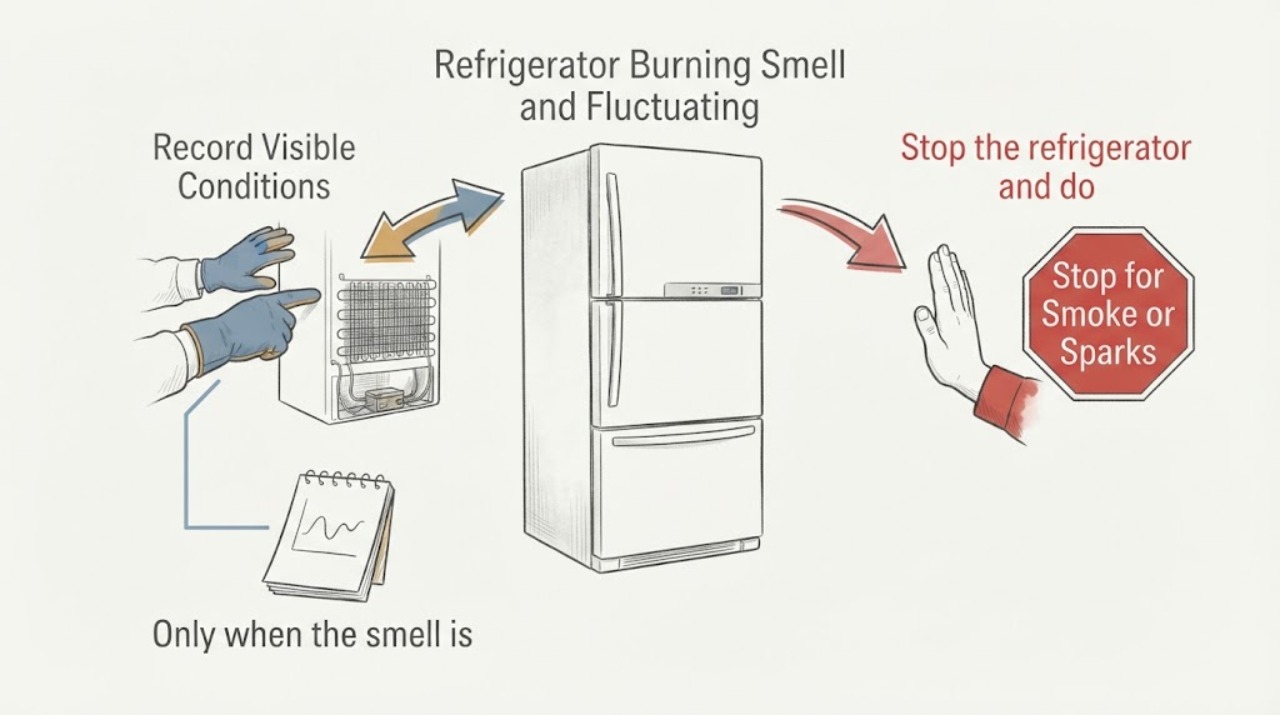
Treat a burning or electrical smell as a stop condition: stop the Whirlpool refrigerator and avoid repeated test runs. From a safe position, note whether there is smoke, heat, arcing, a hot plug or a tripped breaker; if there is active smoke, flame or immediate danger, leave the area and contact emergency services. Once the unit is safely de-energized, the temperature complaint can be separated into ordinary odor sources, airflow/door-seal issues and an unresolved electrical or sealed-system fault. Whirlpool's official guidance supports checking visible vents, door sealing, operating environment, controls and model-permitted condenser access, but it does not let smell plus temperature fluctuation identify a compressor, fan, board or wiring part.
Before you begin
Safety first
- Do not run repeated tests, open panels, probe live wiring, bypass protection, disturb sealed refrigerant tubing or replace a compressor, fan, board or wiring part based only on odor and temperature.
Work through in order
Diagnostic checks
Use only checks that match the exact appliance or system and its official guide.
-
Check 1
Stop the refrigerator and do not run another test when the smell is burning/electrical, smoke-like, worsening, or accompanied by a hot plug, arcing, damaged cord, heat or a tripped breaker.
Expected result: There is active smoke/flame, visible arcing, a hot outlet/plug, a damaged cord or immediate danger.
Next step: Leave the area if needed and contact emergency services or a qualified electrical/appliance professional from a safe location. Do not touch the cord, outlet or cabinet and do not reset a repeatedly tripping breaker.
Why this matters
Why: The situation is an electrical/fire safety concern, not a normal odor or temperature-setting problem.
-
Check 2
From a safe, de-energized position, record the full model/serial, odor location and character, smoke or discoloration, plug/outlet condition, breaker history, compartment temperatures and recent events.
Expected result: The smell is inside with food residue, behind/under the cabinet, at the cord/outlet, or cannot be localized without approaching a hazard.
Next step: Give these observations to Whirlpool service or a qualified professional. Do not restore power just to repeat the observation.
Why this matters
Why: Location and associated electrical signs determine whether ordinary odor cleaning is even in scope; they do not identify an internal part.
-
Check 3
Only when the smell is clearly food/spill related and there is no electrical warning, inspect removable food and visible residue after disconnecting power and allowing surfaces to cool.
Expected result: Spoiled food, a spill or residue explains the smell, or no ordinary source is found.
Next step: Use mild detergent and the exact model cleaning guidance for an ordinary odor. If the odor is burning, returns, or remains unexplained, leave the refrigerator off and arrange service.
Why this matters
Why: A food odor may be handled by the model's cleaning guidance; an unexplained burning smell remains a service safety issue.
-
Check 4
If the refrigerator is safe to operate and the odor is absent or confirmed ordinary, inspect visible vents, door/gasket closure, base-grille clearance, nearby heat sources, room conditions, recent loading and door-opening pattern.
Expected result: A vent is blocked, the door/gasket does not seal, the grille is blocked, the unit is near heat, the room is out of range, or temperatures fluctuate with loading/door use.
Next step: Correct only the plainly visible condition allowed by the model documentation, then monitor with a thermometer. If the smell returns or temperature remains abnormal, stop and request service.
Why this matters
Why: Whirlpool identifies these external conditions as possible contributors to temperature fluctuation; they do not prove a fan, compressor or control failure.
-
Check 5
Arrange Whirlpool or qualified service when a burning smell accompanied the temperature change, the source is unknown, the odor returns, a breaker trips, the plug/outlet is hot, or the unit cannot hold safe temperatures.
Expected result: The combined symptom persists or requires a panel, live electrical measurement, sealed-system work or a part decision.
Next step: Keep the appliance off as appropriate and provide the exact model plus the observation log. Do not open panels, probe live wiring, bypass protection or replace a part from odor and temperature alone.
Why this matters
Why: External observations cannot safely distinguish wiring, controls, fans, compressor, sealed-system or another model-specific condition.
Use your observations
Decision map
Find the observation that best matches what you see, then follow the next safe action.
-
PATH 01Next step
What you see
The odor is sharp, burning or electrical, or smoke, heat, arcing, damaged power hardware or repeated breaker action is present.
Do this next
Stay clear, disconnect power only if safely accessible, and use emergency/electrical/appliance service. Do not re-energize for a test.
Why this path and its safety boundary
Why it matters: This is a safety stop condition; temperature troubleshooting is secondary.
-
PATH 02Next step
What you see
The smell is clearly spoiled food or a spill, with no smoke, heat, electrical sign or temperature hazard.
Do this next
Disconnect power, clean only as the model guide permits with mild nonflammable cleaner, and stop if odor persists or changes character.
Why this path and its safety boundary
Why it matters: Whirlpool's ordinary odor-cleaning guidance may apply.
-
PATH 03Next step
What you see
There is no current safety odor and a visible vent, door seal, grille, heat-source, ambient, loading or door-use condition matches the temperature fluctuation.
Do this next
Correct the visible condition under the model guide and monitor temperature. Escalate if the smell returns or temperatures remain abnormal.
Why this path and its safety boundary
Why it matters: An external airflow, sealing or operating condition may be contributing; it is not an internal diagnosis.
-
PATH 04Next step
What you see
The smell is unexplained or returns, the temperature remains unstable, a breaker trips, or any check would require cabinet/panel access.
Do this next
Leave the unit off as needed and arrange Whirlpool or qualified service with the model and observation history.
Why this path and its safety boundary
Why it matters: The public evidence cannot identify a safe component-level repair for the unidentified model.
Helpful context
Understand the symptom
A burning smell changes the order of troubleshooting. Stop the refrigerator and do not keep cycling power to see whether temperatures recover. If there is smoke, flame, visible arcing, a hot plug or a strong worsening odor, leave the area and use emergency or electrical-professional help from a safe location. Do not touch a damaged cord or open a panel.
Separate an ordinary refrigerator odor from a burning or electrical odor
Whirlpool lists spoiled food, spills, uncovered food and residue as common ordinary refrigerator odors. Those causes can be inspected only after the appliance is safely disconnected and cool. A sharp plastic, insulation, wire or hot-electrical smell—especially with warmth, smoke, a hot plug, noise or temperature loss—should not be cleaned away or tested as if it were a food odor. The smell alone cannot identify a compressor, fan, relay, board or wiring fault.
Record safe observations before requesting service
Without approaching a hazard, record the full model and serial information, where the smell was strongest, whether it was inside or behind the cabinet, whether the plug or outlet felt hot, whether a breaker or GFCI opened, and the refrigerator/freezer temperatures. Note smoke, visible discoloration, unusual noise, frost, leaks and the time relationship between the smell and temperature change. Do not restore power solely to collect a missing observation.
If the smell is not electrical and the unit is safely powered off, check ordinary odor sources
Only when the smell is clearly food or spill related and there is no electrical warning, follow the exact model guide for cleaning. Whirlpool's general odor guidance says to remove spoiled or spilled food, disconnect power before cleaning, use a mild detergent and avoid flammable or harsh cleaners. Do not use that cleaning routine to dismiss a burning smell, and do not reconnect power if the smell returns or the source is uncertain.
For a safe temperature check, look at airflow, doors and surroundings
If the refrigerator has been made safe and the smell is absent or confirmed ordinary, inspect only visible conditions: food or containers blocking internal vents, a gasket that is dirty or not contacting, a door or drawer blocked from closing, a blocked base grille, a nearby heat source, an out-of-range room, recent large grocery loads or frequent door opening. Whirlpool says these conditions can produce warm spots or fluctuating temperatures. Do not infer a failed fan, compressor or control from these symptoms.
Condenser cleaning is conditional and never a reason to re-test a burning smell
Only if the exact model permits user condenser access and there is no active smell, smoke, heat or electrical damage, use Whirlpool's power-off external procedure: disconnect power, protect water lines, use a soft brush or vacuum at the permitted grille/condenser area, replace any grille, and restore power only when the area is secure. If the source of the odor is electrical, the plug/outlet is damaged, or the symptom returns, stop and arrange qualified service instead of cleaning deeper or running another test.
Use service for the combined symptom
Burning odor plus fluctuating temperature is not a reliable field diagnosis. It may reflect an electrical hazard, airflow problem, ordinary food residue, or another model-specific condition, and the available general Whirlpool pages do not select an internal part. Give Whirlpool or a qualified appliance/electrical professional the model, safe observations, temperature history and any breaker or smoke information. Keep the appliance off when the smell is burning/electrical, there is a leak near power, or the source cannot be identified.
When checks do not resolve it
Need a professional?
Call Whirlpool or qualified appliance/electrical service immediately for burning/electrical odor, smoke, heat, arcing, damaged cord or outlet, repeated breaker trips, or a returning smell. Arrange appliance service for persistent temperature fluctuation after safe visible checks. Do not continue operating to reproduce the event.
Safety scope: Do not run repeated tests, open panels, probe live wiring, bypass protection, disturb sealed refrigerant tubing or replace a compressor, fan, board or wiring part based only on odor and temperature.
Have this ready
- Full model and serial, odor description/location, smoke/heat/arcing or plug/outlet observations, breaker history, compartment temperatures, recent loading/door use, and visible airflow or sealing findings.
Common questions
FAQ
Can a fluctuating temperature prove the compressor is failing?
No. Whirlpool lists ambient conditions, heat sources, airflow, door sealing, loading, door openings and normal varying-speed compressor operation as possibilities. The symptom does not select a compressor or any other part.
Should I keep running a Whirlpool refrigerator to find the source of a burning smell?
No. Stop using it when the odor is burning/electrical or is paired with smoke, heat, arcing, damaged power hardware or breaker action. Do not restore power merely to reproduce the event.
Could a refrigerator smell be food instead of an electrical problem?
Yes, Whirlpool lists spoiled food, spills and residue as ordinary odor sources. That cleaning path applies only when there are no electrical warning signs; an unexplained or returning burning smell needs service.
Read the exact guide
Official sources
- How to Check the Air Vents for Blockage—Ensuring Proper Air FlowWhirlpool · Opened Whirlpool Product Help page. It describes visible vent blockage and airflow checks without diagnosing internal components.
- Door Not SealingWhirlpool · Opened Whirlpool Product Help page. It supports external door/gasket/leveling checks and service escalation, not a specific model diagnosis.
- Tripping Breaker—RefrigeratorWhirlpool · Opened Whirlpool Product Help page. It supports electrical-supply boundaries but is not used to diagnose this unidentified refrigerator's internal fault.
- Too Warm in Refrigerator CompartmentWhirlpool · Opened Whirlpool Product Help page. It gives general full-size refrigerator checks and repeatedly directs readers to the exact Owner's Manual for model-specific controls.
- Removing and Preventing OdorsWhirlpool · Opened Whirlpool Product Help page. It lists food/spill odors and says to disconnect power before cleaning; a burning/electrical smell is treated separately as a stop-and-service concern in this article.
- Motor or Compressor Runs too MuchWhirlpool · Opened Whirlpool Product Help page. It explains normal high-efficiency compressor variation and external causes of temperature changes; it does not prove a compressor failure.
- How and When to Safely Clean the Condenser CoilsWhirlpool · Opened Whirlpool Product Help page. It requires power disconnection, warns not to disturb water lines, and limits cleaning to the model-permitted grille/condenser area.
Community feedback
Share a repair observation
Share a plain-text repair observation. Accepted observations are published automatically; this page may take a moment to update.