
On this page
Start here
Quick answer
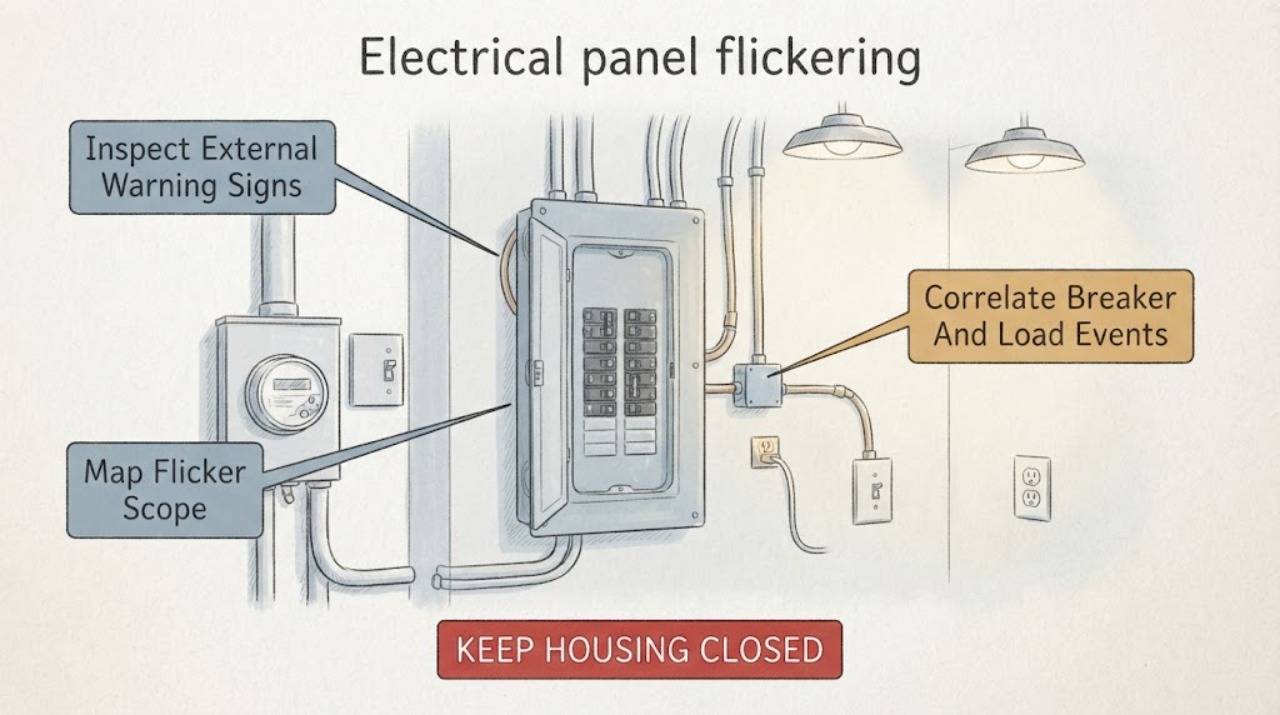
Flickering near an electrical panel or flickering lights in the home can come from one lamp, a loose connection, an overloaded or failing branch circuit, a panel connection, or utility service equipment. First determine whether one light flickers or multiple circuits change together, and whether the change follows a particular appliance, breaker, wind, or utility event. Do not remove the panel cover, touch busbars or service wiring, tighten terminals, replace a breaker by appearance, or repeatedly reset a tripped breaker. If you see sparks, smoke, scorching, a hot or discolored panel, buzzing or sizzling, a burning odor, shock or tingling, water, or flickering across the home, stop using affected equipment and obtain qualified electrician or utility help; call emergency services for fire or active smoke. A single bulb or fixture can be checked only from ordinary safe access after power is off and the fixture is cool, but persistent or panel-related flicker is a professional diagnosis.
Before you begin
Safety first
- This article supports safe scope observation and load documentation only. Do not open the panel, touch service equipment, perform live tests, reset repeatedly, alter protective devices, or repair wiring, breakers, bus connections, or service conductors.
Work through in order
Diagnostic checks
Use only checks that match the exact appliance or system and its official guide.
-
Check 1
From ordinary safe positions, observe the flicker without touching the panel, fixtures, outlets, or cords; compare one affected light or appliance with other rooms and circuits while keeping hands dry and clear of electrical equipment.
Expected result: Record whether one lamp, one room, several rooms, one branch circuit, or the whole home changes; note whether the symptom starts with a motor or high-load appliance, follows a breaker event, occurs during wind or utility activity, or affects only brightness rather than power loss.
Next step: Stop using any appliance or fixture that becomes hot, sparks, smells burned, or behaves abnormally; document the scope and call a qualified electrician. For whole-home or wind-related flicker, also contact the electric utility without touching service equipment.
Stop if: Do not open the panel, remove a receptacle or switch cover, touch exposed conductors, climb to inspect service wiring, or continue observation during smoke, sparks, fire, shock, or water entry.
Why this matters
Why: A single lamp or fixture can be a local lamp, switch, socket, or fixture issue. Multiple circuits or whole-home flicker points toward panel, service, supply, or utility conditions and is not safely explained by replacing a bulb.
-
Check 2
With the panel closed and from a safe distance, inspect only visible exterior conditions such as scorch marks, melted material, moisture, a warm or discolored cover, damaged cable insulation, a buzzing or sizzling sound, or a breaker that appears tripped.
Expected result: Record whether the panel enclosure, nearby outlet or switch, plug, cord, or accessible equipment is hot, discolored, wet, damaged, noisy, or giving off a burning or rubbery odor; do not touch it to test temperature.
Next step: If any warning sign is present, stop using affected circuits and arrange qualified electrician service; for smoke, flame, or active arcing, leave the area and call emergency services. Preserve photos from a safe distance and do not remove the cover.
Stop if: Do not touch a hot, wet, sparking, buzzing, or discolored panel or connection, spray anything into it, place a hand on the cover to gauge heat, or attempt to tighten an external or internal terminal.
Why this matters
Why: Heat, discoloration, odor, unusual sound, sparks, or moisture can indicate overheating, arcing, insulation damage, or shock risk. A normal-looking cover does not rule out a concealed connection fault, especially when flicker affects multiple circuits.
-
Check 3
From outside the panel, note which room or equipment loses power and whether a breaker has tripped; unplug or switch off only clearly identified nonessential loads at their normal controls or plugs, without repeatedly resetting a breaker or using an extension cord to relocate a high-load appliance.
Expected result: Record whether flicker begins when one appliance starts, whether the same breaker trips, whether several circuits are affected, and whether the symptom remains with nonessential loads turned off.
Next step: Leave the suspect appliance or circuit out of use and have a qualified electrician identify the load, circuit capacity, breaker, wiring, and connections. Do not change fuse or breaker ratings or add a circuit yourself.
Stop if: Do not repeatedly reclose a tripped breaker, replace a fuse with another rating or object, remove the deadfront, redistribute wires, or test a suspect circuit with a live meter unless you are a qualified professional.
Why this matters
Why: A repeatable load-related symptom can indicate an overloaded circuit, a failing appliance, or a wiring/connection problem; a breaker trip is a protective event, not proof that repeated resets are safe. Flicker that remains with loads off or spans circuits needs electrical diagnosis.
-
Check 4
If the symptom is limited to one lamp or fixture and there are no panel, heat, odor, noise, smoke, or shock warnings, turn that fixture off at its normal switch, allow it to cool, and inspect only the bulb or visible lamp seating from ordinary access.
Expected result: Record whether the bulb is loose, failed, visibly damaged, incompatible with the fixture instructions, or whether the flicker continues with a known-good compatible bulb; note switch warmth, crackling, discoloration, and whether other lights remain stable.
Next step: Replace or reseat a bulb only when the fixture instructions permit it and the fixture is cool and de-energized; otherwise leave the fixture off and call an electrician. Do not remove a switch or fixture cover to chase the connection.
Stop if: Do not touch exposed lamp contacts, work on a wet or hot fixture, exceed the fixture's marking, use a damaged bulb, or continue using a flickering fixture with a warm switch, odor, sound, or scorch mark.
Why this matters
Why: A single failed bulb or local fixture issue may be separate from panel flicker. Flicker that continues after a safe bulb check, follows the switch, or is accompanied by heat, sound, odor, or discoloration can indicate a fixture, switch, branch wiring, or connection fault.
-
Check 5
If flicker affects multiple circuits, returns after load reduction, coincides with wind or outside service activity, or cannot be isolated to a cool local fixture, stop troubleshooting and record the panel location, affected circuits, timing, weather or utility context, and every warning sign without touching service equipment.
Expected result: Record whether the panel itself buzzes or heats, whether lights vary throughout the home, whether the service drop or meter area shows visible damage, and whether breakers trip or fail to remain set.
Next step: Call the electric utility for suspected utility-side or service-entry conditions and a licensed electrician for the customer-side panel or wiring. Keep affected loads off and do not open or reset equipment unless the responding professional directs a safe action.
Stop if: Do not touch the meter, service drop, overhead or exterior conductors, panel internals, breaker terminals, or damaged equipment; leave and call emergency services for fire, smoke, or active arcing.
Why this matters
Why: A whole-home or service-related pattern can involve the service entrance, utility connection, panel bus or connection, or branch distribution. CPSC warns that service equipment and bad service contacts are not homeowner repair points; a visual observation cannot identify the energized fault.
Use your observations
Decision map
Find the observation that best matches what you see, then follow the next safe action.
-
PATH 01Safety boundary
What you see
Only one lamp or fixture flickers and the panel, other lights, outlets, and appliances show no warning signs.
Do this next
Turn the fixture off, let it cool, and perform only the ordinary-access bulb check allowed by its instructions; call an electrician if flicker persists or any heat, odor, noise, or discoloration appears.
Why this path and its safety boundary
Why it matters: A bulb, local fixture, switch, or connection issue is more plausible than a whole-panel fault, but a persistent local flicker still needs electrical attention.
Safety stop: Do not remove fixture or switch covers, touch exposed contacts, or keep using a warm, noisy, discolored, or burning-smelling fixture.
-
PATH 02Safety boundary
What you see
Flicker starts when a particular appliance or load operates, or a related breaker trips or will not remain set.
Do this next
Leave the suspect load off, do not repeatedly reset the breaker, and have a qualified electrician assess the appliance, circuit, protective device, and connections.
Why this path and its safety boundary
Why it matters: An appliance, overloaded branch, or failing circuit connection may be involved; the breaker event is not a permission to increase its rating.
Safety stop: Do not replace a fuse or breaker by appearance, bypass protection, use an extension cord for a high-load appliance, or open the panel.
-
PATH 03Safety boundary
What you see
Several rooms or circuits flicker together, the panel buzzes or heats, or the symptom remains after nonessential loads are off.
Do this next
Stop using affected loads and arrange prompt licensed-electrician diagnosis without removing the panel cover.
Why this path and its safety boundary
Why it matters: A panel connection, service-side condition, distribution fault, or concealed wiring problem is possible and cannot be isolated safely by a homeowner.
Safety stop: Do not touch the panel interior, tighten terminals, move wires, reset repeatedly, or continue operation with heat, odor, sparks, smoke, or abnormal sound.
-
PATH 04Safety boundary
What you see
Whole-home flicker varies with wind or outside utility activity, or visible damage is present near the meter, service drop, or service entrance.
Do this next
Do not touch the equipment; call the electric utility and report the flicker and visible conditions, then involve a licensed electrician for the customer-side boundary.
Why this path and its safety boundary
Why it matters: The fault may be on utility service equipment or at the service connection, where homeowner intervention is hazardous.
Safety stop: Do not climb, approach damaged conductors, open the meter or panel, or attempt to turn off service equipment beyond a safe instruction from the utility or emergency personnel.
-
PATH 05Safety boundary
What you see
There is smoke, flame, active arcing, a burning odor, hot/discolored equipment, water entry, a shock or tingle, or exposed/damaged wiring.
Do this next
Leave the area for active fire or smoke, call emergency services, and do not touch the panel or equipment. For a non-fire warning, isolate affected loads only from a safe position and call a licensed electrician.
Why this path and its safety boundary
Why it matters: This is an immediate fire or shock hazard, not a diagnostic inconvenience.
Safety stop: Do not use water on an electrical fire, touch hot or wet equipment, restore power, or attempt any repair.
Helpful context
Understand the symptom
Determine whether the panel is the source or only where you noticed the symptom
A flickering indicator, buzzing enclosure, or changing light level near the panel is different from one lamp that flickers at its socket. Map the symptom without opening the panel: one fixture, one room, several circuits, or the whole home. Note whether large loads start, a breaker trips, wind or utility activity coincides, or the flicker is accompanied by heat, odor, sound, or discoloration. The scope changes whether the next call is a fixture repair, an electrician, or the electric utility.
Keep inspection outside the panel enclosure
The panel cover is not a user troubleshooting boundary. External observations can document a warm or discolored door, scorch marks, moisture, a loose-looking cover, unusual noise, or a breaker that will not stay set, but they cannot establish which terminal or conductor is loose. CPSC says warning signs such as flickering, hot plates, and burning plastic require a qualified electrician and warns against do-it-yourself work; service equipment can remain hazardous even when a nearby circuit is off.
Treat whole-home flicker and utility-side symptoms as urgent
If lights throughout the home flicker together, change when the wind moves service wiring, or vary with utility activity, the source may be upstream of the branch breakers. Do not touch the meter, service drop, service entrance conductors, or damaged outside equipment. CPSC directs consumers not to correct or touch service equipment in this situation and to call the electric power company; a licensed electrician handles the customer-side panel and wiring boundary.
Safety boundary
Stop conditions
- Do not remove the electrical panel cover or deadfront, touch busbars, service conductors, breaker terminals, meter equipment, or any exposed wiring.
- Do not tighten terminals, move wires, replace a breaker or fuse by appearance, change protective ratings, bypass protection, or repeatedly reset a tripped breaker.
- Stop using affected equipment for smoke, sparks, scorching, burning odor, hot or discolored panel/outlet, buzzing or sizzling, shock/tingling, water entry, or damaged insulation.
- Do not touch or climb toward service drops, meters, service entrance conductors, or exterior utility equipment; report suspected utility-side conditions to the electric utility.
- Leave and call emergency services for active fire, smoke, or arcing; never use water on an electrical fire and do not attempt live electrical testing.
Only after diagnosis
Potential parts
- compatible lamp, fixture, or switch component
Consider this category only when the flicker is isolated to one fixture and a qualified or manufacturer-directed check identifies a failed local component rather than a circuit or panel fault.
Confirm the exact fixture, lamp type, load rating, dimmer compatibility, enclosure, and installation instructions; do not use a local replacement to mask a multi-circuit or panel symptom. - exact-model circuit breaker or fuse
Consider this category only after a licensed electrician diagnoses a failed protective device and confirms the panel listing and circuit requirements.
Breaker or fuse fit, rating, interrupting capability, bus compatibility, and local code are not established by appearance; never replace or uprate it as a homeowner troubleshooting step. - panel connection, bus, or service-entry repair component
Consider this category only when a qualified electrician or utility professional identifies a failed panel or service connection and specifies the repair assembly.
Service equipment and panel internals require qualified handling, exact equipment identification, utility coordination where applicable, and code-compliant installation; do not order or install these parts yourself.
When checks do not resolve it
Need a professional?
Arrange a licensed electrician promptly for flicker affecting multiple circuits, a panel-related flicker, a symptom that remains after safe load isolation, repeated breaker trips, buzzing or sizzling, warm or discolored equipment, burning odor, shock or tingling, damaged wiring, or any uncertainty about the panel or branch circuit. Contact the electric utility for whole-home flicker tied to wind or visible service-side damage. Call emergency services for fire, smoke, or active arcing.
Safety scope: This article supports safe scope observation and load documentation only. Do not open the panel, touch service equipment, perform live tests, reset repeatedly, alter protective devices, or repair wiring, breakers, bus connections, or service conductors.
Common questions
FAQ
Is electrical panel flickering normal?
Flickering lights, panel-related flicker, buzzing, heat, odor, sparks, or repeated breaker trips should not be treated as normal. Map whether one fixture or multiple circuits are affected without opening the panel, then call a qualified electrician; call the utility for whole-home or service-side flicker.
Can an overloaded circuit cause lights to flicker?
A load-related flicker can accompany an overloaded or failing branch circuit, appliance, or connection, but observation alone cannot identify which. Leave the suspect load off, do not repeatedly reset the breaker or change its rating, and have an electrician diagnose it.
Should I tighten a loose wire in my electrical panel?
No. Do not remove the panel cover or touch terminals and busbars. A flickering symptom can expose shock and fire hazards, and CPSC directs homeowners to qualified electrical professionals rather than DIY panel repairs.
What if the whole house lights flicker when it is windy?
That pattern can involve the service connection or utility equipment. Do not approach or touch the meter, service drop, or damaged exterior equipment; contact the electric utility and have a licensed electrician handle the customer-side installation.
When is flickering an electrical emergency?
Treat smoke, flame, active arcing, burning odor, hot or discolored equipment, water entry, shock or tingling, or exposed wiring as an immediate stop condition. Leave for active fire or smoke, call emergency services, and do not use water on an electrical fire.
Read the exact guide
Official sources
- Electrical Warning Signs – Video ShortElectrical Safety Foundation International · ESFI consumer safety guidance for household electrical systems; it does not identify the fault in a specific panel.
- Home Wiring Safety TipsElectrical Safety Foundation International · ESFI general home-wiring safety guidance; it does not establish the wiring type or fault in a particular home.
- Home Wiring Hazards: Publication 516U.S. Consumer Product Safety Commission · Official CPSC safety publication with a specific focus on aluminum-wired connections; its warning-sign and no-DIY principles do not prove that a particular home has aluminum wiring.
- Don't Overload Your HomeElectrical Safety Foundation International · ESFI consumer guidance for overload symptoms; a flicker does not by itself prove overload and requires diagnosis.
- CPSC Guide to Home Wiring Hazards: Publication 518U.S. Consumer Product Safety Commission · Official CPSC home-wiring safety guide; local utility and electrical rules govern a particular service installation.
- Electrical Safety ChecklistNational Fire Protection Association · NFPA consumer electrical-safety checklist for general household hazards; it is not a diagnosis or substitute for local code or a licensed electrician.
Community feedback
Share a repair observation
Share a plain-text repair observation. Accepted observations are published automatically; this page may take a moment to update.