
On this page
Start here
Quick answer
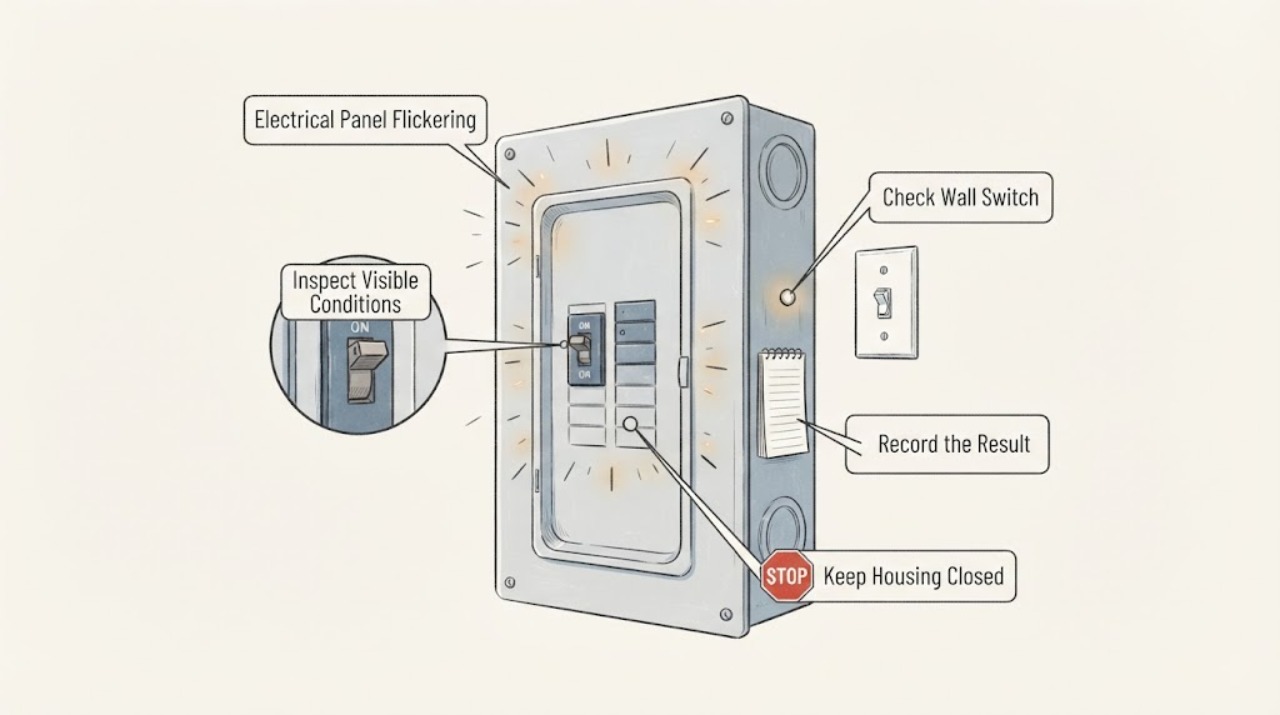
Treat flickering associated with an electrical panel, circuit breaker, or switch as a wiring warning rather than a switch-adjustment problem. From a safe, dry location, observe whether the flicker affects one light, several circuits, or the whole home; note buzzing, visible flashes, smoke, discoloration, heat, odor, or a breaker that trips. Do not open the panel, touch a breaker or switch, operate it repeatedly, or perform electrical testing. If there is arcing, smoke, a burning smell, a hot or discolored panel, a shock, or repeated tripping, leave the area and contact emergency services, the utility, or a licensed electrician as appropriate.
Before you begin
Safety first
- Do not open the panel, touch a breaker or switch, operate protection repeatedly, perform electrical measurements, bypass protection, or enter a wet electrical area.
Work through in order
Diagnostic checks
Use only checks that match the exact appliance or system and its official guide.
-
Check 1
From a safe, dry location, observe the symptom without touching the panel, breaker, switch, or wiring. Record whether the flicker is a panel indicator, one light, several lights, or most of the home, and whether it is dimming, blinking, or a visible flash.
Expected result: Only one fixture flickers, several fixtures on one apparent area flicker, many circuits flicker together, or there is a bright flash or spark.
Next step: Keep clear and record the timing and affected areas. For any flash, spark, smoke, or expanding outage, stop all observation and obtain urgent help.
Stop if: Do not approach the panel or try to identify a particular breaker by touch or operation.
Why this matters
Why: A local symptom may be limited to a fixture or branch circuit, while a widespread change or visible flash can involve broader distribution or service equipment. A flash is an immediate hazard, not a normal flicker.
-
Check 2
Listen from a safe distance and look only at the closed exterior of the panel and nearby switches. Do not touch them to check temperature. Note buzzing, sizzling, crackling, visible discoloration, smoke, melted material, or a burned-insulation odor.
Expected result: There is an unusual sound, visible heat damage or discoloration, smoke, or a burning odor; or the exterior looks and sounds normal.
Next step: For any warning sign, move away and call a licensed electrician or emergency service as appropriate. If there is no warning sign, continue only with non-contact correlation; do not open the cover.
Stop if: Stop immediately for smoke, fire, strong odor, crackling, visible arcing, or a panel exterior that appears hot or damaged.
Why this matters
Why: Buzzing, sizzling, overheating, discoloration, and burned odors are warning signs of a possible wiring or overload problem. A normal exterior does not clear the panel or circuit because dangerous faults may be internal.
-
Check 3
Without operating any switch or breaker, note whether the flicker begins when a known appliance, motor, heater, or lighting group starts, and whether it stops when that device is already switched off by its normal control from a safe location.
Expected result: The flicker follows one appliance or switch, follows several loads, occurs with no obvious load change, or becomes worse when equipment starts.
Next step: Leave the suspected device off if it can be switched off normally and safely; do not unplug wet or damaged equipment. Give the timing and device list to the electrician.
Stop if: Stop correlating loads for smoke, sparks, burning odor, shock, heat, or a device that trips protection or behaves abnormally.
Why this matters
Why: A repeatable load relationship helps an electrician narrow the affected branch or equipment, but it does not prove that the load or breaker is safe. A symptom with no obvious load change may involve a connection or service-side issue.
-
Check 4
From outside the electrical area, observe whether a breaker appears to be in a different position, whether power is lost to a known group of outlets or lights, and whether the symptom returns after an automatic interruption. Do not open the panel or move the breaker handle.
Expected result: A breaker appears tripped, the same area repeatedly loses power, several breakers are affected, or the panel position is not safely visible.
Next step: Keep the affected circuit or equipment unused and call a licensed electrician. If the issue appears to involve incoming service or the entire home, contact the utility from a safe location as well.
Stop if: Do not reset, hold, wedge, replace, or bypass a breaker or fuse, and do not remove the panel cover.
Why this matters
Why: Frequent trips or repeated loss of power can indicate overload, an appliance defect, or a wiring fault. Several affected circuits or an unobservable panel require professional or utility assessment rather than a reset experiment.
-
Check 5
Check only from a safe distance whether the flicker is accompanied by a shock or tingling sensation, a warm or discolored wall switch or outlet, a damaged cord, moisture, or visible damage around the electrical area. Do not touch the suspected item to verify it.
Expected result: There is a shock or tingle, warm or discolored hardware, damaged insulation, moisture, or no visible secondary warning sign.
Next step: Stop using the affected device or area and arrange licensed electrical inspection. If water is present, keep people away and address the water source without entering the electrical hazard zone.
Stop if: Stop immediately for any shock, water entering the panel, active arcing, smoke, or a rapidly worsening flicker.
Why this matters
Why: A shock, heat, discoloration, damaged insulation, or moisture increases the risk of electric shock or fire and makes further homeowner diagnosis unsafe. No visible sign still does not rule out an internal fault.
-
Check 6
Write a timeline for the electrician: when the flicker began, weather or utility events, affected rooms and devices, sounds or odors, visible breaker position, recent electrical work, and whether the symptom changes with a load. Keep the panel closed and untouched while waiting.
Expected result: The timeline points to one circuit or device, multiple circuits, the service entrance, or no repeatable pattern.
Next step: Call a licensed electrician for inspection. If the whole home flickers, the symptom changes with wind or weather, or neighbors are affected, notify the utility as well; do not attempt service-equipment repair.
Stop if: End all observation if any emergency warning appears or if a professional asks the occupants to leave the area.
Why this matters
Why: A clear timeline can distinguish a localized branch symptom from a broader service or utility issue without exposing the homeowner to live parts.
-
Check 7
Arrange a qualified inspection of the panel, circuit breaker, switch, wiring, and service connections when the flicker persists, returns, or cannot be localized by safe observation. Do not order a replacement breaker or switch based only on the symptom.
Expected result: The flicker continues after normal loads are off, returns after a temporary outage, or is accompanied by any warning sign.
Next step: Provide the timeline and photographs taken from a safe distance to a licensed electrician; follow the electrician's or utility's isolation instructions.
Stop if: Do not resume testing, open the panel, touch a breaker or switch, or perform electrical measurements.
Why this matters
Why: The remaining causes can include an internal connection, protective device, branch wiring, service equipment, or utility issue that requires trained inspection and appropriate isolation.
Use your observations
Decision map
Find the observation that best matches what you see, then follow the next safe action.
-
PATH 01Next step
What you see
There is smoke, a bright flash, arcing, a strong burning odor, a hot or discolored panel, or a shock.
Do this next
Leave the area, keep others away, and contact emergency services or the utility from a safe location. Do not touch the panel or try to operate a breaker.
Why this path and its safety boundary
Why it matters: This is an immediate fire or shock hazard.
-
PATH 02Next step
What you see
Several circuits or the whole home flicker, especially with weather, a service event, or a neighboring outage.
Do this next
Keep clear and contact the electric utility and a licensed electrician; do not attempt service-equipment correction.
Why this path and its safety boundary
Why it matters: The issue may be upstream of one branch circuit or at service equipment.
-
PATH 03Next step
What you see
Only one fixture or device flickers and the panel has no visible warning signs.
Do this next
Leave the suspected device off using its normal control if safe, document the pattern, and schedule an electrician; do not open the switch or panel.
Why this path and its safety boundary
Why it matters: A local fixture, switch, appliance, or branch circuit may be involved, but the symptom still needs attention if it persists.
-
PATH 04Next step
What you see
A breaker trips repeatedly or the same circuit repeatedly loses power.
Do this next
Stop resetting it and arrange licensed electrical inspection. Do not replace it with a different rating or bypass the protection.
Why this path and its safety boundary
Why it matters: The protective device may be responding to overload, a faulty appliance, or a wiring fault.
-
PATH 05Next step
What you see
The panel is wet, damaged, inaccessible, or the symptom cannot be localized without opening it.
Do this next
Keep the area clear and call a licensed electrician or emergency service as appropriate; do not open the panel or enter standing water.
Why this path and its safety boundary
Why it matters: The risk and uncertainty are beyond safe homeowner observation.
Helpful context
Understand the symptom
Flickering near an electrical panel can be caused by a lighting or appliance issue, a circuit problem, a loose connection, or a service-side fault. The visible symptom does not identify which part is failing, and a circuit breaker or wall switch is not safe to diagnose by opening or touching the panel.
Begin with non-contact observation from a dry position. Record what flickers, whether the change is local or widespread, whether it follows a particular appliance or switch, and whether the panel exterior shows any warning sign. A licensed electrician can use that timeline to decide whether the circuit, panel, service equipment, or utility supply needs inspection.
Electrical safety organizations list dim or flickering lights, arcs or sparks, unusual buzzing, overheating or discoloration, burned odors, and shocks as warning signs. Any of those signs raises the priority from observation to isolation and professional help.
Stay away from a panel that is wet, smoking, sparking, hot, or making a strong buzzing or sizzling sound. Do not remove the service-panel cover, look for a loose wire, replace a breaker, put in a larger protective device, or keep resetting a tripped circuit.
When checks do not resolve it
Need a professional?
Safety scope: Do not open the panel, touch a breaker or switch, operate protection repeatedly, perform electrical measurements, bypass protection, or enter a wet electrical area.
Common questions
FAQ
Is a flickering electrical panel or light ever normal?
A brief change during a normal, known event may be explainable, but persistent or unexplained flickering should not be ignored. Flicker with buzzing, heat, discoloration, odor, sparks, or shocks is a warning sign requiring professional attention.
Should I reset the breaker to stop the flickering?
Do not repeatedly reset or operate a breaker to investigate flickering. A recurring trip can indicate overload, a faulty appliance, or a wiring problem; leave the affected area or equipment unused and call a licensed electrician.
Can I remove the panel cover to see which breaker is causing the flicker?
No. The service-panel cover should remain closed. Record only what is visible from a safe distance and provide that information to a qualified electrician.
Read the exact guide
Official sources
- Electrical Safety: ChecklistNational Fire Protection Association · Household electrical warning signs and qualified electrician escalation
- Home Wiring Safety TipsElectrical Safety Foundation International · Residential electrical warning signs including flickering, arcs, buzzing, overheating, odors, shocks, and licensed electrician escalation
- CPSC Guide to Home Wiring HazardsU.S. Consumer Product Safety Commission · Home wiring and electrical service equipment warning signs, service-panel cover safety, and utility or electrician escalation
Community feedback
Share a repair observation
Share a plain-text repair observation. Accepted observations are published automatically; this page may take a moment to update.