
On this page
Start here
Quick answer
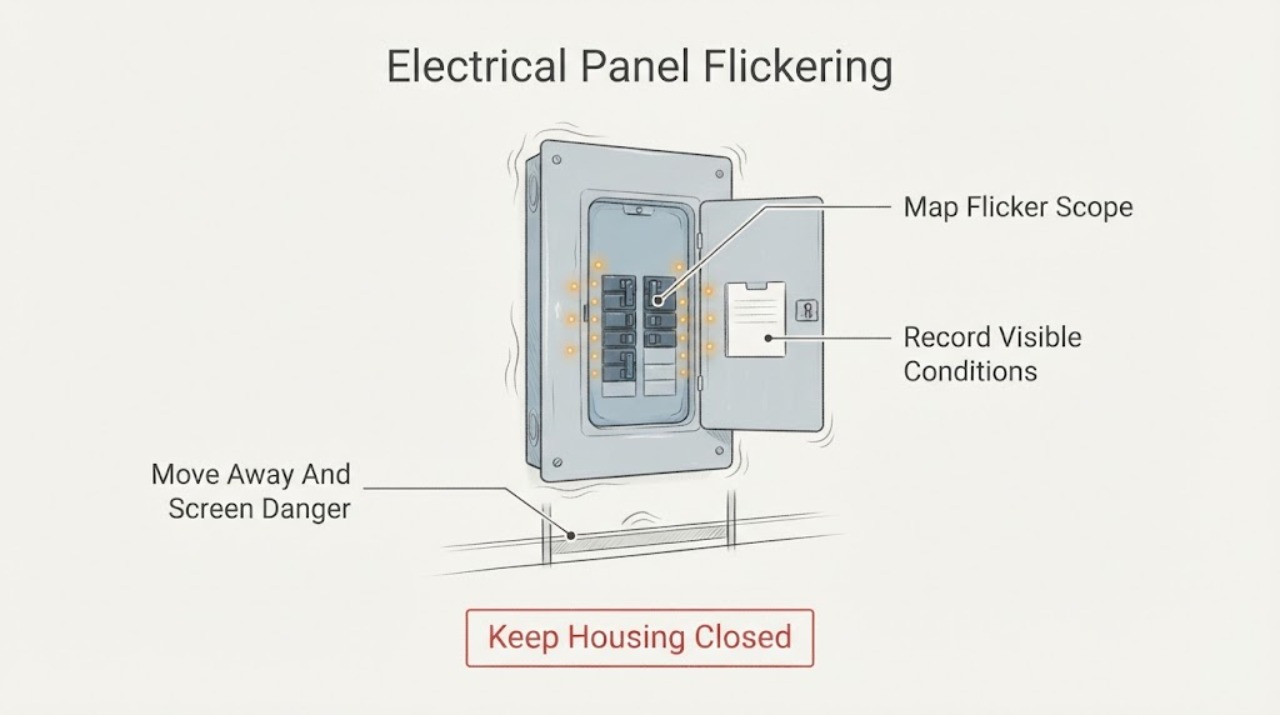
Flickering at or around an electrical panel can reflect a loose connection, an overloaded or failing circuit, a utility-side problem, or a normal-looking light or appliance issue elsewhere. Treat it as a safety symptom, not a reason to open the panel or move a breaker. From a safe distance, note which lights or appliances flicker, whether the whole home or one circuit is affected, whether the panel buzzes, and whether heat, discoloration, burning odor, smoke, arcing, shock, or repeated tripping occurs. Do not touch the panel, breaker, cover, wiring, or service equipment; do not measure voltage or repeatedly reset a breaker. Stop using affected loads and move away for smoke, fire, arcing, hot equipment, or shock, then contact emergency responders or the utility as appropriate. For any unexplained or recurring flicker, arrange a licensed electrician to inspect the circuit breaker, panel, connections, and service supply.
Before you begin
Safety first
- This article supports only non-contact observation from a safe distance and recording the circuit symptom. It does not authorize opening the panel, touching a breaker or wiring, live testing, tightening connections, resetting repeatedly, changing protective-device ratings, or approaching service equipment.
Work through in order
Diagnostic checks
Use only checks that match the exact appliance or system and its official guide.
-
Check 1
Stop normal use of the affected area and observe from a safe distance without touching the panel, breaker, cover, wiring, outlets, or switches. Note smoke, flames, sparks, arcing, a hot enclosure, burning odor, shock, or a sound that is crackling or sizzling.
Expected result: There is no visible hazard and only a flicker, or there is smoke, fire, arcing, heat, odor, shock, or exposed damage.
Next step: For smoke, fire, arcing, shock, or immediate danger, move away and call emergency responders; only use a remote shutoff if it can be reached without approaching the hazard. Otherwise leave the affected loads off and contact a licensed electrician.
Stop if: Do not approach, touch, open, spray, reset, or attempt to extinguish an energized electrical panel or equipment with water.
Why this matters
Why: A bare flicker still needs evaluation, but any accompanying warning sign can indicate overheating, arcing, or shock risk and is not a DIY diagnostic situation.
-
Check 2
From normal room locations, write down which lights, outlets, appliances, or rooms flicker and whether the event affects one area, several circuits, or the whole home. Do not create a test by switching loads on and off.
Expected result: Only one fixture flickers, several loads on one area flicker, multiple rooms flicker together, or the whole home dims when the utility or weather changes.
Next step: Record the scope and time for the electrician. For widespread flicker, contact the electric utility from a safe location as well as arranging professional electrical inspection; do not touch service equipment.
Stop if: Stop observing near the panel for heat, odor, buzzing, smoke, sparks, shock, exposed wiring, or a worsening outage.
Why this matters
Why: A single fixture may be local to that fixture or branch; several rooms or whole-home changes can involve a panel, service connection, or utility supply. Scope does not identify a faulty breaker by itself.
-
Check 3
Without deliberately repeating the event, note whether flickering was already observed when a heater, motor, kitchen appliance, air conditioner, or other normal load started or stopped. Record the appliance and room, but do not unplug hardwired equipment or move plugs in a wet or damaged area.
Expected result: Flicker is associated with one portable appliance, with several loads together, with no identifiable load, or with a device that is hot, damaged, or making noise.
Next step: Stop using the associated load and provide the record to a licensed electrician. Do not add loads, use extension cords to change the circuit, or repeatedly power-cycle the device.
Stop if: Stop for an appliance or cord that is hot, smoking, sparking, damaged, wet, or giving a shock; move away and use emergency response when appropriate.
Why this matters
Why: A load correlation can help an electrician investigate overload, a branch connection, an appliance fault, or voltage disturbance; it does not prove the load or breaker is the cause. A hot or damaged appliance adds a separate stop condition.
-
Check 4
From outside the panel's approach area, look only at the closed cover and nearby wall or floor for discoloration, soot, water, deformation, a missing cover screw, or a visible damaged cable. Do not remove the cover, touch a breaker, or use a flashlight inside the panel.
Expected result: The exterior is cool and intact, or it is discolored, wet, warped, sooty, damaged, or accompanied by buzzing or odor.
Next step: Keep clear and contact a licensed electrician for any visible abnormality. For water near the panel or active smoke, fire, or arcing, leave the area and use emergency response; do not touch the panel or water.
Stop if: Do not open the cover, remove a dead-front, touch the breaker or wiring, wipe energized equipment, or attempt a repair.
Why this matters
Why: A normal-looking cover does not clear the panel or circuit. Discoloration, wetness, deformation, buzzing, or odor is evidence of a possible electrical fault and should not be investigated by opening the panel.
-
Check 5
Do not operate a breaker to see whether the flicker changes. From a safe position, record only whether a breaker has already tripped or whether power remains lost, and whether the event returns without any new operation.
Expected result: A breaker has tripped once, trips repeatedly, will not remain on, or no breaker movement occurred while lights flickered.
Next step: Leave the breaker in its observed state and contact a licensed electrician. If a utility-side outage or widespread flicker is present, report it to the utility without approaching service equipment.
Stop if: Do not reset repeatedly, hold a breaker on, replace a breaker or fuse, install a higher rating, or open the panel.
Why this matters
Why: A trip can reflect overload, a short, an appliance fault, or another circuit problem; repeated trips or inability to restore power require professional diagnosis. No trip does not rule out a loose connection, service issue, or panel fault.
-
Check 6
Compare the time of the flicker with safe, ordinary observations such as nearby street or building power changes, weather, or a whole-home outage. Do not inspect service-drop, meter, or utility equipment and do not touch exterior conductors.
Expected result: The whole home flickers or loses power, neighbors or building areas are affected, or only one branch or room changes.
Next step: Report a widespread event to the electric utility and arrange an electrician if it recurs or is limited to the property. Keep away from service equipment and follow utility or emergency instructions.
Stop if: Do not touch a meter, service cable, pole equipment, panel, or any area with arcing, smoke, water, exposed conductors, or damaged hardware.
Why this matters
Why: Widespread or utility-correlated flicker can be upstream of the panel; one-branch behavior is more localized. Neither pattern authorizes service-equipment inspection by the homeowner.
-
Check 7
Give the electrician a non-contact record of affected rooms and loads, timing, load correlation, breaker state as found, panel exterior observations, weather or utility context, and every odor, heat, buzz, trip, smoke, spark, or shock symptom.
Expected result: The record separates a single fixture, one branch, multiple circuits, whole-home or utility event, or an electrical warning condition.
Next step: Leave affected loads off and arrange prompt licensed-electrician inspection. Ask the professional to verify the breaker, panel connections, branch wiring, service supply, and any correlated appliance before normal use resumes.
Stop if: Do not open the panel, touch a breaker or wiring, measure voltage or current, reset repeatedly, bypass protection, or keep operating after heat, odor, smoke, arcing, shock, or repeated tripping.
Why this matters
Why: A symptom map helps the professional safely choose fixture, branch, breaker, panel, service, or utility coordination checks without asking the homeowner to reproduce a hazardous event.
Use your observations
Decision map
Find the observation that best matches what you see, then follow the next safe action.
-
PATH 01Safety boundary
What you see
Flickering is accompanied by smoke, fire, arcing, sparks, burning odor, a hot panel, shock, exposed wiring, water, or repeated breaker action.
Do this next
Move away, keep others away, and call emergency responders for fire, smoke, arcing, shock, or immediate danger; contact a licensed electrician for urgent inspection once the area is safe.
Why this path and its safety boundary
Why it matters: These are potential electrical fire or shock signs, not a safe breaker troubleshooting exercise.
Safety stop: Do not touch, open, spray, reset, or attempt to extinguish energized equipment with water.
-
PATH 02Safety boundary
What you see
Only one light, outlet, appliance, or room flickers and there are no immediate warning signs.
Do this next
Stop using the affected load, record the timing and normal load correlation, and arrange licensed-electrician inspection without opening or operating the panel.
Why this path and its safety boundary
Why it matters: The issue may be local to a fixture, appliance, branch connection, or breaker; the panel component is not proven.
Safety stop: Do not swap fixtures, touch receptacle or panel wiring, repeatedly operate the load, or continue for heat, odor, buzzing, smoke, sparks, shock, or trips.
-
PATH 03Safety boundary
What you see
Several rooms, circuits, or the whole home flicker together, especially with a utility or weather correlation.
Do this next
Report the event to the electric utility from a safe location and arrange an electrician to assess the property if the event recurs or is not utility-wide.
Why this path and its safety boundary
Why it matters: A panel, service entrance, building distribution, or utility-side condition may be involved; the homeowner should not inspect service equipment.
Safety stop: Do not approach the meter, service drop, panel interior, exposed conductors, smoke, arcing, or damaged equipment.
-
PATH 04Safety boundary
What you see
A breaker has tripped, trips again, will not remain on, or no breaker movement occurred while flickering was observed.
Do this next
Leave the breaker as found, stop using affected loads, and call a licensed electrician. Do not install a higher-rated protective device or reset repeatedly.
Why this path and its safety boundary
Why it matters: A breaker event can reflect overload, short, appliance fault, or another circuit problem; absence of a trip does not clear a loose or failing connection.
Safety stop: Do not hold, replace, open, bypass, or repeatedly reset a breaker or fuse.
-
PATH 05Safety boundary
What you see
The panel exterior looks normal but flickering recurs, the source cannot be scoped safely, or the event does not match a single known load.
Do this next
Keep the affected loads off and arrange a licensed-electrician inspection; use the symptom record rather than trying to reproduce the flicker.
Why this path and its safety boundary
Why it matters: A closed, normal-looking panel does not rule out an internal connection, breaker, branch, service, or utility problem.
Safety stop: Stop for any heat, odor, buzz, discoloration, smoke, sparks, arcing, shock, water, or repeated trip and use urgent or emergency service.
Helpful context
Understand the symptom
Flickering is a symptom, not a breaker diagnosis
A flicker may affect one fixture, one branch, several rooms, or the whole home. It may occur when a load starts, during wind or utility disturbances, or with a panel sound or heat. The pattern helps an electrician choose between a local fixture, branch circuit, panel, service entrance, or utility investigation, but it does not justify touching a breaker or opening the cover.
Observe from outside the hazard area
Record the affected room, light, appliance, time, and what else was operating. Look only at the closed exterior of the panel and nearby plates from a safe distance for discoloration or other visible warning signs. CPSC specifically warns that a panel cover should not be removed by a consumer; a licensed electrician should assess a suspected panel, breaker, service, or wiring problem.
Escalate before a small flicker becomes a fire or shock hazard
Flickering combined with buzzing, heat, odor, smoke, sparks, shock, or repeated breaker action is an urgent electrical warning. Do not try a higher-rated breaker, tighten a connection, test the panel, or keep cycling the circuit. A professional can de-energize the correct equipment and inspect the breaker, bus or connection, branch wiring, and utility-side supply as applicable.
Safety boundary
Stop conditions
- Stop immediately and move away for smoke, fire, arcing, sparks, burning odor, a hot or discolored panel, shock, exposed conductors, water near electrical equipment, or a breaker that trips again.
- Do not remove the panel cover or dead-front, touch a breaker, wiring, service equipment, meter, or connections, measure voltage or current, tighten hardware, or install a higher-rated protective device.
- Do not repeatedly reset or hold a breaker, add loads to test the circuit, operate damaged or wet appliances, use water on energized equipment, or approach a utility service hazard.
- Arrange licensed-electrician service for any unexplained or recurring flicker, a single-branch symptom, a panel-area symptom, a breaker event, or a whole-home event not clearly resolved by the utility. Report utility-side flicker to the electric company and use emergency responders for fire, smoke, arcing, shock, or immediate danger.
When checks do not resolve it
Need a professional?
Call a licensed electrician for any unexplained or recurring electrical-panel flicker, a single-branch symptom, a breaker event, a panel buzz or discoloration, or flicker that affects multiple rooms. Contact the electric utility for a widespread or utility-correlated event without approaching service equipment. Move away and call emergency responders for smoke, fire, arcing, shock, or immediate danger.
Safety scope: This article supports only non-contact observation from a safe distance and recording the circuit symptom. It does not authorize opening the panel, touching a breaker or wiring, live testing, tightening connections, resetting repeatedly, changing protective-device ratings, or approaching service equipment.
Common questions
FAQ
Is flickering near an electrical panel always caused by the circuit breaker?
No. A fixture, appliance, branch connection, panel, service entrance, or utility supply can be involved. Note the scope and timing from a safe distance, but do not touch or open the panel; have a licensed electrician diagnose it.
Should I reset the breaker when lights flicker?
Do not repeatedly reset or hold a breaker to test a flicker. Record its state as found and call a licensed electrician, especially if it trips again or will not remain on. Never replace it with a higher-rated device.
What does it mean if the whole house flickers?
Whole-home flicker can involve the service entrance, building distribution, or utility supply rather than one branch breaker. Report a widespread event to the electric utility without approaching service equipment and arrange an electrician if it recurs or remains property-specific.
When is electrical-panel flickering an emergency?
Treat flickering with smoke, fire, arcing, sparks, burning odor, a hot or discolored panel, shock, exposed conductors, water, or repeated breaker trips as urgent. Move away, keep others away, and call emergency responders for immediate danger; do not touch or open the equipment.
Read the exact guide
Official sources
- Home Wiring Safety TipsElectrical Safety Foundation International · ESFI consumer electrical-safety guidance used for non-contact observation and escalation; it is not permission to inspect or repair an energized panel.
- Does the CAFI/AFI breaker detect loose electrical connections?Schneider Electric USA · Schneider technical guidance used to explain why a breaker is not a substitute for professional connection diagnosis; exact panel and breaker system control the assessment.
- CPSC Guide to Home Wiring HazardsU.S. Consumer Product Safety Commission · CPSC consumer safety guidance used for non-contact warning recognition and professional escalation; local code and site-specific electrician assessment control any repair.
Community feedback
Share a repair observation
Share a plain-text repair observation. Accepted observations are published automatically; this page may take a moment to update.