
On this page
Start here
Quick answer
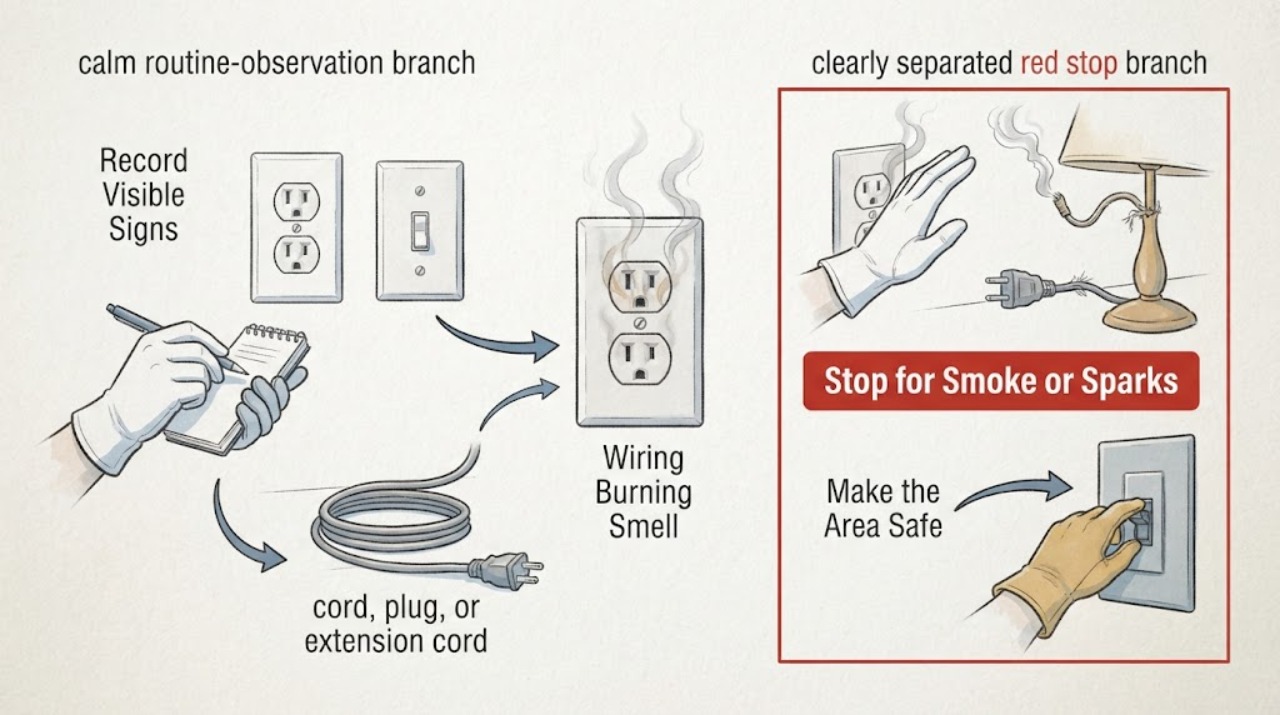
A burning smell from wiring, an outlet, or a switch is a stop-use warning, not a scent to troubleshoot by repeated operation. If there is smoke, flame, sparking, crackling, heat, discoloration, shock, or an escalating odor, leave the area and use emergency help as appropriate. If there is no active fire, disconnect only the cool, accessible load if it is safe, isolate the affected circuit from a safe position, and have a qualified electrician locate the overheated connection or device before restoring service.
Work through in order
Diagnostic checks
Use only checks that match the exact appliance or system and its official guide.
-
Check 1
Stop using the affected room or circuit and look from a safe distance for smoke, flame, glowing material, sparks, crackling, a strong or increasing odor, hot or discolored plates, or an appliance or cord that is visibly melting. Do not touch the outlet, switch, cord, or wall to determine how hot it is.
Expected result: Smoke, flame, active sparking, a rapidly worsening smell, or an immediate fire concern is present.
Next step: Leave the area, keep others away, and contact emergency services from a safe location. Do not operate switches, pull a hot plug, or re-enter to retrieve the device. Only responders or a qualified professional should address the energized fault.
Why this matters
Why: This may be an active electrical fire or an energized overheating fault, and ordinary troubleshooting can increase injury or fire risk.
-
Check 2
If there is no active fire, identify the odor's strongest safe location without opening anything: a receptacle, wall switch, ceiling fixture, electrical panel area, cord or plug, extension cord, or a particular connected device. Note any flickering or dimming lights, buzzing, crackling, tingling, or breaker or fuse operation at the same time.
Expected result: The smell is strongest at a wall plate, switch, receptacle, panel, or fixed wiring area, or it is paired with flicker, buzzing, a tingle, or repeated protective-device operation.
Next step: Stop using that location and arrange a qualified electrician. Do not remove covers or continue turning the switch or circuit on to locate the odor by trial and error.
Why this matters
Why: The pattern is consistent with a wiring, connection, receptacle, switch, overload, or other electrical-system hazard; the nearest visible point may not be the failed connection.
-
Check 3
If the odor is tied to a portable appliance, cord, plug, or extension cord and there is no heat, smoke, water, or visible damage, turn the device off and disconnect it by holding the plug rather than pulling the cord. Inspect only the unplugged cord and plug for cuts, cracks, looseness, discoloration, or melting.
Expected result: The cord or plug is damaged, hot, discolored, loose, or shows sparking or smoke when it was used.
Next step: Keep the device disconnected and take it to an authorized repair center or arrange qualified inspection. Do not tape, splice, bend blades, substitute a higher-rated cord, or reconnect it to another outlet as a test.
Why this matters
Why: The portable device or its cord may be the heat source, but a damaged receptacle can also overheat the plug; the device should not be treated as a simple cord replacement without diagnosis.
-
Check 4
From a dry, safe position, check whether the affected circuit has a tripped breaker or GFCI only if there is no smoke, heat, active sparking, water, or damage at the panel or receptacle. Turn off or unplug connected loads before one normal reset; do not remove a panel cover or replace a fuse during this check.
Expected result: The breaker or GFCI stays on after a single reset, or it trips again immediately or when a particular load is used.
Next step: If it trips again, leave the circuit or device out of service and call a qualified electrician. Never install a larger fuse or breaker and never keep resetting protection while an odor is present.
Why this matters
Why: A stable reset may reflect a temporary overload, while a repeat trip points to an unresolved short, ground fault, overload, wiring condition, or defective device.
-
Check 5
Review what was operating when the smell began. Look for multiple heat-producing loads on the same receptacle or branch circuit, a recently added power strip or extension cord, a loose plug fit, a new fixture, or a device that has been drawing power unusually often. Do not add another load to compare temperatures.
Expected result: Several high-load devices share the circuit, an extension cord or power strip is being used for a heat-producing load, or the smell began under a particular load.
Next step: Stop using the affected arrangement and have the circuit and receptacle assessed. Do not treat a cooler outlet after unplugging one device as proof that the wiring is safe or that the load can simply be moved elsewhere.
Why this matters
Why: Overloading, poor contact, or an unsuitable cord can produce heat in wiring and connections; removing one load may reduce symptoms without correcting the hazard.
-
Check 6
After power has been safely isolated and without opening walls or boxes, record the exact location, the connected device, whether the odor persisted with the load disconnected, any breaker or GFCI behavior, and visible marks. Photograph only from a safe distance and preserve the device label and circuit information for the electrician.
Expected result: The odor remains with the portable load disconnected, or the source cannot be localized to one removable device.
Next step: Keep the affected circuit or area out of service and arrange a qualified electrical inspection. The professional may need to trace the circuit and inspect connections, protective devices, and connected loads before re-energizing it.
Why this matters
Why: A persistent or non-localized odor raises concern for a fixed connection, concealed wiring, panel, or another load on the branch circuit; visual distance checks cannot rule those out.
Use your observations
Decision map
Find the observation that best matches what you see, then follow the next safe action.
-
PATH 01Next step
What you see
Smoke, flame, active sparks, glowing material, or a rapidly worsening burning smell is present.
Do this next
Leave the area, keep others away, and contact emergency services from a safe location. Do not touch or switch the suspected equipment.
-
PATH 02Next step
What you see
The odor is strongest at a warm or discolored receptacle, switch, wall plate, panel, or fixed wiring point.
Do this next
Stop using that location and call a qualified electrician. Do not remove covers, tighten wiring, or keep cycling the switch or breaker.
-
PATH 03Next step
What you see
A portable cord, plug, appliance, or extension cord is visibly damaged, hot, smoky, or sparking.
Do this next
Keep it disconnected and use an authorized repair center or qualified professional. Do not splice, tape, bend, or substitute the cord as a home fix.
-
PATH 04Next step
What you see
The breaker, fuse, or GFCI operates again after the affected load is connected.
Do this next
Leave the load and circuit out of service and have the device and wiring diagnosed. Do not install a larger protective device or repeatedly reset it.
-
PATH 05Next step
What you see
The smell began while multiple heat-producing loads or an extension arrangement was in use.
Do this next
Stop using the arrangement and have the receptacle and branch circuit checked. Removing one load is not proof that the remaining wiring is safe.
-
PATH 06Next step
What you see
The odor persists after a portable device is disconnected or cannot be localized safely.
Do this next
Keep the area or circuit out of service and arrange a qualified inspection of fixed wiring, connections, protective devices, and other loads on the circuit.
Helpful context
Understand the symptom
Wiring odors can originate at a loose connection, receptacle, switch, cord, overloaded branch circuit, light fitting, or a device connected to the circuit. The smell location is useful, but it does not prove the fault is inside the wall or at the nearest outlet. Treat the entire affected circuit as suspect until a professional has isolated the cause.
Do not remove an outlet cover, open a junction box, probe a panel, tighten a terminal, or replace a breaker to make the odor disappear. Those steps can expose energized parts or hide the condition that caused the heat.
Only after diagnosis
Potential parts
- receptacle or wall switch
Consider only after a qualified electrician identifies a worn, overheated, damaged, or incorrectly rated receptacle or switch as the source and confirms the replacement requirements.
Device type, grounding, circuit protection, box, and local installation requirements must be verified before selecting a replacement. - appliance cord or plug
Consider only when an authorized repair source confirms that the portable device cord or plug is damaged and can be replaced without masking a receptacle or internal fault.
Use the exact device documentation and approved cord characteristics; do not choose by visual similarity alone. - circuit breaker or ground-fault protective device
Consider only after an electrician confirms the protective device itself has failed; repeated operation is evidence to diagnose the circuit, not a reason to replace it blindly.
Protection type, rating, panel, wiring, and local requirements are installation-specific and require qualified selection. - damaged wiring connection or junction component
Relevant only if a qualified inspection locates heat damage, a loose connection, arcing, or insulation damage in a fixed wiring section.
The repair method and materials depend on the wiring system and local requirements; do not order a generic part before inspection.
When checks do not resolve it
Need a professional?
Stop immediately for smoke, flame, sparks, crackling, a hot or discolored outlet or switch, shock or tingling, water exposure, damaged insulation, or repeated breaker or fuse operation. A burning smell from wiring is itself enough reason to arrange qualified electrical inspection. Do not open boxes or panels, probe live wiring, tighten connections, or bypass protective devices as a homeowner.
Common questions
FAQ
Is a burning smell from an outlet ever normal?
Treat it as abnormal. NFPA and ESFI list burning odor, warm or discolored outlets, sparks, flicker, buzzing, and tingling among the signs that call for discontinuing use and qualified inspection.
Can I reset the breaker to see whether the smell goes away?
Only a single normal reset is reasonable after connected loads are off and there is no heat, smoke, water, or visible damage. If the protection operates again, or an odor remains, leave the circuit out of service and call a qualified electrician.
What if the smell stops after I unplug one appliance?
Keep that device disconnected. The appliance or its cord may be faulty, but the receptacle or wiring may also have overheated. Have the device assessed and do not move it to another outlet as a test.
Can I replace a scorched receptacle myself?
Do not treat a scorched receptacle as a standalone cosmetic replacement. The heat may have damaged the box, conductors, plug, or upstream connection; keep it out of service and have a qualified electrician trace and repair the cause.
Read the exact guide
Official sources
- Understanding Your Home Electrical SystemElectrical Safety Foundation International · Service panels, branch circuits, breakers, and reset boundaries
- Appliance Safety TipsElectrical Safety Foundation International · Appliance cords, repeated breaker operation, water exposure, and authorized repair safety
- CPSC Guide to Home Wiring HazardsU.S. Consumer Product Safety Commission · Home wiring, receptacle, cord, plug, overload, heat, and qualified-repair safety
- How to Use GFCIsElectrical Safety Foundation International · GFCI reset and test behavior where water and electricity may meet
- Electrical Safety: ChecklistNational Fire Protection Association · Residential electrical warning signs, overloaded outlets, GFCI and AFCI safety, and qualified-electrician boundaries
- Home Wiring Safety TipsElectrical Safety Foundation International · Home wiring hazard signs and licensed-electrician inspection boundaries
- Electrical Safety DosElectrical Safety Foundation International · Electrical overload warning signs, direct connection, and damaged-cord safety
Community feedback
Share a repair observation
Share a plain-text repair observation. Accepted observations are published automatically; this page may take a moment to update.