
On this page
Start here
Quick answer
Flickering or dimming lights can come from a lamp or fixture, a switch or receptacle connection, a branch-circuit load, service equipment, or the utility supply; the symptom alone does not identify the fault. From a safe position, map whether one light, one room, several rooms, or the whole property flickers and whether it changes when a particular appliance starts or when wind or weather changes. Do not remove a panel cover, tighten wiring, test live voltage, probe a receptacle, or touch service equipment. Turn off and stop using a fixture or appliance with heat, discoloration, buzzing, sparks, shock, damaged insulation, smoke, or a burning smell, and arrange qualified electrical service; contact the utility for a possible service-side or outage-related problem.
Before you begin
Safety first
- This article is limited to safe visual and situational observation. A qualified electrician or utility determines whether the cause is a fixture, device, branch wiring, service equipment, utility supply, overload, or connected appliance and performs all de-energization, panel access, testing, and repair.
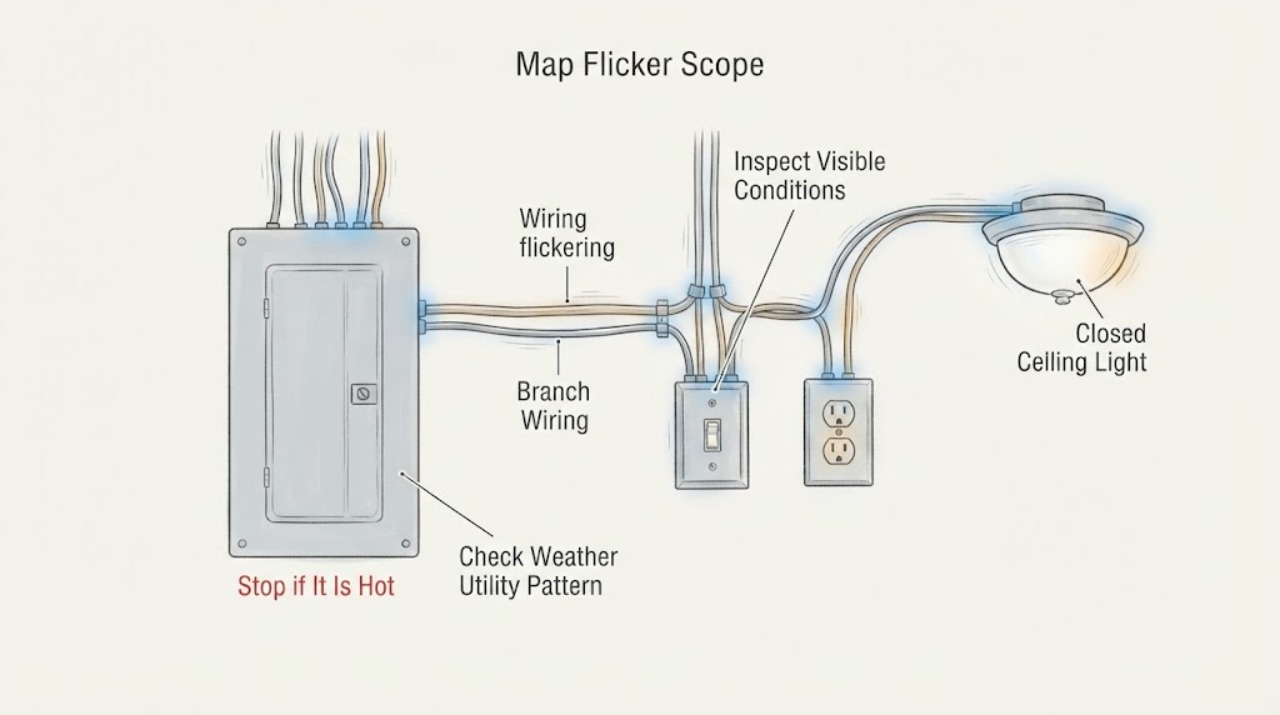
Work through in order
Diagnostic checks
Use only checks that match the exact appliance or system and its official guide.
-
Check 1
From a stable, dry position, observe the flicker without touching the fixture or receptacle and map whether it affects one lamp, one room, several rooms, or the whole property; note whether other loads remain normal.
Expected result: Only one light flickers; multiple lights on one room or branch flicker; lights throughout the property flicker; or the symptom is too brief to locate.
Next step: Write down the locations, time, duration, and affected loads, then continue with trigger observations only if there is no heat, odor, buzzing, spark, shock, smoke, or water exposure.
Stop if: Stop observing and keep clear if there is smoke, active arcing, a burning smell, painful heat, shock or tingling, or visible damaged insulation.
Why this matters
Why: A single point supports a fixture, lamp, switch, or local connection report. A wider pattern raises the possibility of a branch, service, or utility issue and is not safely localized by homeowner probing.
-
Check 2
Without deliberately switching high-load equipment on and off, note whether flicker coincides with the normal start or stop of an air conditioner, heater, motor, kitchen appliance, or other substantial load.
Expected result: The flicker follows one known load; it occurs randomly with no load change; it affects only one fixture; or it occurs across several rooms.
Next step: Stop using the suspected load if it causes heat, odor, noise, sparks, or repeated protective-device operation, and provide the timing record to an electrician; do not perform a load test.
Stop if: Do not add appliances, use extension cords to change the load, open the panel, or reset a tripped device repeatedly to reproduce the flicker.
Why this matters
Why: A load-linked flicker can indicate a circuit, connection, equipment, or supply interaction, but it does not identify a permissible load or a failed part. Random or broad flicker still needs electrical assessment when persistent.
-
Check 3
From indoors or another safe location, record whether the flicker starts with wind, rain, a storm, a neighborhood outage, or a visible utility disturbance; do not approach service drops, meters, transformers, or fallen lines.
Expected result: The entire home or many lights change with wind or utility activity; only one interior fixture changes; or the weather has no apparent relation.
Next step: For a broad weather- or outage-linked pattern, contact the electric utility from a safe location and also arrange electrical inspection when it persists; keep away from any downed or damaged line.
Stop if: Never touch a service drop, meter equipment, fallen line, or anything contacting a line; do not approach in standing water.
Why this matters
Why: CPSC describes home-wide flicker and television-picture variation with wind as a possible service-entrance or service-drop contact problem. A utility-side pattern must not be investigated by touching service equipment, and a single interior point remains a local electrical service concern.
-
Check 4
Only after the affected light, switch, or appliance is switched off and cool, visually inspect the accessible bulb, cord, plug, switch plate, and receptacle face for a loose lamp, cracked insulation, discoloration, moisture, or a cover that is hot or damaged; do not remove a faceplate or fixture cover.
Expected result: The bulb is visibly failed or loose but the socket is cool and undamaged; a cord, plug, switch, or receptacle is warm, discolored, loose, cracked, wet, or buzzing; or nothing visible is abnormal.
Next step: Stop using any damaged or overheated item and arrange qualified electrical service. If the fixture is cool and intact, follow its manufacturer instructions for a matching lamp and stop if flicker continues.
Stop if: Do not touch a hot socket, remove covers, tighten terminals, work on a wet fixture, or replace a lamp while the fitting is energized.
Why this matters
Why: A cool, intact lamp may be replaceable only with the fixture's specified type, but a damaged or hot connection is a wiring hazard. No visible defect does not clear concealed connections, branch wiring, or service equipment.
-
Check 5
From outside the electrical equipment, record whether a fuse or circuit breaker, GFCI, or other protective device has tripped or requires frequent resetting; do not remove the panel cover or alter the device rating.
Expected result: A device has tripped once; it trips again; fuses repeatedly fail; or no protective device change is known.
Next step: Leave the affected load or circuit safely out of use when the problem recurs and arrange qualified electrical diagnosis; provide which loads were operating and when flicker occurred.
Stop if: Do not install a larger fuse or breaker, hold a breaker on, open the panel, or reset repeatedly to keep equipment running.
Why this matters
Why: A repeat trip or repeated fuse failure can indicate an overload, appliance defect, wiring fault, or other hazard. One visible trip does not identify which load or circuit caused it, and the protective device must not be defeated.
-
Check 6
From a safe position, document any buzzing or sizzling, sparks, hot or discolored plates, burning or rubbery odor, shock or tingling, damaged insulation, loose plug, smoke, or water exposure without touching the item.
Expected result: One or more warning signs is present; the sign disappears when the load is off; or no warning sign is visible but flicker continues.
Next step: Keep the affected equipment out of use and arrange an electrician. For smoke, active arcing, fire, or a dangerous service-equipment condition, leave the area and use the appropriate emergency or utility response.
Stop if: Do not touch, sniff closely, spray water, remove a cover, or attempt to locate an arc by moving wires or plugs.
Why this matters
Why: ESFI and NFPA treat these signs together with flickering or dimming lights as reasons for qualified electrical inspection. The disappearance of a sign when a load is off does not make the load safe; it only identifies a useful stop boundary.
Use your observations
Decision map
Find the observation that best matches what you see, then follow the next safe action.
-
PATH 01Safety boundary
What you see
Only one cool, intact fixture or lamp flickers and no heat, odor, buzzing, spark, shock, moisture, or damage is present.
Do this next
Follow the fixture instructions for a matching lamp only when fully de-energized as directed; if flicker continues, arrange electrical service for the fixture, switch, or local wiring.
Why this path and its safety boundary
Safety stop: Do not remove covers or touch terminals.
-
PATH 02Safety boundary
What you see
A switch plate, receptacle, plug, cord, lamp base, or fixture is hot, discolored, cracked, wet, loose, or buzzing.
Do this next
Stop using the affected item and arrange qualified electrician inspection; keep people away from the point until assessed.
Why this path and its safety boundary
Safety stop: Do not touch, tighten, tape over, or continue operating the damaged point.
-
PATH 03Safety boundary
What you see
There are sparks, active arcing, smoke, burning odor, a shock or tingling sensation, or painful heat.
Do this next
Leave the area if unsafe, stop using the equipment without touching it, and use emergency response for active smoke or fire; arrange qualified electrical service.
Why this path and its safety boundary
Safety stop: Do not investigate the arc, spray water, or restore power as a test.
-
PATH 04Safety boundary
What you see
A fuse, breaker, GFCI, or other protective device trips again or requires frequent resetting.
Do this next
Keep the affected load or circuit out of use and arrange qualified electrical diagnosis with the load and timing record.
Why this path and its safety boundary
Safety stop: Do not fit a higher-rated device, hold a breaker closed, or reset repeatedly.
-
PATH 05Safety boundary
What you see
Many lights or the whole property flicker, especially with wind, storms, or a utility disturbance.
Do this next
Contact the electric utility from a safe location and arrange an electrician when the pattern persists or the utility identifies a customer-side issue.
Why this path and its safety boundary
Safety stop: Do not touch the meter, service drop, utility equipment, or fallen lines.
-
PATH 06Safety boundary
What you see
Flicker begins when a particular motor, heater, appliance, or other substantial load normally starts or stops.
Do this next
Stop using that load if any warning sign or repeated trip occurs and ask an electrician to assess the appliance and circuit together; do not reproduce the symptom with extra load.
Why this path and its safety boundary
Safety stop: Do not add extension cords, move conductors, or perform live measurements.
-
PATH 07Safety boundary
What you see
Flicker continues with no visible warning sign and cannot be isolated to a safe, intact lamp or fixture.
Do this next
Arrange a qualified electrical inspection and provide the locations, timing, weather, load, and protective-device record.
Why this path and its safety boundary
Safety stop: Do not open boxes, panels, fixtures, or receptacles to search for the cause.
Helpful context
Understand the symptom
Flicker location changes the likely boundary
A single lamp can have a lamp, socket, switch, or fixture problem, while several lights on one branch or across the home can indicate a circuit, service, or utility issue. A whole-home change that follows wind or a utility disturbance is not a reason to inspect the meter, overhead conductors, or panel. The first useful result is the scope and trigger, recorded without touching energized equipment.
Use visual and situational checks only
You can observe a cool, switched-off fixture, cord, plug, switch plate, or receptacle from ordinary access for discoloration, looseness, damage, buzzing, or heat without removing covers. A bulb may be a simple cause, but replacing it is not an appropriate experiment when the socket is hot, damaged, sparking, or wet. Never treat a flicker as permission to tighten terminals or measure the circuit while energized.
Warning signs turn this into a stop condition
CPSC, ESFI, and NFPA identify warm or discolored outlets, buzzing, sparks, hot insulation odor, shocks, damaged cords, flickering lights, and repeated fuse or breaker problems as reasons for qualified inspection. Smoke or active arcing requires immediate distance and the property's emergency response. Keep the affected load out of use until the hazard is assessed.
Only after diagnosis
Potential parts
- lamp or lighting fixture
Consider this only when a cool, accessible fixture has a clearly failed lamp and no wiring warning signs; a replacement lamp cannot correct a switch, socket, branch, or service fault.
Confirm the fixture's specified lamp type and rating from its label or manufacturer instructions; stop if the socket is hot, damaged, wet, or discolored. - switch or receptacle
Consider this only after a qualified electrician confirms that the local device is defective and replacement is appropriate; flicker alone does not identify a switch or receptacle failure.
A qualified electrician must verify circuit, protection, device type, wiring method, and local requirements before replacement.
When checks do not resolve it
Need a professional?
Arrange qualified electrical inspection for persistent flickering, flicker affecting multiple lights, a load-linked pattern, a warm or discolored switch or receptacle, buzzing, sparks, shock or tingling, damaged insulation, repeated fuse or breaker trips, or an unexplained symptom. Contact the electric utility for a broad wind- or outage-linked pattern and keep away from service equipment or fallen lines. Treat smoke, active arcing, fire, or painful heat as an immediate stop condition.
Safety scope: This article is limited to safe visual and situational observation. A qualified electrician or utility determines whether the cause is a fixture, device, branch wiring, service equipment, utility supply, overload, or connected appliance and performs all de-energization, panel access, testing, and repair.
Have this ready
- Which lamp, room, branch, or property areas flicker and whether other loads are affected
- When the symptom occurs, including load starts, wind, storms, outages, or random timing
- Visible heat, discoloration, buzzing, sparks, odor, damage, shock, moisture, or smoke observations
- Protective-device trips and the appliances or loads operating at the time
- Photos or video taken from a safe position and any recent installation, renovation, or appliance change
Common questions
FAQ
Is a flickering light always caused by bad wiring?
No. A lamp or fixture, switch, receptacle, branch circuit, connected load, service equipment, or utility supply may be involved. Map the scope and trigger safely; do not open covers or test energized wiring.
What should I do if several lights flicker at once?
Record which rooms are affected and whether the pattern follows a load, wind, storm, or utility event. A broad pattern can involve a branch, service, or utility issue, so contact the utility when appropriate and arrange qualified electrical inspection.
Can I tighten a loose switch or receptacle to stop flickering?
No. A loose or flickering device can involve energized wiring or a concealed connection. Do not remove the faceplate or tighten terminals; stop using a hot, discolored, buzzing, wet, or damaged point and call an electrician.
When does flickering become an electrical emergency?
Treat smoke, active arcing, sparks, burning odor, painful heat, a shock or tingling sensation, water exposure, or repeated protective-device trips as immediate stop conditions. Keep clear and use emergency or utility response as appropriate.
Can a high-load appliance make lights flicker?
A flicker that follows a motor, heater, or other substantial load is useful information, but it does not identify whether the appliance, circuit, connection, or supply is at fault. Stop using the load if warning signs occur and have the combination assessed by an electrician.
Read the exact guide
Official sources
- Home Wiring Safety TipsElectrical Safety Foundation International · Supports flickering lights, repeated outages or breaker problems, arcing, buzzing, overheating, odors, shocks, and damaged insulation as professional-inspection clues.
- CPSC Guide to Home Wiring HazardsU.S. Consumer Product Safety Commission · Supports flickering-light warning identification, no-touch service-equipment boundary, heat/odor/spark/shock escalation, and qualified electrical repair.
- Electrical Safety DosElectrical Safety Foundation International · Supports treating flickering or dimming lights, discoloration, buzzing, warm switches or outlets, and burning odor as electrician-inspection triggers.
- Electrical Safety: ChecklistNational Fire Protection Association · Supports electrician escalation for flickering lights, warm or discolored outlets, burning odor, sparks, damaged cords, and repeated breaker problems.
Community feedback
Share a repair observation
Share a plain-text repair observation. Accepted observations are published automatically; this page may take a moment to update.