
On this page
Start here
Quick answer
Treat a new or unusual buzz from wiring, a switch, outlet, plug, or appliance as a possible electrical hazard, not as a noise to ignore. From a safe position, note exactly where it comes from and look without touching for sparks, smoke, burning or hot-plastic odor, scorch marks, melted plastic, a hot or discolored plate, flickering lights, shocks, or repeated breaker trips. Stop using the implicated appliance or outlet. Unplug a portable appliance only if the plug and socket are cool, dry, and undamaged and you can remove the plug safely; do not touch a hot, wet, scorched, loose, or sparking connection. Do not remove covers, open the panel, tighten terminals, move wires, or keep resetting a breaker. If the sound is from fixed wiring, an outlet or switch, the panel, a damaged cord, or an uncertain location, leave it isolated when safe and arrange a licensed or registered electrician; leave immediately and contact emergency services if there is smoke, flame, active arcing, or a strong burning odor.
Before you begin
Safety first
- User checks are limited to listening and visual observation from a safe position, safe disconnection of a cool dry undamaged portable plug, and one clearly identified circuit isolation only when the panel and surroundings are dry and undamaged. Fixed wiring, covers, panels, terminals, breakers, fuses, damaged connections, live testing, and recurring or hazardous symptoms require qualified service.
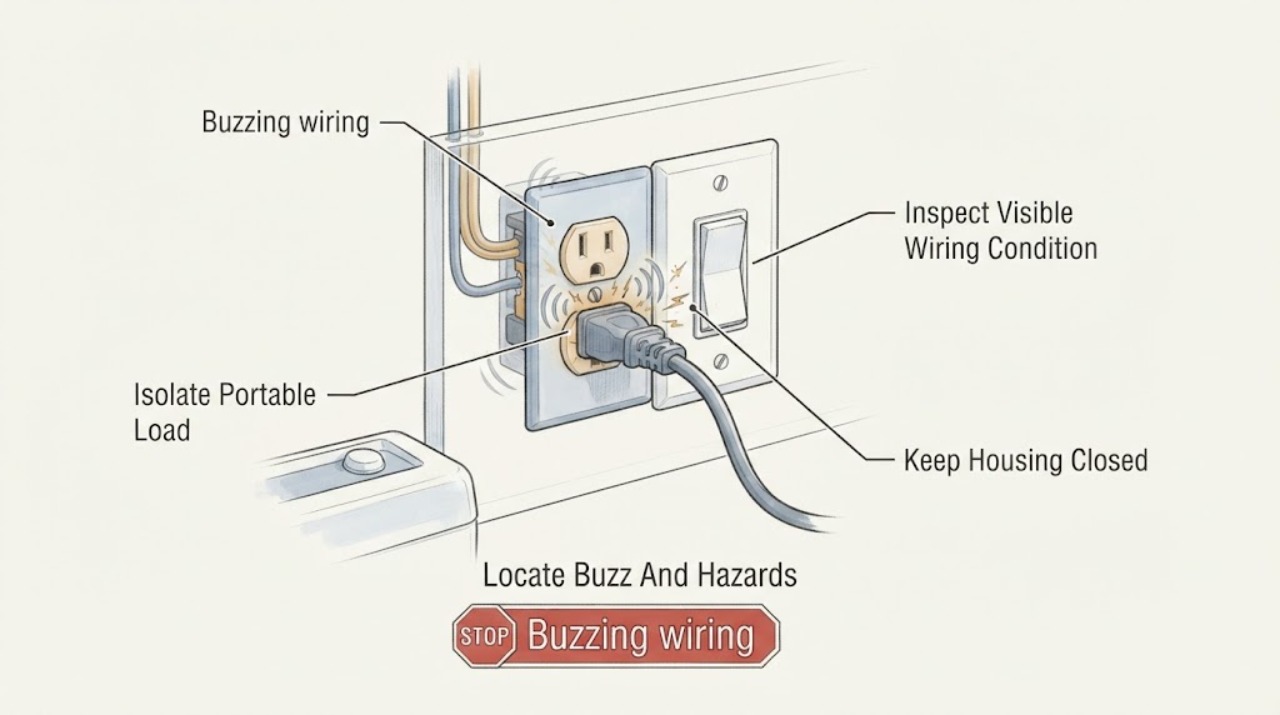
Work through in order
Diagnostic checks
Use only checks that match the exact appliance or system and its official guide.
-
Check 1
From a safe position, listen only long enough to identify whether the sound is at a wall switch, receptacle, plug or cord, fixed wiring, a panel, or a portable appliance. Look without touching for smoke, sparks, flame, burning or hot-plastic odor, scorch marks, melted plastic, flicker, unusual heat, or a shock or tingle reported by anyone.
Expected result: The source is fixed wiring, a switch or receptacle, a plug or cord, a portable appliance, or uncertain; and hazard signs are absent or present.
Next step: For any hazard sign or uncertain fixed source, stop using the area and arrange qualified electrical help; leave and contact emergency services for active smoke or flame. Continue only with a safe portable-appliance isolation check when the plug and socket are cool, dry, and undamaged.
Stop if: Stop immediately for smoke, flame, active sparks or arcing, burning odor, exposed conductors, shock, or equipment too hot to approach safely.
Why this matters
Why: A fixed-wiring, outlet, switch, panel, or uncertain source cannot be safely diagnosed by a user. Smoke, sparks, odor, heat, damage, flicker, or shock raises the condition from a noise complaint to an immediate electrical safety concern.
-
Check 2
If the buzz is clearly from a portable appliance and the plug, socket, and cord are cool, dry, intact, and reachable without touching a damaged area, switch the appliance off and remove the plug by its body. If the connection is hot, wet, scorched, loose, sparking, or difficult to remove, do not touch it; leave the area and arrange qualified help.
Expected result: The sound stops when the appliance is safely disconnected; the sound continues at the outlet or wiring; the cord or plug is damaged; or the connection cannot be safely isolated.
Next step: Keep the appliance disconnected and do not test it in another outlet. For a continuing sound, damaged cord or plug, or unsafe connection, stop and arrange a qualified electrician or repair technician.
Stop if: Do not pull a plug by its cord, touch a hot or wet plug, or remove a plug while sparks, smoke, or active arcing is present.
Why this matters
Why: A sound that stops with a portable load narrows the concern to the appliance, cord, plug, or receptacle under load but does not prove which part is defective. A continuing fixed-source sound or damaged connection requires electrical inspection.
-
Check 3
With power left undisturbed, inspect the outside of the switch, receptacle, plug, cord, and cover plate from a safe distance. Look for blackening, browning, melting, cracks, loose or missing covers, exposed colored wires, fraying, or a plate that is visibly distorted; do not remove the cover or touch a suspected hot surface.
Expected result: The exterior looks normal; there is discoloration or melting; a cord is damaged; a cover is loose or missing; or the plate or plug is visibly hot or distorted.
Next step: Keep the affected outlet, switch, cord, or appliance out of use and arrange qualified electrical inspection. Do not tape, tighten, replace, or reset the damaged item as a user repair.
Stop if: Do not touch, cover over, or continue using a hot, scorched, melted, cracked, or exposed electrical part.
Why this matters
Why: Visible damage, heat, or exposed wiring supports an unsafe connection or overload concern even if the buzz is intermittent. A normal exterior does not clear concealed wiring or an internal appliance fault.
-
Check 4
Without deliberately re-energizing the noise, record whether lights dim or flicker, whether the sound begins when a particular load operates, and whether a breaker has tripped or a fuse has operated repeatedly. Do not keep switching a device on and off or repeatedly reset the protective device to test the pattern.
Expected result: The buzz correlates with one load; lights flicker or dim; protection trips; the symptom affects more than one outlet; or no wider symptom is known.
Next step: Leave the implicated load and circuit unused as safely possible and arrange electrician inspection. Provide the timing and affected outlets rather than adding a larger fuse, bypassing protection, or moving the load to another outlet for testing.
Stop if: Do not bypass, up-rate, repeatedly reset, or deliberately overload a circuit.
Why this matters
Why: A load-related or multi-outlet pattern can involve an appliance, circuit overload, loose connection, or wiring condition. Flicker and repeated protection operation are warning signs, not evidence that resetting has fixed the cause.
-
Check 5
If the sound is from a fixed outlet, switch, or wiring and the corresponding breaker is unmistakably labeled, the panel is dry and undamaged, and you can operate it without approaching heat, smoke, or sparks, switch that circuit off once. If the circuit is not identifiable or the panel is wet, hot, damaged, or smoking, do not operate it and move to a safe location.
Expected result: The circuit is safely isolated; the sound stops but the cause is unknown; the breaker will not stay off; or isolation cannot be performed safely.
Next step: Keep the circuit off and arrange qualified electrician inspection. If isolation is unsafe or the breaker trips again, do not approach the panel; leave the area for smoke, flame, or strong odor and seek emergency help.
Stop if: Do not open the panel, touch exposed wiring, force a breaker, or approach a wet, hot, smoking, or arcing panel.
Why this matters
Why: Turning off a clearly identified circuit can reduce exposure while waiting for service, but it does not locate or repair the fault. A breaker that will not stay off or cannot be identified is a professional boundary.
-
Check 6
Record the sound location, whether it is continuous or load-related, the affected appliance or outlet, flicker or trip history, visible discoloration or odor, the circuit label if safely known, and what was disconnected or isolated. Take photographs only from a dry safe position; do not reopen the circuit to obtain a recording.
Expected result: The sound remains; it returns when the circuit is used; the source is still uncertain; or the sound stops after safe isolation and no hazard is visible.
Next step: Keep the affected equipment or circuit out of use and provide the record to a licensed or registered electrician. Do not select a replacement outlet, breaker, fuse, cord, or wiring component from the sound alone.
Stop if: Stop all user troubleshooting once the source is fixed wiring, the sound recurs, or any warning sign appears.
Why this matters
Why: Stopping the sound does not certify that the wiring or appliance is safe. Recurrence, uncertainty, or any warning sign needs professional diagnosis of the load, connection, circuit protection, and wiring condition.
Use your observations
Decision map
Find the observation that best matches what you see, then follow the next safe action.
-
PATH 01Next step
What you see
Smoke, flame, active sparks or arcing, strong burning odor, rapidly melting plastic, or an electrical shock is present.
Do this next
Leave the area, keep others away, and contact emergency services from a safe location. Do not touch the equipment, operate switches, or re-enter until authorities or qualified professionals say it is safe.
Why this path and its safety boundary
Why it matters: The condition may cause fire, burns, or shock and is not a routine wiring diagnosis.
-
PATH 02Next step
What you see
The buzz comes from a wall switch, receptacle, fixed wiring, service panel, or an uncertain location.
Do this next
Stop using the affected circuit and arrange qualified electrician inspection. If it can be done safely, switch off only the unmistakably labeled circuit once; do not open covers or the panel.
Why this path and its safety boundary
Why it matters: A loose connection, overload, protection, or concealed wiring fault may be involved and cannot be identified safely from the outside.
-
PATH 03Next step
What you see
The sound clearly comes from a portable appliance and stops when its cool, dry, undamaged plug is safely removed.
Do this next
Keep it disconnected and do not test it in another outlet. Arrange qualified appliance or electrical inspection and provide the model and sound pattern.
Why this path and its safety boundary
Why it matters: The appliance, cord, plug, or receptacle under load is implicated, but the appliance is not cleared for reuse.
-
PATH 04Next step
What you see
A plug, cord, receptacle, switch, or cover plate is scorched, melted, cracked, loose, frayed, exposed, or unusually hot.
Do this next
Stop using the connection and arrange qualified electrician or repair service. Do not tape over damage, tighten terminals, replace a fuse, or install a part without diagnosis.
Why this path and its safety boundary
Why it matters: Visible damage or heat indicates an unsafe electrical condition even if the buzz stops.
-
PATH 05Next step
What you see
Buzzing occurs when a particular load operates, lights flicker or dim, several outlets are involved, or breakers trip repeatedly.
Do this next
Stop using the implicated load and arrange electrician inspection. Do not move the load to another outlet for testing or bypass circuit protection.
Why this path and its safety boundary
Why it matters: An appliance, circuit load, connection, or protection problem may be present; repeated resetting can leave the fault energized.
-
PATH 06Next step
What you see
The buzz stops after a clearly identified circuit is switched off, with no smoke, odor, heat, sparks, or visible damage.
Do this next
Keep the circuit off and arrange qualified electrical inspection. Do not restore it repeatedly to see whether the sound returns.
Why this path and its safety boundary
Why it matters: Isolation reduces immediate exposure but does not identify the fault or prove the circuit safe.
-
PATH 07Next step
What you see
The sound is intermittent, its source cannot be located, or it has stopped before inspection.
Do this next
Do not chase the sound by touching or cycling equipment. Record when it occurs, leave the suspect circuit or device unused as safely possible, and arrange electrician inspection.
Why this path and its safety boundary
Why it matters: An intermittent fault can still involve a load, connection, or wiring and may be harder to identify when energized.
Helpful context
Understand the symptom
The sound location changes the risk
A faint sound from a known device is not enough to identify a fault, but an unusual buzz or sizzle from a switch, outlet, plug, or fixed wiring can indicate an unsafe electrical condition. A sound that appears when a particular load runs may involve that appliance, its cord, the receptacle, or the circuit. A sound with flickering, heat, odor, sparks, or repeated breaker operation needs the circuit treated as unsafe until inspected.
Do not open energized electrical equipment
Keep the check visual and from a safe, dry position. Do not remove an outlet or switch cover, open a service panel, tighten a terminal, test live wiring, bypass a breaker, or replace a fuse to see whether the noise stops. Do not touch equipment that is hot, wet, scorched, smoking, sparking, or giving off a burning smell.
A quiet circuit is not proof of a repair
A buzz that stops when a portable appliance is safely disconnected narrows the concern to that appliance, cord, plug, or its connection; it does not make the appliance safe to reuse. A buzz that continues, returns, or comes from fixed wiring needs an electrician even if lights still work and the breaker has not tripped. Record the pattern instead of repeatedly energizing the circuit.
Safety boundary
Stop conditions
- Stop immediately and leave the area for smoke, flame, active sparks or arcing, strong burning odor, exposed conductors, electrical shock, or rapidly melting plastic; contact emergency services from a safe location.
- Do not remove outlet, switch, junction-box, or panel covers; tighten terminals; test live wiring; bypass a breaker; up-rate a fuse; or replace wiring parts based on the sound.
- Do not touch hot, wet, scorched, loose, cracked, melted, or sparking electrical equipment, and do not repeatedly reset a breaker or re-energize a circuit to reproduce the buzz.
- Arrange qualified electrician or appliance-repair inspection for buzzing from fixed wiring, a receptacle, switch, plug, cord, panel, an uncertain source, recurring sound, flicker, shock, or repeated protection trips.
When checks do not resolve it
Need a professional?
Call promptly for any buzzing fixed wiring, outlet or switch, damaged cord or plug, hot or discolored plate, flicker, shock, repeated breaker operation, load-related noise, recurrence, or a circuit that cannot be safely identified or isolated.
Safety scope: User checks are limited to listening and visual observation from a safe position, safe disconnection of a cool dry undamaged portable plug, and one clearly identified circuit isolation only when the panel and surroundings are dry and undamaged. Fixed wiring, covers, panels, terminals, breakers, fuses, damaged connections, live testing, and recurring or hazardous symptoms require qualified service.
Have this ready
- Provide the sound location, continuous versus load-related pattern, affected device or outlet, flicker and trip history, visible heat or discoloration, odor or spark observations, safe isolation result, and photographs from a dry position.
Common questions
FAQ
Is a buzzing outlet or switch dangerous?
An unusual buzz, sizzle, or crackle from an outlet or switch is a warning sign, especially with heat, discoloration, odor, flicker, sparks, or repeated breaker trips. Stop using it, do not remove the cover, and arrange qualified electrician inspection.
Should I keep resetting the breaker if wiring is buzzing?
No. Repeated resets can re-energize an unresolved fault. Stop using the implicated load or circuit; switch off a clearly identified breaker only when the panel and surroundings are dry and undamaged, and arrange qualified electrical service.
What if the buzzing stops when I unplug an appliance?
Keep the appliance disconnected and do not test it in another outlet. The appliance, cord, plug, or receptacle may be involved, but stopping the sound does not prove any of them are safe. Arrange qualified appliance or electrical inspection.
Can flickering lights and buzzing be related?
They can occur together as warning signs of a load, connection, circuit, or wiring condition. Do not deliberately reproduce the symptom or move loads around for testing; stop using the affected equipment and arrange electrician inspection.
When should I leave the area instead of troubleshooting buzzing wiring?
Leave for smoke, flame, active arcing or sparks, strong burning odor, exposed conductors, electrical shock, or rapidly melting plastic. Keep others away and contact emergency services from a safe location; do not operate switches or touch the equipment.
Read the exact guide
Official sources
- Extension leads, cable reels and block adaptorsElectrical Safety First · Safety-body guidance on buzzing or crackling, hot-plastic odor, sparks, scorch marks, melted plastic, damaged cables, unexplained protection trips, and stopping use for qualified inspection.
- Electrical Safety Month PosterU.S. Consumer Product Safety Commission · Government electrical-safety guidance identifying sizzle or buzzing sounds, overheating odor, sparks, hot or discolored plates, flickering, and repeated fuse or breaker operation as warning signs.
Community feedback
Share a repair observation
Share a plain-text repair observation. Accepted observations are published automatically; this page may take a moment to update.