
On this page
Start here
Quick answer
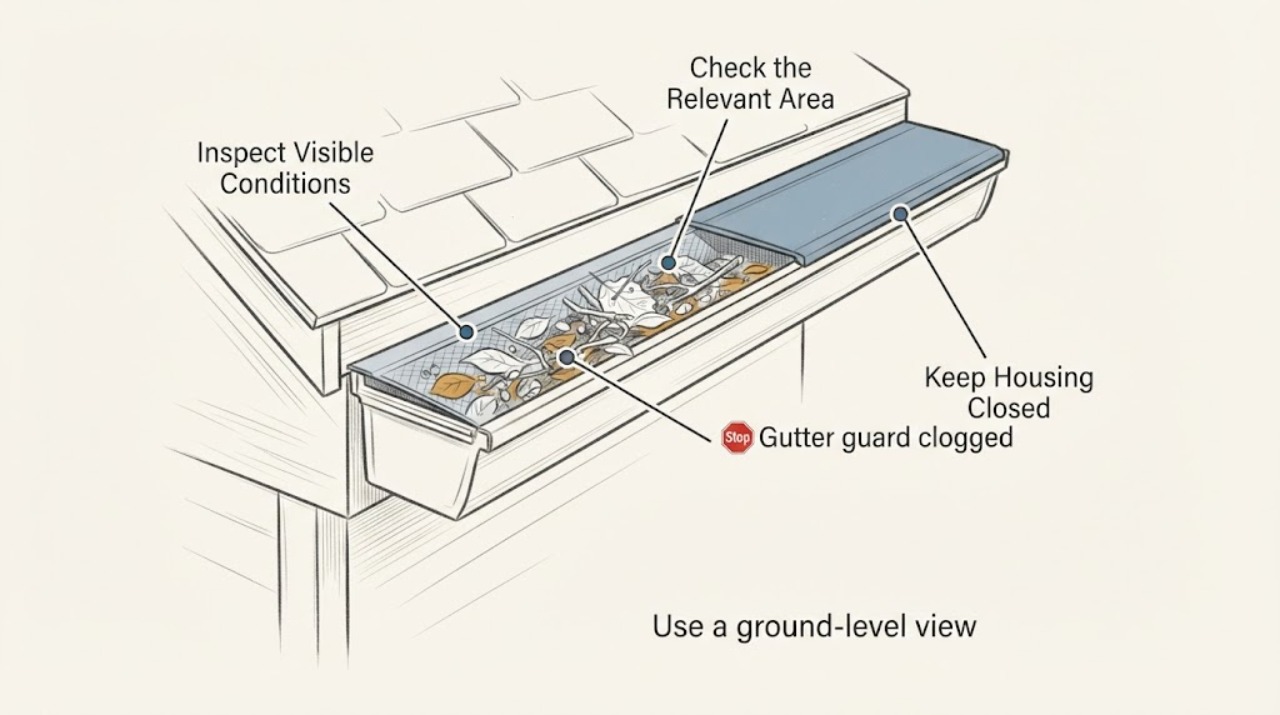
If a gutter guard appears clogged, limit yourself to observations from the ground: watch the system during or just after rain, note overflow and downspout discharge, and photograph any visible debris mat, sag, gap, or displaced section without touching the guard. Do not climb, reach into the guard, or clean from a roof or ladder. A localized overflow can mean debris at one section or a blocked outlet; overflow across several sections can mean a larger capacity, slope, installation, or guard-compatibility issue. If water is reaching walls, windows, doors, foundations, or electrical areas, or if the guard cannot be safely assessed from the ground, stop and arrange a qualified gutter professional or the original installing dealer.
Before you begin
Safety first
- The reader's role ends at safe ground-level observation. Do not climb a ladder or roof, reach into guards, remove covers, probe downspouts, use elevated cleaning equipment, or work near overhead wires.
Work through in order
Diagnostic checks
Use only checks that match the exact appliance or system and its official guide.
-
Check 1
From a stable position on the ground, observe the gutter guard during or immediately after ordinary rain; do not climb, reach upward into the guard, or stand beneath a concentrated discharge.
Expected result: Record whether water flows over the guard, backs up at one short section, drips from a joint, or appears to pass normally into the gutter and downspout.
Next step: Photograph the pattern from the ground and give the section location and weather conditions to a gutter professional or the installing dealer.
Stop if: Stop the observation if rain creates slippery ground, lightning, strong wind, or uncontrolled water near an entry, walkway, or electrical equipment.
Why this matters
Why: Overflow at one section suggests a localized debris, outlet, alignment, or guard issue. Overflow along much of the run points toward a broader drainage, capacity, slope, or installation question rather than a single leaf mat.
-
Check 2
Walk the ground around the safe perimeter and look at the downspout outlets and nearby surfaces without probing or disassembling anything.
Expected result: Note whether each visible outlet has a clear-looking discharge, weak or absent flow during rain, water pooling at the foundation, or runoff cutting a channel through soil.
Next step: Mark the affected outlet and photograph the water path; keep people away from pooling until the source and safe remedy are known.
Stop if: Stop if water is entering the building, approaching a panel or receptacle, undermining a walkway, or creating an immediate slip hazard.
Why this matters
Why: Normal discharge makes a completely blocked downspout less likely but does not prove the guard is clear. Weak flow, pooling, or concentrated erosion raises the priority for a professional drainage assessment.
-
Check 3
Use a ground-level view or a camera zoom to compare the affected section with an adjacent section, without touching the guard, cover, fascia, or gutter edge.
Expected result: Look for a visible leaf or seed mat on top, a gap, lifted edge, sag, rust, dent, or guard section that is out of line; also record when no visible defect can be seen.
Next step: Send only the ground-level images and location notes through the professional's approved intake process; let the professional decide whether access or removal is needed.
Stop if: Do not reach into, lift, press, poke, or pull the guard to confirm what is underneath.
Why this matters
Why: A visible local defect can explain a local overflow and helps identify the section for service. No visible defect does not clear the guard, because debris or a connection problem can be hidden below the cover.
-
Check 4
Compare the timing and extent of the overflow with recent leaf fall, seed drop, roof work, storms, or a guard installation or repair, using memory and visible ground-level evidence only.
Expected result: The issue began after a distinct event, is limited to one run, or has been present across multiple rain events and several runs.
Next step: Give the professional the start date, affected runs, recent weather or work, and whether neighboring sections drain normally.
Stop if: Stop investigating from the ground if the only way to compare sections requires a ladder, roof access, or entry into a restricted area.
Why this matters
Why: A recent event or one run supports a localized inspection. A repeated multi-run pattern may involve guard design, installation, gutter slope, roof runoff, or overall drainage capacity and should not be treated as a simple cleaning spot.
-
Check 5
Find the guard's installation paperwork, product name, warranty terms, or original installer contact without removing any component.
Expected result: The system and installer are identifiable, or the guard type and installer cannot be confirmed.
Next step: Ask the original installer or a qualified gutter professional whether the reported clog is covered service, routine maintenance, or a fitting or drainage defect.
Stop if: Do not buy or install a replacement guard, brush, screen, or cleaning tool until the guard design and fit are confirmed by the responsible professional.
Why this matters
Why: An identifiable system lets the installer or manufacturer apply the correct cleaning and warranty rules. An unknown system increases the risk of damaging a cover or using an incompatible tool or replacement.
Use your observations
Decision map
Find the observation that best matches what you see, then follow the next safe action.
-
PATH 01Safety boundary
What you see
Water overflows at one short section while adjacent sections appear to drain normally.
Do this next
Request a professional inspection of that section, its outlet path, alignment, and the guard-to-gutter interface, using the location photos.
Why this path and its safety boundary
Safety stop: Do not reach into or remove the guard to prove the blockage.
-
PATH 02Safety boundary
What you see
Several sections overflow, or the pattern repeats during ordinary rain despite no visible ground-level defect.
Do this next
Request a full-run drainage and installation assessment that considers roof runoff, gutter slope, guard design, and downspout capacity.
Why this path and its safety boundary
Safety stop: Do not assume a new guard or a generic cleaning tool will solve a system-wide drainage problem.
-
PATH 03Safety boundary
What you see
The downspout outlet has weak or absent discharge, or water pools at the foundation.
Do this next
Treat the issue as a drainage priority and arrange professional service with the outlet location and water-path photos.
Why this path and its safety boundary
Safety stop: Stop immediately if water is entering the building or approaching electrical equipment.
-
PATH 04Safety boundary
What you see
The guard is an identifiable proprietary system with an original installer or warranty contact.
Do this next
Contact that installer first and follow the system's documented service and warranty route; ask what access and cleaning method its design permits.
Why this path and its safety boundary
Safety stop: Do not perform an unauthorized repair that could damage the system or affect its warranty.
-
PATH 05Safety boundary
What you see
The guard type is unknown, access from the ground is insufficient, or the property has a fall, electrical, or structural hazard.
Do this next
Stop user inspection and arrange a qualified gutter professional who can assess the system with appropriate equipment and controls.
Why this path and its safety boundary
Safety stop: No ladder, roof access, reaching into guards, elevated cleaning, or component removal by the reader.
Helpful context
Understand the symptom
A gutter guard is not a guarantee that the rainwater path will stay open. Leaves, seed pods, roof grit, moss, and small debris can collect on or beneath different guard designs, while a blocked outlet or downspout can make an otherwise open guard look clogged. The useful first distinction is whether the problem is one short section or a repeated overflow pattern across the run.
This guide is deliberately ground-level. Watch the gutter during safe weather, use a camera from the ground if useful, and record what water does. Do not climb a ladder or roof, reach into a guard, lift a cover, probe a downspout, or direct a powered tool at the gutter.
Manufacturer instructions vary by guard design. One manufacturer's warranty guidance says that a clog in its proprietary system should be handled by the installing dealer and warns that unauthorized repairs can affect warranty coverage. That is not a universal warranty rule, so identify the installed system and check its own documentation before any work is authorized.
The observations below give a professional a useful starting record without turning a fall or electrical hazard into a do-it-yourself cleaning job. Keep children and pets away from any area where water is discharging or where a professional may later set up equipment.
Only after diagnosis
Potential parts
- gutter guard
Consider a replacement only if a professional identifies a damaged, incompatible, or failed guard section rather than a blockage or drainage-capacity issue.
Confirm the existing guard design, gutter profile, roof edge, attachment method, and local drainage requirements before selecting any replacement. - gutter cleaning tool
Consider a tool only if the guard manufacturer or qualified service provider explicitly approves a ground-level method for that installed design; it is not a substitute for elevated professional access.
Verify the guard manufacturer's instructions and avoid any tool or attachment that requires climbing, reaching into the guard, or contacting power lines.
When checks do not resolve it
Need a professional?
Safety scope: The reader's role ends at safe ground-level observation. Do not climb a ladder or roof, reach into guards, remove covers, probe downspouts, use elevated cleaning equipment, or work near overhead wires.
Have this ready
- Share the affected run or section, rain conditions, overflow and downspout observations, ground-level photos, recent storms or roof work, installation paperwork, and any visible property or electrical hazards.
Common questions
FAQ
Can I clean a clogged gutter guard from the ground?
Do not assume that a ground-level tool is safe or compatible with the installed guard. First record the overflow pattern and ask the guard manufacturer, installing dealer, or qualified gutter professional whether an approved ground-level method exists.
Why does a gutter guard overflow in only one spot?
A local overflow can come from debris at that section, a blocked outlet path, a displaced or damaged guard, or a local alignment issue. Compare it with adjacent sections from the ground and provide the exact location to a professional.
Does a gutter guard that overflows always need to be replaced?
No. The cause may be a blockage, downspout restriction, runoff capacity, slope, installation, or a damaged section. Replacement should follow a professional assessment and compatibility check, not the overflow observation alone.
Read the exact guide
Official sources
- Home Safe: Outdoor RepairsU.S. Consumer Product Safety Commission · Supports the article's user-observation-only boundary and the decision to stop before ladder, roof, power-tool, or electrical work; it is not a gutter-guard cleaning procedure.
- Lifetime Finish Warranty and Maintenance GuidanceLeafguard Gutters / Englert · This is a product-specific example, not a universal rule for every guard. It supports checking the installed system's own instructions and contacting its installing dealer when that proprietary system clogs.
Community feedback
Share a repair observation
Share a plain-text repair observation. Accepted observations are published automatically; this page may take a moment to update.