
On this page
Start here
Quick answer
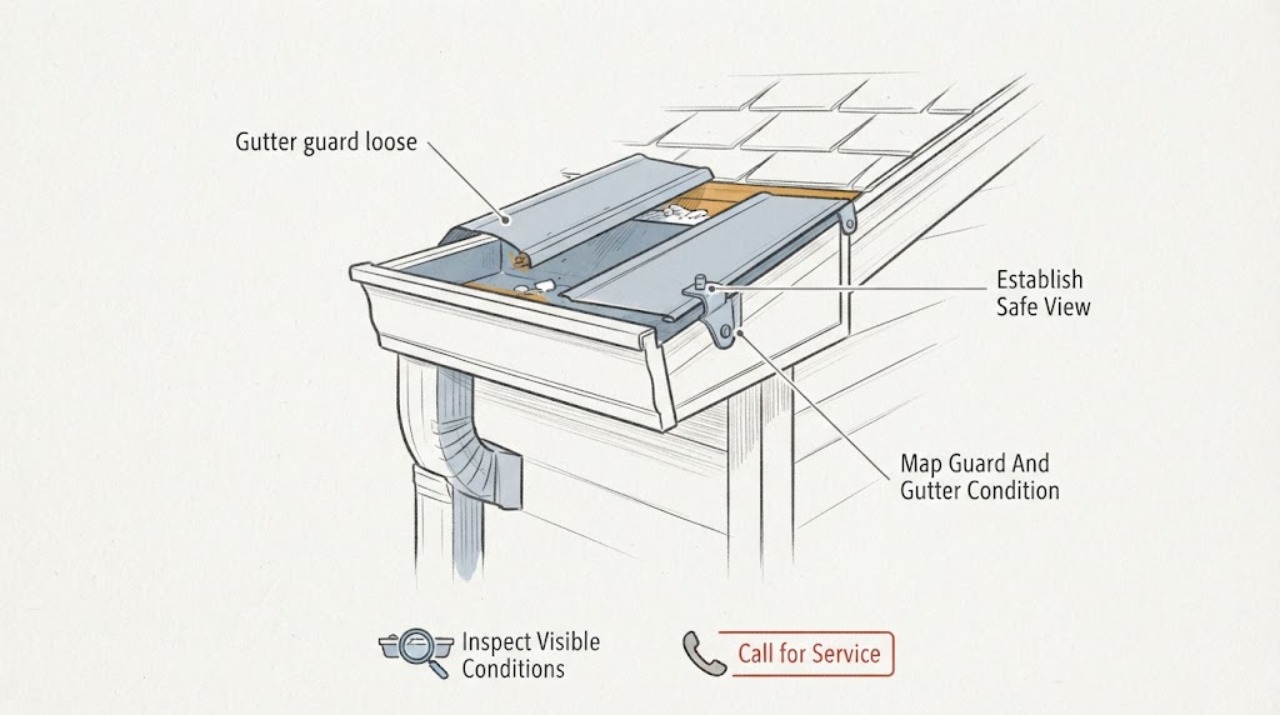
Do not climb, reach, or try to push a loose gutter guard back into place. From the ground or a safe window, photograph the entire roofline and the affected section, and note whether the guard is lifted, bowed, shifted, missing, or hanging over the gutter. After weather has passed, observe ground-level signs of overflow, debris buildup, water staining, or wet areas near the foundation; do not inspect during a storm. A single loose section may involve a failed fastener or an installation-specific fit, but movement along several sections, a sagging gutter, a damaged roof edge, overflow, ice or wind damage, or an inaccessible location needs a qualified gutter or roofing professional. The correct guard and fastener depend on the gutter profile, roof edge, guard design, and existing condition, so do not assume a generic clip or guard will fit.
Work through in order
Diagnostic checks
Use only checks that match the exact appliance or system and its official guide.
-
Check 1
From the ground, a doorway, or a safe window, photograph the affected roofline without using a ladder, roof access, reaching, or touching the guard.
Expected result: Record whether the guard is fully seated from the visible angle, lifted, bowed, shifted sideways, hanging, missing, or partly on the ground. Note whether the gutter itself appears straight or sagging and whether any piece is near a walkway.
Next step: Keep people and pets away from fallen or low-hanging pieces, save the photographs, and continue only with ground-level or window observations. Request service if the guard is unstable, inaccessible, or near a path.
Stop if: Stop if the view would require a ladder, roof or attic access, reaching over an edge, moving a fallen sharp piece, or entering an area affected by wind, ice, or active rain.
Why this matters
Why: A small visible shift is different from a hanging or missing section, and a sagging gutter or fallen piece suggests a wider condition. A limited view is still useful evidence; it is not a reason to climb for a closer look.
-
Check 2
Compare the affected section with adjacent visible guard sections from the same safe position; do not push, lift, or re-seat any part.
Expected result: Note gaps at overlaps, a raised front edge, a separated rear edge, missing or visibly displaced pieces, debris trapped at a valley, a gutter lip that appears bent, or a gutter that sags relative to the roofline. Record unknown where the edge is hidden.
Next step: Photograph the pattern and provide it to a gutter installer or roofing professional. Do not remove debris from above, bend the lip, or attempt to restore alignment from the ground.
Stop if: Stop for sharp or hanging metal, unstable gutter sections, damaged roof edge or flashing, visible ice, a piece over a walkway, or any need to reach or handle the guard.
Why this matters
Why: A single shifted section may be a system-specific attachment issue, while repeated gaps, valley debris, a bent lip, or a sagging gutter can point to a broader installation, loading, drainage, or weather condition. These observations do not identify the correct fastener.
-
Check 3
Only after rain or other weather has passed and from the ground or a safe window, look for visible runoff effects around the gutter and foundation; do not inspect during a storm or place yourself under the roof edge.
Expected result: Record dry conditions, water streaks over the gutter front, overflow at one location, overflow along a longer run, wet soil or puddles at the foundation, or no visible evidence. Note whether the pattern is near a roof valley or downspout without approaching the edge.
Next step: Photograph any visible runoff effect and share it with the service provider. Keep downspout discharge and foundation concerns in the request, but do not alter drainage or attempt a storm-time inspection.
Stop if: Stop for active rain, lightning, high wind, ice, flooding, slippery ground, water near electrical equipment, or any need to walk beneath a damaged or hanging roof-edge component.
Why this matters
Why: Localized overflow may relate to a guard gap or debris, while a long run or foundation puddle suggests gutter, downspout, roof-runoff, or drainage conditions that need wider evaluation. A dry ground view does not prove the guard is secure.
-
Check 4
Compare dated photographs or memories of the roofline and record any recent wind, ice, falling branch, roof work, gutter cleaning, or guard installation; do not recreate the weather event or test the guard.
Expected result: Classify the history as newly shifted after weather or impact, gradually loosening, changed after roof or gutter work, an older condition, or unknown. Note whether more than one section changed and whether water effects began at the same time.
Next step: Give the timeline, photographs, visible section count, weather or work history, and water effects to a qualified gutter or roofing professional. Leave the guard and roofline untouched.
Stop if: Stop if the condition is changing, the roof edge is damaged, the gutter is pulling away, or checking further would require climbing, reaching, or inspecting during unsafe weather.
Why this matters
Why: A new multi-section change after weather or construction raises the likelihood of a broader roofline or gutter assessment. An isolated older shift may still need a system-specific repair, but history alone cannot confirm the attachment.
-
Check 5
Decide whether the loose guard is fully understood from a safe distance and whether no roof-edge, gutter, weather, or water-flow concern is present.
Expected result: Answer yes only when the guard position is stable and visible, the gutter and roof edge appear intact, no sharp or hanging piece is present, no water effect or multi-section shift is reported, and the required work would not involve a ladder or reaching. Answer no for any inaccessible, changing, hanging, missing, multi-section, weather-damaged, sagging, or overflow condition.
Next step: For yes, provide photographs, guard and gutter type if known, and installation history for confirmation. For no, isolate the area below the guard, avoid the roofline, and request service with the full observation record.
Stop if: Do not climb, reach, reattach, bend, drill, screw, cut, or handle the guard or gutter when the answer is no or any required fact is unknown.
Why this matters
Why: Yes supports a planned conversation with the guard manufacturer or installer about a model-specific service path. No means call a qualified gutter or roofing professional; it does not authorize a ground-level improvised reattachment.
Use your observations
Decision map
Find the observation that best matches what you see, then follow the next safe action.
-
PATH 01Safety boundary
What you see
One section appears slightly shifted but stable from the ground or window, with no sagging gutter, roof-edge damage, overflow, or unsafe access issue.
Do this next
Send photographs and the guard or gutter product information to the original installer or manufacturer and ask for a model-specific inspection or service recommendation.
Why this path and its safety boundary
Safety stop: Stop if the section changes, a gap grows, the gutter moves, or the recommended fix would require a ladder, roof access, reaching, or handling sharp material.
-
PATH 02Safety boundary
What you see
A guard is hanging, missing, on the ground, visibly sharp, or positioned over a walkway or entry.
Do this next
Keep people and pets away from the drop zone and arrange prompt gutter or roofing service. Photograph the piece only from a safe position and do not move it.
Why this path and its safety boundary
Safety stop: Do not reach for, carry, bend, trim, or reattach a loose or fallen guard.
-
PATH 03Safety boundary
What you see
Several sections moved, the gutter sags or pulls away, the roof edge or flashing appears damaged, or wind, ice, or impact affected the run.
Do this next
Request a broader roofline and gutter assessment rather than ordering one replacement clip or guard. Keep the area clear until the professional confirms it is safe.
Why this path and its safety boundary
Safety stop: Do not climb, inspect during a storm, alter roof materials, drill into the gutter, or attempt to restore the run.
-
PATH 04Safety boundary
What you see
Post-weather observations show overflow, water streaks, trapped debris, wet foundation soil, puddling, or uncertain discharge.
Do this next
Include the water pattern in a gutter and drainage service request. A professional should evaluate the guard, gutter, downspout, roof runoff, and discharge path together.
Why this path and its safety boundary
Safety stop: Do not enter active runoff, redirect buried drainage, clean from a roof edge, or treat sealant or a fastener as a confirmed water-control solution.
Helpful context
Understand the symptom
Make the first check from the ground
A guard sits at a roof edge and can have sharp or unstable parts above the gutter. A ground-level or window view is enough to document position, gaps, and surrounding damage. Leave any fallen piece on the ground rather than trying to reinstall it while the rest of the roofline is unassessed.
A loose guard can affect water handling
A guard that shifts or develops a gap can change how leaves and rain enter the gutter. Water may overflow at valleys or run past the front lip, but an overflow mark does not identify whether the cause is the guard, debris, gutter slope, downspout capacity, or roof runoff.
Guard systems are not interchangeable
Manufacturer installation guides show that guard geometry, overlaps, front and rear support, and fastening vary by system. Treat the product and fastener as conditional until the existing gutter and roof edge are identified by a qualified installer or the manufacturer.
Only after diagnosis
Potential parts
- gutter-guard fastener
Consider this category only after the existing guard, gutter profile, roof edge, and attachment pattern are identified and a qualified installer confirms that a fastener is the correct repair.
Confirm guard design, gutter material and lip, roof-edge condition, corrosion exposure, and manufacturer requirements; do not select a clip or screw by appearance alone. - gutter guard
Consider this category only when a professional confirms that the damaged or missing section should be replaced and the existing gutter and roof-edge condition can support it.
Match system geometry, section length, overlap, gutter profile, roof configuration, material, and fastening method; a generic screen may change runoff or void an existing system warranty.
When checks do not resolve it
Need a professional?
Call a qualified gutter installer or roofing professional for a hanging, missing, sharp, changing, or inaccessible guard; multiple shifted sections; a sagging or detached gutter; roof-edge or flashing damage; wind, ice, or impact damage; overflow; foundation water; or any work that would require a ladder, roof access, reaching, or handling the guard.
Have this ready
- Provide ground-level or window photographs, affected section count, guard and gutter type if known, installation or weather history, whether the gutter appears straight or detached, post-weather overflow or foundation-water observations, and a statement that no climbing, reaching, storm inspection, or reattachment was attempted.
Common questions
FAQ
Can I push a loose gutter guard back into place from the ground?
No. Do not reach, push, bend, or reattach it. Photograph the position from the ground or a safe window and ask the original installer or a qualified gutter professional to identify the system and safe repair path.
What does a loose gutter guard do to water flow?
A gap or shifted section can change how debris and rain enter the gutter, but overflow can also come from gutter slope, debris, downspout capacity, or roof runoff. Observe post-weather water effects from a safe location and report the whole pattern.
Should I inspect a loose guard during a storm?
No. Do not inspect a roof edge during rain, lightning, high wind, ice, or slippery conditions. Wait until weather has passed and use ground-level or window observations only.
When should I call a gutter or roofing professional?
Call for a hanging, missing, sharp, changing, or inaccessible guard; multiple shifted sections; a sagging gutter; roof-edge damage; overflow or foundation water; or any repair that would require climbing or reaching. Provide photographs and the weather and water history.
Read the exact guide
Official sources
- Gutter Guard by Gutterglove Install GuideGutterglove · Applies only to the Gutter Guard by Gutterglove system; it is used here to show why guard geometry and attachment are model-specific, not as homeowner reattachment instructions.
- Indoor Air Quality and Changing Outdoor EnvironmentsU.S. Environmental Protection Agency · General EPA home water-management guidance; it does not identify a particular gutter-guard attachment or authorize roof-edge work.
Community feedback
Share a repair observation
Share a plain-text repair observation. Accepted observations are published automatically; this page may take a moment to update.