
On this page
Start here
Quick answer
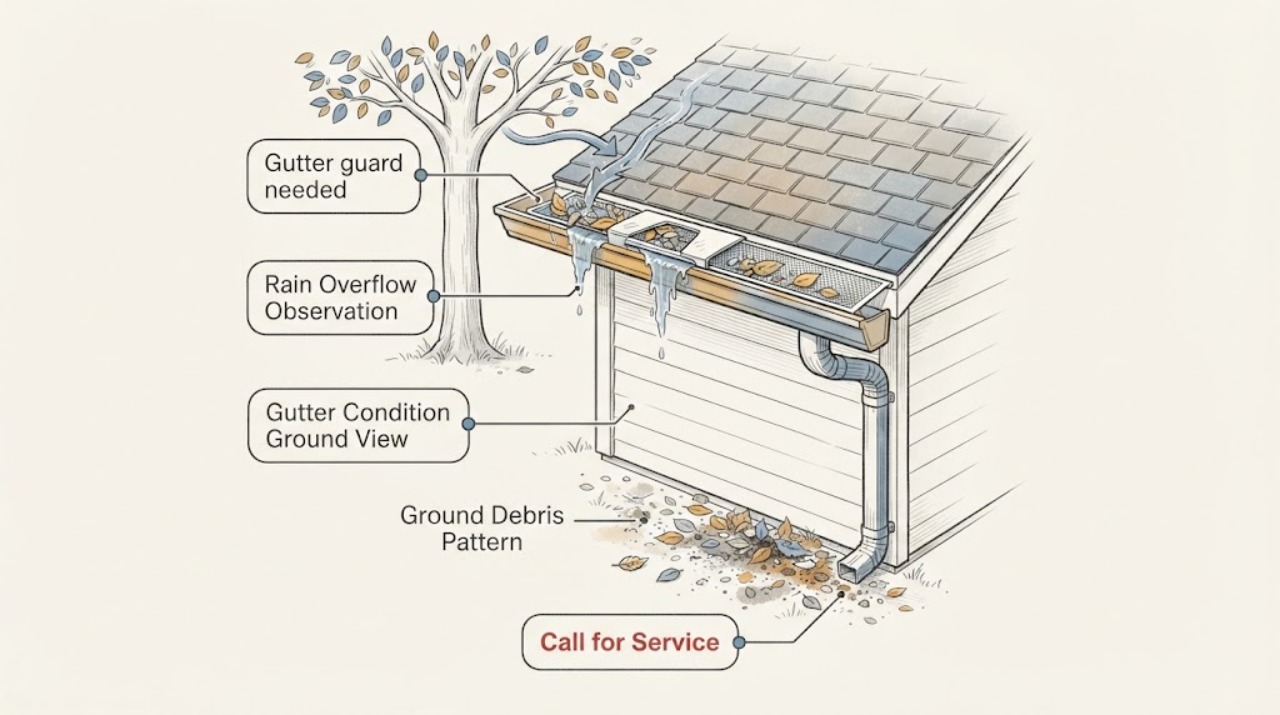
A gutter guard is a project decision, not a reason to climb onto the roof or ladder and install a product yourself. From safe ground or a window, note how much tree debris reaches the roofline, whether gutters overflow during ordinary rain, whether sections sag or separate, and whether downspouts discharge away from the home. A guard may reduce some debris entry, but it will not correct a damaged, undersized, poorly pitched, or blocked gutter system. Share those observations with a qualified gutter or exterior contractor for an inspection and quote; do not reach, remove debris, test with a hose, or perform installation work.
Work through in order
Diagnostic checks
Use only checks that match the exact appliance or system and its official guide.
-
Observe debris at the roofline from ground level
From stable ground or a window, view the roof edge and gutter line with ordinary vision, a camera zoom, or binoculars; do not use a ladder, reach upward, or touch the gutter or roof.
Expected result: Note whether leaves, needles, seed pods, or roof granules visibly collect along the gutter line, whether the debris is concentrated below a particular tree, and whether the pattern changes by season.
Next step: Photograph the roofline from the safe vantage point and give the debris type, affected sides, and seasonal pattern to the contractor. Ask for an assessment of the existing system before selecting a guard.
Stop if: Stop if the view requires a ladder, roof access, reaching over an edge, standing below loose material, or inspecting during wind, lightning, ice, or active storm conditions.
Why this matters
Why: A repeatable debris load supports asking for a gutter-protection assessment, but visible debris does not show whether the channel is blocked, damaged, or correctly sized. DOE guidance notes that nearby tree leaves can clog gutters and that gutter guard systems are one available maintenance approach.
-
Observe runoff during ordinary rain from a safe place
From inside a window, a covered doorway, or another stable location away from falling water, observe the gutter edge and downspout during ordinary rain; do not spray the roof or gutter and do not walk under a suspected overflow.
Expected result: Note whether water spills over the front or back of the gutter, pours at a joint, bypasses a corner, falls from a downspout connection, or appears to flow normally. Record the approximate location and whether the event occurs in light or heavier rain.
Next step: Save a short safe video or written observation and ask the contractor to inspect the existing gutter, outlets, corners, and downspout route. Do not try to clear, seal, or redirect the flow yourself.
Stop if: Stop if rain is accompanied by lightning, high wind, flooding, falling debris, icy surfaces, or water near electrical equipment, and do not approach the gutter or downspout.
Why this matters
Why: Overflow can result from debris, a guard surface, a sagging or poorly aligned channel, insufficient outlet capacity, or a downspout restriction. A guard should not be assumed to solve overflow until the full path is assessed; DOE describes gutters and downspouts as a system that conveys roof water away from the foundation.
-
Compare visible gutter alignment and discharge
From the ground, compare the suspected gutter run with an adjacent section and observe only what is already visible: straightness, sagging, separated joints, loose-looking ends, downspout continuity, and where water appears to discharge.
Expected result: Note whether the gutter line dips, the fascia behind it looks stained, an end cap appears displaced, a downspout stops above the ground, or water collects close to the foundation. Do not pull on the gutter, move a downspout, or measure from a ladder.
Next step: Photograph the affected side and share the comparison with the contractor. Request that the quote separate cleaning, repair, drainage correction, and any guard work rather than treating all symptoms as leaf blockage.
Stop if: Stop if the gutter looks loose, twisted, detached, or likely to fall, or if inspection requires reaching, ladder work, roof access, or contact with a downspout.
Why this matters
Why: Visible alignment or discharge differences indicate that repair or drainage correction may be needed before or instead of a guard. DOE field guidance says gutters should move water to downspouts and that discharge close to the home can contribute to moisture problems; a ground view cannot confirm hidden fastener or fascia condition.
-
Record tree and seasonal site context
From safe ground, note the position of overhanging branches, dense foliage, nearby roof sections, and the season or weather event when maintenance becomes difficult; do not prune, climb, or move branches.
Expected result: Record whether one tree covers a particular run, whether needles or leaves fall year-round or seasonally, whether branches contact the roofline, and whether prior storms changed the debris pattern.
Next step: Give the seasonal history and safe photos to the gutter or tree professional and ask which scopes need separate qualified services. Do not make a roof, ladder, pruning, or guard-installation plan from the ground alone.
Stop if: Stop if branches are unstable, storm-damaged, touching utility lines, or accessible only by climbing or reaching; keep clear and request qualified help.
Why this matters
Why: The context helps a contractor evaluate debris load and whether tree work, roofline repair, cleaning access, or a guard is the appropriate project. DOE advises placing trees far enough away to reduce gutter clogging and roof damage, but an existing tree should not be altered by an unqualified homeowner.
Use your observations
Decision map
Find the observation that best matches what you see, then follow the next safe action.
-
PATH 01Next step
What you see
Debris repeatedly reaches the gutter and the visible system otherwise appears intact from the ground.
Do this next
Request a professional gutter-protection assessment and quote that accounts for debris type, roofline, outlets, and future maintenance. Do not install a guard yourself.
-
PATH 02Next step
What you see
Water overflows, the gutter sags, joints separate, or discharge is close to the foundation.
Do this next
Prioritize a qualified gutter and drainage inspection. A guard is not a substitute for repair, alignment, outlet, or downspout correction.
-
PATH 03Next step
What you see
The roofline or gutter has storm damage, loose material, ice, or unstable branches.
Do this next
Stay clear and wait for safe conditions; arrange qualified exterior, tree, or gutter service. Do not inspect or work from a ladder or roof.
-
PATH 04Next step
What you see
One or more overhanging trees create the recurring debris pattern.
Do this next
Ask a qualified tree professional and gutter contractor to coordinate the appropriate scope. Do not prune, climb, or handle branches near the roof or utilities.
-
PATH 05Next step
What you see
No repeated debris, overflow, or visible drainage issue is observed.
Do this next
A guard may not be necessary based on current evidence. Keep the photos and ask for a professional recommendation rather than buying or installing a product blindly.
Helpful context
Understand the symptom
Decide from the whole drainage system
Gutters collect roof water and direct it through downspouts away from the foundation. A guard can be relevant when recurring leaves or needles are the maintenance problem, but it cannot by itself repair a sagging gutter, a separated joint, a damaged fascia, a blocked downspout, or a drainage route that already overflows. A ground-level record helps a professional decide whether protection, cleaning, repair, or a broader drainage project is appropriate.
Keep the inspection at a safe distance
Look from stable ground or a window on a calm, dry day. Do not use a ladder, climb the roof, reach over an edge, remove a gutter section, pull at a guard, scoop debris, run water through the system, or install a cover. Do not inspect below loose ice, storm debris, or a visibly failing gutter.
What the quote should account for
A useful quote should consider roof and gutter geometry, the type of debris, downspout capacity and discharge, existing damage, and future access for professional maintenance. It should also distinguish a guard from repairs that must happen first. The homeowner can supply observations and photos without directing an installation method.
Only after diagnosis
Potential parts
- Gutter guard
Only consider a guard after a qualified contractor confirms that debris, not sagging, damage, pitch, outlet capacity, or downspout restriction, is the primary maintenance problem.
Fit depends on gutter profile, roof edge, guard design, debris type, weather, and the existing installation. Confirm the professional's compatibility assessment before purchase or installation. - Gutter cleaning tool
Only consider a tool if a qualified professional confirms it can be used safely from the ground for this property; it is not a substitute for a guard, inspection, or ladder-free maintenance plan.
Do not use it from a roof, ladder, or unstable position, and do not use it near power lines or during storms. Confirm the method with a qualified professional.
When checks do not resolve it
Need a professional?
Request a professional quote when debris repeatedly clogs the system, overflow or sagging is visible, downspouts discharge poorly, the roofline is difficult to access safely, or tree branches contribute to the problem. Use urgent exterior help for a detached gutter, falling material, storm damage, flooding, or branches near utilities.
Common questions
FAQ
Does gutter overflow mean I need a gutter guard?
Not necessarily. Overflow can also result from sagging, damage, poor alignment, insufficient outlets, a blocked downspout, or drainage conditions. Ask a professional to assess the complete system before selecting a guard.
Can I install a gutter guard from a ladder?
No. This article does not provide ladder, roof, reaching, or installation instructions. Arrange a qualified contractor to inspect and install any protection safely.
Will gutter guards eliminate maintenance?
No guarantee applies across all homes. Debris type, roof and gutter geometry, guard design, weather, and downspouts affect performance; a professional should explain ongoing inspection and maintenance needs.
What should I show the contractor?
Provide safe photos and notes about debris, overflow, sagging, downspout discharge, tree coverage, seasonality, prior cleaning, and any storm damage. Do not clear the gutter or climb to gather more evidence.
Read the exact guide
Official sources
- Midwest Weatherization Best Practices Field GuideU.S. Department of Energy · General system context for gutter guards, clogging, sagging, downspouts, and discharge; it is not a homeowner installation manual.
- Consumer Guide to Home LandscapingU.S. Department of Energy · Context for observing nearby trees and seasonal debris; no pruning or roof-access work is instructed here.
- Winter Safety Information & TipsU.S. Department of Energy · Context for avoiding gutter inspection or work during hazardous weather and recognizing winter clogging consequences.
- Drip Edge at Roof Eaves and RakesU.S. Department of Energy Building Science Education · Context for recognizing that gutter or roof-edge changes can affect moisture entry; no installation work is provided here.
Community feedback
Share a repair observation
Share a plain-text repair observation. Accepted observations are published automatically; this page may take a moment to update.