
On this page
Start here
Quick answer
If the gutters are new, decide about a guard only after the installer or quote identifies the gutter profile, width, material, hanger support, slope, roof-edge detail, and downspout plan. A guard can reduce leaves and other large debris, but it does not correct an undersized, poorly sloped, sagging, or badly discharged gutter. From the ground, note the roof and tree debris load and any overflow or runoff problem. Then ask the installer to confirm the guard's exact fit and whether adding it now preserves the installation and product warranties. Do not climb a ladder or roof to inspect or install it; defer the work to a qualified gutter professional.
Before you begin
Safety first
- The reader should remain on the ground and should not climb, roof-walk, lift shingles, alter the gutter, or install the guard.
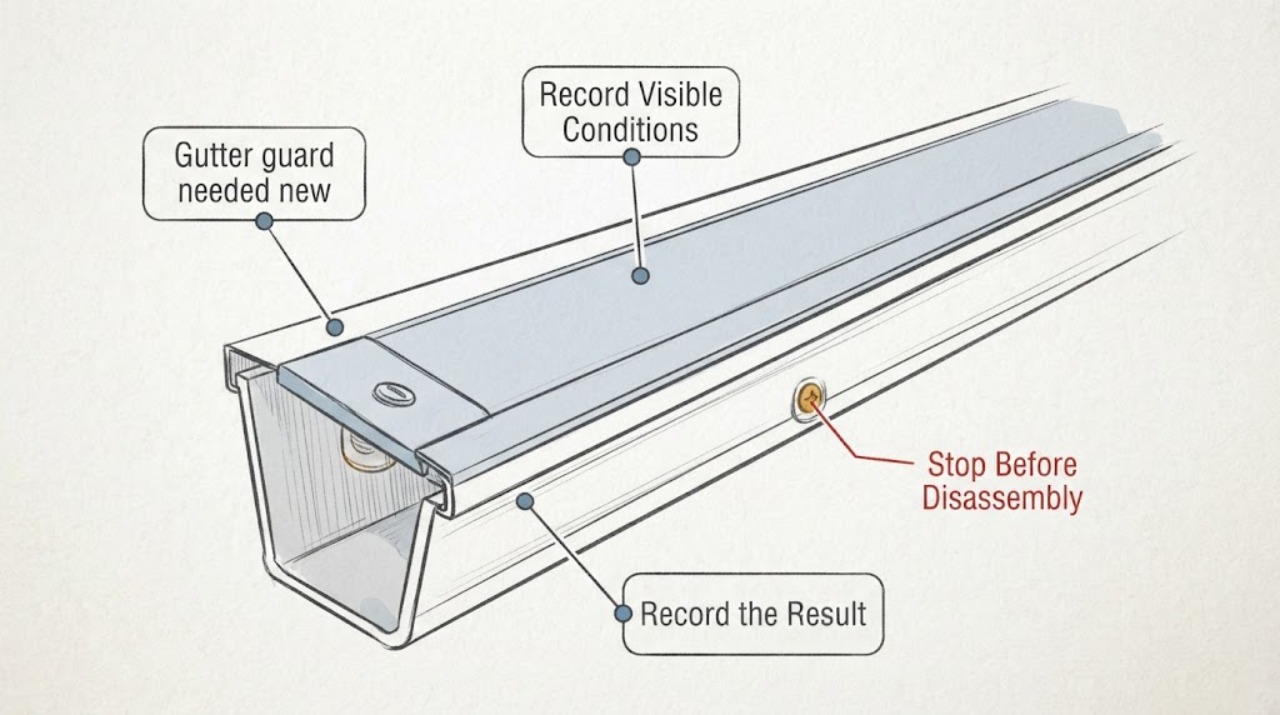
Work through in order
Diagnostic checks
Use only checks that match the exact appliance or system and its official guide.
-
Check 1
From the ground and from already-accessible paperwork, record the new gutter's profile, stated width, material, installer or manufacturer, installation date, corners, end caps, outlets, and downspout sizes.
Expected result: A complete specification record identifies what the guard must fit; a missing profile, width, material, or outlet detail means compatibility is not yet established.
Next step: If any key detail is missing, ask the original installer to identify the installed system before ordering a guard.
Stop if: Do not climb, lift shingles, remove an edge detail, or reach over the gutter to obtain a measurement.
Why this matters
Why: Use the exact record when asking for a guard quote. Do not choose a cover by color or by a generic width label.
-
Check 2
From a safe ground-level position, observe the eaves and downspout outlets during or after ordinary rain and note overflows, drips behind the gutter, standing water, concentrated roof-valley flow, and the kinds of leaves or roof debris present.
Expected result: Overflow, backflow, or water against the fascia points to a drainage, roof-edge, slope, or support issue that a guard will not repair. A heavy or fine debris load changes the guard design and maintenance discussion.
Next step: Send the timing, location, weather, and ground-level photographs to the installer or gutter professional; do not operate from the roof to reproduce the flow.
Stop if: Stop if runoff reaches doors, electrical equipment, unstable ground, or a place that would require ladder or roof access to inspect.
Why this matters
Why: Separate a need for debris control from a defect in the new gutter installation or its discharge route.
-
Check 3
Review the installation paperwork for the gutter slope, hanger or bracket type and spacing, downspout routing, and roof-edge detail; from the ground, look only for an obvious sag, detached end, twisted corner, or downspout pulling away.
Expected result: A straight supported run with a documented fall toward the outlet is a reasonable base for a guard discussion. Visible sag, detached supports, an uncertain roof edge, or a missing slope record should be resolved before covering the gutter.
Next step: Have the installer correct or document the gutter geometry and support before selecting a guard.
Stop if: Do not climb, press on the gutter, remove hangers, or make a roof-edge or support adjustment yourself.
Why this matters
Why: A guard should not conceal a new-installation defect or transfer extra load to an already weak fascia or hanger system.
-
Check 4
Compare the guard manufacturer's written fit range and attachment method with the recorded gutter profile, width, material, corners, and hanger arrangement, and ask the installer to confirm the match in writing.
Expected result: A documented match for the exact gutter profile and width supports bundling the guard with the new installation. A different profile, custom shape, mixed materials, or an attachment that interferes with the roof edge requires installer-specific design rather than a generic cover.
Next step: Use a compatible guard supplied or approved by the installer, or defer the guard until the installer can specify a safe system.
Stop if: Do not lift shingles, drive fasteners, cut a guard, or test-fit it from a ladder or roof.
Why this matters
Why: Guard fit is a system-compatibility question, not just a nominal width question. Manufacturer information can be narrower than the many shapes sold as residential gutters.
-
Check 5
Ask the installer whether adding the guard now is included in the installation scope, approved for the new gutter and roof-edge details, and covered by a written workmanship or product warranty.
Expected result: Yes means the guard can be evaluated as part of one documented installation. No, an unclear answer, or a warning that an accessory could void coverage means the installer should resolve the warranty boundary before any purchase or alteration.
Next step: Keep the quote, product instructions, warranty terms, and the installer's written compatibility answer together. Choose planned professional installation when the boundary is clear.
Stop if: Do not alter a newly installed gutter or roof edge while warranty coverage or installer responsibility is unresolved.
Why this matters
Why: The installer who designed the new gutter can verify attachment, overflow responsibility, and future service access; an unrelated add-on may leave responsibility unclear.
-
Check 6
Decide whether to bundle a guard with the new gutters only after the profile and support are sound, the debris load justifies the maintenance tradeoff, the downspouts can handle the roof runoff, and written compatibility and warranty terms are available.
Expected result: Yes supports asking the installer for one coordinated guard installation. No means fix the gutter, roof-edge, support, or discharge issue first, or keep the new open gutter and plan safe professional cleaning instead.
Next step: Give the professional the specification record, ground-level runoff observations, photographs, tree and debris notes, and warranty questions.
Stop if: Do not climb, roof-walk, remove the guard, or attempt installation to settle the question yourself.
Why this matters
Why: The new-installation condition changes the decision: correcting the system and preserving one accountable installer is usually more valuable than immediately adding an unverified cover.
Use your observations
Decision map
Find the observation that best matches what you see, then follow the next safe action.
-
PATH 01Safety boundary
What you see
The new gutter profile, width, material, support, slope, roof-edge detail, and downspout plan are documented; no overflow or sag is visible from the ground; and the guard fit is confirmed.
Do this next
Ask the original installer to quote and install the compatible guard under one written scope.
Why this path and its safety boundary
Why it matters: The new-installation condition supports a coordinated guard decision instead of an unverified retrofit.
Safety stop: Stop if the written fit or warranty boundary changes.
-
PATH 02Safety boundary
What you see
The gutter overflows, drips behind the back edge, sags, has a detached support, has an uncertain roof edge, or lacks a documented outlet and slope plan.
Do this next
Have the gutter installer assess and correct the geometry, roof-edge detail, support, or downspout routing before discussing a guard.
Why this path and its safety boundary
Why it matters: A guard could hide or worsen a new-installation defect and does not fix insufficient drainage or support.
Safety stop: Do not cover the gutter or attempt a correction from a ladder or roof.
-
PATH 03Safety boundary
What you see
Overhanging trees, roof valleys, or recurring leaves, needles, seed pods, and fine sediment create a clear maintenance burden, while the gutter itself drains and is supported.
Do this next
Ask the installer to compare a compatible guard with a professional cleaning plan and explain how fine debris will be maintained.
Why this path and its safety boundary
Why it matters: A guard may be useful, but its openings, overflow behavior, cleaning needs, and attachment must match the new system and local debris.
Safety stop: Do not assume a guard is maintenance-free or enter the roof area to inspect debris.
-
PATH 04Safety boundary
What you see
The new gutter is a custom, half-round, box, mixed-material, unusual-profile, or otherwise undocumented system, or the proposed guard has no written fit and attachment information.
Do this next
Keep the gutter open and ask the original installer or guard manufacturer for a documented compatible system.
Why this path and its safety boundary
Why it matters: A generic guard may not seat, may interfere with the roof edge, or may create an unclear service and warranty boundary.
Safety stop: Do not cut, fasten, tuck, or lift any roof or gutter component to test compatibility.
-
PATH 05Safety boundary
What you see
The installer will not confirm whether the guard is approved, who owns overflow or leak claims, or how the accessory affects the new-gutter warranty.
Do this next
Pause the purchase and request the scope, product instructions, warranty terms, and installer responsibility in writing.
Why this path and its safety boundary
Why it matters: The commercial and repair responsibility is unresolved, even if the physical guard appears to fit.
Safety stop: Do not alter a new installation on the basis of a verbal fit promise.
Helpful context
Understand the symptom
Start with the new gutter system, not the guard
A new gutter is a system: its profile and width, metal or plastic material, outlet and downspout capacity, hanger support, slope, roof edge, and corners all affect how water moves. Record what is on the quote, invoice, product label, or installer paperwork. Do not infer a compatible guard from appearance alone. A guard sized for one profile may not seat on another, and an added cover should not hide a drainage or support defect.
Tree and roof conditions change whether a guard is useful
From a safe ground-level viewpoint, note whether trees overhang the roof, whether the roof has valleys that concentrate runoff, and whether the debris is mostly broad leaves, pine needles, seed pods, or fine sediment. Watch for overflow at the eaves or downspouts during ordinary rain only if it can be seen without entering an unsafe area. A screen or cover can keep out larger debris, but it still needs maintenance and cannot substitute for adequate gutter capacity or a safe discharge path.
Make compatibility and warranty part of the installation decision
Before ordering anything, give the installer the exact gutter profile, width, material, corner and end details, hanger arrangement, roof-edge condition, and downspout layout. Ask which guard attachment method is approved for that new system, whether the guard is supplied or supported by the installer, and who handles overflow, leaks, finish damage, or a later service call. Keep the written answer with the installation records. If the gutter line visibly sags, the outlet cannot carry the roof runoff, the roof-edge detail is incomplete, or the fit is uncertain, correct that condition first rather than adding a cover.
Safety boundary
Stop conditions
- Do not climb a ladder or roof, lift shingles, reach over the gutter, remove a guard, or access a roof-edge detail for this decision.
- Stop for unstable ground, active runoff into an unsafe area, loose gutter material, exposed electrical equipment, or any condition that requires elevated access.
- Do not drill, cut, fasten, bend, or press on the new gutter or its hangers to test a guard.
- Call a qualified gutter professional when drainage, support, roof-edge details, compatibility, or warranty responsibility cannot be confirmed from safe observations and the installation records.
Only after diagnosis
Potential parts
- gutter-guard
Consider only after the installer confirms the new gutter profile, width, material, attachment method, and warranty-compatible fit.
A nominal width is not enough; verify profile, corners, roof-edge interaction, material compatibility, and approved installation with the installer. - gutter-cleaning-tool
Consider only if the installer recommends retaining an accessible maintenance plan or the selected guard requires periodic cleaning.
Choose a method that does not require ladder or roof access and does not damage the new gutter, guard, fascia, or downspout.
When checks do not resolve it
Need a professional?
Arrange a planned professional review before ordering a guard. Request prompt service for overflow against the building, a detached or sagging new gutter, unsafe access, or runoff that reaches electrical equipment.
Safety scope: The reader should remain on the ground and should not climb, roof-walk, lift shingles, alter the gutter, or install the guard.
Have this ready
- The new-gutter quote, invoice, product label, profile, stated width, material, and installation date
- Installer and manufacturer information, including the written warranty and any accessory restrictions
- Ground-level photographs and notes about overflow, drips, sagging, downspout routing, and roof valleys
- Tree location and the type and frequency of leaves, needles, seed pods, or fine debris
- The exact guard fit statement, attachment method, and unresolved responsibility questions
Common questions
FAQ
Should a guard be installed at the same time as new gutters?
It can be efficient when the gutter profile, support, slope, roof edge, and downspout plan are already correct and the installer confirms an approved fit and warranty boundary. If any of those are uncertain, resolve them before covering the new gutter.
Does a gutter guard fix an undersized or poorly sloped new gutter?
No. Overflow, water behind the gutter, sagging, or a downspout that cannot carry the runoff calls for an installer assessment of capacity, slope, support, roof-edge detail, and discharge before debris control is added.
What should I check about a guard's fit?
Use the exact gutter profile, width, material, corners, end details, hanger arrangement, and roof-edge condition. Ask the installer to confirm the attachment method in writing; a guard that fits one gutter shape is not automatically compatible with another.
Will a guard eliminate gutter maintenance?
No. Guards can reduce large debris entering the gutter, but fine sediment, needles, seed material, and debris on the guard can still affect flow. Ask the installer how the selected system is inspected and maintained without unsafe access.
Who should answer a warranty question about adding a guard?
Start with the installer who supplied the new gutter. Get written confirmation of the approved accessory, installation responsibility, overflow and leak coverage, and any action that could affect the product or workmanship warranty.
Read the exact guide
Official sources
- Specification System SpecifierEnglert · Supports checking gutter capacity, slope, hanger support, material compatibility, and the distinction between product and installer warranty; values apply to this specified system, not every gutter.
- National Pollutant Discharge Elimination System (NPDES) Compliance Inspection Manual - Chapter 14U.S. Environmental Protection Agency · Supports separating debris filtration from drainage capacity and recognizing that screens and guards require maintenance.
- SureGuard Gutter Guard | Gutter Screen | EnglertEnglert · Provides a concrete manufacturer example that a guard attaches to the gutter lip and has a stated fit range; it is not a generic compatibility promise for every gutter.
Community feedback
Share a repair observation
Share a plain-text repair observation. Accepted observations are published automatically; this page may take a moment to update.