
On this page
Start here
Quick answer
Do not force, pick, bypass, or destructively take apart a broken interior door lock. If the door is open, keep it open while you make a few gentle observations: check whether the handle or privacy turn moves the latch with the door open, compare that behavior with the door closed only if you can safely reopen it, and look for a loose handle, shifted strike, or hinge-side sag. A latch that works open but binds closed points toward alignment; a handle that wobbles or a latch that will not move with the door open points toward the lockset or latch. If anyone is locked in or out, the door cannot be safely opened, or the lock serves an access-controlled or emergency area, stop and call a qualified locksmith, building manager, or the appropriate emergency service.
Before you begin
Safety first
- Do not bypass, pick, force, pry, drill, chisel, destructively disassemble, or repeatedly cycle a jammed lock. Keep an unreliable door open when safe and authorized.
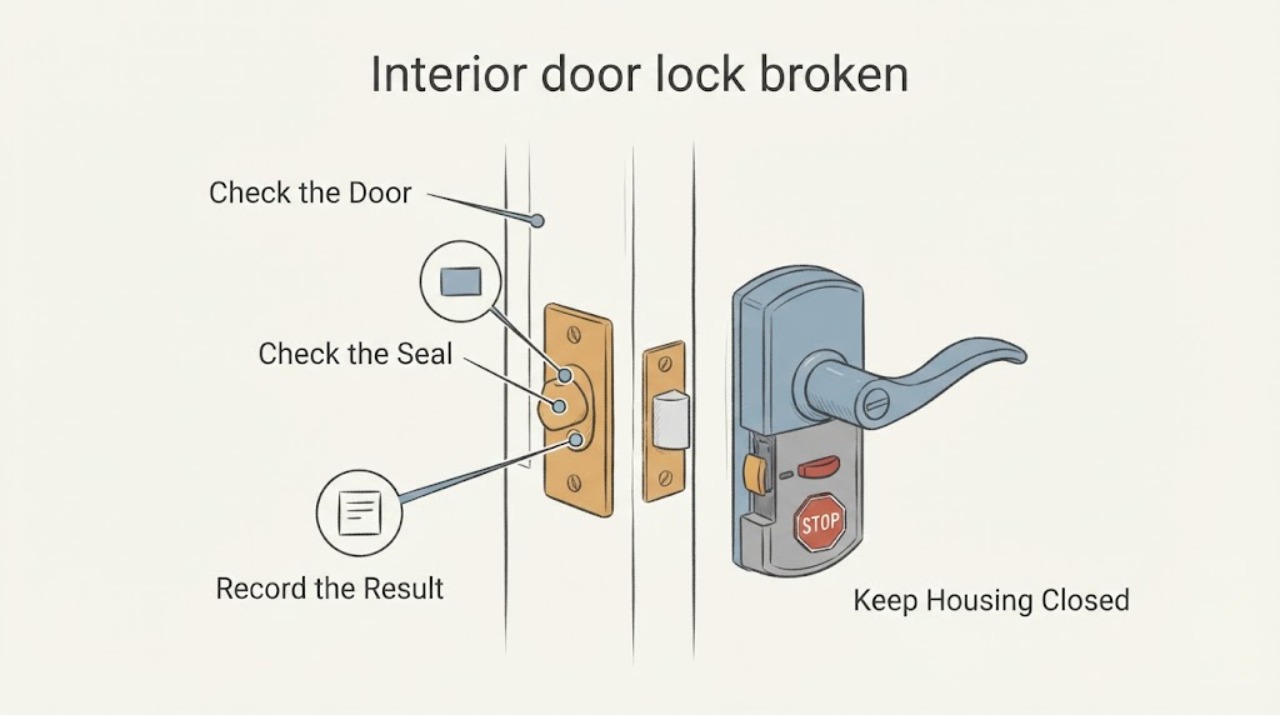
Work through in order
Diagnostic checks
Use only checks that match the exact appliance or system and its official guide.
-
Check 1
Confirm the access state before touching the hardware: if the door is open, keep it open; if it is closed, determine whether it can be opened normally from the authorized side without force. Do not test a privacy release, pick, or bypass method.
Expected result: A door that is open and usable is a low-urgency inspection; a person locked in or out, a door that will not open normally, or a door guarding a safety or access-controlled area is an access incident.
Next step: If access is normal, leave the door open and continue with the handle-and-latch observation. If access is blocked or someone may be at risk, call the appropriate professional immediately and provide the door location and lock type if visible.
Stop if: Stop all testing if a person is trapped, the door is a required egress, the lock is part of a controlled facility, or normal operation does not open it.
Why this matters
Why: The access state determines whether gentle diagnosis is appropriate or whether a qualified locksmith, building manager, or emergency service must take over without a defeat technique.
-
Check 2
With the door open and your hands clear of the edge, turn the handle or privacy turn once in each normal direction and watch the latch face at the door edge; release it as soon as resistance or grinding occurs.
Expected result: The latch should retract and return smoothly with normal handle movement. A handle that moves without retracting the latch, a latch that stays extended, or grinding and sticking while open indicate a lockset or latch-side fault rather than a strike-only alignment issue.
Next step: Photograph the handle, latch face, and any visible marking, then ask a locksmith to assess the lockset and determine whether a compatible replacement is needed.
Stop if: Stop if the handle binds, parts begin to separate, the latch does not return, or the lock becomes warmer, sharper, or more unstable than before.
Why this matters
Why: A mechanism that fails while the door is open is a reason to arrange lockset or latch service; it is not a reason to force the handle or open the lock body.
-
Check 3
Only if the door opens freely from the authorized side, close it gently once and observe whether the latch meets the strike without pushing, pulling, lifting, or slamming the door; reopen it normally immediately after the observation.
Expected result: If the latch works open but rubs the strike, misses the opening, or needs the door lifted or pulled, the failure is consistent with door-to-frame alignment, hinge looseness, or strike position. If it still fails with the door open, alignment is less likely to be the primary fault.
Next step: Record the contact location and whether the door sags or rubs, then request a locksmith or qualified door-hardware professional to correct the alignment. Do not enlarge the strike opening or move the plate based on guesswork.
Stop if: Stop if the door does not reopen normally, the latch jams in the strike, the frame flexes, or the door requires force to move.
Why this matters
Why: Manufacturers identify latch/strike misalignment and door sag as common causes of a lock that operates open but binds closed; the observation chooses between alignment service and lockset service.
-
Check 4
With the door open, inspect the visible handle, rose or escutcheon, faceplate, and hinge-side edge for wobble, a missing fastener, a shifted plate, or a latch face that is no longer flush; use a flashlight rather than removing covers.
Expected result: A loose handle or shifted visible plate can explain lost movement or an intermittent latch, while a flush and stable exterior with an inoperable handle points more strongly to an internal mechanism or latch fault.
Next step: Capture close photos and note which side is loose; have a locksmith decide whether a safe visible adjustment is suitable or whether the lockset should be replaced.
Stop if: Stop if a plate is sharp, the handle is separating from the door, screws are stripped, the door is carrying a heavy panel, or the lock becomes less stable when touched.
Why this matters
Why: This separates a visible mounting problem from a failure that needs professional disassembly or a compatible lockset replacement.
-
Check 5
Look at the strike plate and surrounding frame from the room side without removing the plate: note whether the plate is visibly loose or shifted, whether the wood is split, and whether the latch has a consistent contact mark at one edge.
Expected result: A loose or shifted strike, split frame, or one-sided contact mark supports a frame/alignment problem; a stable strike with a latch that fails open still points toward the lockset or latch.
Next step: Keep the door open if practical, photograph the strike and frame, and provide the observation with the door’s material and location when booking service.
Stop if: Stop if the frame is cracked, the strike can move by hand, the door is part of a fire or security assembly, or the latch has damaged the frame.
Why this matters
Why: The result tells the service provider whether to assess the door frame and hinges along with the lock, rather than assuming a replacement lock alone will solve the problem.
Use your observations
Decision map
Find the observation that best matches what you see, then follow the next safe action.
-
PATH 01Next step
What you see
The door cannot be opened normally, someone is locked in or out, or the opening is needed for safety or egress.
Do this next
Stop diagnosis and contact a qualified locksmith, building manager, or appropriate emergency service. Do not use a bypass or force the door.
-
PATH 02Next step
What you see
The handle or latch fails while the door is open.
Do this next
Treat the lockset or latch as the leading service area; keep the door open and request a professional assessment or compatible replacement selection.
-
PATH 03Next step
What you see
The latch operates open but binds, misses, or requires lifting or pulling when the door is closed.
Do this next
Request door-alignment, hinge, and strike inspection. Do not enlarge the opening or reposition hardware by guesswork.
-
PATH 04Next step
What you see
The handle, rose, faceplate, or strike is visibly loose, shifted, split, or unstable.
Do this next
Stop using the door if hardware could fall or pinch, photograph the condition, and have a locksmith or door-hardware professional assess the mounting and frame.
-
PATH 05Next step
What you see
The lock is part of a controlled, fire-rated, rented, or otherwise regulated assembly.
Do this next
Contact the responsible building or security professional before changing hardware; do not defeat, alter, or replace the assembly yourself.
Helpful context
Understand the symptom
Use an open-door test, not a bypass
Manufacturers distinguish between a mechanism that operates freely with the door open and one that binds only after the door closes. That distinction is useful without defeating the lock: the door can remain open while you gently observe the handle and latch. Do not insert improvised tools, probe the latch, remove concealed trim, or keep cycling a mechanism that is jammed. If access is not secure or the door cannot be opened normally, a locksmith should control the next step.
A replacement is conditional
A complete interior lockset may be appropriate when the handle or privacy mechanism remains loose or inoperable with the door open, but a new lock will not correct a sagging door or a shifted strike by itself. Record the door type, lock function, visible brand or model marking, finish, and the observed failure before choosing a part. The final fit must match the existing door preparation and the hardware configuration.
Only after diagnosis
Potential parts
- interior door lockset
Consider a complete lockset only if the handle or privacy mechanism fails with the door open and a professional confirms that replacement, rather than frame alignment, is appropriate.
Match the privacy or passage function, door thickness and preparation, latch configuration, handing if applicable, finish, and any building requirements; verify fitment from the door and existing hardware rather than assuming a universal match. - interior door latch
Consider a latch-only replacement only when the visible latch or its movement is confirmed faulty and the existing lockset is otherwise compatible with that latch.
Confirm the lockset family, faceplate or drive-in style, backset, door-edge preparation, and manufacturer fit information before ordering; do not substitute a latch for a frame or strike problem.
When checks do not resolve it
Need a professional?
Call a qualified locksmith or door-hardware professional when the handle or latch fails with the door open, when alignment requires force or adjustment, when access is blocked, or when the hardware is part of a controlled, fire-rated, rented, or safety-critical assembly.
Safety scope: Do not bypass, pick, force, pry, drill, chisel, destructively disassemble, or repeatedly cycle a jammed lock. Keep an unreliable door open when safe and authorized.
Have this ready
- Provide the door location, whether it is open or inaccessible, privacy or passage function, visible brand or model marking, photos of the handle, latch face, strike, frame, and hinge-side gap, and the result of the open-versus-closed observation.
Common questions
FAQ
How can I tell whether the lock or the door alignment is broken?
With the door open, gently observe whether the handle retracts and returns the latch. If it fails open, the lockset or latch is a leading suspect. If it works open but binds only when closed, the strike, hinges, frame, or door alignment may be involved.
Can I force the latch back if the handle is stuck?
No. Do not probe the latch or use a bypass method. Keep the door in its safe accessible position if possible and call a qualified locksmith, especially if access is blocked.
Should I buy a new interior lockset immediately?
Not before identifying the failure. A replacement may be appropriate when the mechanism fails with the door open, but it will not correct a sagging door, shifted strike, split frame, or incompatible door preparation.
What if the door is part of a rental or controlled building?
Contact the responsible manager or security professional before altering the hardware. Fire-rated, access-controlled, and other regulated assemblies may require a specific replacement and installation process.
Read the exact guide
Official sources
- How to fix a door that won’t latchSchlage · Supports distinguishing a lock that works open from one that binds against the strike when closed, and observing sagging or loose hinges as possible alignment causes.
- Support for Latch IssuesKwikset · Supports using an open-versus-closed comparison to identify alignment or binding and escalating persistent latch problems to technical support or a qualified professional.
- 4 Install knobsKwikset · Supports observing whether the latch is centered, whether the latch enters the strike, and whether the latch is loose in the strike; it does not authorize bypass or destructive work.
Community feedback
Share a repair observation
Share a plain-text repair observation. Accepted observations are published automatically; this page may take a moment to update.